Animal Facts
Horse Facts & Trivia: Fascinating Things to Know
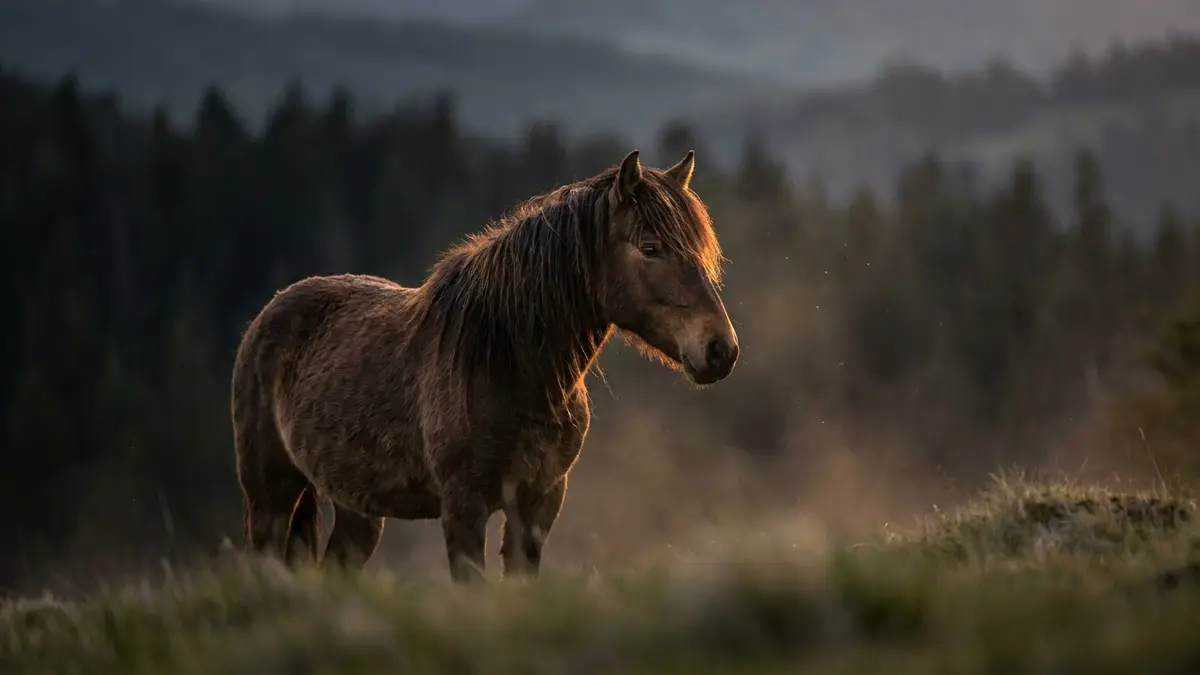
Horses need surprisingly little sleep for an animal their size — just 2.5 to 3 hours a day — and they can gallop at roughly 27 miles per hour. Their eyes are the largest of any land mammal, one piece of a sensory setup that's been sharpening for some 50 million years of evolution. Today there are more than 200 recognized breeds and an estimated 60 million horses worldwide.
An almanac
- Diet
- Herbivore (plant-eater)
- Top speed
- ~27 mph at a gallop
- Gestation
- ~11 months (10–12 range)
- Sleep
- 2.5–3 hours a day
- Breeds
- 200+ recognized
- Population
- ~60 million worldwide
Few animals have trotted alongside human history quite like the horse, whether pulling plows, carrying riders into battle, or racing around a track for sport. Beneath that familiar silhouette is a surprisingly specialized creature — one with the largest eyes of any land mammal and a family tree that traces back tens of millions of years. It's also an animal that keeps showing up in movies and songs, decade after decade.
Fascinating Horse Facts
A horse is a plant-eater through and through, and its vocabulary comes with its own built-in glossary: an adult male is a stallion, an adult female a mare, and their offspring are colts (males) or fillies (females). Scientists classify the species as Equus caballus, part of the order Perissodactyla and the family Equidae, and breeders have shaped that single species into a huge range of forms — estimates put the number of recognized breeds well over 200, with roughly 160 of those counted as fully distinctive types.
- Pregnancy runs long for a mare — about 11 months on average, though anywhere from 10 to 12 months is normal.
- A horse's toolkit of senses — sharp smell and hearing, plus taste, touch, and sight — is unusually keen, and its eyes are the largest of any land-dwelling mammal.
- Horses can doze standing up or lying down, but they only need about 2.5 to 3 hours of actual sleep in a full day.
- Foals are up and moving remarkably fast, able to run shortly after being born.
- At a full gallop, a horse can cover roughly 27 miles per hour.
- Researchers estimate the species has been evolving for around 50 million years, descending from much smaller ancestral creatures.
- No two horses look exactly alike, and each one uses its ears, eyes, and nostrils to broadcast its mood — reading a horse's face is practically its own language.
- Both smell and hearing are sharper in horses than in people.
- Roughly 60 million horses are thought to exist worldwide today.
- One especially long-lived 19th-century horse, nicknamed Old Billy, reportedly reached the age of 62.
- The horse holds a spot among the 12 animals of the Chinese zodiac, and it's also the official state animal of New Jersey.
- Car names have borrowed the horse's image for decades — think of the Ford Mustang, Pinto, and Bronco, or the Dodge Colt — and the NFL's Indianapolis Colts and Denver Broncos carry the theme onto the field.
- Old folklore treats horses as walking omens: a horseshoe is a classic good-luck charm, brass fittings on tack were once thought to ward off witchcraft, and renaming a horse was considered a bad idea. A horse turned toward a hedge supposedly signals rain on the way, and a whinny at the door was taken as a warning of illness.
- More superstition: seeing a white horse after spotting a white dog (and staying silent in between) was said to bring good fortune, while a couple who spotted a gray horse on their wedding day could expect a lucky life together. Horseshoe nails bent into a loop were kept as protective charms, and legend held that a horse weeps when its owner dies.
- Not every superstition was flattering — a horse with four white feet was traditionally considered a poor bet for racing. The Arabian is often singled out as the purest of all breeds, and one old local law in Bluff, Utah reportedly threatened jail time for any unmarried woman caught riding a horse on a Sunday.
Horses in Movies, TV & Music
Horses have carried entire film careers on their backs. Black Beauty alone has been adapted again and again — 1921, 1946, 1971, 1978, and 1994 versions all exist — while Seabiscuit, Secretariat, and Phar Lap turned real-life racehorses into screen legends.
Animated and family favorites add more names to the herd: Spirit: Stallion of the Cimarron, National Velvet, My Friend Flicka (and its sequels and remakes), The Horse Whisperer, Hidalgo, War Horse, and Tangled. Even a few unicorns and long-running franchises, like the many Flicka films, kept the genre galloping through the decades.
Songwriters have leaned on the same imagery. America's "A Horse With No Name," Taylor Swift's "White Horse," and the Rolling Stones' classic "Wild Horses" all put the animal front and center, while Toby Keith's "Beer For My Horses" and Big & Rich's "Save A Horse (Ride A Cowboy)" took the theme in a country direction.
Several horse stories and films even inspired their own theme songs, from "Black Beauty" and "Black Stallion" to "Flicka" and the tune tied to the classic sitcom Mr. Ed.
Frequently Asked Questions
What are male, female, and baby horses called?
An adult male horse is a stallion, an adult female is a mare, a young male is a colt, and a young female is a filly.
How fast can a horse run, and how long is a mare pregnant?
A galloping horse can reach around 27 miles per hour, and a mare's pregnancy (gestation) typically lasts about 11 months, ranging from 10 to 12 months.
How many horse breeds exist, and how much sleep do horses need?
There are well over 200 recognized horse breeds worldwide, and despite being large animals, horses only need about 2.5 to 3 hours of actual sleep per day, whether standing or lying down.
More about the Horse
More from Animal Facts
Not sure which animal is yours?
Consult the quiz