Animal Facts
Jellyfish Facts & Trivia: 505 Million Years Old
No brain, no heart, no bones — and half a billion years of practice.
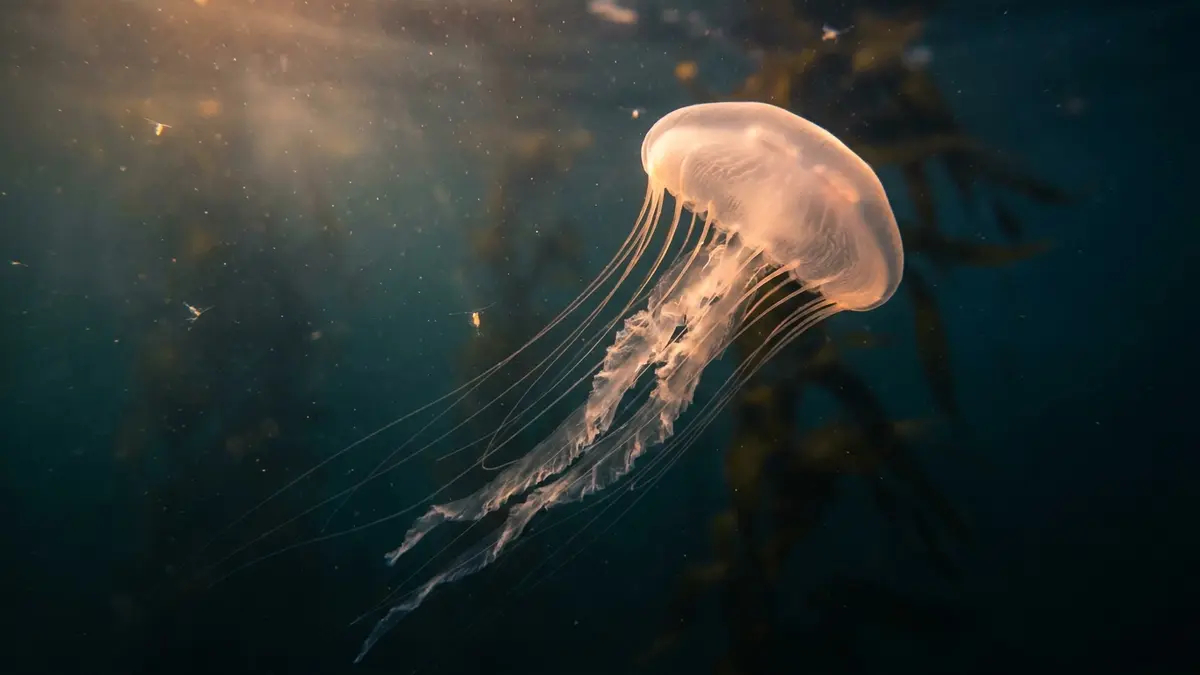
Jellyfish are about 95% water and have no bones, brain, heart or blood, yet the upside-down jellyfish Cassiopea sleeps, dropping from about 58 bell pulses a minute by day to 39 at night. The oldest known free-swimming jellyfish is 505 million years old, and a protein first found in one of them won the 2008 Nobel Prize in Chemistry.
An almanac
- Body
- About 95% water; no bones, brain, heart, teeth or blood
- Oldest fossil
- Burgessomedusa phasmiformis, 505 million years old
- Heaviest
- Probably Nomura's jellyfish — about 2 m across and around 200 kg — though few medusae have ever been weighed
- Smallest dangerous
- The Irukandji, with a bell 1–2 cm across and tentacles up to a metre
- Eyes
- Box jellyfish carry 24, in four clusters called rhopalia
- Eaten by people
- For roughly 1,700 years in China
A jellyfish has no brain, no heart, no bones and no blood, and is about ninety-five percent water. It also sleeps, sees through twenty-four eyes, and has been doing all of this for longer than there have been dinosaurs — the oldest known free-swimming jellyfish is 505 million years old.
One of them changed modern science by accident. Green fluorescent protein, first noticed in Aequorea victoria in 1962, is now in laboratories everywhere and won the 2008 Nobel Prize in Chemistry.
The stings are where the misinformation concentrates, so that section is specific about what the clinical advice actually says — and about the thing from Friends that you should not do.
Jellyfish Facts Worth Knowing
- About 95% water. Only around five percent of a jellyfish is solid matter.
- No bones, brain, heart, teeth or blood. What it has instead is a decentralised nerve net — with roughly 1,000 neurons active at any moment in a box jellyfish, one of its four rhopalia taking a turn as its nervous system.
- One opening does both jobs. Food goes in and waste comes out of the same hole.
- The oldest known free-swimming jellyfish is 505 million years old. Burgessomedusa phasmiformis predates the first dinosaurs by roughly a quarter of a billion years.
- A jellyfish protein rebuilt modern biology. Green fluorescent protein was first seen in Aequorea victoria in 1962 and won the 2008 Nobel Prize in Chemistry; it is now standard equipment in labs worldwide.
- They sleep without a brain. The upside-down jellyfish Cassiopea drops from about 58 bell pulses a minute in daytime to about 39 at night — the most evolutionarily ancient animals known to sleep.
- The moon jellyfish is among the most efficient swimmers alive. A trick called passive energy recapture cuts its cost of transport by 48%.
- Box jellyfish have 24 eyes in four clusters, and use them to steer around mangrove roots.
- The "immortal jellyfish" rewinds itself. A stressed or ageing Turritopsis dohrnii medusa settles, forms a cyst, and within 24 to 72 hours is a juvenile polyp again. This is a stress response rather than everyday behaviour, and it does not make individuals unkillable.
- Probably the heaviest jellyfish — though few medusae have ever been weighed — is Nomura's jellyfish, about 2 m across the bell and around 200 kg, roughly the mass of a large male lion.
- The Australian box jellyfish carries up to 60 tentacles, each up to 3 m long, in four clumps at the corners of a bell up to 30 cm across.
- The Irukandji is the size of a fingernail. Its bell is 1–2 cm across, with tentacles up to a metre long.
- People have fished and eaten jellyfish in China for roughly 1,700 years.
- The golden jellyfish of Palau's Jellyfish Lake commute daily, tracking the sun so the algae living in their tissues can photosynthesise.
Four Jellyfish Facts That Are Not True
"Someone should pee on it." Popularised by a 1997 episode of Friends and repeated on beaches ever since. Urine has never been shown to work, and fresh water and ice may make envenomation worse: stinging capsules left on the skin fire in response to changes in the surrounding salt concentration, which is exactly what rinsing with anything unsalted does. Household vinegar, lidocaine and non-scalding hot water are what the clinical advice actually names.
"The Portuguese man o' war is a big jellyfish." It is not a jellyfish, and it is not even one animal. It is a siphonophore — a floating colony of genetically identical zooids, each specialised for floating, hunting, feeding or reproducing. Its trailing tentacles average around 10 metres.
"A jellyfish on the sand is harmless, and so is a loose bit of tentacle." Neither is safe. Stinging capsules are self-contained pressurised cells that fire on contact. They do not need the animal to be alive, or even attached to it.
"Jellyfish are taking over the oceans." The first global analysis of the data found no such trend. Numbers swing on a roughly 20-year worldwide cycle, and the 1990s happened to be a rising phase — which is precisely when the takeover story took hold. Some regions genuinely have seen increases; the planet-wide version does not survive the data.
Jellyfish in Culture
SpongeBob SquarePants made jellyfishing a national pastime for a generation of children: the episode "Jellyfishing" aired on 31 July 1999, three months after the show's Nickelodeon premiere on 1 May that year. Jellyfish anchor the aquarium experience in most major cities — Monterey Bay Aquarium's 1992 Planet of the Jellies exhibit is often credited with starting the trend of displaying them as living art. In Finding Nemo (2003) a jellyfish bloom nearly kills Dory. And the immortal jellyfish, Turritopsis dohrnii, has become a fixture of internet science writing, usually with its actual biology mangled.
Jellyfish That Made History
Aequorea victoria is the most consequential jellyfish that has ever lived. Osamu Shimomura isolated green fluorescent protein from it in 1962; the protein is now used to make the inner workings of cells visible, and Shimomura shared the 2008 Nobel Prize in Chemistry for it.
Turritopsis dohrnii, the immortal jellyfish, earns its reputation honestly if not literally: a stressed or ageing medusa can settle, form a cyst, and become a juvenile polyp again within 24 to 72 hours.
Burgessomedusa phasmiformis, described from the Burgess Shale, is the oldest free-swimming jellyfish known — 505 million years old, and swimming a quarter of a billion years before the first dinosaur.
Frequently Asked Questions
Do jellyfish have brains?
No. They have a decentralised nerve net instead. In a box jellyfish only about 1,000 neurons are active at any moment, with one of its four rhopalia effectively taking a turn as the nervous system.
Should you pee on a jellyfish sting?
No. Urine has never been shown to help and may make things worse: stinging capsules left on the skin fire in response to changes in salt concentration, which is what rinsing with urine or fresh water causes. Household vinegar, lidocaine and non-scalding hot water are what clinical guidance names.
Can a dead jellyfish still sting you?
Yes. Stinging capsules are self-contained pressurised cells that fire on contact and do not require the animal to be alive or even attached. A beached jellyfish and a drifting scrap of tentacle both sting.
Is the immortal jellyfish really immortal?
Not in any everyday sense. A stressed or ageing Turritopsis dohrnii medusa can settle, form a cyst and return to being a juvenile polyp within 24 to 72 hours. It is a stress response, not a permanent exemption from death — the animal can still be eaten or killed.
Do jellyfish sleep?
The upside-down jellyfish Cassiopea does. Its bell pulses drop from about 58 per minute in daylight to about 39 at night, and it responds more slowly to stimulation — making it among the most evolutionarily ancient animals known to sleep.
Is the Portuguese man o' war a jellyfish?
No, and it is not even a single animal. It is a siphonophore: a floating colony of genetically identical zooids, each specialised for floating, hunting, feeding or reproducing. Its tentacles average about 10 metres.
More about the Jellyfish
More from Animal Facts



Sources
Claims on this page were checked against these published sources.
- What is a jellyfish?
Only about five percent of the body of a jellyfish is solid matter; the rest is water.
Read the source → - Jellyfish: The smart stinging creatures drifting through our oceans
Jellyfish don't have bones, brains, hearts, teeth or blood. However, what they do have is a network of nerves called a nerve net.
Read the source → - Royal Ontario Museum Researchers Identify Oldest Known Species of Swimming Jellyfish
505-million-year-old swimming jellyfish from the Burgess Shale
Read the source → - Press release: The Nobel Prize in Chemistry 2008
The remarkable brightly glowing green fluorescent protein, GFP, was first observed in the beautiful jellyfish, Aequorea victoria in 1962.
Read the source → - The Surprising, Ancient Behavior of Jellyfish
the jellyfish go through periods of inactivity at night, only pulsing about 39 times per minute, compared to about 58 times per minute during the day.
Read the source → - Passive energy recapture in jellyfish contributes to propulsive advantage over other metazoans
reduced metabolic demand by passive energy recapture improves the cost of transport by 48%
Read the source → - Box jelly's simple eyes control motion
Guided by their visual system of 24 simple eyes, the animals successfully avoid contact with damaging mangrove roots
Read the source → - Cellular Reprogramming and Immortality: Expression Profiling Reveals Putative Genes Involved in Turritopsis dohrnii's Life Cycle Reversal
medusae of T. dohrnii that are stressed, damaged, or senescent settle on a surface and transform into a cyst stage that, in 24–72 h, metamorphoses back into a single juvenile polyp
Read the source → - Sizing ocean giants: patterns of intraspecific size variation in marine megafauna
Nemopilema nomurai can reach ca. 2 m in bell diameter and ca. 200 kg in body mass.
Read the source → - Box Jellyfish
up to 60 tentacles in four clumps along the base of the bell
Read the source → - Irukandji, Carukia barnesi
1 cm - 2 cm bell (diameter), up to 1 m tentacles
Read the source → - Blue Herons, Jellyfish, and Other Animals With Daily Commutes
The millions of golden jellyfish that pack Palau's Jellyfish Lake spend much of their lives on the move during a daily migration that follows the sun's arc across the sky.
Read the source →
Not sure which animal is yours?
Consult the quiz