Animal Facts
Kangaroo Facts: Hopping, Pouches and Hard Numbers
A kangaroo's tail pushes it forward as hard as its front and hind legs combined.
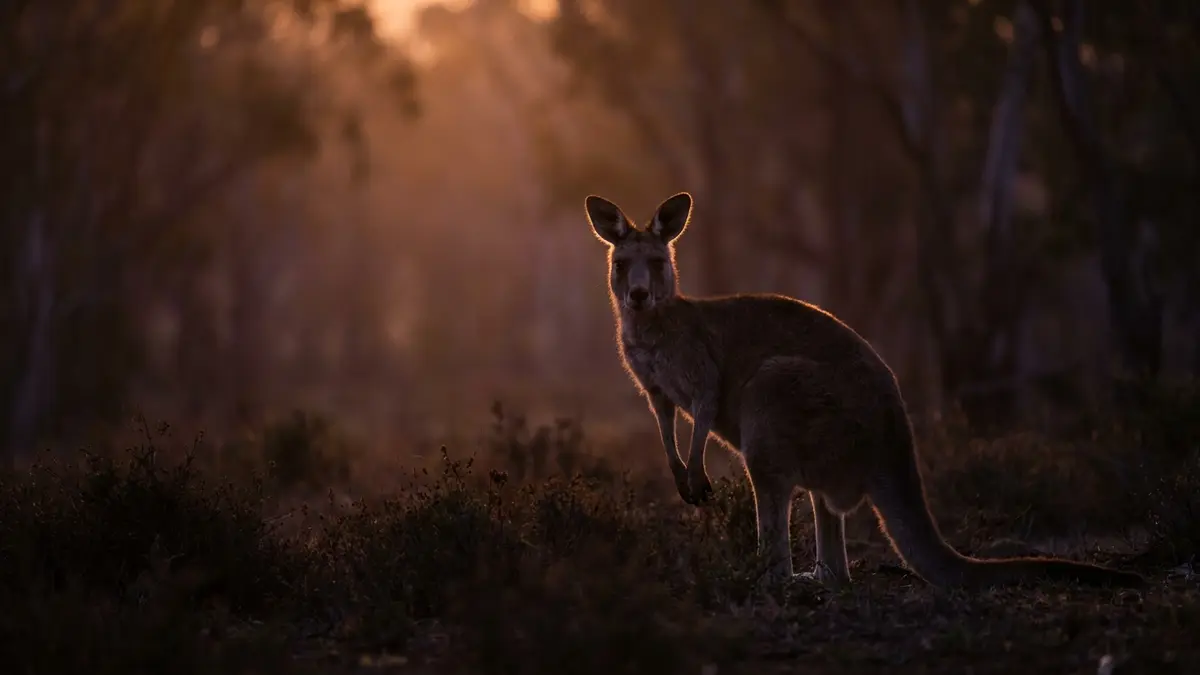
A male red kangaroo reaches 92 kg, roughly double the weight of a female, and is the largest marsupial alive. Pregnancy lasts about 33 days; the joey, born at about a gram, then leaves the pouch permanently around day 235 and suckles until roughly 12 months. Red kangaroos sustain about 40 km/h with bursts of 50-65 km/h, and the single highest figure ever recorded, 64 km/h, was set by a female eastern grey kangaroo.
An almanac
- Scientific name
- Osphranter rufus (red kangaroo); Macropus giganteus (eastern grey kangaroo)
- Family
- Macropodidae — four species are called 'kangaroos'; 50+ macropod species in total
- Adult weight
- Male red kangaroo up to 92 kg; female up to 39 kg
- Speed
- Red kangaroos: ~40 km/h sustained, bursts of 50–65 km/h (SDZWA). The single highest recorded figure is 64 km/h, set by a female eastern grey kangaroo (Australian Museum).
- Gestation and pouch life
- About 33 days in the womb, then roughly 235 days in the pouch
- Diet
- Herbivore — grasses, forbs and the leaves of shrubs
- IUCN status
- Least Concern (all four kangaroo species)
Four species in the family Macropodidae are called kangaroos, out of more than fifty macropods. The red kangaroo is the largest marsupial alive: a male can reach 92 kg, about double a female's 39 kg. All four species are listed as Least Concern.
What makes the animal worth reading about is the engineering. The hind legs store and return elastic energy, so hopping faster barely raises the fuel bill. The tail is not a counterweight but a working limb. And in a desert, water discipline outranks comfort — a red kangaroo shuts off its sweat the moment it stops moving, and a mother recycles a third of the water she puts into milk.
Kangaroo lists on the internet recycle each other, which is why the same page can print a top speed of 48 km/h and 56 km/h in adjacent paragraphs, or credit a 2025 modelling study with treadmill measurements taken in the 1970s. Everything below is attributed to the study or institution that actually produced it, and where the sources disagree, the page says so instead of picking the biggest number.
Kangaroo facts, with the source that produced them
- The largest marsupial alive, and lopsided about it. A male red kangaroo can reach 92 kg — roughly double the weight of a female, which tops out near 39 kg (Australian Museum).
- A newborn weighs about 1 gram. It takes roughly three minutes to crawl up its mother's belly and latch onto a teat.
- Thirty-three days inside, 235 days in the pouch. Red kangaroo pregnancy lasts about 33 days; the joey then rides in the pouch until around day 235 and keeps suckling until it is about 12 months old.
- A pregnancy can be parked. In embryonic diapause, a fertilised embryo — a blastocyst of just 70 to 100 cells — can be carried in the uterus for many months, restarting its development only when the pouch frees up.
- Two milk recipes at once. A mother can produce milk of two different types from two different teats at the same time: one for a newborn, one for an older joey that has left the pouch but still nurses.
- The tail is a fifth leg, and it does real work. Walking slowly, a kangaroo plants its tail like a limb. Force-plate measurements published in Biology Letters (2014) found the tail is responsible for as much propulsive force as the front and hind legs combined.
- Hopping faster costs almost nothing extra. Treadmill respirometry from the 1970s–90s (Dawson & Taylor 1973; Baudinette et al. 1992) found little to no increase in oxygen consumption rate with hopping speed in red kangaroos and tammar wallabies; the 2025 eLife modelling study cites this as the phenomenon it is trying to explain.
- Past 18 km/h, hopping beats running. At speeds over 18 km/hour, less energy is required for a kangaroo to hop than for a four-legged animal to run (San Diego Zoo Wildlife Alliance).
- The ankle tendons run at about half their breaking stress. Kram & Dawson (1998) reported that a 46.1 kg male red kangaroo's ankle extensor tendons operate at safety factors near two even at slow hopping speeds (3.9 m/s); the 2025 eLife paper quotes this as background.
- Top speed depends entirely on which figure you take. Burst speed figures vary by source: San Diego Zoo gives "more than 30 miles (48 kilometers) per hour" in one sentence and "almost 35 miles (56 kilometers) per hour" in another; SDZWA's research factsheet gives 40 km/h sustained with bursts of 50–65 km/h. This page uses the SDZWA research factsheet as its basis. The single highest recorded figure is 64 km/h, set by a female eastern grey kangaroo (Australian Museum) — a sprint of a few seconds, not a cruising speed.
- The working hop is about 7 metres, not 12. The larger kangaroos cover over 7 metres per hop when cruising at top speed. Popular lists quote 12-metre leaps as routine; San Diego Zoo describes the 12-metre, 3-metre-high bound as an emergency manoeuvre, and SDZWA's research factsheet puts maximum stride at about 6 metres.
- Breathing is cheaper in mid-air. A kangaroo uses less energy to breathe while hopping than while standing still: with each bound the abdominal organs slam into and pull away from the diaphragm, pumping the lungs for free (Advances in Physiology Education, 2010).
- At 45 °C, both species mainly pant. At 45 °C both species relied mainly on panting; the difference is that in red kangaroos cutaneous evaporative heat loss was additionally significant, at 40% of total evaporative heat loss. Evaporation from the skin surface accounted for 40% of red kangaroos' evaporative heat loss at 45 °C, and the study attributed it mainly to saliva spread by licking rather than to sweating.
- Sweating stops the instant hopping stops. Red kangaroos sweat only while exercising and switch it off when they stop, even if body temperature is still high. In the desert, water outranks comfort.
- A third of the water in milk comes back. A red kangaroo mother consumes the faeces and urine of her joey inside the pouch, recycling about one third of the water she spent producing milk.
- Rain, then ovulation. Drought-breaking rain stimulates ovulation in female red kangaroos, often within 14 days of the rain.
- 35,199,311 macropods counted in 2023. Australian government aerial and ground surveys returned that total — but only for the designated commercial harvest areas of NSW, Queensland, South Australia, Victoria and Western Australia, and it lumps in wallaroos, euros and tammar wallabies alongside the red, eastern grey and western grey kangaroos. It is not a count of every kangaroo in Australia; the true national figure is unknown and could be higher.
- Less methane than cattle, but not little methane. Per kilogram of body mass, kangaroos release roughly 27% as much methane as ruminants. On that same per-kilogram-of-body-mass basis, their absolute methane production resembled values previously reported in wallabies and non-ruminant herbivores such as horses, and the authors caution that the comparison per kilogram of meat has not been modelled.
Five things the popular version gets wrong
"Kangaroo means 'I don't understand' — what a Guugu Yimithirr man supposedly told Cook's party when they pointed at the animal." It does not. In Guugu Yimidhirr, gangurru/kanguru refers to the male of a large black or grey kangaroo species — a specific term, not the generic word for kangaroos. The muddle traces to a later visitor, Captain Phillip King. King recorded the word in 1820 as menuah; scholars think he had probably heard minha, a general term for 'edible animal'. The confusion persisted until the 1970s.
"Kangaroos cannot move backwards." This is the belief that put the animal on the coat of arms, and the evidence trims it rather than confirming it. Contrary to widespread belief, kangaroos can move their hind limbs independently — while swimming and when moving backwards (San Diego Zoo Wildlife Alliance). On land the hind legs normally swing together, which is why a kangaroo looks locked into forward motion. What the sources here establish is limb independence, not how far or how readily a kangaroo actually travels in reverse; nothing in this research measures that.
"Joeys are born inside the pouch." The joey is born at the birth canal, outside the pouch, as a blind pink grub weighing under a gram. It then makes the long climb largely unaided from the birth canal through its mother's fur, uphill, using its clawed forelimbs — and only then reaches the pouch and clamps onto a teat.
"Kangaroos barely produce methane, which makes kangaroo meat a climate-friendly swap for beef." Kangaroos are not mysteriously low methane-producing creatures, but herbivores with an active methane-producing microbe community. Per kilogram of body mass, their absolute methane production resembled values reported in wallabies and non-ruminant herbivores such as horses. They emit less than cattle largely because food moves through their gut faster, not because their microbes work differently.
"Hopping is the only gait a kangaroo has." Below about 6 km/h a kangaroo does not hop at all. It walks on five limbs, planting its tail as a crutch while both hind feet swing forward together. This pentapedal gait is what it uses for the grazing that fills most of its day, and it is energetically expensive; hopping only takes over at higher speeds.
The emblem: a coat of arms and a boxing glove
Australia made the kangaroo official in a Royal Warrant dated 19 September 1912. The Department of the Prime Minister and Cabinet still explains the choice this way: the kangaroo and emu were picked "to symbolise a nation moving forward, based on the fact that neither animal can move backwards easily." The reasoning leans on exactly the belief the research complicates — the hind limbs can move independently, including when backing up — but the emblem outlived the biology behind it, which is usually how national symbols work.
Sport supplied the other kangaroo everyone recognises. The Boxing Kangaroo flag flew from Australia II when it took the America's Cup in 1983, and the image has stood in for Australian teams ever since: a stylised animal in gloves, upright, mid-swing, owing nothing to anything a wild kangaroo does.
Skippy, the most famous kangaroo there has been
On screen, Skippy the Bush Kangaroo set the benchmark: three series and 91 episodes, shot between 1966 and 1969 and broadcast from 1968 to 1970, plus the 1969 spin-off feature Skippy and the Intruders. The National Film and Sound Archive records that at its peak the programme aired in 128 countries to more than 300 million viewers — reach that no wild kangaroo, and few Australian exports of any kind, has matched since.
It is worth being precise about what became famous. Skippy is a character and the Boxing Kangaroo is a logo; neither is a named individual animal with a life history anyone recorded. The verified material here supplies no famous wild kangaroo — no long-studied matriarch, no tagged record-holder. The animal's fame attaches to a bush-adventure premise and a coat of arms, while the genuinely unusual things about it, the paused embryos and the two-recipe milk and the tail that pushes as hard as four legs, stayed in the journals.
Frequently Asked Questions
How fast can a kangaroo actually run?
Red kangaroos sustain about 40 km/h and manage 50-65 km/h only in short bursts, according to San Diego Zoo Wildlife Alliance's research factsheet. The single highest figure ever recorded is 64 km/h, set by a female eastern grey kangaroo (Australian Museum). Popular figures disagree — San Diego Zoo's public page gives "more than 30 miles (48 kilometers) per hour" in one sentence and "almost 35 miles (56 kilometers) per hour" in another — so check which basis a number is using before quoting it.
Are baby kangaroos born inside the pouch?
No. The joey is born at the birth canal, outside the pouch, as a blind pink grub weighing under a gram. It hauls itself uphill through its mother's fur largely unaided, using its clawed forelimbs, and fastens onto a teat in about three minutes.
Can kangaroos move backwards?
Contrary to widespread belief, kangaroos can move their hind limbs independently — while swimming and when moving backwards. On land the hind legs normally swing together, which is why the animal looks committed to forward motion. The sources here establish limb independence; none of them measures how far or how easily a kangaroo travels in reverse.
How long does a joey stay in its mother's pouch?
Red kangaroo pregnancy lasts about 33 days. The joey leaves the pouch permanently at around 235 days old and carries on suckling until it reaches about 12 months. A mother can nurse that older joey and a newborn at the same time, producing two different types of milk from two teats.
Does the word kangaroo really mean "I don't understand"?
No. In Guugu Yimidhirr, gangurru/kanguru refers to the male of a large black or grey kangaroo species — a specific term, not the generic word for kangaroos. Captain Phillip King recorded the word in 1820 as menuah; scholars think he had probably heard minha, a general term for 'edible animal'. The confusion persisted until the 1970s.
Are there more kangaroos than people in Australia?
Australian government surveys counted 35,199,311 macropods in 2023, but only across the commercial harvest areas of NSW, Queensland, South Australia, Victoria and Western Australia, and the total includes wallaroos, euros and tammar wallabies alongside red, eastern grey and western grey kangaroos. It is not a national census; the true figure is unknown and could be higher.
More about the Kangaroo
More from Animal Facts
Sources
Claims on this page were checked against these published sources.
- Red Kangaroo
Male Red Kangaroos are double the body weight of females and can weigh up to 92kg while the females can weigh up to 39kg
Read the source → - Red Kangaroo (Osphranter rufus) Fact Sheet: Reproduction & Development
Newborn travels up mother's belly and fastens to a teat in about 3 minutes
Read the source → - Kangaroo and Wallaby
A mother kangaroo can produce milk of two different types to feed two different babies at the same time: one that has emerged from the pouch but is still nursing and a newborn.
Read the source → - The kangaroo's tail propels and powers pentapedal locomotion
We found that the tail is responsible for as much propulsive force as the front and hind legs combined.
Read the source → - Eastern Grey Kangaroo
The highest recorded speed was set by a female Eastern Grey Kangaroo at 64km/hr.
Read the source → - How does a hopping kangaroo breathe?
Interestingly, a kangaroo uses less energy to breathe while hopping than while standing still.
Read the source → - Red Kangaroo (Osphranter rufus) Fact Sheet: Physical Characteristics
To conserve water, stop sweating when they stop hopping, even if body temperature still high
Read the source → - Decreasing methane yield with increasing food intake keeps daily methane emissions constant in two foregut fermenting marsupials, the western grey kangaroo and red kangaroo
Although our data suggest that kangaroos only produce about 27% of the body mass-specific volume of CH4 of ruminants, it remains to be modelled with species-specific growth rates...
Read the source →
Not sure which animal is yours?
Consult the quiz