Animal Facts
Ladybug Facts: What the Spots Actually Mean
Ladybug spots mark the species, not the years — and brighter really means more toxic.
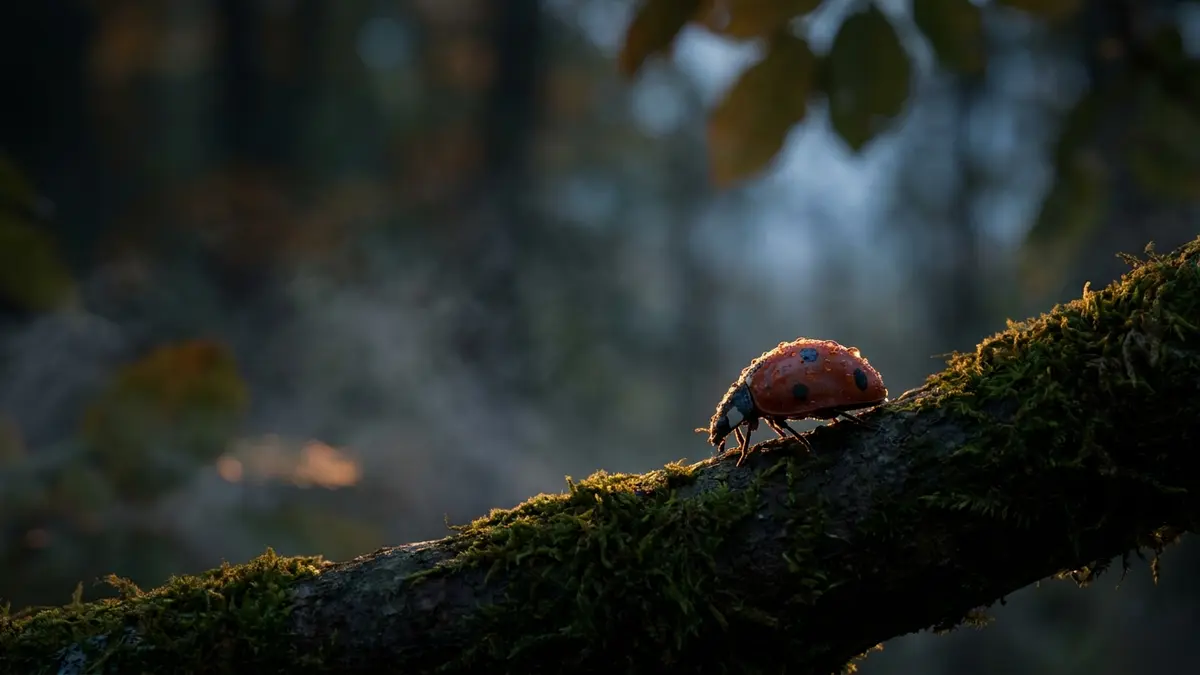
A ladybug is a beetle in the family Coccinellidae, and its spots identify the species rather than its age. About 90% of described species are predators of aphids, scale insects, whiteflies, mealybugs and mites, and University of Kentucky entomologists put the lifetime ceiling at as many as 5,000 aphids for a single beetle. Global species estimates vary by authority, from at least 3,500 to roughly 6,000, with about 500 in North America north of Mexico.
An almanac
- Family
- Coccinellidae — beetles, not true bugs
- Species
- At least 3,500 to roughly 6,000 worldwide; about 500 in North America
- Diet
- About 90% predatory: aphids, scale insects, whiteflies, mealybugs, mites
- Defence
- Bad-tasting liquid secreted from the joints, backed by honest warning colours
- Eggs
- Laid on end in clusters of about 10 to 30; several hundred per female
- Adult life
- About two months in the growing season (convergent lady beetle)
- Flight
- Detected by radar up to about 1,100 m; roughly 18 km in a typical high-altitude flight
The ladybug is one of the few insects almost nobody is frightened of, which is exactly why so much of what people repeat about it is wrong. The spots do not count years. The name has nothing to do with the beetle's sex. And the bag of live ladybugs sold to save your roses will mostly be gone by the weekend.
What survives fact-checking is stranger than the folklore. The colours are an honest advertisement of toxicity, tested by birds. The defensive fluid costs the beetle part of its immune system. Radar has tracked ladybirds hundreds of metres above British fields, and 129 imported beetles once saved California's orange groves for $1,500.
Below, each claim is tied to the body that measured it — USDA Agricultural Research Service, UC Statewide IPM, the Natural History Museum in London, and the journals PNAS, PLOS ONE and Scientific Reports. Where authorities disagree, the disagreement is stated rather than smoothed over.
Verified ladybug facts
- Nobody knows how many species there are. Global estimates genuinely vary — at least 3,500 (Natural History Museum, London), more than 4,000 (UConn Extension), more than 5,000 (Will County Forest Preserve District), approximately 6,000 (USDA Agricultural Research Service). For North America the sources broadly agree: USDA and UConn both give about 500, and NC State's "more than 400" is consistent with that rather than a rival count.
- About 90% of the family are predators. USDA ARS puts roughly nine species in ten on a diet of aphids, scale insects, whiteflies, mealybugs and mites. The remainder eat fungi or plants.
- The 5,000-aphid figure is a lifetime ceiling, not a rate. University of Kentucky entomologists state that a single lady beetle may eat as many as 5,000 aphids in its lifetime — a maximum accumulated across the larval and adult stages, not a daily or typical tally.
- Eggs are laid standing on end. A female convergent lady beetle lays them in clusters of about 10 to 30 and can produce several hundred during a growing-season adult life of about two months, according to UC Statewide IPM.
- The larvae look nothing like the adults. They are long-legged, spiny and fast, and UC entomologists describe them as resembling tiny alligators. Most gardeners who kill one have no idea what they have destroyed.
- The defence is chemical, and it has a price. Ladybugs secrete a bad-tasting liquid from their joints, a behaviour called reflex bleeding. A 2020 study in Scientific Reports found that inducing it twice a week for three weeks significantly reduced haemocyte concentration, total protein content and antimicrobial activity against Micrococcus luteus in Harmonia axyridis.
- The colours are an honest signal. Researchers at Exeter and Cambridge, publishing in Scientific Reports in 2015, showed that toxicity varies among and within ladybird species and that a beetle's colour contrast against the background is a good predictor of how toxic it actually is. Birds attack the duller models more often.
- Wing folding was solved by transplant. For a 2017 PNAS study, artificial transparent elytra were transplanted onto living ladybird beetles so the folding of the hindwings could be observed directly. The hindwings snap open in under 0.1 seconds at takeoff.
- Radar has tracked them at altitude. Vertical-looking entomological radar detected ladybirds up to ~1,100 m above ground and at displacement speeds up to ~60 km/h, though most flew between ~150 and 500 m at a mean 30 km/h. Separate tethered-flight experiments estimated an average flight time of 36.5 minutes, implying about 18 km in a typical high-altitude flight — up to 120 km only for the longest flights at higher altitude.
- Biological pest control began with a ladybug. 129 vedalia beetles shipped from Australia in three consignments between 30 November 1888 and 24 January 1889 rescued California's citrus industry from cottony cushion scale. Orange shipments from Los Angeles County jumped from 700 to 2,000 carloads within a year of the release, and the total cost of the project was $1,500.
- The harlequin reached Britain in 2004. The first British record of Harmonia axyridis was from Sible Hedingham, Essex. Its northerly spread through Britain was calculated at 105 km per year over 2004–2008, and declines in distribution have been demonstrated for seven of eight assessed native ladybird species over the invasion period.
- Most British ladybirds are not the beetle you picture. The UK has 46 native species, of which around 26 are the colloquially "conspicuous" spotted kind. The other 20 are drab and inconspicuous, and go almost entirely unnoticed.
- Harlequins carry a sexually transmitted fungus. Laboulbenia forms little scales on the wing cases and sometimes a white crust on parts of the exoskeleton, both visible to the naked eye — and humans cannot be infected.
- How the Asian lady beetle reached America is unsettled. The first US field populations were found in Louisiana in 1988. USDA deliberately attempted to establish the species from the 1960s to the 1990s, NC State Extension records a deliberate import in the late 1970s, and the same source notes accidental introductions by cargo freighters in the New Orleans area in the late 1980s. The confident claim that today's beetles descend from a specific USDA release is not established.
- They can ruin wine. Beetles harvested along with grapes cause a measurable fault: the compound IPMP has a detection threshold of 1–2 ng/L in red wine and 0.3–1.6 ng/L in white.
- New York's state insect disappeared for 29 years. The nine-spotted ladybug, Coccinella novemnotata, went unrecorded until a volunteer found one on 30 July 2011 at the Quail Hill Organic Farm in Amagansett, on Long Island's South Fork.
- The "lady" is the Virgin Mary. An old European legend holds that the name began when farmers prayed to Our Lady for help as masses of aphids destroyed their crops, and named the beetles that answered after her. It is a legend of naming rather than a documented event, and it says nothing about the insects' sex — male and female beetles are both ladybugs.
- A ladybug experiment was booked onto the Space Shuttle. A student ladybug-and-aphid microgravity experiment designed by the all-girl Javiera High School in Santiago, Chile was manifested on BioServe's STARS payload for Space Shuttle Columbia in July 1999, to document whether aphids — which normally jump downward to escape ladybugs hunting up wheat stalks — could still escape without gravity.
Myths worth correcting
"You can tell a ladybug's age by counting its spots." Spots have nothing to do with age. A ladybug's spot pattern is a species trait, not a birthday count — as the Forest Preserve District of Will County puts it, "a ladybug's spots can't tell us how old the insect is or anything about the future. What they can tell you, at least in some cases, is what species of ladybug you are seeing." Adults emerge pale and unmarked, and the pattern darkens into place over the following hours to days, after which it never changes.
"A ladybug is a bug." It is a beetle. True bugs (Hemiptera) have needle-like piercing mouthparts; beetles chew, and their forewings are hardened into shells called elytra that fold over membranous flight wings. Ladybirds sit squarely in the beetle family Coccinellidae, which is why entomologists prefer "lady beetle".
"Every ladybug is a gardener's friend that eats aphids." Not all of them are predators. Part of the family eats fungi or plants, and two North American coccinellids — the Mexican bean beetle and the squash beetle — are outright crop pests that skeletonise the leaves of beans and squash. University of Maryland Extension names them as the exception to the rule.
"Buy a bag of ladybugs, release them, and they will clear the aphids off your roses." They leave almost immediately. The beetles sold in garden centres are collected from wild overwintering aggregations and are primed to disperse: UC IPM records that most will fly away from the release site within 1 or 2 days after they are released even if aphids are plentiful.
"Ladybugs are completely harmless — they can't bite, and they're safe around pets." Asian lady beetles do bite, and their defensive fluid is chemically aggressive. A veterinary case published in Toxicon documented sixteen Harmonia axyridis removed from the oral cavity of a dog, diagnosed as a beetle-induced chemical burn of the mucosa.
The ladybug in pop culture
Pixar's A Bug's Life (1998) built a running joke out of ladybug biology. Francis, a circus clown voiced by Denis Leary, is a male ladybug endlessly mistaken for a woman — a gag that only lands because so many people assume the "lady" in the name is literal. It is not; the name is religious, and it applies to both sexes.
The biggest ladybug property alive is Miraculous: Tales of Ladybug & Cat Noir, the French CGI series created by Thomas Astruc, which premiered on TF1 on 19 October 2015, ran five seasons through 2023 and returned for a sixth in 2025. In print, Ladybird Books traces back to an 1867 Loughborough printing firm and survives as a Penguin Random House imprint whose beetle logo sat on millions of British childhoods.
The traffic runs both ways. For the 2017 PNAS study, artificial transparent wing cases were transplanted onto living beetles specifically so that the hidden folding of the hindwings could be watched as it happened — a piece of laboratory theatre that produced the clearest look yet at how the beetle packs its flight wings away.
Famous ladybugs
The most consequential ladybug in history is the vedalia beetle. 129 of them were shipped from Australia in three consignments between 30 November 1888 and 24 January 1889 to attack cottony cushion scale in California's citrus groves. Orange shipments from Los Angeles County jumped from 700 to 2,000 carloads within a year of the release, and the whole project cost $1,500 — the founding success of biological pest control.
The most notorious is the harlequin, Harmonia axyridis, first recorded in Britain at Sible Hedingham, Essex, in 2004 and calculated to be spreading north at 105 km per year over 2004–2008. In the United States, the same species turned up as wild field populations in Louisiana in 1988 and is now the beetle most people mean when they complain about ladybugs in the house.
The most missed is New York's state insect. The nine-spotted ladybug, Coccinella novemnotata, went unrecorded in the state for 29 years until a volunteer found one on 30 July 2011 at the Quail Hill Organic Farm in Amagansett, on Long Island's South Fork.
And a few were booked for orbit. A microgravity experiment designed by pupils at the all-girl Javiera High School in Santiago, Chile was manifested on BioServe's STARS payload for Space Shuttle Columbia in July 1999, intended to document whether aphids — which normally jump downward to escape ladybugs hunting up wheat stalks — could still escape with no gravity to fall through.
Frequently Asked Questions
Do ladybug spots tell you how old it is?
No. Spots have nothing to do with age — the pattern is a species trait, and in many cases it tells you which ladybug you are looking at, not how long it has lived. Adults emerge pale and unmarked, and the pattern darkens into place over the following hours to days, after which it never changes.
Are ladybugs bugs or beetles?
Beetles. True bugs (Hemiptera) have needle-like piercing mouthparts, while beetles chew and their forewings are hardened into elytra that fold over membranous flight wings. Ladybirds belong to the beetle family Coccinellidae, which is why entomologists prefer the name lady beetle.
How many aphids does a ladybug actually eat?
University of Kentucky entomologists state that a single lady beetle may eat as many as 5,000 aphids in its lifetime. That is a ceiling accumulated across the larval and adult stages, not a daily rate or an average beetle's tally.
Does buying ladybugs for your garden work?
Usually not. The beetles sold for release come from wild overwintering aggregations and are primed to disperse: UC IPM reports that most fly away from the release site within one or two days of release even when aphids are plentiful.
Do ladybugs bite people or hurt pets?
Asian lady beetles do bite, and their defensive fluid is chemically aggressive. A case published in Toxicon documented sixteen Harmonia axyridis removed from a dog's oral cavity and diagnosed as a beetle-induced chemical burn of the mucosa.
Why are they called ladybugs?
The "lady" refers to the Virgin Mary. An old European legend says farmers prayed to Our Lady when masses of aphids were destroying their crops, and named the beetles that arrived after her. The name says nothing about the insects' sex — males and females are both ladybugs.
More about the Ladybug
More from Animal Facts

Sources
Claims on this page were checked against these published sources.
- Research on the Coccinellidae—lady(bird) beetles
There are approximately 6,000 species of Coccinellidae worldwide
Read the source → - Ladybugs (ENTFACT-702)
A single lady beetle may eat as many as 5,000 aphids in its lifetime.
Read the source → - Convergent Lady Beetle — Natural Enemies Gallery
Adult females can lay several hundred eggs during their growing-season lifespan of about two months.
Read the source → - Signal honesty and predation risk among a closely related group of aposematic species
Here we demonstrate that different levels of toxicity exist among and within ladybird species and that signal contrast against the background is a good predictor of toxicity, showing that the colours are honest signals.
Read the source → - Investigation of hindwing folding in ladybird beetles by artificial elytron transplantation and microcomputed tomography
In the present study, artificial transparent elytra were transplanted on living ladybird beetles, thereby enabling us to observe the detailed wing-folding processes.
Read the source → - Cottony cushion scale — Applied Biological Control Research
The shipments of fresh oranges from Los Angeles County jumped from 700 to 2,000 carloads within one year of the release of R. cardinalis and the total cost of the project was $1,500.
Read the source → - Ten years of invasion: Harmonia axyridis (Pallas) (Coleoptera: Coccinellidae) in Britain
The first British record of Harmonia axyridis (Pallas) (Coleoptera: Coccinellidae), the harlequin ladybird, was from Sible Hedingham, Essex, England, in 2004
Read the source → - Why harlequin ladybirds are invading our homes
In the UK there are 46 native species. Of these around 26 colloquially are called 'conspicuous' ladybirds.
Read the source → - Asian Lady Beetle Infestation of Structures (ENTFACT-416)
The first field populations in the United States were found in Louisiana in 1988.
Read the source → - A Review of Ladybug Taint in Wine: Origins, Prevention, and Remediation
The detection threshold for IPMP in red wine is 1–2 ng/L and 0.3–1.6 ng/L in white wine
Read the source → - After 29 years, nine-spotted ladybugs found on Long Island
The first nine-spotted ladybug -- Coccinella novemnotata -- was discovered by a volunteer July 30 at the Quail Hill Organic Farm in Amagansett on Long Island's South Fork (Suffolk County).
Read the source → - The Lady Bug Story
An old European legend says that the name 'ladybug' started when farmers prayed to the Virgin Mary for help when masses of aphids were destroying their crops.
Read the source → - CU-Boulder to send experiments ranging from ladybugs to water quality on NASA shuttle
The objective will be to document the movements of ladybugs, which hunt upward on wheat stalks, and aphids, which jump down to escape.
Read the source →
Not sure which animal is yours?
Consult the quiz