Animal Facts
Hummingbird Facts: Hovering, Torpor and Dive Speed
A diving Anna's hummingbird covers 385 body lengths a second — beating a falcon.
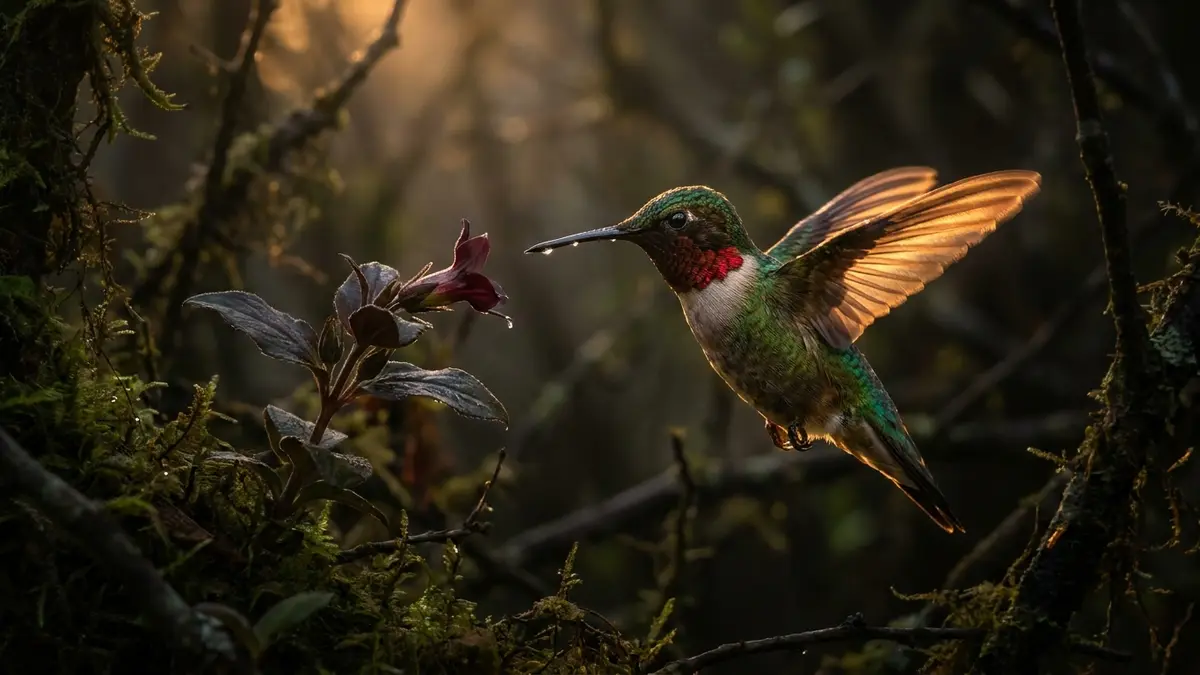
There are almost 340 hummingbird species and every one of them lives only in the Americas. A ruby-throated hummingbird's heart beats about 225 times a minute at rest and more than 1,200 times a minute in flight, and Cornell records rufous hummingbirds at 52–62 wingbeats per second. Hummingbirds are the only birds capable of sustained hovering, and the Cuban bee hummingbird, at under two grams, is the smallest bird in the world.
An almanac
- Species
- Almost 340, all restricted to the Americas
- Smallest
- Bee hummingbird of Cuba — about 2¼ in, under 2 g
- Heart rate
- About 225 beats a minute at rest, 1,200+ in flight
- Wingbeats
- 52–62 per second in rufous hummingbirds (Cornell)
- Longest hop
- 18–20 straight hours across the Gulf of Mexico
- Dive speed
- 27.3 metres per second — 385 body lengths per second
- Annual survival
- ~31% of adult males, 42% of females (Powdermill banding)
A hummingbird is a bird built around a fuel problem. It runs a heart that beats more than 1,200 times a minute in flight, burns the sugar it has just swallowed straight in its flight muscles, and then, on a cold night in the Andes, shuts most of that down and lets its body temperature fall to within a few degrees of freezing.
Most of the popular hummingbird facts hold up. A few of the most repeated ones overstate what the sources actually say — the single wingbeat number, the "only vertebrate that can hover" line, the survival statistics quoted as if they applied to the whole species. Where the usual version goes further than the evidence, this page says so rather than smoothing it over.
Everything below traces to Smithsonian's National Zoo, the Cornell Lab of Ornithology, Audubon, the Field Museum, Princeton, the University of New Mexico and the peer-reviewed literature. Where a source hedged, the hedge is kept.
Hummingbird facts
- Every species lives in the Americas. There are almost 340 hummingbird species, and every one of them lives only in the Americas — no hummingbird occurs naturally in Europe, Africa, Asia or Australia (Smithsonian's National Zoo).
- A heart running at roughly 20 beats a second. A ruby-throated hummingbird's heart beats about 225 times a minute when the bird is at rest and more than 1,200 times a minute when it is flying.
- The only birds that truly hover. Hummingbirds are the only birds capable of sustained hovering — holding position in mid-air rather than merely pausing — and they can also fly backward and upside-down. Smithsonian's own wording is "only vertebrates", but nectar-feeding bats hover at flowers for sustained periods too, which is why the careful phrasing is "only birds".
- There is no single wingbeat number. Wingbeat rate scales with body size and behaviour — Cornell records Rufous Hummingbirds at 52–62 beats per second, while Smithsonian puts a Ruby-throated at about 70 per second in direct flight and more than 200 per second in a dive.
- A Gulf crossing on stored fat. Smithsonian's National Zoo says migratory Ruby-throated Hummingbirds "have no problem flying 18 to 20 straight hours to cross the Gulf of Mexico, powered by their fat stores and given a bit of help from winds."
- The smallest bird in the world. The bee hummingbird of Cuba is about two and a quarter inches long and weighs under two grams — less than a US dime (Audubon).
- A nest that stretches as the brood grows. The nest is about 2 inches across, made of plant down held together with spider silk and sometimes pine resin; the female stamps the base to stiffen it, but the walls stay pliable and stretch as the chicks grow.
- A migration measured in body lengths. Cornell calls the Rufous Hummingbird's ~3,900-mile Alaska-to-Mexico flight "one of the longest migratory journeys of any bird in the world, as measured by body size" — about 78,470,000 body lengths for a bird just over 3 inches long, versus 51,430,000 body lengths for the 13-inch Arctic Tern's much longer 11,185-mile trip.
- Most adults do not survive the year. Banding data from Pennsylvania's Powdermill Nature Reserve indicate that only about 31 percent of adult male Ruby-throated Hummingbirds and 42 percent of females survive a given year.
- The largest hummingbird turned out to be two birds. In May 2024 researchers reported in PNAS that the giant hummingbird is actually two species — the southern Patagona gigas and a newly named northern species, Patagona chaski — that look nearly identical but are deeply divergent genetically. As the Cornell Chronicle put it, "They are as different from each other as chimpanzees are from bonobos."
- Torpor takes the body to within a few degrees of freezing. To survive freezing Andean nights hummingbirds enter torpor and, per UNM, "reduce energy use by more than 90 percent"; the coldest bird the team measured hit 3.26 °C (38 °F) — described by the researchers as the lowest body temperature ever measured in a non-hibernating bird or mammal.
- The fastest vertebrate relative to its own size. Diving male Anna's Hummingbirds hit 27.3 metres per second — 385 body lengths per second, the highest length-specific speed measured in any vertebrate, and faster in relative terms than a diving peregrine falcon (Proceedings of the Royal Society B, 2009).
- The dive chirp is made by feathers, not the throat. The sharp sound at the bottom of an Anna's Hummingbird's courtship dive is not a song — it is made by air fluttering the inner vanes of the bird's two outermost tail feathers, as Christopher Clark and Teresa Feo showed in 2008.
- A fourth colour cone. Hummingbirds have a colour cone humans lack, and Princeton-led trials with wild broad-tailed hummingbirds proved they can actually tell apart "nonspectral" colours such as ultraviolet+green, ultraviolet+red and ultraviolet+yellow.
- The shine is structural. A hummingbird's iridescence is structural, not simply pigmentary: Field Museum-led researchers who examined 35 species under transmission electron microscopes found that the melanin-bearing organelles in the feather barbules are pancake-shaped and packed with tiny air bubbles — unlike a duck's log-shaped, air-free melanosomes — and that flattened, air-filled geometry is what splits and bounces the light.
- Sugar goes straight to the muscle. Hummingbirds burn the sugar they have just swallowed directly in their flight muscles, skipping the usual step of storing it as fat first. Scaled to human size, that is an energy burn more than ten times an Olympic marathon runner's (University of Toronto Scarborough).
- A beak longer than the bird. The sword-billed hummingbird of the northern Andes is the only bird in the world whose beak is longer than its body — a 3-to-4-inch spike built for flowers no other bird can drain (Audubon).
Hummingbird myths, corrected
"Hummingbirds hitch a ride on the wings of Canada Geese." Audubon files this under "one particularly amusing theory". Hummingbirds make the trip under their own power: Smithsonian's National Zoo says migratory ruby-throats "have no problem flying 18 to 20 straight hours to cross the Gulf of Mexico, powered by their fat stores and given a bit of help from winds", and Cornell puts the rufous hummingbird's one-way Alaska-to-Mexico journey at roughly 3,900 miles. Geese and hummingbirds also migrate at different times, on different routes, to different places.
"Leave your feeder up in autumn and hummingbirds will forget to migrate." Migration is triggered by day length and the angle of the sun, not by how much food is around. Audubon is explicit: "It's not a lack of nectar source or colder weather that makes them leave—they know it's time based on changes in the length of the day and the angle of the sun." A feeder left up simply feeds late-moving stragglers and birds coming down from further north; it cannot override the internal calendar that tells a hummingbird to go.
"Hummingbird nectar has to be dyed red, or the birds won't find your feeder." Real flower nectar is clear, and feeders already have red plastic parts doing the attracting. The Cornell Lab is blunt — "There is absolutely no reason to add any red dyes to hummingbird sugar water" — and Audubon adds that "the reddening chemicals could prove to be harmful to the birds". Plain white sugar in water, roughly one part sugar to four parts water, is all that is needed: no dye, no honey, no artificial sweetener.
"A hummingbird sucks nectar up its tongue like a drinking straw." High-speed filming of 18 species across seven of the nine main hummingbird clades showed something different: the tongue is squeezed flat inside the bill, and when the flattened tip touches nectar it springs back open, pumping fluid into its grooves. It is an elastic micropump, and it works far faster than capillarity could — matching real licking rates near 14 times a second instead of the 5 predicted by the straw model. The 2015 paper in Proceedings of the Royal Society B states that the work "falsifies the long-standing idea that capillarity is an important force filling hummingbird tongue grooves during nectar feeding".
"Hummingbirds live entirely on nectar, so sugar water is a complete diet." Nectar is fuel, not food. Hummingbirds get their protein by hunting: they catch insects in midair, pull them out of spider webs, and pick aphids and small caterpillars off leaves. Cornell lists mosquitoes, gnats, fruit flies, small bees and spiders as standard ruby-throated prey, and Smithsonian notes that insect-hunting peaks in the breeding season, when chicks need protein to grow.
The hummingbird in culture
Hummingbirds have been celebrity birds for two thousand years. One of the Nazca Lines etched into the Peruvian desert between the 4th century B.C. and the 10th century A.D. has been known for decades simply as "the hummingbird" — though a 2019 study in Journal of Archaeological Science: Reports, led by Masaki Eda of the Hokkaido University Museum with Takeshi Yamasaki and Masato Sakai, re-identified the figure as a hermit, a forest-dwelling hummingbird group that does not even live near Nazca.
In Aztec religion the sun and war god Huitzilopochtli takes his name from the Nahuatl words for hummingbird and left, and dead warriors were said to return as hummingbirds. Victorian London had its own craze: John Gould's "Hummingbird House" of 24 glass cases at the 1851 Great Exhibition, which Charles Dickens wrote up for his weekly Household Words under the title "Tresses of the Day Star".
Jamaica made the red-billed streamertail — the "doctor bird" — its national bird. And Disney's Pocahontas (1995) gave the family its most-watched cameo in Flit, the hummingbird voiced by Frank Welker.
The people behind the hummingbird's reputation
John Gould (1804–1881) was the great hummingbird obsessive. His Hummingbird House of 24 display cases drew crowds at London's Great Exhibition in 1851, and six of those original cases still survive at the Natural History Museum in London.
Gerald Mayr of the Senckenberg Research Institute complicated the family's history from a very different direction. In the 7 May 2004 issue of Science he described Eurotrochilus inexpectatus — hummingbird fossils from a German clay pit, taken from deposits dating to between 34 and 30 million years ago, in a group whose living members are confined to the Americas.
The modern literature has its own pair of names: Christopher Clark and Teresa Feo, who in 2008 at UC Berkeley showed that the beeps and chirps of an Anna's hummingbird courtship dive, long assumed to be vocal, are produced by the bird's tail feathers in the airflow.
Frequently Asked Questions
Are hummingbirds found anywhere outside North and South America?
No. There are almost 340 hummingbird species and every one of them lives only in the Americas — none occurs naturally in Europe, Africa, Asia or Australia.
Is the hummingbird the only animal that can hover?
Hummingbirds are the only birds capable of sustained hovering — holding position in mid-air rather than merely pausing — and they can also fly backward and upside-down. Smithsonian's wording is "only vertebrates", but nectar-feeding bats hover at flowers for sustained periods too, so "only birds" is the claim that holds.
Should I put red dye in my hummingbird feeder?
No. The Cornell Lab says there is absolutely no reason to add red dyes to hummingbird sugar water, and Audubon warns the reddening chemicals could prove harmful. Real flower nectar is clear and feeders already have red parts. Use plain white sugar in water, roughly one part sugar to four parts water.
Will leaving my feeder up in autumn stop hummingbirds from migrating?
No. Audubon says migration is triggered by changes in day length and the angle of the sun, not by a lack of nectar or by colder weather. A feeder left up simply feeds late-moving stragglers and birds coming down from further north.
How long do hummingbirds live?
Not long. Banding data from Pennsylvania's Powdermill Nature Reserve indicate that only about 31 percent of adult male ruby-throated hummingbirds and 42 percent of females survive a given year.
Do hummingbirds eat anything besides nectar?
Yes — nectar is fuel, and the protein comes from hunting. Cornell lists mosquitoes, gnats, fruit flies, small bees and spiders among ruby-throated prey, caught in midair or pulled out of spider webs, and Smithsonian notes that insect-hunting peaks in the breeding season when chicks need protein.
More about the Hummingbird
More from Animal Facts
Sources
Claims on this page were checked against these published sources.
- Hummingbirds
The almost 340 species of hummingbirds are entirely restricted to the New World.
Read the source → - Rufous Hummingbird Overview
The wingbeat frequency of Rufous Hummingbirds has been recorded at 52–62 wingbeats per second.
Read the source → - Get to Know the Bee Hummingbird, the World's Smallest Bird
They weigh less than two grams — less than a dime.
Read the source → - Ruby-throated Hummingbird Life History
The female stamps on the base of the nest to stiffen it, but the walls remain pliable, allowing it to stretch as the chicks grow.
Read the source → - Hummingbirds Lead Intense Lives: How Long Do They Live?
only about 31 percent of adult male Ruby-throated Hummingbirds and 42 percent of females survive any given year.
Read the source → - World's largest hummingbird is actually two species
They are as different from each other as chimpanzees are from bonobos.
Read the source → - UNM professors examine how hummingbirds live in extreme climate
The lowest body temperature the team recorded was 3.26 degrees Celsius or 38 degrees Fahrenheit, only a few degrees above freezing.
Read the source → - Courtship dives of Anna's hummingbird offer insights into flight performance limits
reached an average maximum velocity of 385 body lengths s−1 (27.3 m s−1)
Read the source → - Hummingbird's tail feathers make the beeps and chirps of courtship display, UC Berkeley study finds
The beeps, chirps and whistles made by some hummingbirds and thought to be vocal are actually created by the birds' tail feathers
Read the source → - Wild hummingbirds see a broad range of colors humans can only imagine
hummingbirds can see a variety of nonspectral colors, including purple, ultraviolet+green, ultraviolet+red and ultraviolet+yellow
Read the source → - Hummingbirds' rainbow colors come from pancake-shaped structures in their feathers
Hummingbirds' melanosomes are pancake-shaped and contain lots of tiny air bubbles.
Read the source → - Hummingbird metabolism unique in burning glucose and fructose equally
If a hummingbird were the size of a human, it would consume energy at a rate more than 10 times that of an Olympic marathon runner.
Read the source → - 10 Wonderfully Weird Bird Beaks
The sword-billed hummingbird, which lives in the northern Andes Mountains, is the only bird with a beak longer than its body.
Read the source →
Not sure which animal is yours?
Consult the quiz