Mammals · Spirit animal
Horse Spiritual Meaning & Symbolism
Untamed drive paired with loyal partnership, the courage to run free without losing your herd.
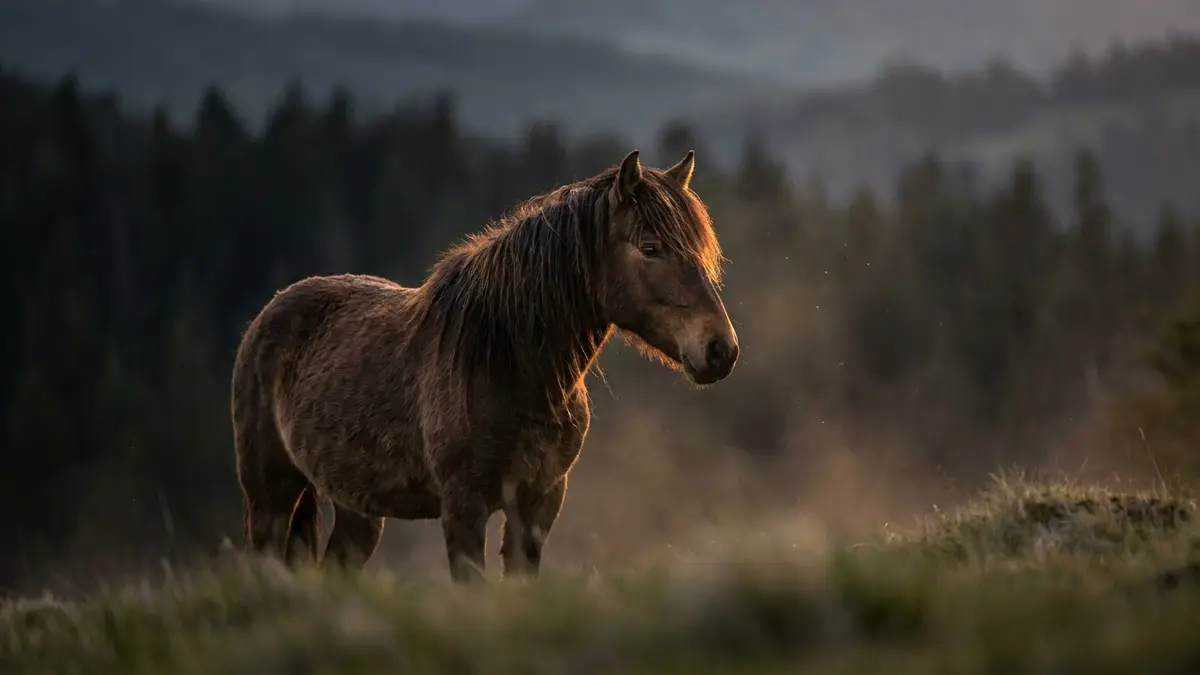
A Horse can symbolize freedom, energy, and self-mastery. Being this animal's totem or power animal suggests loyalty and the drive to transform ambition into progress. Depending on its behavior, it may be indicating restrained instinct or a feeling of duty. When you dream of a Horse, it's a sign that stamina, charisma, and success are all on their way.
An almanac
- Core message
- Freedom, drive, and staying true to yourself
- Spirit animal
- A push to break free and move forward
- Totem for
- Adventurous, loyal, family-minded people
- Power animal
- Bridges ordinary reality and the spirit world
- In dreams
- Stamina, charisma, success drawing near
- Cultural roots
- Celtic, Native American, biblical, Far Eastern
- Greek myth
- Poseidon's creation, father of Pegasus
- Norse myth
- Sleipnir, Odin's 8-legged mount
Horse was an all-powerful symbol across nearly every mythology you can think of, revered for the blend of strength and devotion that made it so beloved. It's still that way as a spirit animal, totem, or power animal. Horse is about freedom and personal drive combined with the self-control it takes to transform good ideas into real-world progress. You can even see this mix of power and self-control in legends about Celtic goddesses and the horsemen from the Book of Revelation.
Horse Symbolism & Meaning
A free horse embodies pure, unadulterated strength and drive. It can run free yet keep to its herd. It shows how strong bonds and strong instincts aren't at odds.
Carl Jung saw the horse as representing personal power and high skill—attributes tied to self-actualization, which is about understanding your drives and fulfilling your potential.
A horse shown stable-bound symbolizes restrained strength, dedication, or circumstances that inhibit your freedom. It points to the burdens you need to shed.
White horses are companion-animals to heroes and sun gods throughout history, and saying "news straight from the horse's mouth" evokes those long-held associations.
Horse Spirit Animal
When Horse shows up as your spirit animal, it's a sign that a new feeling of freedom is welling up inside of you. Maybe you're in a bad relationship that's started to drain you, or you have a job that doesn't seem to offer any direction. If that's the case, the message of Horse is very blunt: stop stalling and choose a new direction.
Seeing Horse shows up repeatedly can also indicate a surge of energy that will carry you forward past whatever has been holding you back.
Horse also represents the bond between humans and wind and open-air energy. Many traditions believe Horse is able to take messages from people to higher, unseen realms.
Does Horse fit you?
Tap the ones that sound like you — 6 traits, no right answer.
0 of 6 Nothing picked yet — start tapping.
Horse Totem Animal
Horse is an animal that knows how to express itself and how to move naturally. If Horse is your totem, those are traits you also have. You also tend to feel free, loyal, strong, and adventurous.
You like to keep moving and don't usually like to be stuck where you are. Staying still is as far from your nature as standing still can be.
Horse Power Animal
Horses as spirit allies can transport shamans between ordinary reality and the spirit world, sharpening their connection to unseen forces and allowing them to see more clearly. Horses can also keep the shaman's feet firmly planted on the earth.
Horse medicine is about honesty, or being your authentic self, instead of trying to be someone else. Horse medicine also keeps you in the present instead of lost in worry, helping you to express your gratitude for people in your life.
Across cultures
6 traditions — pick one to read its take.
Horse in Native American Symbolism
Native Americans call the horse a "God Dog." This name says a lot about Native people's deep respect for the horse. For centuries, the horse was vital to their way of life. Native people rode horses into battle, and they used them to travel. Their ties to horses were different than those of humans to other animals. The bonds that riders developed with the horses were partners built on mutual trust.
Some artwork shows a shaman riding an airborne horse as it carries him toward the spirit world.
After Europeans brought horses to America, Native people adopted them quickly and enthusiastically. The spiritual reverence once reserved for their own extinct species was now deepened. The horses expanded Native Americans' ability to travel and served as symbols of wealth and survival.
After a war, some tribes honored the bond between warrior and animal by making ceremonial stick-carvings of fallen horses. They used these sticks in their Horse Dance.
Horse in Christian & Biblical Symbolism
The clearest scriptural depiction of horses and their symbolism is Revelation's Four Horsemen, unleashed when the Lamb breaks the first four Seals. The white horse is associated with conquering, and depending on your perspective, the rider symbolizes either Christ or a false counterpart. A red horse is bound to war. A black horse to famine. And the sickly pale horse carries Death itself.
Horses are often depicted as instruments of war in scripture, and modern believers frequently interpret them as symbols of faith and inner strength.
Horse in Celtic Symbolism
Celtic mythology shows how the horse connects both this life and the spiritual world. It's associated with three goddesses: Epona, who also has Roman connections; Macha, who guards the land and kingship; and Rhiannon, who is tied to the Otherworld.
A fourth figure is Manannán mac Lir, who is related to horses much as he is related to water. He rides a horse called Aonbharr, who can gallop over land and sea.
The horse symbolizes warrior courage in Celtic tradition. An aspirant to kingship would sleep in a horsehide before assuming the throne.
Not all of their horses are noble animals. A legendary creature called a Pooka will lasso you and ride you hard through this world (usually without damaging you), just as the famous trickster-horse of Greek legend.
Horse in Far Eastern Symbolism
The horse plays a recurring symbol in Asian culture, representing nobility, strength, and good fortune. It's connected to life itself, in part because Buddha's own horse was said to have died of grief when it learned its master no longer needed it. In Buddhist teaching, the horse is associated with prana, or "breath of life," and with devotion.
The "Wind Horse" is often used as a way to picture the mind's restless gallop, but here the rider (your higher awareness) has learned to steady those scattered thoughts. Chinese folklore also describes the Qilin, a creature, who represents harmony and prosperity. It resembles the Western unicorn.
Hindu tradition includes a less well-known theme: that Krishna killed a demon who had taken the form of a horse.
Horse in Greek & Roman Symbolism
Greek mythology attributes the horse to Poseidon's domain: the ancient world credited him as the tamer of this first horse (in some versions, the very father), bringing it into being with a mighty strike of his trident against a rock. He is also worshipped in Arcadia under the epithet Hippios, "of the horse." Poseidon is called the father of Pegasus, Perseus's winged horse and Arion, a horse who could speak. The mythical horses have a strong connection to Poseidon because of his parentage. This explains why ocean waves often resemble white horses on a cresting sea. The Romans had their own rituals for honoring Poseidon's influence: an October Horse, gifted to Mars in honor of fertility, harvest and turning seasons. This was a winner of a chariot race at first and was sacrificed as an offering every year.
Horse in Norse Mythology
Odin's own mount, Sleipnir, is an eight-legged gray horse from Norse mythology. A couple of myths make Sleipnir, who is Odin's steed, special because he's also a trustworthy escort between worlds.
The god Hermóðr rode Sleipnir into the underworld to bring Baldr back to life. That journey took nine days.
So not only does this horse pull Odin across boundaries, but it also shows up at crossings in other ways. These same kinds of crossing show up in myths and other stories from all over the world.
Horse Tattoo Meaning
A horse tattoo marks an independent spirit and a love for horses. This animal shows untamed sexuality and a desire to move through life without boundaries. Some people draw from darker meanings, referencing Revelation's horses of the apocalypse. Others turn to an image of wealth, ambition, or a hard-won journey.
Color carries a range of additional meanings: black horses suggest power and transformation, including initiation and even death; gold ones point to solar vitality and creative fire. Versions like Pegasus or unicorns borrow the same core symbolism, with unicorns adding purity and innocence.
Horse in Dreams
Dreaming of a horse can reveal themes related to stamina, charisma, and sexual energy. It often means success is closer than you think. Horses can symbolize different things depending on their action in the dream: - A motionless horse suggests that you are working harder than necessary at something that isn't worth your efforts. Re-evaluate whether you're beating a dead horse. - A toy or lifeless horse in your dream warns of Trojan horses—unwanted surprises or opportunities that will slip through an open door or subtle gaps in security. - A multicolored horse symbolizes shifting situations and different elements at play. - A horse with its head high and ears pricked signifies your intuition or instinct when making decisions and taking actions. - A galloping horse represents positive progress. - A standing still horse represents rest and some breathing room to regroup before moving forward again. - A dragging horse suggests you are carrying burdens that aren't yours. - A running towards you symbolizes an opportunity or a message that is coming towards you at a rapid pace.
A white horse often represents purity and victory in dreams. Brown horses represent grounded practical matters and issues close to home. Black horses carry intense charges - meaning suppressed passion, anger, buried emotions coming up for change.
Horse in Astrology & Zodiac
Different astrological traditions assign different significance to the Horse.
In the Chinese zodiac, people born in a Year of the Horse are lively, sociable, and sharp-witted, natural leaders who put in a great deal of effort to achieve their goals but chafe at anything that feels restrictive; their drive comes from the desire for personal freedom as much as from the desire for companionship.
A less studied system (popularized in recent decades but not accepted by all scholars) is a tree-based Celtic zodiac that assigns Horse to people. According to this tradition, Horse signs are passionate, persistent, and indifferent to any obstacles in their path.
Regardless of which system you use to study your own star sign, however, the underlying message is the same: Individuals whose natal chart places them near Horse display energy and determination.
Horse Spiritual Meaning
Nobility, momentum, and the courage to stay who you are — that is where Horse's spiritual message lands. It represents the body itself as a vehicle for the soul, so where you're headed on the outer journey often mirrors an inner one. Tarot's four Knights make this vivid: the Wands knight gallops forward already in motion; the Swords knight speeds ahead chasing conquest; the Cups knight approaches at an easier pace; and the Pentacles knight rides a horse standing still, suggesting real abundance sometimes requires you to hold your horses and wait it out. Horse energy blends feminine intuition with hard-earned strength, echoed in customs from a lucky grey wedding-day horse to Ehwaz, the Elder Futhark rune for horse that urges you to trust your body's own wisdom. This animal pairs sensitivity with raw power: free, courageous, unmistakably yourself.
Frequently Asked Questions
What does Horse symbolize as a spirit animal?
Horse as a spirit animal represents freedom, forward motion, stamina, and drive. It brings the power and energy to drive you toward your goals and break free of whatever's been holding you back.
What is the difference between a wild horse and a tamed horse in symbolism?
A wild horse points to raw vitality and a powerful need for independence. A tamed horse symbolizes dutiful service and a restrained instinct. They are both prompts to notice what is wild and uncontrollable about your life and what is under control.
What does it mean to dream about a white horse?
In dream-lore, a white horse is a symbol of purity, victory, and strength, foretelling that an adventure or a hard-won success is on its way. Whether your journey will be marked by swift freedom or slowed by a hobble depends on whether the horse moves freely or is restrained in the dream.
What does a black horse mean in a dream?
If you dream of a black horse, this may be a sign that you have strong emotions that you have been suppressing. It could be something like anger, passion, or even a personal transformation that you haven't told anyone about. Instead of thinking of this as a bad sign, see if you can express those feelings or allow yourself to notice any changes taking place without fear or secrecy.
What does Pegasus symbolize?
Pegasus, a winged horse, is a Greek symbol of inspiration and the mind's ability to transcend its limits; he carried Perseus as he returned to earth with the head of Medusa. Compared to an ordinary horse, who symbolizes an ordinary drive, Pegasus represents soaring imagination and the spirit's sense of elevation.
Why is Sleipnir depicted with eight legs?
Sleipnir, the legendary horse of Odin, is described with eight legs. The many legs of Sleipnir symbolize his unmatched status as a horse and emphasize his importance as a servant to transport Odin across the boundary between this world and the next. Scholarly writing about Odin's horse compares Sleipnir to human funeral biers, which are usually carried by four bearers.
Horse also represents
- Other animals that represent love →Alongside Dove, Swan, Wolf, Seahorse
- Other animals that represent strength →Alongside Lion, Bear, Tiger, Elephant
- Other animals that represent freedom →Alongside Eagle, Hawk, Butterfly, Albatross
- Other animals that represent loyalty →Alongside Dog, Wolf, Swan, Penguin
Sources
Claims on this page were checked against these published sources.
- Epona
The name Epona ('Great Mare') originates from Gaulish, an extinct Celtic language.
Read the source → - Four Horsemen of the Apocalypse
a white horse, and he who sat on it had a bow; and a crown was given to him, and he went out conquering and to conquer.
Read the source → - Qilin
Qilin generally have Chinese dragon-like features: similar heads with antlers... The body is fully or partially scaled and often shaped like an ox, deer, or horse, or more commonly a goat.
Read the source → - Kanthaka
Following the departure of Siddhartha, Kanthaka died of a broken heart.
Read the source → - Horse (Evolution)
Yet between 10,000 and 7,600 years ago, the horse became extinct in North America.
Read the source → - Horses in the United States
Horses returned to the Americas thousands of years later, well after domestication of the horse, beginning with Christopher Columbus in 1493.
Read the source → - Rhiannon
She is a beautiful woman arrayed in gold silk brocade, riding a shining canwelw (pale-white) horse.
Read the source → - Manannán mac Lir
a horse that could travel over land or sea called Aonbharr of Manannan, translated in popular re-telling as 'Enbarr of the Flowing Mane'.
Read the source → - Macha
Like other sovereignty goddesses, Macha is associated with the land, fertility, kingship, war and horses.
Read the source → - Ehwaz
*Ehwaz is the reconstructed Proto-Germanic name of the Elder Futhark e rune ᛖ, meaning "horse"
Read the source → - Púca
the púca will do its rider no real harm
Read the source → - Keshi (demon)
Keshi assumes the form of a huge horse... As soon as Krishna thrusts his left arm into Keshi's mouth, all of Keshi's teeth fall.
Read the source → - Horse (zodiac)
Certain characteristics of the Horse nature are supposed to be typical of or to be associated with either a year of the Horse and its events, or in regard to the personality of someone born in such a year.
Read the source → - Poseidon
The god was considered the creator of the first horse, and it was believed that he taught men the art of taming horses. ... he held the epithet Hippios ... particularly in Arcadia where he had multiple temples dedicated to this aspect of his identity. In some myths he is the father of horses, either by spilling his seed upon a rock or by mating with a creature who then gave birth to the first horse.
Read the source → - Sleipnir
Sleipnir belongs to Odin ... The creature possesses eight legs ... is described as "the best of all horses." ... it "is sometimes ridden to the location of Hel" ... Hermóðr rode Sleipnir on a mission to retrieve the god Baldr from the realm of the dead.
Read the source → - Kalki
He is described as riding a white horse named Devadatta and wielding a fiery sword.
Read the source →