Animal Facts
Hyena Facts: Four Species, One Bad Reputation
A hyena is closer kin to a mongoose than a dog, and the giggle means it is losing.
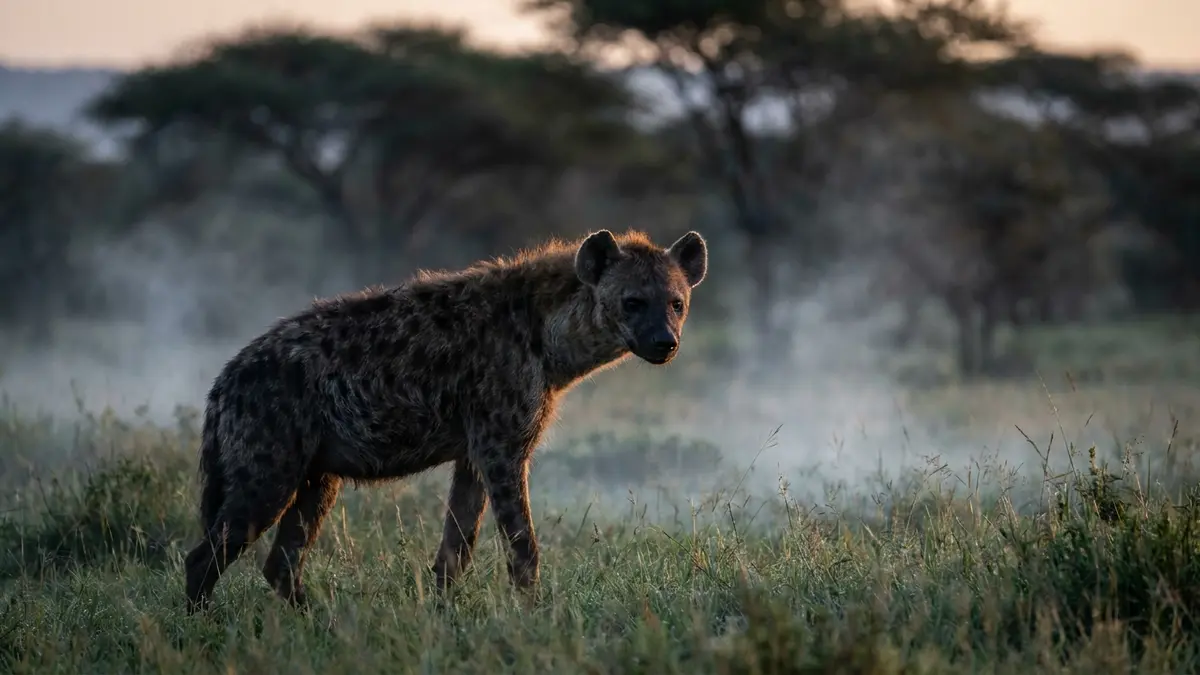
The family Hyaenidae has exactly four living species: the spotted, striped and brown hyenas plus the aardwolf, which eats almost nothing but termites and can lick up as many as 300,000 in a night. Spotted hyenas live in matrilineal clans of roughly 8 to 80 animals, females often weigh more than males, and studies indicate they kill up to 95 percent of what they eat rather than scavenging it. They are feliforms, closer to mongooses and civets than to any dog, and the giggle is a stress call that encodes the caller's age, identity and rank.
An almanac
- Family
- Hyaenidae — four living species
- Weight (spotted)
- 40–86 kg (88–190 lb)
- Clan size
- About 8–80; 55–75 in the Serengeti
- Closest relatives
- Mongooses, civets, genets
- Whoop range
- Audible up to 5 km (about 3 miles)
- Aardwolf diet
- Up to 300,000 termites a night
- Striped hyena status
- Near Threatened, under 10,000 adults
The hyena turns up in most people's heads pre-loaded: a cowardly dog that laughs, changes sex, and lives off whatever the lions leave. Almost every part of that is wrong, and the parts that are half-right are wrong in an interesting way.
What the research actually describes is a small family of four species on the cat branch of the carnivore tree — including one that eats nothing but termites. Spotted hyenas run female-led clans, hunt most of their own food, carry skulls engineered to break bone, and produce a giggle that encodes who is calling and how old they are.
Everything below is traced to a published source. Where the popular version rests on a shaky number — the 1,100 PSI bite, the cubs that murder each other at birth, the neat 95 percent hunting figure — this page says so instead of repeating it.
Hyena facts that hold up
- "Hyena" is a family, not a species. Hyaenidae has exactly four living members: the spotted hyena (Crocuta crocuta), the striped hyena (Hyaena hyaena), the brown hyena (Parahyaena brunnea) and the aardwolf (Proteles cristata).
- The smallest hyena is an insect specialist. The aardwolf eats almost nothing but termites of the groups Trinervitermes and Hodotermes, licking up as many as 300,000 in a single night with a flat, sticky tongue.
- Females often outweigh males. Spotted hyena adults run 40–86 kg (88–190 lb), and females often weigh more than males — unusual among large carnivores.
- Dominance is bought with allies, not muscle. Female dominance in spotted hyenas tracks social support rather than body size or sex: whichever animal had more potential allies won one-on-one interactions, irrespective of body mass and sex. The study did not measure hormones, so it neither confirms nor rules out an androgen contribution. Females hold the advantage largely because males disperse from their birth clan and lose their social network in the process.
- Birth goes through the clitoris, and it is lethal. Female spotted hyenas mate and give birth through an elongated, penis-like clitoris. UC Berkeley researchers reported that over 60 percent of first-born cubs, and up to 10 percent of first-time mothers, die during that first delivery.
- Cubs are born armed and looking around. Spotted hyena cubs arrive with their eyes already open and their milk teeth fully erupted, unlike the blind, helpless newborns of most carnivores — and twins, born roughly an hour apart, can direct aggression at each other from very early on.
- Sibling starvation is a real mechanism, not a routine event. A dominant cub can monopolise the milk and starve its twin, and the first-born holds an early advantage. But the frequency is highly site-dependent: in the prey-rich Ngorongoro Crater, aggression between twins is usually very low, and the long-running study there has never observed a cub starving because of sibling rivalry.
- Rank is inherited from the mother, then males hand it back. Cubs of both sexes inherit their mother's rank in the clan hierarchy. After puberty most males leave their natal clan to find mates, and lose that rank in the process.
- Keepers cannot sex a hyena by looking. The external genitalia of females so closely resemble those of males that a blood test is needed to verify the sex of the animal.
- The giggle is a data-rich signal. Acoustic analysis shows the laugh encodes the caller's age, individual identity and whether it is dominant or subordinate. Pitch drops as a hyena gets older.
- The whoop travels 5 km. The spotted hyena's long-range call can be heard up to 5 km (about 3 miles) away, and each animal's whoop carries an individual signature — but not a clan-wide one.
- Clans are matrilineal and elastic. Spotted hyenas live in matrilineal clans of roughly 8 to 80 animals, built from related female lines plus unrelated immigrant males; clan size tracks prey density, from about 8 in the southern Kalahari to 55–75 in the prey-rich Serengeti.
- They are predators that also scavenge. Studies indicate spotted hyenas kill up to 95 percent of what they eat, and a single hyena can take prey of up to about 18 kg (40 lb) on its own. That 95 percent is the top of a range, not a universal number: the hunted-versus-scavenged split swings by site and prey density, and where prey is scarce hyenas scavenge more. The Ngorongoro Hyena Project states that hyenas there hunt most of their food themselves.
- The gut processes the entire carcass. Skin, hooves, ligaments, horns, hair and bone all go down. What cannot be digested comes back up as pellets, much like an owl's.
- Bone-cracking has evolved only three times, and hyenas are the last ones standing. All three groups of bone-cracking carnivorous mammals converged on robust teeth, a vaulted forehead and a pronounced sagittal crest. In hyenas that crest is hollow — pneumatised by an elongated frontal sinus that spreads the stress of the bite.
- Primate-level societies, patchier puzzle-solving. Spotted hyena societies are as socially complex as many primates', and when researchers put a novel steel puzzle box in front of 62 wild hyenas in Kenya's Masai Mara, a minority worked out how to open it — success was predicted by how many different exploratory behaviours an individual tried, not by its social rank.
- Ice Age Europe had its own hyena. The cave hyena, Crocuta crocuta spelaea, ranged across Eurasia. A 194-bone partial skeleton from Los Aprendices Cave in northern Spain came from an animal weighing roughly 227 pounds — heavier and more powerful than living spotted hyenas.
- One species is sliding fast. The striped hyena is the family's most-declining member: IUCN lists it as Near Threatened, with a global population the Wildlife Conservation Society estimates at fewer than 10,000 mature individuals and still falling. At the CMS CoP15 meeting in Campo Grande, Brazil, at the end of March 2026, governments granted it dual Appendix I and Appendix II listing.
What the popular version gets wrong
"Hyenas are a kind of wild dog." They are feliforms — on the cat branch of the carnivore tree. A hyena is more closely related to a mongoose or a civet than to any dog. The doglike build is convergent evolution, two unrelated lineages arriving at the same shape for the same job.
"Hyenas are hermaphrodites, or switch sex from year to year." Every spotted hyena is one sex for life. The confusion comes from the female's anatomy: an elongated, erectile clitoris that looks like a penis, flanked by fused labia filled with fatty tissue that pass for a scrotum.
"Hyenas are cowardly scavengers that live off lion kills." It runs the other way. In the Ngorongoro Crater, lions steal kills from hyenas more often than hyenas steal from lions, and hyenas hunt most of their own food. Hyenas can only take a carcass off lions when the lions are females or young males and the hyenas outnumber them roughly six to one; against an adult male lion they always lose. Lions are the leading cause of death for Crater hyenas.
"Hyenas laugh because they're amused, or to mock their prey." The giggle is a stress and frustration call. Hyenas produce it when they are losing — mobbed off a kill by lions, or squabbling with a higher-ranking clan mate over a carcass. In the Berkeley study that decoded it, researchers reliably triggered giggling by holding a bone just out of an animal's reach.
"The hyena has the strongest bite in the animal kingdom, measured at 1,100 PSI." That number is far shakier than the internet suggests. Most estimates of spotted hyena bite force land between 500 and 1,000 newtons; the enormous 4,500-newton figure that gets recycled traces to a single animal measured in the year 2000. Very few carnivore bite forces have ever been directly measured, and nearly all of those came from captive animals, which researchers note almost certainly understate what wild animals can do. The defensible claim is the one zoos actually make: the hyena's jaws are the most powerful in proportion to body size of any mammal.
The hyena on screen
Disney shaped the modern hyena more than any documentary. In The Lion King (1994), the trio Shenzi, Banzai and Ed — voiced by Whoopi Goldberg, Cheech Marin and Jim Cummings — are Scar's dim, cackling henchmen, skulking in an elephant graveyard on the wrong side of the Pride Lands. Disney returned to them in a photoreal remake in 2019.
The portrait is close to a point-by-point inversion of the animal. The film's hyenas are muscle for a lion; the Ngorongoro data has lions stealing kills from hyenas more often than the reverse. They are drawn as bumbling and dim; wild hyenas run societies as socially complex as many primates'. They cackle when they are pleased with themselves; a real giggle means the animal is stressed, frustrated or losing a fight over food. And the henchmen framing misses the one detail a scriptwriter might actually have used: a spotted hyena clan is run by females, and rank passes down the female line.
That is the cost of a good villain design. The elephant-graveyard hyena is now the default mental image, which is why almost every myth on this page needs debunking twice — once for the folklore, once for the film.
The hyenas that are actually famous
Hyenas have no celebrity individuals in the way lions or gorillas do. The named ones — Shenzi, Banzai, Ed — are cartoons. The genuinely well-known hyenas are research animals, and they are the reason almost everything on this page can be stated at all.
The clans of the Ngorongoro Crater in Tanzania, followed for decades by the Ngorongoro Hyena Project at the Leibniz Institute for Zoo and Wildlife Research, are the best-documented hyenas alive. They are the source for the twin-rivalry work — including the finding that in all those years of watching, no cub there has been observed starving because of a sibling — and for the reversal of the scavenger story, since it is in the Crater that lions were recorded stealing more kills from hyenas than hyenas took from lions.
Then there are the 62 wild hyenas of Kenya's Masai Mara, presented with a steel puzzle box they had never seen before; the minority that cracked it were the ones that tried the widest range of exploratory behaviours, not the highest-ranking animals. And there is the captive colony at UC Berkeley, whose giggles were recorded, played back and decoded into age, identity and rank, and whose births produced the grim reproductive numbers — over 60 percent of first-born cubs and up to 10 percent of first-time mothers dying at that first delivery.
The oldest famous hyena is a fossil. A 194-bone partial skeleton of a cave hyena, Crocuta crocuta spelaea, recovered from Los Aprendices Cave in northern Spain — a site dated between roughly 143,000 and 38,000 years ago — came from an animal of about 227 pounds, heavier and more powerful than any spotted hyena on the plains today.
Frequently Asked Questions
Are hyenas related to dogs?
No. Hyenas are feliforms, on the cat branch of the carnivore tree, which makes a hyena a closer relative of a mongoose, civet or genet than of any dog. The doglike body is convergent evolution — two unrelated lineages arriving at the same shape for the same job.
Why do hyenas laugh?
The giggle is a stress and frustration call, not amusement. Hyenas produce it when they are being mobbed off a kill by lions or tussling with a higher-ranking clan mate over a carcass; Berkeley researchers triggered it reliably by holding a bone just out of reach. Acoustic analysis shows the call carries the animal's age, individual identity and whether it is dominant or subordinate.
Do female hyenas have a pseudo-penis?
Yes. A female spotted hyena has an elongated, erectile clitoris that looks like a penis, flanked by fused labia filled with fatty tissue that pass for a scrotum, and she mates and gives birth through it. The resemblance is close enough that a blood test is needed to confirm the sex of the animal. First births are dangerous: UC Berkeley researchers reported over 60 percent of first-born cubs and up to 10 percent of first-time mothers dying during that delivery.
How many types of hyena are there?
Four living species, all in the family Hyaenidae: the spotted hyena, the striped hyena, the brown hyena and the aardwolf. The aardwolf is the odd one out — it eats almost nothing but termites, taking as many as 300,000 in a night with a flat, sticky tongue.
Do hyenas hunt or just steal from lions?
They hunt. Studies indicate spotted hyenas kill up to 95 percent of what they eat, and a single hyena can take prey of around 18 kg (40 lb) alone — though that 95 percent is the top of a range, and hyenas scavenge more where prey is scarce. In the Ngorongoro Crater the theft runs the other way: lions steal more kills from hyenas than hyenas take from lions, and lions are the leading cause of death for hyenas there.
Do hyenas have the strongest bite of any animal?
The commonly quoted figures are not solid. Most estimates of spotted hyena bite force fall between 500 and 1,000 newtons, and the huge 4,500-newton number that circulates online traces back to one animal measured in 2000. Very few carnivore bites have ever been directly measured, nearly all of those in captive animals. The claim that stands up is the one zoos make: the hyena's jaws are the most powerful of any mammal in proportion to body size, supported by a skull with a vaulted forehead and a hollow, sinus-pneumatised sagittal crest that spreads the stress of the bite.
More about the Hyena
More from Animal Facts

Sources
Claims on this page were checked against these published sources.
- Insights into cranial anatomy and craniometry of the aardwolf (Proteles cristata) with comparisons to extant hyaenids
The carnivore family Hyaenidae includes four extant representatives: the smallest one – aardwolf (Proteles cristata, Sparrman, 1783)
Read the source → - Proteles cristata (aardwolf)
With this method, they may consume up to 300,000 termites every night.
Read the source → - Spotted Hyena (Crocuta crocuta) Fact Sheet: Summary
Body Weight: 40-86 kg (88-190 lb); females often weigh more than males.
Read the source → - Extraordinary Births: UC Berkeley researchers report on hyena reproduction
up to 10 percent of first-time mothers, and over 60 percent of first-born young die during birth.
Read the source → - Twin rivalry — Ngorongoro Hyena Project
spotted hyena cubs are born with their eyes open and teeth fully erupted
Read the source → - Love them or hate them, hyenas are getting the last laugh
Cubs of both sexes inherit the rank of their mother, though after puberty most males leave their natal clans to find mates and thus lose their rank.
Read the source → - Spotted Hyena (Crocuta crocuta) fact sheet
External genitalia of females so closely resembles that of males that a blood test is needed to verify the sex of a hyena.
Read the source → - What the hyena's laugh tells: Sex, age, dominance and individual signature in the giggling call of Crocuta crocuta
the hyena's laugh can encode information about age, individual identity and dominant/subordinate status
Read the source → - Long-distance vocalizations of spotted hyenas contain individual, but not group, signatures
The whoop vocalization is loud and can be heard up to 5 km away
Read the source → - Of arcs and vaults: the biomechanics of bone-cracking in spotted hyenas (Crocuta crocuta)
The ability to break open large bones has evolved independently in only three groups of carnivorous mammals, all of which have robust teeth, vaulted foreheads, and pronounced sagittal crests.
Read the source → - What Hyenas Can Tell Us about the Origins of Intelligence
spotted hyenas not only have social groups as complex as those of many primates, but are also capable of some of the same types of problem solving.
Read the source → - Well Spotted: A New Look at the Cave Hyena
The partial skeleton was found at Los Aprendices Cave, a 143,000-38,000 year old site in northern Spain.
Read the source →
Not sure which animal is yours?
Consult the quiz