Mammals · Spirit animal
Panda Bear Spiritual Meaning & Symbolism
Gentle strength that protects its own sanctuary and moves through the world unbothered by chaos
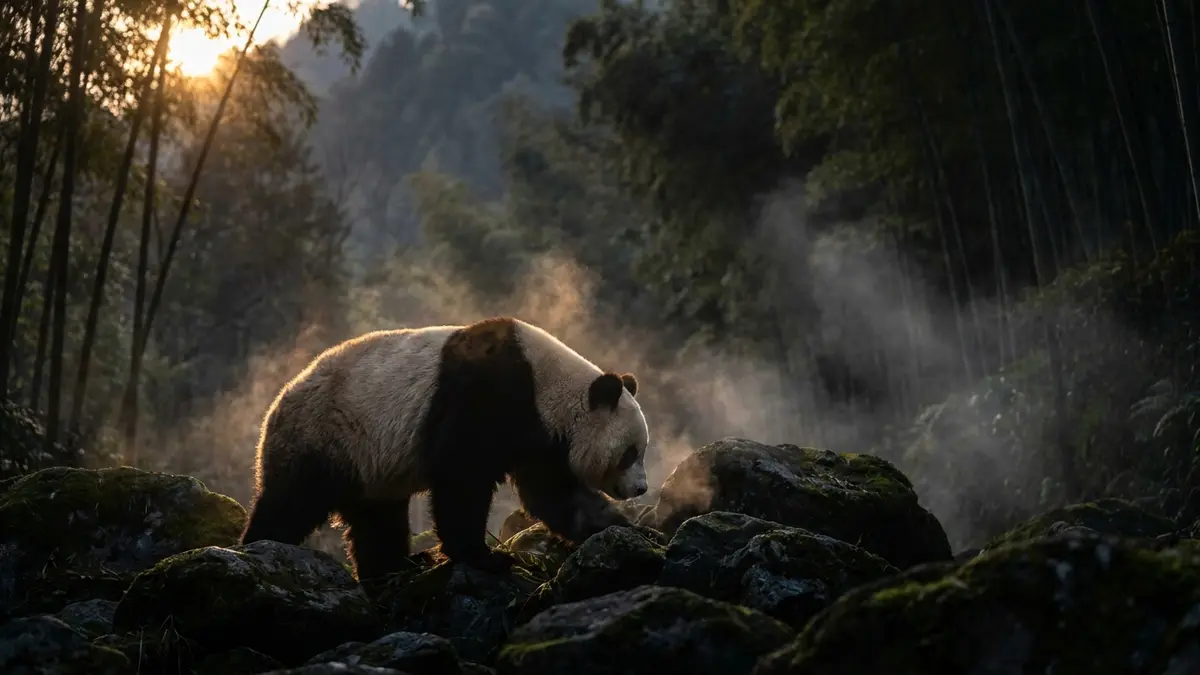
Panda Bear is a gentle, strong spirit animal. When it shows up, the message is about maintaining your boundaries and protecting your peace without getting into conflict. It draws on the Panda Bear's association with peace and good fortune in Chinese culture, where panda bear has long symbolized balance between Yin and Yang. And it's a nudge toward practicing gratitude, taking some time alone and rebalancing your priorities.
An almanac
- Core message
- Protect your peace and boundaries
- Spirit animal
- Gratitude, balance, incoming abundance
- Totem for
- Peacemakers who need solitude
- Power animal
- Restoring depleted energy
- In dreams
- Nourishment, boundaries, reconciliation
- Cultural roots
- China — peace, Yin and Yang
- Wild diet
- 70–100 lbs of bamboo, 10–16 hrs/day
- Conservation symbol
- WWF logo since 1961
Behind its cute, round features hides an animal built for only one thing: stand your ground and defend what is yours. The spirit animal Panda Bear embodies the message of how to establish and hold boundaries, cultivate quiet self-sufficiency, and choose calm over conflict whenever possible. In China, where the legend began, the creature has long represented peace, good fortune, and balance. Today, that reputation still shapes our understanding of this great bear's appearances.
Panda Bear Symbolism & Meaning
Panda is soft and furry with big eyes, so that's what it presents to the world. But its temperament is fierce, very fiercely determined to make and keep its own space, no matter what anyone else says or does.
When you think of Panda, you tend to feel lighter, especially in the heart area. You're thinking about personal safety both physical, emotional, and spiritual. It reminds you how important it is for everyone to have a safe place.
Panda also means how to calm your mind with stillness and watch what's going on around without worry. Maybe someone has been crowding you or draining your energy? Panda will tell you point blank to clear it out.
Finally, Panda is part of the Bear family as well. So reading about more general bear symbolism might also help give insight on other related themes.
Panda Bear Spirit Animal
A panda is a symbol of focus, one that encourages you to slow down and take a closer look at whatever's in your life that helps you feel grounded. This could involve committing to daily gratitude practices rather than setting it aside as something you'll do at the end of the week, or recognizing if you're putting more time or effort into one area of your life than others. The panda can also be a reminder to spend abundance on things that are more valuable in the long run instead of spending things away on things that are only temporary pleasures.
The panda represents personal space. If you've been feeling unsafe lately, the panda is a symbol for seeking out that private area where you can heal and re-energize yourself. If you've been considering putting your efforts into service for others, the appearance of this creature may be a sign to follow through with these plans and actually see where they can go.
Does Panda Bear fit you?
Tap the ones that sound like you — 6 traits, no right answer.
0 of 6 Nothing picked yet — start tapping.
Panda Bear Totem Animal
The native animal for people born under the Totem of the Panda is, of course, the panda. If this is your animal totem, you are likely one of the many people who feel most at home in nature and alone. Even if you aren't someone who loves being on your own every waking hour, that quality is essential to your well-being. Naturally you are a peacemaker who tends to feel more comfortable sitting quietly while thinking through a problem than getting in the middle of a fight or conflict.
When you are in a difficult position, you tend to respond by retreating and waiting things out quietly rather than by fighting.
Keeping your friends few but good is important when this is your animal totem. It's so much better for them that they see your gifts clearly than it is for them to be impressed by how many friends you've gathered.
Panda Bear Power Animal
Panda can help you recharge your energy. Call on this power animal when you feel depleted or need a break from the outside world. You can also look to Panda if you want to grow or change something in your life. A lot of Panda's guidance is about doing things quietly and at your own pace. If you've been around too many people or too much noise or stress lately, Panda can show you how to retreat from it all and start building yourself back up. Sometimes the best progress comes slowly. Pairing with Panda can help you stay steady and keep a healthy pace toward balance in mind, body, and soul.
Far Eastern Panda Bear Symbolism
China is where the panda is from. The symbolism there is about peace and goodwill. Panda was traditionally a diplomatic gift from China to other countries. That's also what some countries do now. People have noticed that a panda's coat is black and white. In popular stories, that's sometimes called an echo of Yin and Yang, where Yin and Yang are two forces in life that are opposite but also balanced together.
Panda Bear in Dreams
A panda in your dream may have different meanings depending on the specific details of the dream.
It can point to a need for nourishment, either physically or spiritually. This can be a sign that you need to pay more attention to your body or your mind, or both.
For example, if you dream of a panda eating alone, it could mean that you are neglecting yourself and not taking care of your needs.
If you dream of two pandas cuddling, it could symbolize a gentle and caring nature and the importance of balance in relationships.
A panda that is being displayed or held by someone else may represent an upcoming truce or reconciliation between two parties.
In Chinese dream interpretation, a panda in the background may signify improving communication and goodwill within a family or close group.
A group of three or more pandas together can represent healing at a community level, which can be powerful for individual personal healing as well.
Panda Bear Spiritual Meaning
Peacemaking is often called passive when it's actually an active pursuit. A strong spirit can hold boundaries, retreat when necessary, and stay calm without losing anything. The panda reminds you to take care of yourself, to know that you have a sacred sanctuary inside yourself that needs tending. The panda says this through stillness and gentleness, but at the same time lives up to its own image of strength. When the panda crosses your path often, you are probably feeling a need to slow down and restore balance between work and other responsibilities.
Panda Bear and the Medicine of the Bamboo Diet
Pandas really have it rough. When they get hungry, they need to eat seventy to a hundred pounds of bamboo. There's a lot of work involved: They spend ten to sixteen hours each day chomping on stalk after stalk. What happens to all that material? Well, not much.
A panda's digestive system is actually more suited to meat than it is to bamboo.
Read this as medicine: sometimes worthwhile things never become efficient or glamorous, and yet you do your best to keep them going anyway. And that doesn't mean you're looking for a shortcut but that you're willing to put in the repetitive work necessary—and knowing that there will be a harvest eventually.
Panda Bear in Japanese Culture
China's diplomatic gift-giving history with Panda didn't end in antiquity. In October 1972, Japan received its own first pair, Kang Kang and Lan Lan, a gift from China that marked the normalization of relations between the two nations. The public response was immediate and enormous: pandas "became a huge fad in Japan," with over seven million visitors a year flocking to Tokyo's Ueno Zoo just to see them.
That reception has held for decades. In the popular imagination there, Panda is often described as an emblem of gentleness, good fortune, and quiet joy, a softer echo of the peace and harmony China has long assigned it, carried across the water by two real animals sent as a gesture of goodwill rather than a myth.
Spiritually, it's worth noting that Panda's influence has repeatedly traveled between nations not through force, but through the sheer disarming pull of its presence. That's a fitting mirror for the animal's whole message: goodwill, offered without aggression, is what actually crosses old divides.
Panda Bear as the World's Protector
The World Wildlife Fund (WWF) was just getting off the ground when it needed an image to represent its mission. The WWF chose the panda bear, as this story about Chi-Chi explains.
Chi-Chi was a giant panda from the Beijing Zoo who was transferred to the London Zoo in 1958. In 1961, they turned to Chi-Chi, specifically her cute, fuzzy black-and-white coat.
In choosing this animal, they were also making a statement. Panda's tenderness and fragility are some of the first things you notice about them. Whether you mean that in a literal sense or use it as shorthand for something even more subtle is up to you.
Panda bears represent something that needs protection: if it works for humans, why wouldn't it work for any endangered species?
Frequently Asked Questions
What does it mean when Panda Bear is your spirit animal?
Pandas usually signal the beginning of a season in which it's time to be grateful, to bring your priorities back in balance, and to protect your personal space from people or demands that go overboard.
It can also mean that you're heading into a period of abundance which you should spend on genuine needs, rather than random wants.
What does a panda symbolize in Chinese culture?
People used to say that pandas mean peace, harmony and goodwill in China, and their black and white coats reflect the balance of Yin and Yang in the universe. There was a time when it was considered a gift worthy of a royal, though.
What does it mean to dream about a panda?
If a panda is eating, it might be telling you that you need deeper nourishment, physical or spiritual. If you're watching two pandas cuddle, the dream might suggest gentle affection and healthy boundaries. If someone displays a panda to you in your dream, that's an indication of an approaching truce or reconciliation.
Why is the panda the symbol of the World Wildlife Fund?
WWF's founders wanted a distinctive symbol that could be understood by anyone in the world, regardless of language, and they picked the giant panda Chi-Chi, who arrived at London Zoo from Beijing in 1958. Sir Peter Scott created the final logo from sketches in 1961, and it has come to represent global conservation ever since.
How much bamboo does a panda eat, and what does that mean spiritually?
Wild giant pandas eat about 70 to 100 pounds of bamboo every day. Foraging takes them 10 to 16 hours, because their digestive system isn't designed for plants. To a spiritual reader, this means perseverance: you should commit fully to worthwhile tasks even when you're not seeing results right away.
Panda Bear also represents
Sources
Claims on this page were checked against these published sources.
- Giant panda
approximately 99% of its diet consisting of bamboo... The average giant panda eats 9 to 14 kg (20 to 31 lb) of bamboo shoots per day.
Read the source → - Giant Panda
A panda needs to consume a comparatively large amount of food—from 70 to 100 pounds of bamboo each day. A panda must spend 10 to 16 hours a day foraging and eating.
Read the source → - So long, Xiang Xiang: Time is running out to see popular giant panda at Tokyo's Ueno Zoo
The zoo's first giant pandas, Kang Kang and Lan Lan, arrived in October 1972 as a gift from China to commemorate the establishment of diplomatic relations between the two countries. Pandas became a huge fad in Japan and over 7 million visitors came annually to see them.
Read the source → - World Wide Fund for Nature
Chi-Chi... was transferred from the Beijing Zoo to the London Zoo in 1958, three years before WWF was established... The logo was then designed by Sir Peter Scott from preliminary sketches by Gerald Watterson, a Scottish naturalist.
Read the source →