Mammals · Spirit animal
Buffalo & Bison Spiritual Meaning & Symbolism
Abundance, gratitude, and grounded communal strength
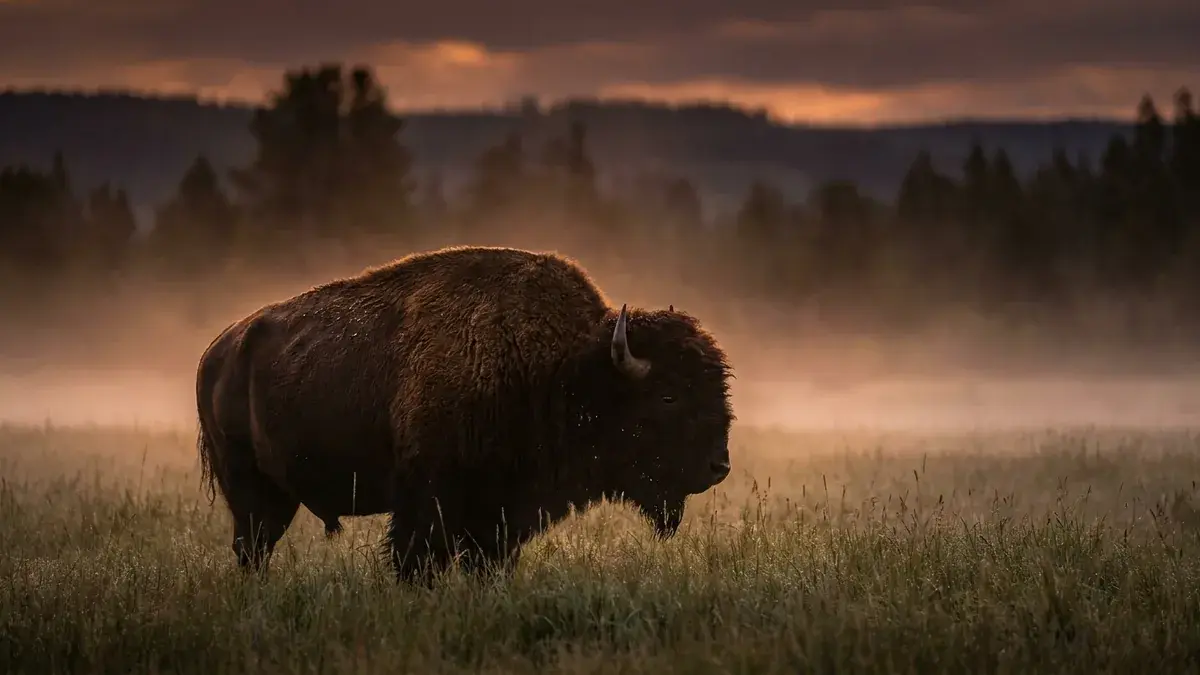
Buffalos and bison symbolize abundance, gratitude, and strong community support. If the buffalo or bison appears to you, it may be encouraging you to slow down and enjoy what you have. It may also nudge you toward collaborating with others instead of going it alone.
As a spiritual totem, the buffalo or bison often belong to those who are humble, dependable, and drawn toward serving others. As a power animal, the buffalo or bison may give you strength to carry on despite a difficult situation.
If you dream of a buffalo or bison, it usually means that your goals have gotten tangled. Dreaming of white bison, however, is almost always a symbol of unification and rekindled hope.
An almanac
- Core message
- Practice gratitude for what you already have
- Spirit animal
- Abundance and grounded communal strength
- Totem for
- Humble, dependable, service-driven people
- Power animal
- Backbone to hold your ground and carry a heavy load
- In dreams
- You've drifted from your goals; white = coming success
- Cultural roots
- Central to Plains Native American tradition
- Species fact
- True buffalo live in Africa & Asia; ours is a bison
- National status
- Named U.S. National Mammal in 2016
Bison and buffalo share almost identical symbolism, because they're closely related. These giant herbivores carry enormous symbolic weight because entire communities depended on them for survival. Bison bring messages of gratitude, grounded strength, and abundance.
In everyday life, bison often show up when we're feeling stuck in our ways. They remind us to slow down and remember all the wonderful things we already have.
Buffalo & Bison Symbolism & Meaning
Because the buffalo and the bison are closely related, their symbolism is similar as well. They remind us of how powerful a herd can be.
The buffalo and the bison teach us to appreciate nature around us and to honor the many gifts in life. One of those gifts is simply remembering to show gratitude.
A buffalo and a bison have massive heads that mean they have great thoughts and wisdom. It also has broad shoulders so it can easily carry a heavy load.
The large buffalo or bison herd protects their young with ferocity. That means that when a group of buffalo feels threatened, they grow very strong and powerful.
Buffalo & Bison Spirit Animal
When a buffalo or bison steps into your life, your relationship with abundance may well be on the line. Is the feeling of success unsettling to you or would you really rather feel like a failure?
It could also be there to point you in the right direction. Buffalo have been so important to native people — providing food, shelter, and clothing — that we can learn from their careful way of building resources rather than thoughtlessly wasting them.
Are you ready to find out what happens when you venture outside your own safe routine? Pushing against our boundaries is a good way of finding out what actually serves us rather than undermines us.
Many buffalo lived free as a herd. Sometimes they even remind us that we belong to something greater than ourselves and that working together brings better results than going it alone. However, sometimes buffalo just step into your life to remind you of where your courage comes from.
Does Buffalo & Bison fit you?
Tap the ones that sound like you — 6 traits, no right answer.
0 of 6 Nothing picked yet — start tapping.
Buffalo & Bison Totem Animal
Born under the Buffalo or Bison totem, you carry a natural connection to the spiritual side of daily life.
You are humble in nature, often preferring to use your inner strength instead of force to get your way. You hold the Earth as sacred, and this totem blends manifestation with service, making change happen in the world around you through practical means.
People born under this spirit animal are dependable and generally calm, and many consider it an omen of good fortune. Also, if the mouse is your current spirit animal when you wish it were something bigger — remember that your spiritual development lets you call on new allies as you continue on your journey into greater awareness.
Buffalo & Bison Power Animal
The buffalo and bison can empower you to stand your ground and defend yourself when something important is at stake. These animals also give you the energy and the motivation to make your goals come true.
If you call upon this power animal, it can help you look after yourself even when you are facing challenges. By doing this, it will allow you to help others and cope with your own problems. You will realize that it is important to practice self-care when facing any life challenges.
You will be able to trust your own judgment. This animal can show you that personal growth takes time and effort.
Native American Buffalo & Bison Symbolism
The buffalo and bison are associated with many different themes across a number of Native nations, particularly those of the Great Plains, where it appears in tales, ceremonies, and sayings. In many cultures there are prayers dedicated to it.
Among other things, the buffalo symbolizes life, death, strength, protection, endurance, unity, change.
As a testament to how much this animal is respected and valued by Native Americans as a whole is the prominent role it plays in the Sun Dance.
This ceremony is of utmost importance. It's held annually in spring or early summer when herds had gathered after winter so they could feed everyone who had gathered for a few days of shared ritual.
Buffalo & Bison in Dreams
Sometimes when you see a buffalo or bison in a dream, it's a sign that you have lost touch with your sense of power, that you might have lost your own goals. It could mean that you are about to get sidetracked with a project or something that can't become your focus. You will do best by stepping away for now and waiting to see if the situation really becomes worth the energy.
Seeing one in your sleep can mean good things coming, events turning out better than expected.
Seeing this animal in your dreams might give you a sign about how to handle a decision if they block your path.
If the bison was grazing in an open field, it probably means that they are satisfied with their lives as they are at the moment and don't want anything more from them.
If the animal seemed angry or aggressive towards you, then it means there is probably something that they are trying to tell you so listen. Then think about what it could be and maybe do something before it gets worse.
Buffalo & Bison Spiritual Meaning
The buffalo reminds us that life doesn't have to be one big race to grab as much as we can — there's plenty for everyone. Stay grounded, take care of yourself, and remember that you don't have to eat alone.
The buffalo's strength and steadiness inspire us to appreciate the things we already have before we try to get more — just like gratitude isn't something you just "feel" once; it's a daily practice. When you take care of your body, cherish your friends and family, and share your love with others, you really can have everything you need.
Buffalo or Bison? Why the Name Carries Its Own Lesson
People sometimes use the words "buffalo" and "bison" interchangeably, even though they refer to different animals. The word "bison" applies to a North American species with a humped back and shaggy beard. The word "buffalo," on the other hand, has some slightly different connotations. It applies to a different species found in Africa and Asia, with horns and no hump.
That difference is where the most interesting story comes in: nobody can quite agree how those words swapped places on this continent. Some people say the name came from the French boeuf, which means beef. Other people say that the skin of the shaggy bison looked like a buff soldier's uniform, which was popular at the time.
Either way, people labeled it as something they already knew, whether beef or soldier. Those labels hid an animal whose true nature lay under its borrowed name. Spiritually speaking, it's a cautionary tale. Maybe there is strength in being your own person even if it makes others confused.
From the Brink of Extinction: A Living Symbol of Recovery
Back before Europeans showed up, millions of bison roamed the continent, from Alaska down through Mexico's grasslands and into the forests of the Appalachians. As the 19th century wore on, habitat destruction and overhunting pushed the bison population to nearly zero.
William Hornaday was a naturalist working alongside Theodore Roosevelt in the early 1900s when he founded the American Bison Society in an attempt to pull the species back from the edge. The recovery effort worked, and in 2016 bison became America's national mammal.
Spiritually, that arc mirrors what bison teach. Reckless consumption can easily destroy our resources, but if we're willing to learn and look out for one another, we can restore them too.
The Shadow Side of This Medicine
Every animal totem has a shadow side, a harder edge that gets taken advantage of if you're not paying attention. This animal's harder edge is tricky to spot because its gifts feel so wholesome. But they can calcify into stubbornness and an unwillingness to bend even when the circumstances have really changed, or a habit of pushing forward just by force of will rather than pausing to consider whether the direction is still right for you.
Sometimes people also mistake holding firmly onto something for control as a more subtle form of rigidity. Really, this spirit is calling you to find the right balance between staying grounded and holding on too tightly. If you notice yourself tightening your grip and refusing to loosen your hold because of pride or stubbornness, it's time to loosen that grip without letting go of your connection to the core qualities this spirit is giving you.
Frequently Asked Questions
What does the Buffalo or Bison spirit animal mean?
If the buffalo or bison spirit animal appears to you, it might be time to reevaluate how you handle abundance. It could mean that you need to be more thankful for your blessings and ground your strength in community. Don't go at this alone.
What does it mean to see a white buffalo?
Native Americans often see a white buffalo as a sacred sign of unity and good fortune. White buffaloes also symbolize renewal, hope, and transformation. Seeing a white buffalo in a dream often means your life will have good luck and success soon.
What is a Buffalo totem animal like?
People with a Buffalo totem are humble, grounded, and tend to seek service to others. They work quietly for real change and protect whatever or whoever needs their care.
Is a buffalo the same animal as a bison?
Even though they may look the same, North American bison are not true buffalo, which include only two species: the African Cape buffalo and the Asian water buffalo. The North American variety were named by European settlers; some speculate that it was a mistranslation from French boeuf (for "beef") or from a resemblance to buff-colored military coats.
Why was the bison named the U.S. national mammal?
The bison was designated the national mammal of the United States on May 9, 2016. This designation recognized both the bison's cultural importance and its recovery after near-extinction.
Hunted down to a few hundred animals in the late 1800s, conservation efforts led by William Hornaday and Theodore Roosevelt helped save the species.
Buffalo & Bison also represents
- Other animals that represent strength →Alongside Lion, Bear, Tiger, Elephant
- Other animals that represent protection →Alongside Bear, Wolf, Dog, Elephant
- Other animals that represent family →Alongside Elephant, Wolf, Penguin, Ant
- Other animals that represent luck →Alongside Ladybug, Rabbit, Cricket & Grasshopper, Koi
Sources
Claims on this page were checked against these published sources.
- American bison
providing more than 150 uses for all parts of the animal, including being a major food source, hides for clothing and shelter, bones and horns as tools as well as ceremonial and adornment uses
Read the source → - White Buffalo Calf Woman
taught the Lakota seven sacred ceremonies to protect the Mother Earth and gave them the čhaŋnúŋpa, the sacred ceremonial pipe
Read the source → - It's Bison, Not Buffalo. And Other American Bison Facts
Bison have large humps at their shoulders and bigger heads than buffalo. They possess beards, as well as thick coats which they shed in the spring and early summer. Their horns are typically sharp and shorter than the average buffalo's.
Read the source → - 15 Facts About Our National Mammal: The American Bison
In prehistoric times, millions of bison roamed North America—from the forests of Alaska and the grasslands of Mexico to Nevada's Great Basin and the eastern Appalachian Mountains. By the late 1800s, there were only a few hundred bison left in the United States after European settlers pushed west, reducing the animal's habitat and hunting the bison to near extinction.
Read the source → - Why Is the Bison America's National Mammal?
In 1905, American zoologist William Hornaday worked with President Theodore Roosevelt and others to form the American Bison Society to help save bison from extinction—the first national effort to save an American wildlife species.
Read the source → - Sun Dance | Native American Ritual & Ceremony
The Sun Dance is the most important religious ceremony of the Plains Indians of North America... Traditionally, a Sun Dance was held by each tribe once a year in late spring or early summer, when the buffalo congregated after the long Plains winters. The large herds provided a plentiful food source for the hundreds of individuals in attendance.
Read the source →