Mammals · Spirit animal
Goat Spiritual Meaning & Symbolism
Sure-footed resilience that climbs toward abundance on the smallest possible foothold.
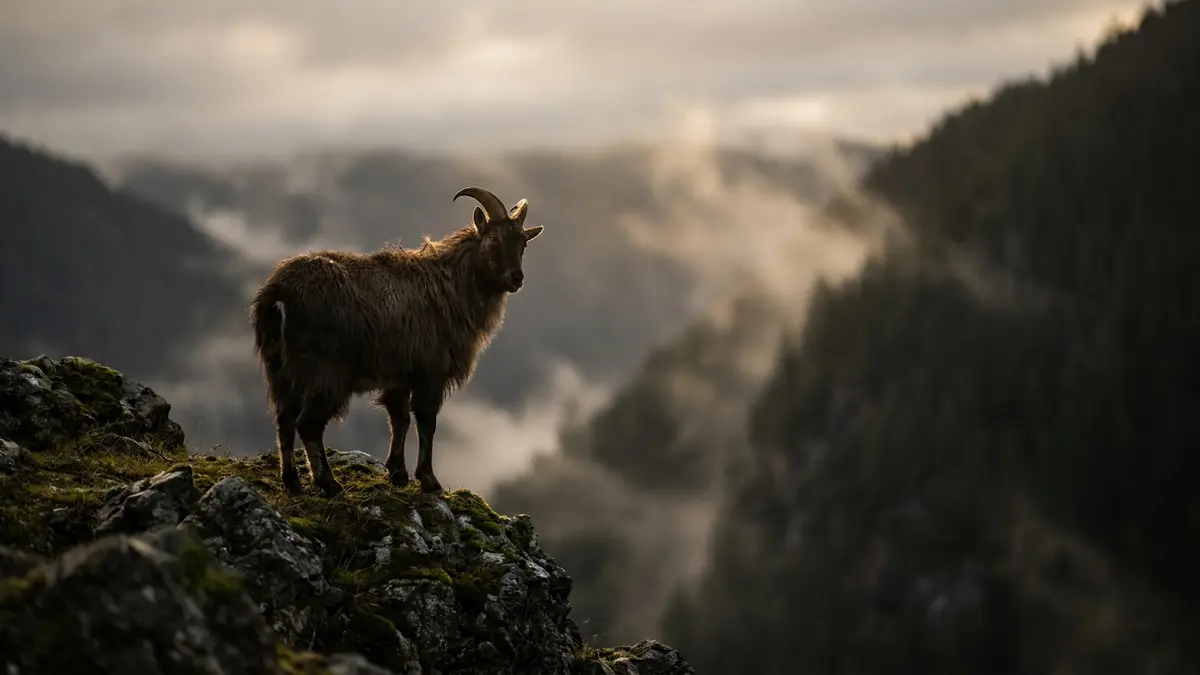
The goat is a sure-footed animal. A person with a goat as a spirit animal might find that they're fertile and abundant, and they can accomplish good things while starting from a small place. This means they are patient and steady under pressure, and they're patient enough to wait for the right moment before moving on their chosen path. It also means that they should trust their grip while moving on a narrow path instead of waiting for something bigger or wider to come along.
An almanac
- Core message
- Steady footing through instability
- Spirit animal
- Keeps you upright while climbing
- Totem for
- Surefooted, curious, patient people
- Power animal
- Confidence, patience, timed action
- In dreams
- Balance, unfair blame, shaky ground
- Cultural roots
- Greek myth — Zeus, Pan, Dionysus
- Zodiac sign
- Capricorn — Dec 22 to Jan 20
- Norse myth
- Thor's goats, killed and reborn nightly
The Goat isn't dumb or stubborn. It's one of the smartest, most aware creatures in the mammal kingdom. It's a symbol for strength, fertility, and climbing toward something when it feels like there is only nothing beneath you.
Goat Symbolism & Meaning
Goats are smart and loving. Their horns show they're strong and want to enjoy life.
Goat is sometimes confused with Antelope. But all it really stands for is the same things that Antelope stands for.
In Greek stories, the Satyrs were half-men and half-goat. They liked fun and parties too much. Zeus, as an infant, was nursed by a goat.
In Norse mythology, goats pulled Thor's chariot. That shows how strong people thought Goat was.
Goats were first domesticated a long time ago, about 10,000 years ago in what we now call the Middle East. This led to some important changes:
- Goat's hair can be made into cloth.
- Goat skin can be used to carry water.
People also sometimes used goats as sacrifices (maybe this is where we get the word "scapegoat").
Some other meanings for goat:
- People in Arabic thought that goats had a lot of dignity compared with sheep.
- A lot of stories say goats symbolize being stubborn.
- In Chinese mythology, Goat is Yin energy.
- Christians make Goat evil because people thought goats tempted good people to do wrong things.
Goat Spirit Animal
As a spirit animal, Goat sees a handhold where you see nothing but a sheer cliff. When they arrive as a guide, they're showing you an excellent example of how to keep going even when you're walking on air.
Goat's message is that you can hold on to your vision even when the path in front of you is unclear. In the case of male Goat (buck), the lesson is bolder: Keep looking for new paths forward, and don't be afraid to blaze your own.
If female Goat arrives, she'll still push you to move forward, but she'll focus more on feeding your goals with careful nourishment.
Goat also indicates that it's time for you to break out of boredom. When they appear in your life, it's because there's another level in your development that's calling for exploration.
Does Goat fit you?
Tap the ones that sound like you — 6 traits, no right answer.
0 of 6 Nothing picked yet — start tapping.
Goat Totem Animal
People born with Goat as their totem tend to find their footing easily. They're rarely rattled, and don't need much space to get things moving. They're naturally curious, and while risk doesn't bother them much, it's boredom they really can't stand.
Goat people carry two sides in them at once. They're both very nurturing like a doe and quite assertive like a buck, but one side or the other might be more apparent at different times of their life.
People with Goat as their totem are often mistaken for being stubborn, when what they're really being is patient.
Goat Power Animal
Goat is a good animal ally to call on when you're ready for independence and abundance, or when you're finding it hard to start something new or change your routine. This energy can help you feel more confident, and help you feel more at home and grounded.
Don't worry if things don't go smoothly right away. As much as Goat wants to help, it's up to you to make the change. With Goat's guidance, everything will happen in its own time.
It's easy to confuse Goat's calmness with weakness, but that isn't true at all. When two male goats try to protect their territory or their female partner, the fight between them can be really fierce. They wait until they know their timing is right before they fight.
Goat encourages you to do the same thing. If a challenge feels too overwhelming, or if it feels like there are just too many details for you to take care of right now, then wait. But when the moment feels right, move forward with confidence and determination.
Across cultures
3 traditions — pick one to read its take.
Goat in Native American Symbolism
Goats are a recent introduction to Native American culture, arriving alongside sheep in the 16th and 17th centuries. As such, there's only a limited amount of lore about them from pre-contact traditions.
What stories there are cast goat as a helpful, intelligent creature whose desire to investigate everything unfamiliar eventually gets labeled as stubbornness. It also comes with an association for defending its territory and friends.
Goat as a Greek Animal Symbol
Greek shepherds and woodland folk revere Pan, the god with a goat's lower body and cloven hooves but a human upper body and two horns. Pan was the "Lord of the Woodland" in the old Greek religion (his Roman equivalent was Faunus). Christian artists later used Pan as the model for the Devil, twisting an image of pagan reverence into a symbol of evil.
Thor's Goats in Norse Myth
Norse mythology gives Goat one of its strangest recurring roles. Thor's chariot is drawn by two goats, Tanngrisnir and Tanngnjóstr, names that translate roughly to "teeth-barer" and "teeth-grinder." Each night on his travels, Thor slaughters the pair for meat, and each morning he raises them whole again with a swing of his hammer, Mjölnir. In one telling, a peasant boy sharing the meal cracks open a shinbone to get at the marrow inside, and the goat comes back the next morning lame in that leg, a detail the old storytellers clearly meant as a warning about respecting what sustains you, even when it looks like an inexhaustible resource.
That live-die-live cycle didn't stay locked in myth. Scandinavian folklore carried it forward into the Yule Goat, a straw-and-ribbon figure tied to midwinter celebrations for centuries. Its role shifted over time: from a spirit invoked at the feast table, to a costumed gift-bringer in 19th-century households, to Finland's Joulupukki, who still carries "goat" in his name today even though he now looks like Santa Claus. Sweden's city of Gävle has built a giant straw version every December since 1966, and the goat has been burned down by vandals more times than anyone bothered to count, an oddly fitting modern echo of Thor's goats getting devoured and restored on schedule.
Goat in Dreams
A goat wandering into your dream might be your unconscious mind referring to the saying that someone "got your goat." Or it might be a reference to the scapegoat, someone unfairly blamed for something. That depends on the context.
For example, if your dream features a goat climbing rocks or moving over rough ground, that might be telling you that you need more solid ground before moving forward. Or if you see two bucks butting heads, this could mean you're about to face a string of hard challenges in your life. But if your dream includes a calm and gentle goat, this may indicate support or help is on the way from someone you least expect. If the goat is unusual, like an albino or spotted goat, then this may hint at a missed opportunity.
Goat Spiritual Meaning
Centuries of bad press never touched Goat's spiritual core, which is simple: balance under pressure, appetite for growth, and the discipline to wait for the right moment. It pushes you to stop needing a wide, guaranteed path before you'll move, and to trust that a small, solid foothold is enough to start climbing.
Whether it enters your life as Spirit, Totem, or Power Animal, Goat is telling you that curiosity, patience, and steady nerve will carry you higher than brute speed ever could.
Goat & the Capricorn Zodiac
That the zodiac sign Capricorn is tied to symbolism around goats might seem obvious: the word is Latin for "horned goat," for starters, and also sticks to people born between December 22 and January 20. But go back a bit further and you'll find that the constellation of Capricorn, already familiar to Babylonian astronomers, is older than that, too.
Like the Babylonians, Greeks transplanted various stories into Capricorn as time passed. One interpretation explains it as Pan, a Greek nature god who grew a fish's tail from his hind legs and dove when he ran into a monster named Typhon—turning Pan half-goat, half-fish. A slightly later account identifies the constellation with Amalthea, the goat who nursed Zeus when he was an infant hiding from his father Cronus. She was placed in the sky where she became the star Capella.
The personality traditionally assigned to people born under Capricorn feels consistent with broader goat symbolism no matter which legend you favor. They're said to be ambitious, disciplined, patient, and willing to move slowly—climbing high on their own terms instead of trying to take shortcuts—but reliable all along. Those values align pretty neatly.
Frequently Asked Questions
What does it mean when a Goat crosses your path?
When a goat crosses your path, it's a nudge to find steady footing before you go any further. It's a call to slow down and weigh the ground beneath your decisions, and trust that even a small step forward is better than a big leap.
Is Goat a good or bad omen?
Goat, despite what you might have been led to believe, is not an omen of misfortune. Traditionally, it symbolized resilience, fertility, and abundance--the negative reputation largely comes from its later religious symbolism rather than the original meaning.
What's the difference between a male and female Goat as a spirit guide?
A male Goat, or Buck, shows up as a spirit guide to emphasize assertiveness, inventive energy, and renewal. A female Goat focuses on nurturing, nourishment, and the deeper connection to spiritual sustenance. Both versions of the Goat are messengers of their own distinct patterns and meanings.
Is Baphomet based on a real ancient goat god?
Not exactly. The winged, human-goat figure people most often picture as Baphomet is the design of a French occultist named Éliphas Lévi, who drew it in 1856 to be a symbol of balance between opposites. The name Baphomet has a much older history: it surfaces in the confessions extracted from Knights Templar in 1307, perhaps a garbled French rendering of the name Mohammed. Another image linked to the Devil didn't appear until 1897, decades after Lévi's design and with a different intent behind it.
What does the Goat mean in the Chinese zodiac?
A goat's energy is Yin. It's the eighth of the animals in the Chinese zodiac, and it symbolizes a time of peace, kindness, and popularity with friends. As an animal, a goat is an easy-going and auspicious sign.
Why do some goats appear to 'faint'?
Certain goat breeds have a condition that causes their muscles to twitch or spasm for a few seconds whenever they get a shock, like being startled. They don't pass out; they just flop over stiff-legged. It's not usually dangerous, but it looks funny enough that people have nicknamed these goats "fainting goats." The scientific term is myotonia congenita.
What is the Puck Fair, and why is a goat crowned king?
The Puck Fair is an annual festival in Killorglin, Ireland. This is where locals catch a wild mountain goat from nearby hills and make it the King Puck for a three-day festival. This goes back as far as 1613, although it is thought to have pagan roots. A young girl who comes from a local school gets crowned "Queen of Puck". This is one of the most literal ways that the goat can symbolize abundance and the turning season.
Goat also represents
- Other animals that represent peace →Alongside Dove, Crane, Deer, Elephant
- Other animals that represent resilience →Alongside Cockroach, Camel, Salmon, Turtle
- Other animals that represent determination →Alongside Salmon, Ant, Beaver, Falcon
- Other animals that represent patience →Alongside Turtle, Heron, Spider, Ant
Sources
Claims on this page were checked against these published sources.
- Amalthea (mythology)
the nymph Amalthea, who has the infant reared by a she-goat ... In Ovid's account ... Amalthea, filling the broken horn with fruit, brings it back to Zeus
Read the source → - Dionysus
Bull, panther, tiger or lion, goat, snake, leopard, fox ... Melanaigis Μελάναιγις ('of the black goatskin') at the Apaturia festival.
Read the source → - Tanngrisnir and Tanngnjóstr
the two goats are named Tanngrisnir and Tanngnjóstr ... appear in poems like Hymiskviða and Þrymskviða ... Prose Edda ... explicitly names the goats
Read the source → - Scapegoat
William Tyndale, in his 1530 translation, rendered the Hebrew term as "(e)scape goat"—meaning the goat that was sent away. Over time, the initial letter was dropped, creating the modern word "scapegoat."
Read the source → - Pan (god)
the hindquarters, legs, and horns of a goat ... frequently identified with Faunus, a nature god
Read the source → - Yule goat
a popular theory is that the celebration of the goat is connected to worship of the Norse god Thor, who rode the sky in a chariot drawn by two goats, Tanngrisnir and Tanngnjóstr
Read the source → - Capricornus
the constellation Capricornus has one of the oldest mythological associations, having been consistently represented as a hybrid of a goat and a fish since the Middle Bronze Age, when the Babylonians used MULSUḪUR.MAŠ 'The Goat-Fish' as a symbol of their god Ea.
Read the source → - Capricorn (astrology)
Capricorn (♑︎; Ancient Greek: Αιγόκερως, romanized: Aigókerōs, Latin for 'horned goat') is the tenth astrological sign in the zodiac... Under the tropical zodiac, the sun transits this area from around December 22 to January 20.
Read the source → - Baphomet
Éliphas Lévi established the modern iconic depiction in his 1856 work Dogme et Rituel de la Haute Magie... a winged, androgynous human-goat hybrid, a deliberate synthesis of binary opposites designed to represent the concept of perfect equilibrium.
Read the source → - Goat (zodiac)
In Chinese astrology, Goats are described as peace-loving, kind, and popular... The Chinese commonly regard sheep as an auspicious animal, and the year of the sheep, therefore, heralds a year of promise and prosperity.
Read the source → - Myotonic goat
Myotonia congenita is caused by an inherited disorder of a chloride channel in the muscles of the skeleton... The mutation causes a delay in the relaxation of the muscles after the goat has made an involuntary movement.
Read the source → - Puck Fair
a group of people go up into the MacGillycuddy's Reeks mountain range and catch a feral goat. The goat is brought back to the town and the 'Queen of Puck'... crowns the goat 'King Puck'... officially trace back as far as 1613 when King James I issued a charter... origins stem from Pre-Christian Ireland, from the Celtic festival of Lughnasa
Read the source →