Mammals · Spirit animal
Cheetah Spiritual Meaning & Symbolism
The swift, focused hunter who teaches patient timing before explosive action.
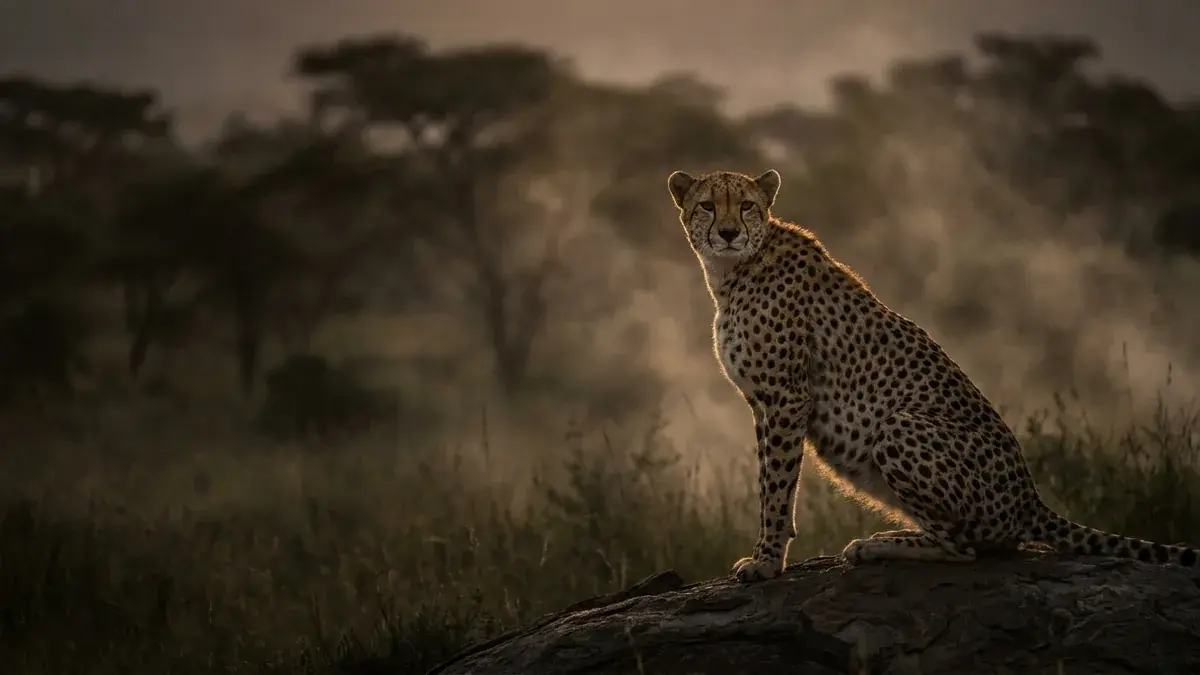
Cheetahs, whether they're spirit, totem, or power animals, teach the virtue of patience coupled with quick action — the discipline to observe and conserve energy until you find a promising opportunity, then move in full force. Calculated timing beats brute force, so it's worth waiting for just the right moment before taking a chance. Rest is an essential part of the work — it's not time off — so seize that fleeting opening while it's still there. When a cheetah appears in your dreams, there's powerful energy circulating around something big in your life — if it's hiding or pacing or lunging at you, you'll know what that "something" is.
An almanac
- Core message
- Calculated timing beats brute force
- Spirit animal
- Urgent nudge to act before the chance closes
- Totem for
- Instinctive, adaptable, solitude-seeking people
- Power animal
- Short bursts of focused effort, then rest
- In dreams
- Strong energy circling your waking life
- Cultural roots
- Egyptian goddess Mafdet; African Bushmen folklore
- Acceleration
- 0 to 60 mph in about 3 seconds
- Conservation status
- IUCN Vulnerable; under 7,000 left wild
Nothing on Earth can outrun the cheetah, and yet its most valuable trait isn't its raw speed. It's the way it uses that speed. A cheetah will watch for hours, conserving energy, then, at exactly the right moment, put every ounce of its speed into a single heart-stopping sprint. If Cheetah is your spirit animal, you are wise enough to know when to use your power and when not to. When you spot an opportunity to use your talents to their full potential, do so fully charged.
Cheetah Symbolism & Meaning
The cheetah can reach 70 miles an hour. They have sharp, retractable claws that help them grip like an athlete on a track. They have long tails, like rudders for controlling their balance mid-chase.
But this animal isn't at all impulsive. It will stand absolutely still and watch its target for a long time. It's patient. If it sprints without checking the situation first, it might waste energy it can't get back. Cheetah says, look at everything carefully and then commit — when you see an opening, take it.
In the social world, cheetahs are more independent than most people might think. The females mostly hunt alone while the males cooperate with each other in forming their own territories and hunting in packs when necessary.
It's amazing that the spotted coat on cheetahs can blend so well with the golden grasses nearby, allowing them to sneak up closer to their prey without being seen.
Cheetah Spirit Animal
When the cheetah appears to you as a spirit animal, it's likely an urgent call to action. The cheetah lives in the moment and responds to conditions as they present themselves, and it may be nudging you to do the same. There's probably something that you've been circling around — something that requires your attention right now, not later.
Your situation might not be so dire, but that doesn't mean it isn't worth your attention. You may be stagnant, or you may be just starting out on something. Cheetah might be reminding you that it doesn't always take much of a nudge for a situation to change for the worse.
If this has been happening to you — spreading yourself thin across too many different interests and diluting your effort over all of them — it is probably something that can shift if you redirect your focus in a way that lets your efforts flourish. Cheetah spirit also helps highly sensitive people recognize that they have the option of letting go of some of their emotional energy — even just crying can help us feel lighter and more energized.
Does Cheetah fit you?
Tap the ones that sound like you — 6 traits, no right answer.
0 of 6 Nothing picked yet — start tapping.
Cheetah Totem Animal
A cheetah person trusts her instinct more than overthinking. She pays attention to the quiet push she feels, and when it tells her something, she moves toward it. This gives cheetah people a nimble mind for solving problems that come up on the spot and lots of momentum — they see their way toward a goal and move toward it with a graceful ease.
They don't get stuck on setbacks — they pivot.
Those who have this totem have super-sight: they see a lot of what's going on in their world. You should expect to be noticed when around them, since cheetah people don't miss much.
They prefer quiet communication over the drama of confrontation. All that noise can drain their energy — they do better in cozy places with all the distractions hushed down.
Give the cheetah people close to you room to be alone. It's how they recharge.
Cheetah Power Animal
Summon Cheetah as a power ally when you need speed, self-assured focus, and flexibility to adapt to any changes. This cat is built for quick bursts of intense effort rather than sustained grinding. So when a moment demands total focus over a brief window—like last-minute exam prep or tight deadline or whatever—you'll do well to call on this mighty ally.
It also helps you adapt: flexing with whatever the situation throws at you. Just remember Cheetah's natural rhythm: after an all-out effort, this kitty needs rest and recovery time—just like you will! Treat this time as part of the work instead of a reward you try to skip.
Cheetah in African & Egyptian Symbolism
Ancient Egypt believed Mafdet was a cat-headed goddess and the cheetah protector. In Egypt Mafdet gets her name from things cheetahs are known for: they can run. She had some more powerful jobs, though. They called her one who brings justice or makes things right and keeps them safe. And when Mafdet was the cheetah she dealt with wrongdoers quickly, without mercy.
Despite all these stories, people really liked cheetahs and didn't treat them like mythology. The top leaders kept cheetahs as companions and hunting partners. Then they would draw them in their tombs so that the cheetah would also be there after they died to protect them in the next world.
Stories from Bushmen of Southern Africa are gentle compared to the angry goddess in Egypt, though. A cheetah is racing an antelope as fast as it can and when the antelope falls down, even though it's going to win the race, the cheetah stops to help it get back up. If that story is true, people say that why cheetahs are so fast is because they're kind.
Cheetah in Dreams
Cheetahs in dreams have to do with strong, cyclic energy in your waking life. Pay attention to the specific actions in the dream:
If a cheetah lunges at you but misses, it's saying you're rushing things and you should hold back a little.
If the cheetah is lying idly, it means you're stalling on your goals. You need to get moving.
If a cheetah is hidden in the brush or stalking you, it indicates that some threat is nearby — it might be a person or group or some circumstance. Stay alert to what's going on around you.
If a cheetah runs towards something specific, notice where the cheetah is headed. That scene colors what the omen means. Running towards water or joyful scenes are often favorable signs.
If a cheetah is pacing back and forth or trailing you endlessly, you might be stuck in a repeating pattern that needs breaking.
Finally, if you fight and defeat a cheetah, it means that you can overcome difficult challenges or rivalries in waking life.
Cheetah Spiritual Meaning
The whole point of the Cheetah is to stay alert, conserve your energy and trust that standing still isn't a waste of time because it's preparation. Rather than being about constant speed, the Cheetah's lesson is about knowing when that moment comes to move fast, and then using that split-second with all the speed you have in your body.
A quick reminder: Patience and decisive action aren't opposites. Patience allows you to act when you're fully prepared. Afterward, we need to rest in order for the next sprint to be possible.
Cheetah's Black Tear Marks
It's as if the cheetah wears permanent eye make-up, two broad black tears that start at its inner eyes and run down to the edges of its mouth, a look that gives it a sad expression. The cheetah uses them like eye black, absorbing glare from the midday sun so it can keep its focus on fast-moving prey across open grasslands. At a distance they look like tears of sadness but up close you can see they're tools for clarity.
The cheetah reminds us that it's possible to wear pain and be ready to act, neither one losing out to the other. The face worn by feeling isn't a separate face from the face capable of sharp focus. It's a single face.
Cheetah as a Daylight Hunter: Choosing Your Moment Wisely
Every other big cat likes to hunt in the dark. Cheetahs are daylight hunters, and they have a good reason: hunting in daylight keeps them from running into predators like lions, leopards and hyenas. Hunting in daylight makes cheetahs more likely to get their food without competing with or losing it to a more powerful animal.
Many species win competitions by being bigger, stronger, or faster than their rivals. Cheetahs aren't the strongest animals in the savanna: other animals might be stronger and quicker and chase them off their kills. But cheetahs know what to look for in the savanna: where they can hunt quickly without getting bitten by a predator. They use their speed rather than strength to hunt for food.
That's a subtle but powerful lesson for life outside the savanna, too: rather than waste energy trying to beat people who are built to compete with you in ways you can't match, you can think carefully about how you can take advantage of your talents at work.
Cheetah as a Symbol of Fragility Within Power
Cheetahs are the fastest land animals in the world. They're also among the most fragile. Cheetah power isn't armor — it doesn't protect against competition. Their narrow strength is not indestructible.
The best approach to achieving long-term success is to build strength and support around a single outstanding quality. If you lean too hard on one particular strength — especially an endurance strength rather than a sprint strength — you may need to rest every once in a while to recharge.
Frequently Asked Questions
What does a cheetah symbolize spiritually?
Spiritually, a cheetah represents patience combined with decisive action. It waits and observes, then commits fully if the situation is worth the risk.
What does it mean when a cheetah appears in your dream?
The energy around you is running at a high level, even intensity, with the way the cheetah is behaving adding nuance to the interpretation. For instance, a missed pounce means you're probably going too fast, while an idle cheetah implies you've been procrastinating instead of just doing it.
What is a cheetah totem animal known for?
People who consider cheetahs totems tend to act on their gut instincts, speedily work toward their goals, and adapt with ease around obstacles. They tend to do better in calm and quiet environments than in loud and chaotic ones.
Why do cheetahs have black tear marks on their faces?
Cheetahs' black tear marks are a powerful combination of practicality and symbolism. First, consider the scientific purpose: Under-eye black helps cut glare from bright sunlight, which makes for better focusing during high-speed daytime hunts. On a spiritual note, the dark tear tracks mark what many find a memorable combination of a sensitive face and a keen analytical mind.
Why do cheetahs hunt during the day instead of at night?
Cheetahs hunt during the day rather than at night to avoid tougher competition from predators who are stronger at night: lions and hyenas. If they avoided competition in this way, cheetahs could take advantage of their strength in daytime contests. This suggests that you should compete with people on ground where your particular strengths are more evident.
Are cheetahs endangered, and does that affect their spiritual symbolism?
Yes. The IUCN classifies them as "vulnerable," which means there are fewer than 7,000 mature animals in the wild. Some people who work with the cheetah as a spirit or totem animal think that the cheetah's decline in numbers is part of the lesson: that great gifts still need protection, and that power without protection isn't the same as security.
Cheetah also represents
Sources
Claims on this page were checked against these published sources.
- Cheetah
The highest reliably reported running speed is 104 km/h (65 mph).
Read the source → - Cheetah
Wild cheetahs are thought to be able to reach speeds of nearly 70 miles an hour
Read the source → - Mafdet
In art, Mafdet was alternately shown as a feline or mongoose ... The type of feline varies but is commonly interpreted as a cheetah or serval. ... Mafdet was the deification of legal justice, or possibly of capital punishment.
Read the source → - Why Do Cheetahs Hunt During the Day?
Diurnal hunting behaviour in cheetahs is common in areas with large competitors.
Read the source → - Living Species - Cheetah
The cheetah is globally listed as Vulnerable on the IUCN Red List. The number of mature individuals is tentatively estimated at 6,517 animals
Read the source → - About Cheetahs
She raises her cubs alone, caring for them for up to 18 months. Male siblings, however, remain together for life in groups known as coalitions.
Read the source →