Animal Facts
Hippo Facts: What's True, What Isn't
Hippos don't swim — they gallop along the riverbed, and their nearest kin are whales.
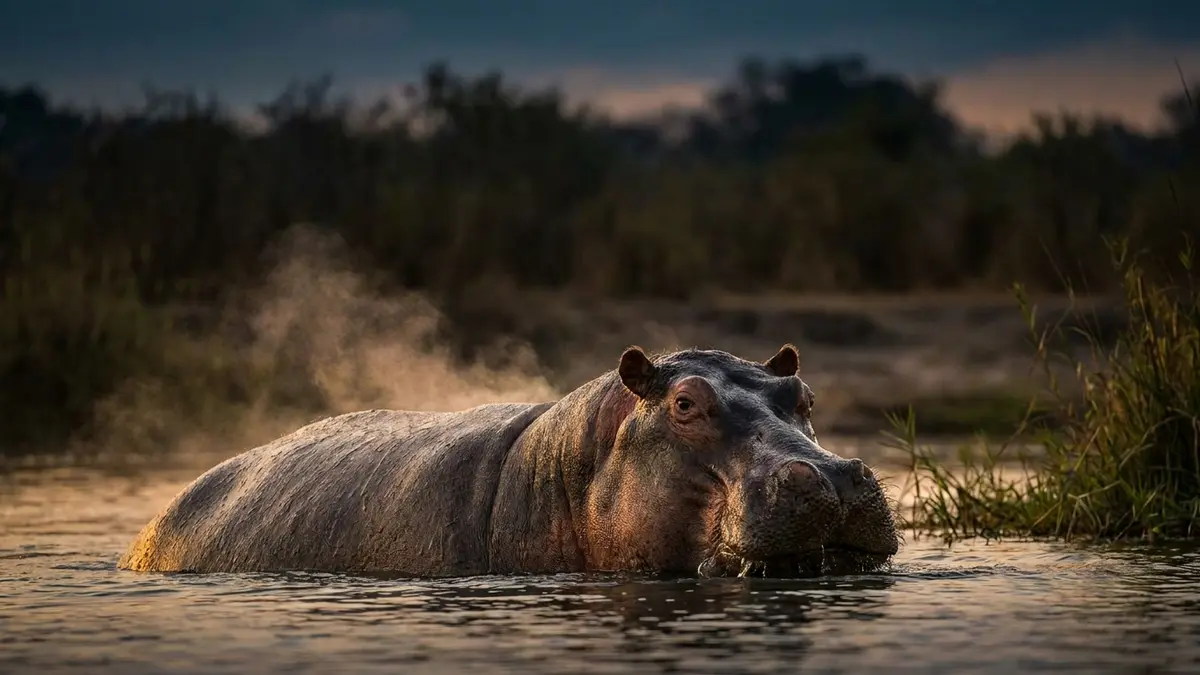
Hippopotamus amphibius does not swim: filmed underwater, it uses a gallop-like gait along the bottom at an average of 0.47 m/s. Its closest living relatives are whales and dolphins rather than pigs, and its canine and incisor teeth grow continuously, with canines reaching 51 cm. It has been listed as Vulnerable on the IUCN Red List since 2006, and at the 2016 assessment populations were decreasing or unknown in 25 of 38 range states.
An almanac
- Scientific name
- Hippopotamus amphibius (Linnaeus, 1758) — the common hippo; the pygmy hippo is a separate species, Choeropsis liberiensis
- Weight and height
- San Diego Zoo puts adult females at about 1,400 kg and males at 1,600–4,500 kg, with a shoulder height up to 1.6 m; AWF gives a broader 1.4–5 tons.
- Size ranking
- Popular sources including the African Wildlife Foundation call the hippo the third-largest land mammal 'after elephants and white rhinos.' Counting by species rather than by group, Hutchinson & Pringle (2024) rank it fifth-heaviest — behind three elephant species and the white rhino — and note it is close in size to the black rhino.
- Closest living relatives
- Whales and dolphins — not pigs. Cetaceans and hippos form a single group; pigs sit outside it.
- Conservation status
- Vulnerable on the IUCN Red List, listed as such since 2006 and reconfirmed in 2016
- Wild population
- Estimates differ by source and none is a census: ZSL gives 125,000–150,000; the 2016 IUCN assessment is cited at 115,000–130,000.
- In water
- Walks and gallops along the bottom rather than swimming; average underwater speed 0.47 m/s
The hippo is one of the most confidently misreported animals in the world. Almost every widely shared line about it — that it sweats blood, that it is a giant pig, that it swims, that it can outrun a horse — is either wrong or a hardened version of something much softer in the original source.
What survives checking is stranger than the folklore. A two-tonne herbivore that cannot swim and instead bounds along the riverbed. An animal whose nearest living relatives are whales. A grazer that quietly moves 0.4 metric tons of silicon a day into a Kenyan river and, by doing so, feeds the algae at the base of a lake food web hundreds of kilometres downstream.
Everything below is tied to a source that can be opened and read. Where the numbers disagree between reputable sources — population size, charge speed, human deaths — the page says so rather than picking the roundest figure.
Hippo facts that hold up
- The famous size ranking depends on how you count. Popular sources including the African Wildlife Foundation call the hippo the third-largest land mammal 'after elephants and white rhinos.' Counting by species rather than by group, Hutchinson & Pringle (2024) rank it fifth-heaviest — behind three elephant species and the white rhino — and note it is close in size to the black rhino.
- For its bulk, it eats very little. San Diego Zoo Wildlife Alliance reports hippos eat an average of 88 pounds (40 kg) of food a night — a modest amount for their size, roughly 2–3% of a typical adult's body mass. The percentage is a derived figure, not one the zoo publishes.
- The teeth never stop growing. Canine and incisor teeth grow continuously, and the canines can reach 51 cm (20 inches), according to San Diego Zoo Wildlife Alliance.
- Fights are usually settled by mouth size. When rival bulls meet they stand nose to nose and open their mouths as wide as possible, up to a 150-degree angle, to compare weaponry before anyone commits to a fight.
- Newborns have a 40-second breath-hold. Calves can stay under about 40 seconds at a time, against five minutes or more for an adult.
- They sleep underwater. A reflex lets a sleeping hippo bob up, take a breath and sink back down without waking.
- They are the only mammals known to make amphibious calls — vocalisations that carry through air and through water at the same time.
- Underwater they gallop rather than swim. Coughlin & Fish (2009) recorded an average underwater speed of 0.47 m/s and a gait similar to a gallop, with extended unsupported intervals.
- On land they trot, and essentially only trot. No hippos in the 2024 PeerJ study used other than trotting (or near-trotting) footfall patterns, and at their fastest they appear to use brief aerial phases, which the 2024 authors describe as 'apparently a new discovery' — observed mainly in online video footage rather than measured directly.
- Charge speed is routinely inflated. San Diego Zoo Wildlife Alliance gives up to 30 km/h for an agitated hippo on land. The widely shared '30 miles per hour' version would be about 48 km/h, far faster than anything measured, and the zoo's own page renders the imperial conversion inconsistently as 14 mph. The 2024 Royal Veterinary College study did not measure a true top speed; it worked from video of trotting animals and concluded it remains unclear whether hippos can outrun elephants.
- No sweat glands at all. Instead of sweating, hippos secrete a viscous red fluid that protects the skin against the sun and may act as a healing agent.
- They are a river's silicon pump. In Kenya's Mara River, hippos move 0.4 metric tons of silicon a day by grazing on land and defecating in the water — up to 76% of the river's total silicon flux, which feeds the diatoms at the base of downstream lake food webs.
- Listed as Vulnerable since 2006. At the 2016 assessment, populations were decreasing or unknown in 25 of 38 range states: decreasing in 16, unknown in nine, stable in nine and increasing in only four.
- The '500 deaths a year' figure is not a count. The line 'they kill about 500 people in Africa each year' is National Geographic's, relayed by Africa Check; Africa Check assigns it no rating of its own and the piece is an explainer that passes on National Geographic, the BBC and Smithsonian without independent verification. Deaths usually happen at rural waterways and often go unrecorded, so treat 500 as a rough order of magnitude.
- Colombia's wild hippos came from four animals. Three females and one male were imported from a United States zoo in 1981 for Pablo Escobar's private zoo at Hacienda Nápoles. A 2023 model in Scientific Reports put the descendant population at 91, growing 9.6% a year and heading past 1,000 by 2050.
- There is a second, rarer hippo. The pygmy hippo of West Africa is limited to very restricted ranges, and is a shy, solitary forest dweller — now endangered.
Myths worth killing
"Hippos sweat blood." The secretion is neither blood nor sweat. It leaves the skin as a thick clear fluid and turns red-brown within a few minutes as two pigments — hipposudoric acid and norhipposudoric acid — form and polymerise. Those pigments absorb light across roughly 200–600 nm, and the red one also acts as an antibiotic, which matters for an animal that fights as often as this one does. Hippos have no sweat glands whatsoever.
"Hippo milk is bright pink." It is white or beige, like almost any other mammal's. The claim got a large boost from a National Geographic Facebook post in July 2013 and was subsequently debunked. It is a mash-up of two unrelated things: hippos secrete a reddish skin pigment, and red plus white makes pink. There is no evidence the pigment ever enters the milk.
"Hippos are basically giant pigs." Genetic evidence puts hippos with whales and dolphins and explicitly excludes pigs. Analysis of insertions of short and long interspersed elements found that cetaceans and hippopotamuses form one group, while pigs and peccaries form a separate one. Older textbooks classified hippos alongside pigs on tooth and skull shape; molecular data overturned that in the 1990s.
"Hippos are powerful swimmers." Coughlin & Fish (2009) filmed two captive hippos underwater and recorded no swimming — the animals used a gallop-like gait along the bottom, averaging 0.47 m/s. It is a two-animal captive sample, not a demonstration that hippos are incapable of swimming. The paper describes the underwater gait as an unstable, gallop-like bounding motion facilitated by water's buoyancy — the authors compare it to moving in microgravity.
"A hippo opening its mouth wide is yawning because it is sleepy." The wide gape is a threat and assessment display, not fatigue. Rival bulls face each other and open up to about 150 degrees to compare weaponry — those continuously growing canines can reach 51 cm — and the smaller animal usually withdraws without a fight. A hippo gaping at a boat is warning it, not settling down for a nap.
Hippos in pop culture
Hippos have an outsized screen and toy-shelf presence for an animal most people never see. Disney's Fantasia (1940) handed the ballet sequence "Dance of the Hours" — set to music from Ponchielli's 1876 opera La Gioconda — to Hyacinth Hippo in a yellow tutu, partnered with Ben Ali Gator and animated by Norman Ferguson, Preston Blair and John Lounsbery.
In 1953 Columbia Records flew ten-year-old Gayla Peevey to New York to record "I Want a Hippopotamus for Christmas," written by John Rox with the Mitch Miller Orchestra; it reached number 24 on the Billboard chart and sold over 300,000 copies. A quarter of a century later, Hasbro's Milton Bradley released Hungry Hungry Hippos in time for Christmas 1978, built on a 1967 idea from toy inventor Fred Kroll and fronted by four named marble-gobbling hippos: Lizzie, Henry, Homer and Harry.
The modern reference point is DreamWorks Animation's Madagascar, which opened on 27 May 2005 with Jada Pinkett Smith voicing Gloria the hippo, and grossed $542 million worldwide against a $75 million budget.
Famous individual hippos
Obaysch, captured near an island in the Nile, reached London on 25 May 1850 as the first hippo in Europe since the Roman Empire. He went on to father London Zoo's first calves in 1871–72 and died in 1878.
Huberta became famous for walking. From 1928 she covered roughly 1,600 km down the South African coast, drawing attention at every stage of the journey. Her carcass was found in the Keiskamma River on 23 April 1931, and four farmers were each fined £25 for shooting an animal that had been declared protected.
Frequently Asked Questions
Are hippos related to pigs?
No. Analysis of insertions of short and long interspersed elements found that cetaceans and hippopotamuses form one group, while pigs and peccaries form a separate one — so whales and dolphins are the hippo's closest living relatives. Older textbooks grouped hippos with pigs on tooth and skull shape, and molecular data overturned that in the 1990s.
Can hippos swim?
Coughlin & Fish (2009) filmed two captive hippos underwater and recorded no swimming — the animals used a gallop-like gait along the bottom, averaging 0.47 m/s. It is a two-animal captive sample, not a demonstration that hippos are incapable of swimming.
Do hippos really sweat blood?
No. Hippos have no sweat glands. The fluid comes out clear and thick and turns red-brown within minutes as hipposudoric and norhipposudoric acids form and polymerise. Those pigments absorb light across roughly 200–600 nm, and the red one also works as an antibiotic.
How fast can a hippo run on land?
San Diego Zoo Wildlife Alliance gives up to 30 km/h for an agitated hippo. The widely shared "30 miles per hour" would be about 48 km/h, faster than anything measured, and the zoo's own page converts inconsistently as 14 mph. The 2024 Royal Veterinary College study did not measure a top speed at all and concluded it is unclear whether hippos can outrun elephants.
Is hippo milk pink?
No — it is white or beige, like almost any other mammal's. The claim spread after a National Geographic Facebook post in July 2013 and was later debunked. It confuses the reddish skin secretion with milk; there is no evidence the pigment ever enters the milk.
Why are there wild hippos in Colombia?
Four hippos — three females and one male — were imported from a United States zoo in 1981 for Pablo Escobar's private zoo at Hacienda Nápoles. A 2023 model in Scientific Reports put their descendants at 91 animals, growing 9.6% a year and heading past 1,000 by 2050.
More about the Hippo
More from Animal Facts

Sources
Claims on this page were checked against these published sources.
- Hippo
Despite their enormous weight, hippos eat an average of only 88 pounds (40 kilograms) of food a night.
Read the source → - Hippopotamus Underwater Locomotion: Reduced-Gravity Movements for a Massive Mammal
Hippopotami used a gait underwater that was similar to a gallop with extended unsupported intervals.
Read the source → - Footfall patterns and stride parameters of Common hippopotamus (Hippopotamus amphibius) on land
No hippos studied used other than trotting (or near-trotting) footfall patterns.
Read the source → - Hippopotamus
Instead of sweating, they secrete a viscous red fluid, which protects the animal's skin against the sun and possibly acts as healing agents.
Read the source → - Hippos (Hippopotamus amphibius): The animal silicon pump
Hippos transport 0.4 metric tons of Si day−1 by foraging grass on land and directly egesting in the water.
Read the source → - CoP19 Prop. — Consideration of Proposals for Amendment of Appendices I and II: Hippopotamus amphibius
However, the assessment stated that hippo populations were decreasing or unknown in 25 of 38 (65%) of hippo range States: trends were decreasing in 16, unknown in nine, stable in nine and increasing in only four (Lewison & Pluháček, 2017, Supplementary Information).
Read the source → - Rapid population growth and high management costs have created a narrow window for control of introduced hippos in Colombia
An initial population of 4 hippos (3 females and 1 male) were imported to Colombia in 1981 from a zoo in the United States for Pablo Escobar's private zoo at Hacienda Nápoles
Read the source → - Obaysch the hippo
Today there are an estimated 125,000 to 150,000 hippos remaining throughout Sub-Saharan Africa, of which Zambia (40,000) and Tanzania (20,000-30,000) have the largest populations.
Read the source → - Yes, hippos kill 'around 500 people a year in Africa'
they kill about 500 people in Africa each year
Read the source →
Not sure which animal is yours?
Consult the quiz