Mammals · Spirit animal
Hippo Spiritual Meaning & Symbolism
Quiet strength that guards its emotional territory and carries you safely through deep water.
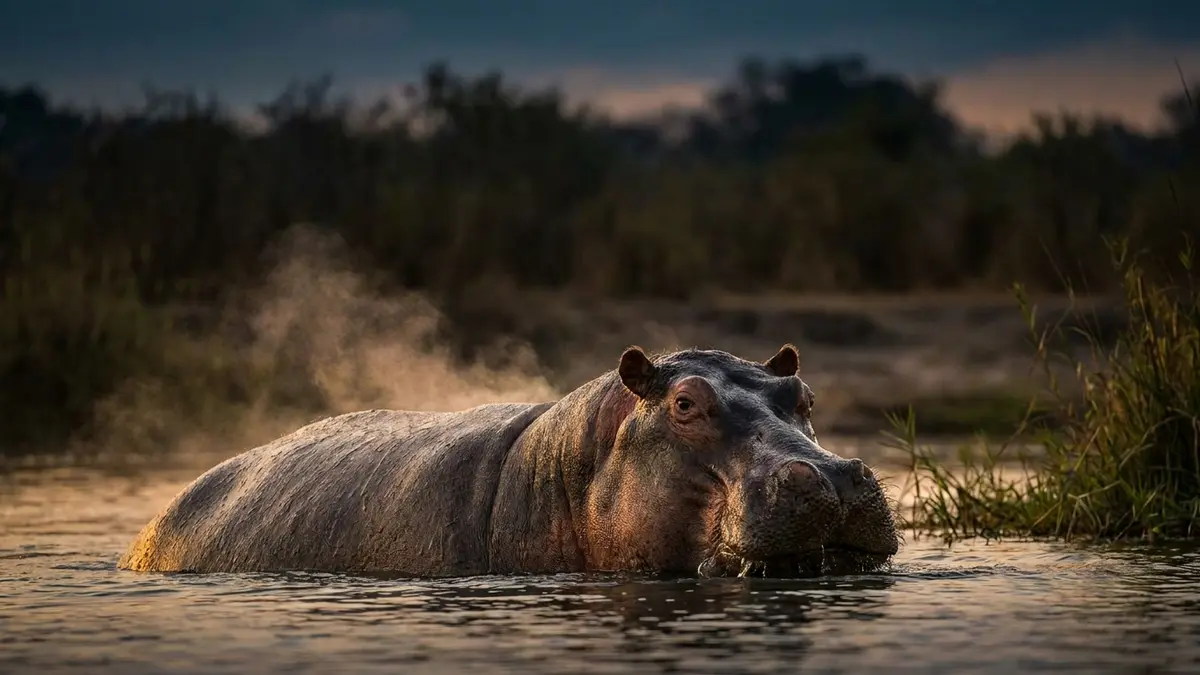
The hippo is a good spirit animal for when you need extra emotional strength. It symbolizes the courage to stand up for yourself, set boundaries, and speak your truth — without losing your balance and stability. If you see a hippo as a spirit animal, that's a sign that it's time to act confidently and decisively in any situation. In a dream, seeing a hippo might mean that something big and important is about to come to the surface in your life, or that you're about to see your inner power.
An almanac
- Core message
- Honest emotional strength
- Spirit animal
- Stand your ground, speak honestly
- Totem for
- Blunt, grounded, private people
- Power animal
- Clearing creative blocks, restoring vitality
- In dreams
- Pent-up emotions ready to surface
- Cultural roots
- Egyptian protector goddess Taweret
- Closest relative
- Whales and dolphins, not horses
- Biblical tie
- Behemoth in the Book of Job
The ancient Greeks called the hippopotamus the river horse, a name that barely describes the animal's sheer presence and heft. Through the ages, artists have created images of these impressive beasts, and people have long seen them as guardians of boundaries of feeling and truth. But don't let their bulky appearance fool you—the hippopotamus is also a surprisingly agile teacher.
Hippo Symbolism & Meaning
So you know a hippo is big. But don't be fooled into thinking hippos are clumsy brutes.
Once the water holds a hippo, all that bulk just flows. Once you give in to your environment and it supports you, so does your potential grow.
Hippos know their territories like pros. From its jaws' distinctive shape you can tell that a hippo is all about eating and growing well. It never attacks: it grins its teeth. So even if a hippo looks threatening, its only purpose is self-defense.
So think about what you keep all to yourself and your own thoughts. Are your boundaries there only for protection or for scaring people off?
When the world sees a hippo glowing red, people worry it's bleeding like some wild beast. No: hippos produce their own oils. These oils clean wounds as well as soothe sore skin.
As those colors prove false alarms, so do many first impressions of ourselves and others hide happiness behind what seem like danger signals at first glance.
Hippo Spirit Animal
A hippopotamus spirit animal almost always shows up in a big, showy way. Its sheer size can be a little overwhelming at first, but this animal wants you to stop hiding from a big situation and take charge of it.
It isn't telling you to give up what already works for you — just that it's time to get past whatever anxiety is holding you back.
Hippopotamus is associated with fertility and safe childbirth in Egyptian culture. So many people who are growing their family have a hippo as their animal guide.
One thing a hippo animal spirit teaches is how to create an "emotional armor." Hippopotamus also tends to spark creative thinking; people who have this guide as an animal spirit are often creative or see themselves that way.
And hippo means being open and honest with yourself. This spirit animal will want you to speak your mind about things and see your inner life clearly.
Does Hippo fit you?
Tap the ones that sound like you — 6 traits, no right answer.
0 of 6 Nothing picked yet — start tapping.
Hippo Totem Animal
People who are drawn to the hippo have quietly confident natures. Kids with this symbol often figure out what they like and dislike very early, and have a strong-minded streak that keeps testing every boundary it finds.
As an adult, if you have this totem you may not have a lot of patience with people who trample your boundaries. It can be hard to stay cool if someone keeps doing things you don't want them to do. But other people know better than to ask your opinion on important matters, because if you don't like something you will just tell them, and sugarcoating is not your style. You're happy being alone.
You do know how to keep things between yourself and those around you peaceful.
Hippo Power Animal
Sometimes when you're stumped on a creative idea, or need a change of pace, you can call on the hippopotamus to inspire you and help break through. It's because of the hippo's reddish coloring: this is their protective oil. Colors are a great tool for lifting your mood and redirecting your mind, and bold hues can sometimes loosen what keeps you stuck.
If you've let yourself get exhausted by feeling overlooked, you can also call on the hippopotamus for fresh energy. It can help clear away heavy emotions so that you have more space to think about what you want and move forward.
Across cultures
3 traditions — pick one to read its take.
Hippo in Celtic Symbolism
Hippos weren't native to Celtic lands. However, sometimes the carvings on ancient Scottish standing stones depict creatures that look like sea horses. These appear to have been inspired by Roman designs, although scholars aren't sure they're meant to represent hippos.
Irish legend also tells of a river god named Nechtan, who stood guard over a well where nine hazel trees dropped their nuts into the water, where they fed the Salmon of Wisdom. This was near where the River Boyne arose. Legends connect Nechtan with deities from Italy and Rome named Neptune and Nodens.
Hippo in Egyptian Symbolism
The hippo has a rich mythology in Egypt. A goddess called Taweret combined a hippo's head, body, and legs with a crocodile's tail. Other goddesses incorporated some of Taweret's characteristics but took on more specific roles; Reret, for instance, was known as the Sow, and Hedjet was the White One. Any of these goddesses were invoked to protect households and children, especially during childbirth. Bes was another god who protected families against danger.
Set could also transform into a hippo in his mythical battles with Horus. Set's ability to transform might have represented both his potential for destructive chaos and his power over life and death.
Because hippos' bodies were linked to rebirth in Egyptians' minds, Taweret is often associated with midwifery and purification. That is one of the reasons why Egyptians wore amulets in the form of her image or red jasper charms.
Hippo in African Folklore
One widely told tale explains why hippos behave the way they do. After creating every animal, the story goes, the Creator realized the hippo had been left behind and worried no place on earth would suit such a creature. Hippo begged for a home split between land and water — grazing grass on the savanna after dark and staying submerged by day.
To reassure the Creator it would never eat other animals, hippo swore that its dung would always show only plant matter as proof of honesty, which is why hippos still scatter their waste while feeding even today. A companion story tells how a thin-skinned hippo, sunburned and desperate on dry land, pleaded to live in the river instead.
The other water animals feared it would eat all their food, so hippo promised to open its jaws wide every day, showing no bones or scales inside, to prove the vow was kept.
Hippo in Dreams
Many people dream of hippos, and the dream can be instructive about pent-up emotions that need to be expressed. A hippo standing facing you is a signal that you have a hidden strength that needs to be used. Seeing baby hippos can signal big changes in the works. A brightly colored baby hippo is a sign that inspiration is coming your way from an unexpected source. If the baby hippo is surrounded by a number of other hippos, you’re on track to slowing down, getting more grounded, and paying close attention to your feelings.
Sometimes, a charging hippo can be upsetting in a dream. In this case, it means that boundaries you’ve let slide or anger you’ve been swallowing are calling out for your attention and don’t deserve to be ignored any longer. Watching a whole pod of hippos crowding the water is a sign that you need distance from overcrowded, overstimulating situations and may need to get out and take some time alone.
Hippo Spiritual Meaning
The hippo's spirit lessons circle back to one thing over and over: true power is self-possession. When your strength is comfortable in its own skin, it doesn't need to be loud to be noticed, and it doesn't need to stay invisible either. Be a hippo in this world and ask, How big can I make this space? A hippo isn't cowed by people. Hippopotamus spirits want you to act that way too.
Hippo isn't a fussy animal, so don't expect animal guide messages from it that come wrapped in puffy language. Hippo is blunt but not mean; when it wants you to remember something, it delivers that message without prettiness or flattery but also without blame.
Overwhelmed people can ask hippo for strength because the creature's energy can transform shakiness into steadiness and relaxation into resilience. If you're vulnerable right now, this spirit guide might help you get some of your color back.
Hippo as the Biblical Behemoth
The Book of Job describes a primeval beast called Behemoth, a creature of almost unimaginable might: it grazes on grass like cattle, carries its strength in its loins and belly, and stands so far beyond ordinary danger that "only his Maker can draw the sword against him." Long before scholars could even read ancient Egyptian, this description was widely read as a portrait of the hippopotamus, and the identification has stuck for centuries.
One theory traces the Hebrew name itself back to an Egyptian phrase meaning roughly "the water-ox", a fitting label for an animal that grazes like cattle but rules a river. The link left its mark on language too: modern Russian still uses begemot, a word descended from Behemoth, as the ordinary term for hippopotamus.
Read as spirit medicine, Behemoth's hippo connection points at the same idea found across most of this animal's traditions: a plant-eater's calm discipline housed inside a body built like a weapon. The lesson isn't to intimidate, but to carry restrained power so obviously that no one questions where your boundaries lie.
What Hippo Biology Teaches
Despite the common folklore linking hippopotamuses to horses and pigs, science now understands they share a closer kinship with porpoises, dolphins, and whales. Those two lineages split away from one another about 55 million years ago. That history says a lot: the boundary between those types was never as fixed in reality as it looks.
Aquatic creatures like hippos don't need air breaks as often. Adult hippos can hold their breath for up to six minutes at a stretch, while calves breathe every two to three minutes. Spiritually, that gap reflects the animal's core teaching: you can stuff your emotions down deep inside longer than you'd think possible, but they'll eventually surface for release.
On land, an adult hippo is capable of running up to 30 km/h (19 mph), strong evidence that bulk doesn't tell the whole story. Hippo asks you to trust in the speed and strength you have inside — whether you feel the habit of stillness is real.
Frequently Asked Questions
What does a hippo symbolize spiritually?
The hippo symbolizes the ability to protect your boundaries, express real feelings, and carry weight through life without losing balance.
What does it mean when a hippo appears in your dream?
A hippo in your dream usually means emotions that you are ready to express and clear away. A hippo just staring at you could mean that you have inner strength that you don't know is there, while a baby hippo often signals a significant announcement about to happen.
Is the hippo a totem of aggression or peace?
Although hippopotamuses have very intimidating-looking jaws, they generally prefer harmony and avoiding conflict if possible. They fiercely defend their boundaries only when pushed.
Why is the hippo linked to the biblical Behemoth?
The giant grass-eating behemoth in Job has been compared with the hippopotamus. These days there's a Russian word for hippo: begemot, descended directly from Behemoth.
Is a hippo more closely related to a horse, a pig, or a whale?
Despite their Greek name and old legends tying them to pigs, science considers hippos to be close relatives of whales, dolphins, and porpoises. They share a common ancestor dating back roughly 55 million years. The hippo spirit, thus, naturally sits between land and deep water.
What does it mean to dream of an aggressive or charging hippo?
A dream of an aggressive or charging hippo often means you've been ignoring your personal boundaries for too long, or keeping your anger to yourself instead of speaking up. Try to imagine this is not a warning of dangerous things to come. Rather, it's a way to remind yourself of the need to express your boundaries and feelings directly before your frustration or anger rises too high.
Hippo also represents
- Other animals that represent peace →Alongside Dove, Crane, Deer, Elephant
- Other animals that represent rebirth and change →Alongside Butterfly, Snake, Dragonfly, Frog
- Other animals that represent protection →Alongside Bear, Wolf, Dog, Elephant
- Other animals that represent healing →Alongside Snake, Deer, Dog, Bee
Sources
Claims on this page were checked against these published sources.
- Hippopotamus
from ἵππος (híppos) 'horse' and ποταμός (potamós) 'river', together meaning 'horse of the river'
Read the source → - Hippopotamus facts
their remarkably strong jaws can open to 180 degrees
Read the source → - Hippopotamidae
Like pigs, they have four toes, but unlike pigs, all of the toes are used in walking.
Read the source → - Taweret
bipedal female hippopotamus with feline attributes, pendulous female human breasts, the limbs and paws of a lion, and the back and tail of a Nile crocodile
Read the source → - Pictish stone
Pictish Beast (apparently mythical – perhaps intended as a sea monster).
Read the source → - Nechtan (mythology)
the name Nechtan is perhaps cognate with that of the Romano-British god Nodens or the Roman god called Neptunus
Read the source → - Behemoth
Even before the decipherment of Ancient Egyptian in the early 19th century, there was widespread identification of the biblical behemoth with the hippopotamus. ... modern Russian begemot ... entered the language in the mid-18th century
Read the source →