Animal Facts
Hedgehog Facts & Trivia: Spines, Sleep and Decline
Five thousand spines, none of which it can throw.
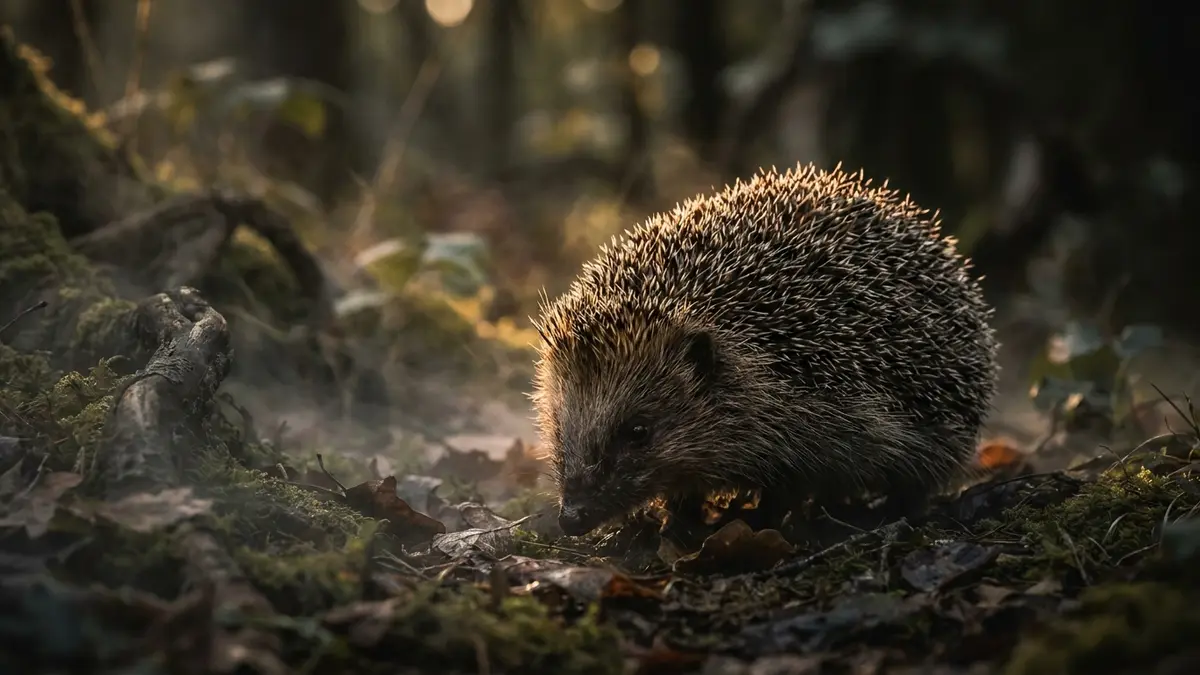
A hedgehog carries about 5,000 spines, and unlike a porcupine's they are unbarbed and cannot detach — they are armour, not ammunition. It does not sleep through winter either: hibernation is broken every one to two weeks. In October 2024 the IUCN moved the Western European hedgehog from Least Concern to Near Threatened.
An almanac
- Lifespan
- Up to 6 years in the wild; up to 10 in captivity (European hedgehog). Verified record: 16 years.
- Conservation status
- Western European hedgehog moved from Least Concern to Near Threatened on the IUCN Red List in October 2024; classified Vulnerable on Great Britain's Red List for mammals
- Standout number
- About 5,000 spines on an adult - all of them unbarbed and undetachable
- Nightly range
- Walks roughly one to two kilometres every night
A hedgehog is armoured but unarmed. Its roughly five thousand spines are unbarbed and undetachable, which makes them nothing like a porcupine's quills — a hedgehog cannot shoot, flick or shed them. It can only roll up and wait.
The rolling itself is done by one named muscle running around the rim of the spiny coat like a drawstring on a bag. And the spines may not have evolved for defence at all: hedgehogs climb walls and trees, then get down by curling into a ball and dropping.
The conservation news is the part that has changed most recently, and it is not good.
Hedgehog Facts Worth Knowing
- An adult European hedgehog carries around 5,000 spines, which are hollow, made of keratin, grooved to save weight, and grown from ordinary hair follicles.
- Hoglets are born with their spines already grown, but sealed under a fluid-filled membrane that protects the mother during birth; it shrinks within a day to reveal about 150 soft white prickles.
- Hedgehog spines may have evolved as shock absorbers for falls rather than as anti-predator defence - hedgehogs climb walls and trees, then get down by rolling up and dropping.
- The oldest known mammal with defensive spines is Pholidocerus, an extinct relative of hedgehogs that lived more than 40 million years ago.
- In hibernation a hedgehog's heart rate falls from about 190 beats per minute to roughly 20, body temperature drops from 35C to 10C or less, and it breathes about once every few minutes.
- In October 2024 the IUCN moved the Western European hedgehog from Least Concern to Near Threatened, on evidence of declines approaching or exceeding 30% in ten years across much of its range.
- Surveys in Denmark and Sweden found up to 60% of hedgehogs carry mecC-MRSA, and genetic dating published in Nature in January 2022 traced that methicillin resistance back around 200 years - long before antibiotics were used in medicine.
- That resistance evolved because the bacterium shares hedgehog skin with the fungus Trichophyton erinacei, which produces its own antibiotics - an arms race running on a hedgehog's back.
- The oldest scientifically verified European hedgehog, a male called Thorvald from Denmark, reached 16 years - seven years beyond the previous record holder.
- Hedgehogs carry a protein called erinacin that blocks snake-venom haemorrhagins; a 2000 Toxicon paper showed it neutralises the main haemorrhagic metalloprotease of Bothrops jararaca venom. This is not immunity to snake venom. Erinacin is an antihaemorrhagic factor: it inhibits one class of venom enzyme - metalloproteases that rupture blood vessels - and does nothing against neurotoxins. It was purified from muscle extract and tested in the lab, not in bitten animals, and hedgehogs bitten by adders can still die.
- A hedgehog walks roughly one to two kilometres a night and rarely uses the same daytime nest for more than a few days, which is why sealed-off gardens are such a problem for them.
- The widely quoted figure of hedgehog hearing reaching 45 kHz comes from the long-eared hedgehog, not the familiar European garden species. Hearing in Erinaceus europaeus has barely been studied. The 45 kHz number belongs to a different species with conspicuously larger ears, yet it is routinely repeated as though it applied to the hedgehog in your garden.
- British colonists introduced hedgehogs to New Zealand in the 1870s out of homesickness; they are now classed as a pest that eats native invertebrates, small reptiles and ground-nesting birds' eggs.
What People Get Wrong About Hedgehogs
“Hedgehogs are related to porcupines - or are some kind of spiky rodent.” Hedgehogs are not rodents and are not close to porcupines at all. Their nearest relatives are moonrats, gymnures, moles, desmans, shrews and solenodons. Porcupines are rodents; the resemblance is convergent evolution, not kinship.
“A cornered hedgehog can shoot, throw or fire its spines at an attacker.” Hedgehog spines are unbarbed and firmly anchored in the skin - they do not detach at all. A hedgehog's only defence is to roll into a ball and wait. (Porcupines cannot shoot their quills either; theirs merely detach on contact.)
“Put out a saucer of bread and milk for the hedgehog in your garden.” Hedgehogs are lactose intolerant. Milk causes diarrhoea, which can kill a small animal fast, and bread carries essentially no nutritional value for them. Meat-based cat or dog food plus a shallow dish of water is what the RSPCA actually recommends.
“Hedgehogs are crawling with fleas that will jump onto your cat or dog.” The flea found on hedgehogs is a specialist, Archaeopsylla erinacei, built for a spiny coat. It will not establish itself on a cat, dog or person. Most wild hedgehogs carry only a few resident fleas, which do them no harm.
“That spiky little animal in the pet shop - or the one in Madagascar documentaries - is a hedgehog.” Spiny tenrecs from Madagascar look almost identical to hedgehogs but sit in a completely different order, Afrosoricida, part of the African mammal radiation that also produced elephants and aardvarks. Another case of convergent evolution rather than family resemblance.
In Culture
Sonic the Hedgehog launched on the Sega Mega Drive/Genesis on 23 June 1991 and, bundled with the console, moved around 15 million copies - the best-selling game on any Sega system. Paramount's live-action adaptation reached cinemas in February 2020 only after the first trailer's character design drew such fan backlash that director Jeff Fowler's team rebuilt Sonic and the studio pushed the release back from November 2019; sequels followed in April 2022 and December 2024. Hedgehogs were literary long before Sega. Lewis Carroll's Alice's Adventures in Wonderland (1865) stages the Queen's croquet match with live hedgehogs as balls and flamingos as mallets. Beatrix Potter's The Tale of Mrs. Tiggy-Winkle appeared in October 1905. Yuri Norstein's ten-minute Soyuzmultfilm short Hedgehog in the Fog (1975) was voted the greatest animated film ever made by the 140 animators polled at the 2003 Laputa Animation Festival. Muriel Barbery's novel The Elegance of the Hedgehog (2006) became an international bestseller. And Schopenhauer's 1851 parable - written about porcupines, not hedgehogs - survives as the "hedgehog's dilemma", the title of Neon Genesis Evangelion's fourth episode, broadcast 25 October 1995.
Notable Individuals
Thorvald is the only hedgehog holding a world record. A male living near Silkeborg in central Denmark, he was killed by a dog in 2016; volunteers in a Danish citizen-science project recovered his body, and researchers counting growth rings in a thin section of his jawbone found sixteen - announced in February 2023 as the oldest European hedgehog ever verified, seven years beyond the previous record holder. Beatrix Potter kept a real pet hedgehog named Mrs Tiggy-winkle, carried her along while travelling, and drew her as the model for The Tale of Mrs. Tiggy-Winkle, published in October 1905. In the internet era, Mr Pokee - an African pygmy hedgehog belonging to Talitha Girnus of Wiesbaden, Germany - passed a million Instagram followers before dying in March 2019 from a bacterial infection after dental surgery. A successor hedgehog, Herbee, inherited the account.
Frequently Asked Questions
Are hedgehogs rodents, or related to porcupines?
Hedgehogs are not rodents and are not close to porcupines at all. Their nearest relatives are moonrats, gymnures, moles, desmans, shrews and solenodons. Porcupines are rodents; the resemblance is convergent evolution, not kinship.
Can a hedgehog shoot its spines?
Hedgehog spines are unbarbed and firmly anchored in the skin - they do not detach at all. A hedgehog's only defence is to roll into a ball and wait. (Porcupines cannot shoot their quills either; theirs merely detach on contact.)
Should you give a hedgehog bread and milk?
Hedgehogs are lactose intolerant. Milk causes diarrhoea, which can kill a small animal fast, and bread carries essentially no nutritional value for them. Meat-based cat or dog food plus a shallow dish of water is what the RSPCA actually recommends.
Do hedgehogs sleep all winter?
No. Hibernation is broken by spontaneous arousals every one to two weeks, each lasting a day or two, during which the animal forages and urinates. Rewarming burns a large share of its stored fat, which is why disturbing a hibernating hedgehog is costly to it.
How many spines does a hedgehog have?
About 5,000 on an adult. They are hollow, made of keratin, grooved to save weight, and grown from ordinary hair follicles — and unlike a porcupine's quills they are unbarbed and cannot detach.
More about the Hedgehog
More from Animal Facts





Sources
Claims on this page were checked against these published sources.
- Erinaceus europaeus (western European hedgehog)
An adult hedgehog usually has around 5,000 spines covering its body.
Read the source → - Spines and Quills (Special Collections)
Baby hedgehogs are born with their spines, but they are covered with a fluid-filled membrane to protect the mother during birth. Within a day, this covering shrinks, dries, and disappears to reveal about 150 white, flexible prickles.
Read the source → - Hibernation
They become immobile, their bodies cool and their normal physiological activities are slowed down e.g. their heart rate decreases considerably from approximately 190 per minute to a faint 20 per minute, the body temperature, which is normally 35°C drops to 10°C or less and respiration almost stops (they will breath about once every few minutes).
Read the source → - Breaking: European hedgehog listed as Near Threatened on IUCN Red List
The conservation status of the West European Hedgehog ( Erinaceus europaeus ) has been updated from Least Concern to Near Threatened in the latest release of the IUCN Red List.
Read the source → - MRSA arose in hedgehogs long before antibiotic use
They were investigating the surprising discovery - from hedgehog surveys from Denmark and Sweden - that up to 60% of hedgehogs carry a type of MRSA called mecC-MRSA.
Read the source → - World's oldest European hedgehog found in citizen science project
The male hedgehog, called Thorvald, lived for 16 years, 7 years longer than the previous record holder.
Read the source → - The antihemorrhagic factor, erinacin, from the European hedgehog (Erinaceus europaeus), a metalloprotease inhibitor of large molecular size possessing ficolin/opsonin P35 lectin domains
Erinacin inhibits the hemorrhagic and proteolytic activity of the major hemorrhagic metalloprotease from the venom of Bothrops jararaca.
Read the source → - European hedgehog (Erinaceus europaeus)
They are nocturnal, travelling around one to two kilometres per night, often using the same daytime nest for just a few days before moving on.
Read the source → - Hedgehog (Erinaceus europaeus) - Pest search
Hedgehogs were introduced to New Zealand by British colonists in the 1870s to remind them of home.
Read the source →
Not sure which animal is yours?
Consult the quiz