Mammals · Spirit animal
Hedgehog Spiritual Meaning & Symbolism
A quiet-hearted guardian: firm boundaries, quick wit, and the nerve to soften once the danger has passed.
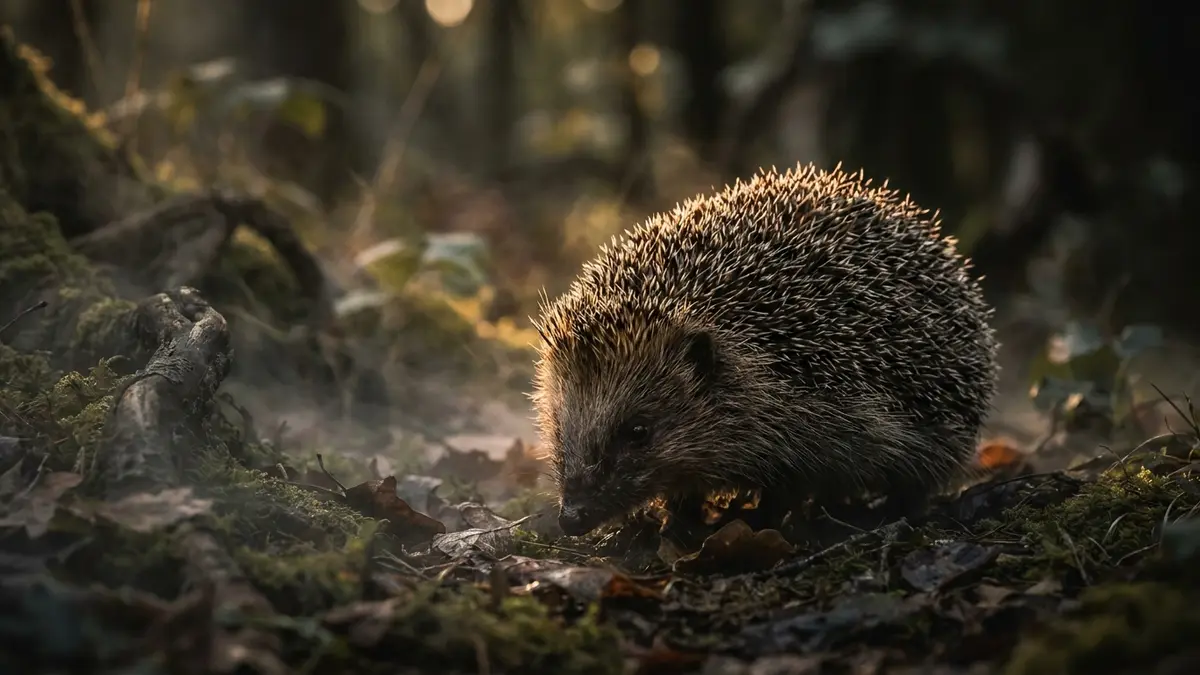
So the hedgehog medicine animal symbolizes being protectively calm: noticing when you're in a dangerous situation, being "wise enough to set a firm boundary," and "withdrawing into your own quiet space" when you need to. Afterwards, when you've handled what was upsetting you, the hedgehog guidance symbolizes being able to come back out of hiding with a renewed curiosity about the world around you. The "close bond with the Earth" and an "unhurried attitude" make it important to trust what your instincts are telling you about danger.
An almanac
- Core message
- Protection without cruelty
- Spirit animal
- Withdraw safely, soften once the danger passes
- Totem for
- Gentle, curious, quietly resilient people
- Power animal
- Deeper Earth connection and letting go of control
- In dreams
- Feeling vulnerable or misunderstood
- Element
- Earth and Fire
- Curious ritual
- Self-anointing — coats its spines in its own foam
- Not a Porcupine
- Unrelated animal, fixed non-barbed spines
Small, unhurried, and quietly self-assured, the Hedgehog carries a surprising amount of wisdom for its size. Real strength doesn't need to roar, it teaches — sometimes it just needs to curl up, wait out the storm, and trust that softness will return once safety does. Traditions across the globe have read this little creature as a sign of grounded calm, sharp cleverness, and a close bond with the rhythms of the earth.
Hedgehog Symbolism & Meaning
The Hedgehog is small but symbolically dense, long associated with motherhood, contentment, and inner steadiness. It may be one of the most easygoing mammals alive until it senses danger, at which point it rolls into a tight sphere and presents thousands of soft-tipped spines.
Because those quills carry no venom or hooks, the Hedgehog is read as defense without cruelty — it protects itself while leaving no lasting harm behind.
Elements and ancient associations
Its low-slung body keeps it in constant contact with the soil, tying it to the Earth element, and some Iranian traditions link the animal to land fertility and abundance for that reason. Others have viewed it as a solar creature, its bristling coat suggesting rays of light, even though it's actually active at night. That contradiction gives it a dual nature: fiery daytime logic on one side, the intuitive pull of darkness on the other.
Because Hedgehogs shrug off snake venom with relative ease, several European peoples cast them as symbols of triumph over death and malevolent forces. Ancient Greek and Roman observers, meanwhile, noticed Hedgehogs skewering fallen grapes on their spines to carry them off, and took this as proof of the animal's ingenuity and resourcefulness.
Seasons and weather lore
In Britain, the Hedgehog is pictured amid autumn leaves, honoring its habit of nesting down for winter, and communities there still check for hidden Hedgehog dens before lighting seasonal bonfires — a shift from older days when the animal was viewed with suspicion, even blamed for sorcery.
European folklore has long cast burrowing animals as weather prophets. The German Candlemas custom watched for a badger's shadow, and Pennsylvania Dutch settlers later transferred that same shadow-watching lore onto the groundhog once badgers grew scarce in America.
Spiritual guide and folklore
As a spiritual guide, the Hedgehog is tied to the North and South directions, to both Earth and Fire, and to themes of stability, resolve, and quiet vigor. Slavic folk tales cast Hedgehogs as wise, gentle guides holding ancient secrets.
A Latvian tale credits a Hedgehog with advising a careless Creator to squeeze the overly large Earth into mountains — earning its coat of needles as a reward.
Balkan stories feature a Hedgehog talking the Sun out of marrying (to spare the world from fiery offspring) and finding an enchanted plant that springs open locked doors. The Brothers Grimm gave us the fable of the tortoise-like Hedgehog outwitting the swift Hare through sheer cunning rather than speed.
Largely solitary and independent, Hedgehogs pair up only to mate. Gardeners in many places consider them lucky visitors and useful allies in the garden.
Hedgehog Spirit Animal
The hedgehog spirit animal may appear when you feel unseen or misunderstood by the people around you. You may want to pull away and hide behind a forced smile, but realize that it's okay to feel this way. Let others know it's nothing to be ashamed of if you need some time alone, even if they don't understand.
The hedgehog encourages you to find joy in solitude, connecting with yourself and the natural world around you. There's an entire world out there waiting to be explored, from gardening to walking on trails and collecting treasures by the shore. Take breaks when needed, and enjoy rest at day's end.
The hedgehog energy is not flashy but can make its presence known with grounding and authenticity. With its guidance, your gifts will surface naturally — no need for grand gestures or excessive displays of power. Pay attention to your senses as they sharpen — it might reveal messages about safety, health, or protection that were previously hidden beneath an external facade.
Does Hedgehog fit you?
Tap the ones that sound like you — 6 traits, no right answer.
0 of 6 Nothing picked yet — start tapping.
Hedgehog Totem Animal
People who are a Hedgehog sign are gentle and curious, often with a quietly optimistic attitude about life. They don't like looking for trouble; they'd rather avoid it. But they're surprisingly good at finding ways to work through tough times.
Hedgehog signs hate pessimism. If they get a vibe from someone, or hear someone saying negative things over and over, they tend to back away quickly. That's because they want to keep as much happy energy around them as possible. But that sensitivity can also lead them into trouble, sometimes making them think something is wrong when it's not.
Hedgehog people have learned to keep this in check by being honest with themselves and others. If something bad happens, they'll own up to their mistakes right away, and they'll try to fix the problem so the relationship can stay healthy.
This all leads to their strong resistance to bad energy, literal or figurative: no matter how much poison someone else is putting into their life, a Hedgehog person will be okay. In fact, they might even be more relaxed than most about it! But if you look at their drinking habits — or how much time they're spending outside — you might see some signs of trouble.
When a Hedgehog person stays inside all day, they tend to get moody and lose energy quickly. It's important for them to have some time outdoors each day; just one flowerbed can hold their attention for hours! It helps clear their mind and gives them new ideas to work with when they return home again.
Hedgehog Power Animal
If you're trying to make a connection with the Earth and nature's life systems, call on the hedgehog as your power ally. Weather watchers might also find some useful insights here.
When you're stuck in conversations that keep going in the wrong direction, turn to the hedgehog. It can help you stay focused on the conversation and keep away unnecessary defensiveness.
When you're trying to relax but are too stressed to let go of control, reach for a hedgehog. It will tell you that resting sharpens your focus and improves your decision-making abilities, and that everyone — including people who have a lot on their plate — deserves time for play.
Across cultures
2 traditions — pick one to read its take.
Egyptian Hedgehog Symbolism
Ancient Egyptians loved hedgehogs. They made amulets and painted their faces on the hulls of funerary boats to help guide the dead on to the next world.
Just like scarabs, hedgehogs were also symbols of rebirth. Hedgehogs curl up in a ball when they're in danger and disappear underground during tough times. They only come out when things start going well again, as if they'd come back from the dead.
Hedgehogs are also known for being really smart in Egyptian folklore. At one point, they were even having a fight with a wolf and a fox over a plum that had fallen out of a passing cart. But the hedgehog outsmarted them both and took the plum home.
Far Eastern Hedgehog Symbolism
In Central Asia, hedgehogs are associated with the harvest and land fertility. This may come from the solar symbolism of the animal itself or from folk tales that say the hedgehog gave fire to humankind. The creature is more a quiet benefactor than a background animal here. Its presence is linked to the health of the fields.
Hedgehog in British & Celtic Folklore
Hedgehogs are not uncommon throughout Britain. Though their population has declined, simple precautions like driving carefully or calling in sightings help scientists monitor the species. These efforts are relatively new: In early times, people thought Hedgehogs were witches and they killed hundreds of thousands. In reality, what they saw was a hedgehog drinking milk from a leaking cow.
Hedgehog in Dreams
Seeing a hedgehog in a dream often points to a fear of judgment by others or of being misunderstood.
Common dream images include: - meeting a hedgehog — this may mean that someone you trust is about to enter your life - when the hedgehog curls up into a ball — this could be interpreted as protection - when the hedgehog’s fur is white — this symbolizes peace-making and starting fresh - when the hedgehog uncurls toward you — something in your life has relaxed or softened - when the hedgehog chases you — the issue has not been resolved and may still be coming after you - when the hedgehog is dead — whatever caused your defensiveness no longer exists
Hedgehog Spiritual Meaning
Hedgehogs are playful and sensitive. They're gentle, but they also want to protect themselves from danger, and sometimes they curl up into a ball to feel safe. They teach you how to meet the world's dangers without anger — how to use gentleness to set boundaries and trust your instincts when the danger's gone. When you see a hedgehog, it reminds you that strength can come from being quiet and calm instead of acting aggressive.
Self-Anointing: The Hedgehog's Own Sacred Ritual
Biologists have a name for the oddest thing Hedgehogs do: self-anointing. A Hedgehog runs into a new smell or taste — a strange leaf, an animal's poo, even a glove discarded by humans — and without fail, it sniffs it, licks it, and chews on it until it gets foam at its mouth. Then the Hedgehog smothers its spines with that foam as carefully as it can.
Nobody really knows what Hedgehogs do this for. Researchers have put forward some ideas, like the idea that foamy saliva helps conceal their scent so they don't get eaten by predators. Or maybe the spines are smoother and easier to use because of the foam. Or maybe they benefit from certain scents and tastes that they get onto their spines.
The idea that seems most true is one of the older ones: that self-anointing is part of scent-marking. Marking your scent on things is something many animals do, and self-anointing is sort of like marking your own skin in this way, almost like wearing perfume on your body.
If you look at self-anointing as a spiritual act rather than just as an act in biology or science, it seems more like a ritual. The Hedgehog dips its face into another world and then rubs what it finds on itself. It takes something outside into itself. It makes something small into something greater than itself by taking what's outside into itself.
It is an act of taking things outside yourself so deeply inside you that you are completely changed from how you were before, all by yourself. This self-anointing is one small lesson to not let things slip away and to see everything as sacred.
The Hedgehog Immortal in Chinese Folk Religion
In the northeastern Chinese region, people used to believe in the Báixiān, a spirit of a white hedgehog.
Hedgehogs were called the White Immortal, and worshipped as part of a group of five animal spirits called the "Five Great Immortals."
The five Great Immortals are the Snake, Rat, Hedgehog, Fox, and Weasel. These were all creatures that people thought could show them how to use shamanism.
The hedgehog was seen as more than just a creature. It was a spirit with power to heal people who were sick. They would ask for that spirit's help to prevent or cure diseases.
Some people also thought that this same spirit helped bring good fortune. It was counted as one of many "Little Wealth Gods" in this tradition.
"The Fox Knows Many Things, But the Hedgehog Knows One Big Thing"
"The fox knows many things, but the hedgehog knows one big thing." That fragment long predates spirit-animal traditions and was probably first said by the ancient Greek poet Archilochus. It was later used by the philosopher Isaiah Berlin to describe the differences between what he called two kinds of thinkers — foxes and hedgehogs. These days, you'll still hear people use this saying to talk about how different types of people see and approach the world.
But they both seem to be saying that it's important to hold on to one thing that's true and keep doing it. A fox might rely on cunning and range, but a hedgehog relies on depth. If you see something complicated going on in the world, hold on to what you know is true. That is enough.
Frequently Asked Questions
What does it mean when a Hedgehog crosses your path?
A hedgehog walking along the road is supposed to remind you that you should protect yourself and keep your boundaries in mind, but you should also know when to let your guard down.
What does a Hedgehog symbolize spiritually?
It's this: the gentleness that makes the animal protective, its strong connection to the Earth that gives it groundedness, and its clever ability to be resourceful without turning to aggression when facing difficulty.
Is the Hedgehog a good totem animal to have?
Yes. People with a hedgehog totem are perceptive, resilient, and nature-loving. They're good at recovering from setbacks, but they may become too sensitive about reading others' intentions.
Is a Hedgehog the same as a Porcupine?
Despite the spines, these are unrelated animals. Hedgehogs have about 5,000 spines that lie flat against their bodies and stay attached when the hedgehog isn't threatened. They curl up into a ball to defend themselves against predators. Porcupines are rodents with longer quills that detach easily. They shake these quills as an active warning against predators. Spiritually, the Hedgehog represents quiet boundary-setting; its spines stay put when it isn't threatened, but it will curl up if it needs to defend itself from a predator. The Porcupine is a more confrontational cousin; it waves its detached quills in the air as a warning to predators.
Why do Hedgehogs cover themselves in foam?
There's no consensus about why Hedgehogs do it, but scent-marking is the best hypothesis. They find something with a strong odor, grind it up and make a lather of saliva, and then spread the lather over their spines. Spiritually it reads very much like reverence.
Hedgehog also represents
Sources
Claims on this page were checked against these published sources.
- Hedgehog
not poisonous or barbed
Read the source → - The Hare and the Hedgehog
published 1843 in the 5th edition of Grimms' Fairy Tales by the Brothers Grimm... the hedgehog's wife rises and calls out to him: 'Ick bün all hier!'
Read the source → - Hedgehog Awareness Week
aims to raise awareness of the problems hedgehogs face and how we can all help them
Read the source → - Erinaceinae
Egyptian amulets and sculptures from the New Kingdom
Read the source → - European Hedgehog Behaviour - Self-Anointing
Self-anointing involves the hedgehog covering its spines with a frothy saliva-stimulant mixture... it is sniffed, licked and then chewed... The resulting saliva is applied to the spines and fur with the underside of the tongue as the hedgehog contorts its body... Self-anointing plays a role in scent-marking that we've yet to understand, perhaps involving the vomeronasal organ.
Read the source → - Wudaxian
The Báixiān (白仙 'White Immortal') is the Hedgehog God. He is primarily worshipped as a medical deity to prevent and cure diseases... also known by the epithet of 'Little Wealth Gods' (Xiǎocáishén).
Read the source → - The Hedgehog and the Fox
A fox knows many things, but a hedgehog knows one big thing... Published in 1953... Berlin divided intellectuals into two groups: hedgehogs who view reality through a single unifying principle, and foxes who draw from diverse experiences... He applied this classification to analyze Leo Tolstoy's historical philosophy in War and Peace.
Read the source → - Why hedgehogs used to be hated
sneak into fields at night to steal milk directly from cows' udders... Parishes were required to kill them, with bounties of three pence paid for each hedgehog, a significant sum at the time... over the 140 years from 1660 to 1800, around half a million hedgehogs were destroyed in this way.
Read the source → - What's the Difference Between Echidnas, Hedgehogs and Porcupines?
Whereas porcupine quills detach from their body quite easily, hedgehog quills do not... shake them, making them rattle, as a warning to predators... Porcupines are rodents, while hedgehogs belong to a different order.
Read the source →