Mammals · Spirit animal
Leopard Spiritual Meaning & Symbolism
Stealth, hidden strength, and the quiet confidence of moving unseen
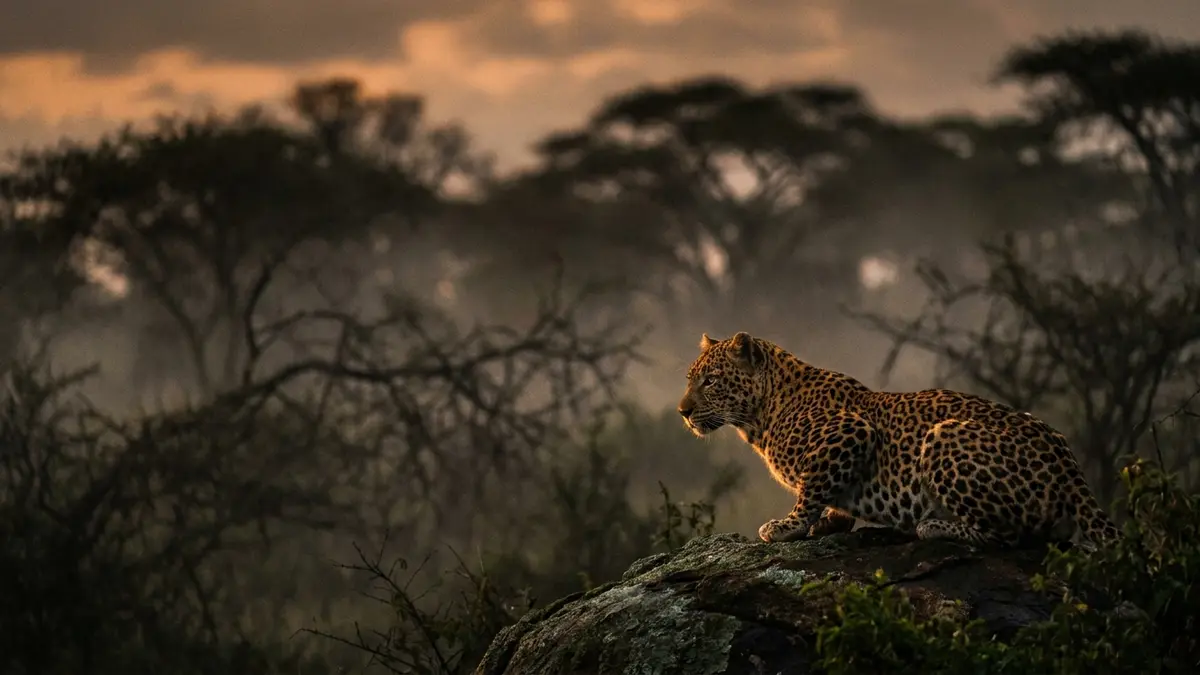
An animal spirit guide could be especially helpful at a time when you feel weakest, or alone, or unable to embrace traits that make you unique. The leopard is an animal that embodies these things.
If the leopard comes to you as a spirit animal, you are reclaiming strengths that you once thought were lost. You may find it difficult to trust your own instincts in a climate where only what's understood or conventional is accepted.
The leopard is both fierce and patient. It tends to pursue its targets silently. Things will happen in your favor if you simply wait them out.
In dreams, leopards usually represent good omens: things will go well for you.
An almanac
- Core message
- Trust your senses, act with quiet precision
- Spirit animal
- Reclaiming strength after hardship
- Totem for
- Quietly self-assured, intuitive people
- Power animal
- Precision, shapeshifting & shadow work
- In dreams
- A struggle resolving in your favor
- Cultural roots
- Native American, Celtic, Egyptian, African & Far Eastern lore
- First photographed wild
- Early 1970s, Pakistan's Hindu Kush (Snow Leopard)
- Sacred to
- Dionysus (Greek) & Waghoba (Indian)
If you say the word "Leopard," what's the first thing that pops into your mind? Something quiet, waiting, holding its breath so you don't notice it until it decides to move. The Greek people said that the Leopard's name comes from the "lion" and the "male panther." That sounds like they were saying this animal is really just a lion with a panther father--a hybrid. But underneath that common idea about leopards is some solid scientific stuff about sharp senses, extreme stealth, and a fur coat that is great for disappearing in broken light.
Taken together, all these things are why leopard symbolism keeps coming back to these things: hidden power, sharp perception, and quiet self-command.
Leopard Symbolism & Meaning
Like the jaguar and the black panther, the leopard has overlapping symbolism and much of its meaning echoes theirs. In the wild, this animal is very patient: it can usually close a distance on its prey in seconds, and can drag a kill up a tree where nothing else can reach it.
Leopard defends its territory fiercely, and would rather melt into shadows than confront any invader. So for ages it has meant quickness, strength, solitude, and guardianship. Its eyesight and hearing are far beyond those of humans, and the gift of that heightened awareness extends to every area where Leopard walks. It is also often viewed as a shapeshifter: its spots match broken shadows like camouflage.
Leopard Spirit Animal
If the leopard spirit animal is crossing your path, you're likely facing a new chapter in life. But it's a light at the end of a tunnel, not a warning that something is about to get worse. It's recognition that after enduring hardship, strength and balance are finally within reach.
So trust your instincts. Stop hiding who you are or are meant to be. In this new journey, be guided by what really matters.
Does Leopard fit you?
Tap the ones that sound like you — 6 traits, no right answer.
0 of 6 Nothing picked yet — start tapping.
Leopard Totem Animal
Like its namesake, people who are attracted to the leopard as their totem already know who they are, which means they don't have a need to worry about what other people think. They'll learn about their environment without advertising themselves, and trust their instincts even when most people are troubled by a situation.
But leopard people sometimes falter when it comes to straightforwardness; like their totem, they'd rather deal with conflict sideways than face it head on. But these same characteristics make them good practitioners of Leopard-style kung fu, a martial art that emphasizes speed and timing. Unlike people who rely on brute force, Leopard-style kung fu practitioners use carefully applied strength that may not feel so strong at first.
Leopard Power Animal
The leopard is a power animal whose medicine you can bring in to face a situation where you need precision and focused, sensitive action rather than raw strength. Its energy gives you well-honed instincts that keep you from taking unnecessary chances or needing to expose yourself more than you want to, which comes in especially handy when you're doing magic or rituals that involve shaping your energy into another form or uncovering and integrating all of who you are. But it only offers its help if it thinks that's what you really need, so this isn't an energy you can force to cooperate. It watches and waits for an opening, and you'll have a much better chance at convincing it if it thinks that you're humble and recognize your own limits instead of acting cocky or demanding to be indulged.
Leopard has the power to protect you. Its medicine is also associated with sharp problem-solving, sensitivity, resilience, courage, and quiet dignity. Those might be the themes for rituals in which this power animal shows up.
Across cultures
5 traditions — pick one to read its take.
Native American Leopard Symbolism
Across Native American tradition, the leopard is an animal that guides you through the unfamiliar — staying beside you in times of change, especially during times of spiritual, emotional, or physical growth. This animal represents many of the same qualities as the jaguar and mountain lion, its symbolic neighbors in Native American tradition.
Though leopards are native to only parts of Asia and Africa, most of what's described online as Native American Leopard symbolism actually comes from jaguars and mountain lions. In Native American communities, these big cats are known for being fearless and excellent hunters. It's often said that when they move at night, they're a lunar symbol. This makes the leopard a symbol of its own, representing solitude and thinking things through.
All in all, it describes an animal that is intense but also watchful. It provides magical energy and is a good helper for people who know how to use it spiritually.
Leopard as a Celtic Animal Symbol
Celtic legend is packed with symbols including the Questing Beast. A fabled creature with a serpent's head, a leopard's body, a lion's legs, and deer's feet, it cried out as if a whole pack of dogs were on the chase.
One story had it spring from the lustful plot of a princess for her own brother. A dark character herself, she enlisted the help of a devil to falsely accuse and kill him — and this happened in the same cycle as King Arthur's own incestuous love for his half-sister Morgause. The Beast was then said to symbolize the chaos and betrayal spreading through Arthur's court.
To heraldic artists, however, it signaled something more flattering. To them, this beast represented courage: a proven quality, unshakable. That was just about the opposite of what you'd call one of those mythological monsters.
Leopard in Egyptian Symbolism
Egyptian culture considered the leopard divine. Anyone who encountered one on his journey, even to cross its path, was considered to be on an important and holy path. Ancient Egyptians believed in seeking the advice of leopard when making difficult decisions.
One such myth centers on the god Osiris. Seth, another god and Osiris' enemy in this story, killed Osiris and changed into a leopard. Anubis chased Seth down and beat him. Anubis then put spots all over Seth's leopard hide so that he'd always remember that he lost that fight. Ancient Egyptian priests would wear this spotty hide during burial ceremonies. The goddess Seshat, who was in charge of writing and measurement, also had spotty hide draped around her while she worked on her various important duties.
Leopard in African Folklore
In African oral tradition, the Leopard was called the Guardian of the Dead. One well-known Ethiopian story says that there was a hunter and a Leopard who worked together and wore each other's skins while hunting. They hunted so well that their prey ran away from them. The hunter and Leopard traced their prey to a place where zebras were and began hunting them, too. And in many legends about the shapeshifting abilities of Leopards, it's said that these skills came from them working together while wearing each other's skins.
Far Eastern Leopard Symbolism
The Far Eastern Leopard is a symbol of martial courage and prowess across East Asian tradition. The Leopard style favored by Shaolin practitioners emphasizes speed and targeted attacks — punches, elbows, and low kicks — that outmaneuver their opponents rather than overwhelm them. Buddhism also associates Leopards with protection and hard-won wisdom.
Leopard in Himalayan & Tibetan Folklore
Himalayan folk tradition tells different stories about the snow leopard.
In some Nepalese communities, it's a disguise assumed by a group of wandering Tibetan monks who travel to collect rare herbal medicine. In other parts of Nepal, the cat is seen as a guardian that protects the fields from grazing livestock.
That's not the only story snow leopards play in Himalayan lore. According to some tales, snow leopards are reincarnated souls who were reincarnated in order to settle uncompleted business from a past life. According to these beliefs, anyone who harms a snow leopard now has to deal with the leopard's debt as it was left unresolved in its previous life.
The same body of folklore also talks about leopard pearls, stones that snow leopards would supposedly carry with them. In fact, healers and sorcerers have for ages cherished the pearls, long seeing them as magical stones.
These legends aren't just spiritual thoughts — the snow leopard earns its reputation as being elusive. The species was unphotographed until around 1970 when George Schaller caught rare pictures of them in their native habitat high up in Pakistani mountains for National Geographic Magazine.
Leopard in Dreams
Dreams about leopards generally signify something good. They imply that a struggle you've been having will soon come to an end in a way that you like, and your recent work will start to pay off. The dream is telling you not to stop being special, but keep going.
Common dreams about leopards include:
• A caged leopard, which may mean that you're protected. • A leopard on the attack, which means there may be some friction in the future. • A leopard walking calmly beside you, which may mean travel is coming. • A mother leopard guarding her cubs, which usually means happiness or compromise or a settled heart. • A leopard chasing you may mean that you've been worrying about something instead of dealing with it directly.
It usually means success or a problem was solved if you kill or fight a leopard in a dream.
If you see a leopard skin or if it's around you, it usually means that this animal's confidence has become yours and that the confidence is something you will now have.
Leopard Spiritual Meaning
Heed your own senses, act directly and concisely, and don't apologize for your unique qualities — that's the spiritual bottom line to understanding the meaning of Leopard. This animal seeks no spotlight; it wins through patience, accuracy, and utter faith in its instincts.
When Leopard shows up in your life, think of it as a sign to hold onto what matters fiercely, take action even when things are uncertain, and be completely at ease with the spots on your own character. Real power doesn't typically need to make noise.
Leopard in Hindu Mythology
In parts of India, the leopard isn't just a folklore figure — it's a deity, at least to some communities. Across the Warli, Gond, Kol, and other tribal communities in central India and Maharashtra, people still honor Waghoba as their leopard-and-tiger god. These communities built small shrines at the edges of forests and asked Waghoba to keep dangerous animals away from people who had to cross the forest daily. And that meant treating leopards like guardians — like spirits you appease and honor rather than simply fear.
It's a good way to think about Waghoba's message: a watchful predator doesn't mean hostility; it means protection that works in your favor when you respect it.
Leopard in the Bible
Whenever scripture talks about something unchanging, immovable and fixed — something so ingrained it’s bound to stay that way — you get a reference to Leopard. Take Jeremiah 13:23. "Can an Ethiopian change his skin or a leopard its spots?" Jeremiah asks, laying down what sounds like a big ol’ no in the conversation. In the language of that age, though, he's setting things up for one of scripture's stranger pieces of reassurance: the traits and habits that once seemed immutable really were only yours from the beginning.
Said differently, the traits that look immovable from scripture’s perspective were actually just your shape. The spot pattern you thought you had to camouflage is really just the feline your soul was always going to grow into.
Leopard in Greek Mythology
Leopard was already a Greek thing before there were Egyptian or Warli myths about this cat. Back in those days, Greeks gave this big cat to Dionysus, who was the god of wine, ecstasy, and how ordinary rules get broken. If you look at Greek vases and Roman mosaics from a later time that were based on older images, you often see him on a panther or beside one, with the panther symbolizing everything in life that's leashed and tame.
It makes sense for Dionysus to have an animal like leopard as a companion. Because Dionysus wasn't the god of order; he was the disrupting force that overthrew it. And leopard is a neat partner for a god built around that very same reversal. Leopard looks quiet until it decides to become "not quiet." It looks tame until it really doesn't look tame at all.
Frequently Asked Questions
Is a Leopard the same animal as a Black Panther or a Jaguar?
While a black panther is a leopard or jaguar with a melanistic gene that turns its coat solid black, these are not the same animal. A true jaguar is native to the Americas. The meanings of leopards, black panthers, and jaguars often overlap, since all three are associated with stealth, protection, and hidden strength.
What does it mean if Leopard is your totem animal?
When someone has a Leopard as their Totem, they tend to be resourceful, intuitive, and quietly confident. They read situations carefully before acting and trust their instincts. However, in general, they tend to dodge conflict rather than directly confront it.
What does dreaming about a Leopard usually mean?
Leopard dreams usually signal that a struggle is nearing its end, and any work you've been doing is getting you there.
The context of the dream can add information to the interpretation. If you dream of a caged Leopard, this probably means protection for you personally. If you dream of an attacking Leopard, there will likely be some friction. If you dream of a mother Leopard with her cubs, you can look forward to a time of happiness and a calm heart.
Is seeing a leopard in real life good luck or bad luck?
Across many traditions, seeing a leopard in the real world is a sign of good luck rather than bad. In parts of India, for example, communities that live near forests filled with leopards sometimes see them as divine protectors. By itself, an encounter with a leopard often asks you to be more observant, rather than warning you about danger. That said, it's always wise to treat wild leopards with the same respect you'd give any powerful predator.
What does a Snow Leopard symbolize differently from a regular Leopard?
Snow leopards are as quiet, stealthy and solitary as regular leopards, but they lean more toward mystery and solitude — which is fitting for an animal that wasn't photographed in the wild until the early 1970s. In Himalayan tradition, snow leopards are guardians of high, sacred ground rather than lowlands hunters, so their medicine feels like spiritual watchfulness more than raw physical power.
Leopard also represents
Sources
Claims on this page were checked against these published sources.
- Leopard - Etymology (etymonline.com)
literally 'lion-pard, lion-panther' (the animal was thought in ancient times to be a hybrid of these two species), from Greek leopardos, from leon 'lion'...+ pardos 'male panther.'
Read the source → - Leopard
drag larger carcasses over several hundred metres and caches it safely in trees, bushes or even caves
Read the source → - Questing Beast
there came Sir Palomides, the good knight, following the Questing Beast that had in shape a head like a serpent's head, and a body like a leopard, buttocks like a lion, and footed like an hart
Read the source → - Fūjin
wearing a tiger or leopard skin loincloth/kilt, carrying a large, inflated bag of winds
Read the source → - Leopard kung fu
The leopard does not overwhelm or rely on strength, as does the tiger, but instead relies on speed and outsmarting its opponent.
Read the source → - Waghoba
Waghoba...is an ancient tiger/leopard deity worshipped by a number of tribes in India for centuries. Tribes, including the Bhaina, Bharia, Bhatra, Dangis, Gond, Gosain, Kol, Korku, Koshti, Velip, and Warli, are stout worshipers of Waghoba or Bagheshwar... communities strongly believe that the Waghoba protects them and the jungle.
Read the source → - Jeremiah 13:23
Can an Ethiopian change his skin or a leopard its spots? Neither can you do good who are accustomed to doing evil.
Read the source → - Dionysus
Bull, panther, tiger or lion, goat, snake, leopard, fox [are listed among Dionysus's associated animals]... Dionysus accompanied by a panther, detail [description of Roman marble relief after Hellenistic models].
Read the source → - Sem priest
In the myth, Seth attacked Osiris and then transformed himself into a leopard. Anubis defeated Seth and branded his pelt with spots. The leopard robe commemorates victory over Seth... They were visually distinguished from other priests by wearing a leopard skin and a sidelock wig or shaved head.
Read the source → - Seshat (Seshet) - Egyptian Goddess of Writing & Wisdom
The goddess Seshat is depicted in relief carvings dressed in her characteristic leopard-skin outfit.
Read the source → - Rare Pictures: Snow Leopards Caught in Camera Trap
the first photographs of snow leopards in their natural habitat appeared in November 1971, when National Geographic magazine published images taken in Pakistan... featured renowned zoologist and photographer George Schaller documenting these elusive cats.
Read the source →