Animal Facts
Leopard Facts & Trivia: The Cat That Carries Its Kill Up
The widest range of any big cat, and the least seen.
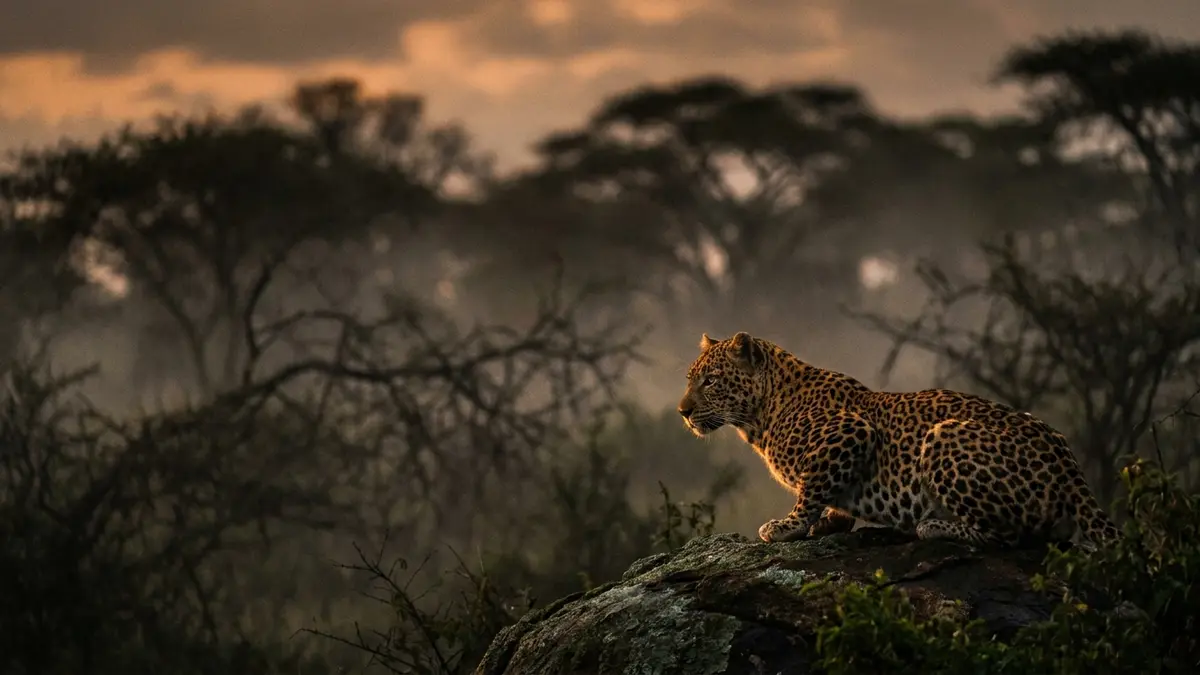
A leopard hauls kills heavier than itself up into trees to keep them from lions and hyenas. Its rosettes are individual enough to identify it the way a fingerprint would. And a black panther is not a separate species — it is a leopard or a jaguar carrying a melanistic coat, with the rosettes still visible in the right light.
An almanac
- Scientific name
- Panthera pardus (Linnaeus, 1758) - eight subspecies currently recognised
- Size
- Head and body 91-191 cm; tail a further 51-101 cm
- Weight
- 17-90 kg - African and Persian males reach 90 kg, Arabian leopards average about 25 kg
- Lifespan
- 12-15 years in the wild; up to about 23 years in zoos
- Range
- Africa and Asia, roughly 62 countries - the largest range of any big cat
- Conservation status
- Vulnerable (IUCN, 2023 assessment); the Arabian and Indochinese subspecies are Critically Endangered
- Standout number
- 63-75% of its historic range is already gone - worse than the average for the world's largest carnivores
The leopard has the widest natural range of any big cat and is the one people are least likely to see. That combination is the whole animal: adaptable enough to live almost anywhere, secretive enough that it usually does not have to be noticed.
It is also the only big cat that routinely stores food off the ground, hauling carcasses heavier than itself into trees, out of reach of lions and hyenas.
The black panther question comes up more than any other, so it is answered directly below: there is no such species.
Leopard Facts Worth Knowing
- Leopards have lost 63-75% of their historic range since roughly 1750, a bigger proportional loss than the average for the world's largest carnivores (53% across 17 species).
- The collapse is lopsided by continent: Asian leopards have lost 83-87% of their historic range, African leopards 48-67%.
- In sub-Saharan Africa alone, researchers have documented 92 different species in the leopard's diet.
- A leopard can haul a carcass heavier than itself as high as 15 m (50 ft) up a tree, and one was recorded dragging a 100 kg young giraffe into cover.
- Hoisting a kill into a tree does not guarantee the leopard keeps it: in one study, two of every three tree-cached kills were still lost to scavengers. The popular version treats tree-caching as a foolproof anti-theft trick. It is not. This figure comes from a single study (Stander et al. 1997) in the southern Kalahari, so it is one population's experience rather than a species-wide rate - but it punctures the idea that a leopard in a tree has won.
- Leopards run in bursts up to 58 km/h (36 mph), leap 6 m (20 ft) forward in a single bound and jump 3 m (10 ft) straight up.
- Leopards can go as long as 10 days without drinking, taking the moisture they need from the bodies of their prey.
- The leopard's rasping "sawing" call - its most distinctive vocalisation - carries up to 3 km (nearly 2 miles).
- The Amur leopard, the subspecies of the Russian Far East, numbered about 130 mature individuals in the IUCN's 2023 count.
- Fewer than an estimated 120 Arabian leopards remain in the wild, surviving in small isolated groups on the Arabian Peninsula.
- The roughly 40 leopards living inside Mumbai's Sanjay Gandhi National Park eat about 1,500 stray dogs a year, and researchers estimate they prevent around 1,000 dog bites and 90 rabies cases annually.
- Between 4,500 and 7,000 leopards are killed in Africa each year to supply skins to followers of a single religious group, the Nazareth Baptist (Shembe) Church.
What People Get Wrong About Leopards
“The black panther is its own species of big cat.” There is no such species. "Black panther" is a description of colour, not a taxon - it refers to a melanistic leopard in Africa and Asia, or a melanistic jaguar in the Americas. The spots never go away; they are simply buried under excess pigment, and infrared cameras or the right angle of sunlight reveal the rosettes underneath.
“Leopards are strictly nocturnal.” Activity depends entirely on where the leopard lives and what it is hunting. Savanna and woodland leopards are indeed mostly night-active, but leopards in undisturbed rainforest in Gabon were found to be largely daytime hunters, tracking the rhythms of their forest prey.
“Leopards are so adaptable and widespread that they are not really in trouble.” This is the single most consequential falsehood about the species, and the researchers who mapped leopard range called it out by name. Leopards have lost 63-75% of their historic range - worse than the average for the world's biggest carnivores - and three subspecies have each lost as much as 98% of theirs.
In Culture
The leopard's most famous fictional ambassador is Bagheera, the black panther of Rudyard Kipling's The Jungle Book (1894) - a melanistic Indian leopard, voiced by Sebastian Cabot in Disney's 1967 animation and Ben Kingsley in Jon Favreau's 2016 remake. Live leopards drove the screwball comedy of Bringing Up Baby (1938), and a black leopard stalks the shadows of Val Lewton's Cat People (1942). Disney's Tarzan (1999) gave the villain role to a leopard, Sabor. In literature the animal is mostly metaphor: Giuseppe Tomasi di Lampedusa's Il Gattopardo (1958) became Visconti's film The Leopard (1963) and a six-part Netflix series on 5 March 2025. Music has Bob Dylan's "Leopard-Skin Pill-Box Hat" (Blonde on Blonde, 1966) and the deliberately misspelled Def Leppard, formed in 1977. Apple shipped Mac OS X 10.5 Leopard in 2007 and 10.6 Snow Leopard in 2009. Pokemon added Liepard in Black and White (2010). Online, the animal survives as a political punchline: Adrian Bott's 20 October 2015 tweet about the "Leopards Eating People's Faces Party" spawned the subreddit r/LeopardsAteMyFace in 2017.
Notable Individuals
Legadema is probably the best-documented leopard who ever lived. Dereck and Beverly Joubert filmed her in the Mombo area of Botswana's Okavango Delta from eight days old to the age of three; the result, Eye of the Leopard, premiered on National Geographic on 8 October 2006, narrated by Jeremy Irons. In Kenya's Maasai Mara, Jonathan and Angela Scott followed a female called Half-Tail from 1988 - named for the tail she lost in a fight - who became a star of the BBC's Big Cat Diary before she was killed near the end of the 1990s after taking Maasai livestock; her daughter Zawadi was tracked until 2012. Less charming is the man-eater of Rudraprayag, blamed for 125 deaths in Garhwal between 1918 and 1926 and shot by Jim Corbett on 2 May 1926. In 2019, San Diego Zoo Global cameras confirmed a wild black female leopard in Laikipia County, Kenya, in the African Journal of Ecology.
Frequently Asked Questions
Is a black panther a separate species?
There is no such species. "Black panther" is a description of colour, not a taxon - it refers to a melanistic leopard in Africa and Asia, or a melanistic jaguar in the Americas. The spots never go away; they are simply buried under excess pigment, and infrared cameras or the right angle of sunlight reveal the rosettes underneath.
Are leopards nocturnal?
Activity depends entirely on where the leopard lives and what it is hunting. Savanna and woodland leopards are indeed mostly night-active, but leopards in undisturbed rainforest in Gabon were found to be largely daytime hunters, tracking the rhythms of their forest prey.
Are leopards endangered?
This is the single most consequential falsehood about the species, and the researchers who mapped leopard range called it out by name. Leopards have lost 63-75% of their historic range - worse than the average for the world's biggest carnivores - and three subspecies have each lost as much as 98% of theirs.
Why do leopards drag their kills into trees?
To keep them from lions and spotted hyenas, which will steal a carcass on the ground. A leopard can haul prey heavier than itself vertically up a trunk, which is the single most distinctive thing it does.
Can you identify an individual leopard by its spots?
Yes. The rosette pattern is individual enough to work like a fingerprint, which is how camera-trap surveys count populations without capturing anything.
More about the Leopard
More from Animal Facts
Sources
Claims on this page were checked against these published sources.
- Leopard (Panthera pardus) status, distribution, and the research efforts across its range
Contrary to the pervasive impression of the leopard as being one of the most widespread, adaptable and resilient carnivores, our calculated range loss of 63–75% exceeds the average range loss documented for the world’s largest carnivores (53% for 17 species; Ripple et al., 2014).
Read the source → - Living Species - Leopard
In sub-Saharan Africa, 92 prey species were documented.
Read the source → - Leopard
Leopards have incredible strength and can climb as high as 50 feet (15 meters) up a favorite tree while holding a fresh kill in its mouth, even one larger and heavier than themselves!
Read the source → - Leopard (Panthera pardus) Fact Sheet: Behavior & Ecology
Tree cached kills often lost to scavengers, 2 of every 3 in one study (Stander et al. 1997)
Read the source → - Amur leopard
According to the IUCN, in 2023, there were estimated to be around 130 mature individuals.
Read the source → - Smithsonian's National Zoo and Conservation Biology Institute and Royal Commission for AlUla Advance Next Phase of Global Effort to Save the Critically Endangered Arabian Leopard
With fewer than an estimated 120 Arabian leopards remaining in the wild, coordinated global action is essential to prevent the extinction of one of the world’s rarest big cat species.
Read the source → - How City-Dwelling Leopards Improve Human Health
Using statistical averages of dog bites and rabies cases in the region, the researchers also estimated that the park's leopards prevent 1,000 bites and 90 possible rabies cases.
Read the source →
Not sure which animal is yours?
Consult the quiz