Mammals · Spirit animal
Kangaroo Spiritual Meaning & Symbolism
The bounding spirit of forward motion, grounded strength, and fierce maternal protection.
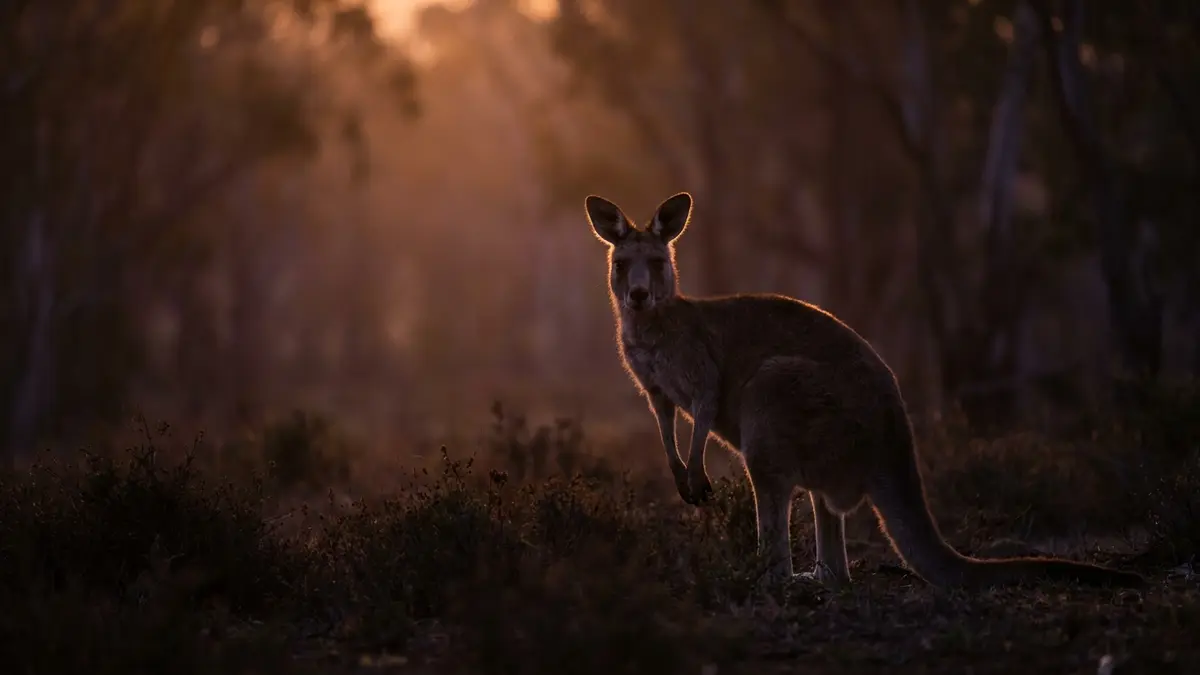
A kangaroo is a real animal, but it's also an important symbol that can be called on as a spirit guide. It's a force that is powerful, fast, and strong — yet gentle, caring, and protective.
The kangaroo is a symbol of the journey itself. It knows the most important thing about moving forward — the ability to be steady on its feet while having to leap around in many directions at any given time. It can also teach you about being patient — knowing when it's time to pause and when it's time to push ahead. In certain types of dreams, it might symbolize motherhood or creativity.
An almanac
- Core message
- Leap boldly, stay grounded
- Spirit animal
- Reach big, keep practical footing
- Totem for
- Protectors of the vulnerable
- Power animal
- Sustained effort, sharp instinct
- In dreams
- Motherhood, new beginnings, focus
- Cultural roots
- Aboriginal Dreamtime & modern Australian zodiac lore
- Top speed
- ~43 mph in short bursts
- Word origin
- Guugu Yimithirr "gangurru"
The kangaroo isn't just Australia's most popular marsupial. It's also a living metaphor. Its magnificent leap and full pouch are signs of the same enduring energy: steady yet explosive, strong yet trusting. That gets at the core lesson of the kangaroo: raw drive combined with deep roots is how you make lasting progress.
Kangaroo Symbolism & Meaning
The kangaroo is a powerful symbol across Australia, and its mythology shines an ancient light on the land's modern culture. In a zodiac created in the 1990s and not tied to Aboriginal traditions, kangaroo represents Aries in the modern Australian astrology. Aries brings independence, generosity, and courage to the table when you need help taking on a new opportunity.
A kangaroo's signature way of getting around, its powerful leaps, not only get them away from threats but also close the distance between them and any opportunity that arrives. Kangaroo's four toes are a marker of grounding and building structure, both of which are sensible approaches to bold new ideas before taking action.
When you're considering a big move, consider whether that idea can stand on its own two feet, or if you need help getting there — the placement of your feet as much as their number can be a good early sign. Kangaroos can achieve great speeds over short distances but never run for too long before taking a breather; don't forget to schedule in some rest breaks when considering your next big leap.
Kangaroos live in large mobs where they learn to identify each other by scent, and may hold off reproducing during tough times like drought but return after things improve. This is a timely lesson: jumping at the first thought or opportunity isn't always helpful. Sometimes we have to wait for conditions to be more favorable before we move.
Kangaroo has deep symbolic significance in Australia's art and history: it's on their money and coat of arms, along with their military emblems.
Kangaroo Spirit Animal
Kangaroo typically shows up for the outgoing, warm-hearted and down-to-earth people. It complements their natural ability to welcome others with warmth and make everyone feel comfortable.
Its main message encourages a person to stay focused on their goals while reaching for them, so you don't fantasize without the reality of your circumstances. Dream big, but stay grounded to ground your aspirations in reality.
It teaches a person to trust themselves, that their fears might be larger than they really are. For those who are stuck in a decision between two options, Kangaroo's answer is simple: make a decision and jump into it.
For those trapped in draining or unsafe situations, Kangaroo's energy will nudge them to make a bold decision decisively, so they can escape rather than be paralyzed by uncertainty.
Kangaroo teaches us that resisting change is worse than accepting it because once you've stopped fighting it, everything will be easier. It also nudges us towards gratitude: If you ignore the small blessings in your life, you'll overlook new opportunities.
Does Kangaroo fit you?
Tap the ones that sound like you — 6 traits, no right answer.
0 of 6 Nothing picked yet — start tapping.
Kangaroo Totem Animal
If the kangaroo is your totem animal, you have remarkable endurance. You tend to keep on going, no matter what obstacles get in the way. You're a survivor.
Even though you're not timid, you don't charge into every situation head-on. When it's time to run away, you do that, and when it's time to stand up for yourself, you do that.
You love children and animals. They might be young or might be older — what matters is how fragile they are.
You know just when to let your young one go out into the world and find its own way, not before that.
You fall in love hard. You know right away when someone is the one.
But don't fall so hard that you become short-sighted. Take others' opinions seriously. See if it's worth pausing to listen to them even when you know they mean well and are on your side.
Kangaroo Power Animal
A kangaroo is a power animal you can call upon when you need to maintain your determination and keep going despite obstacles. It's a reminder that in pursuing what matters to you, the journey is as satisfying as any goal or accomplishment. Kangaroo connects you with your instinctual nature, keeping you alert and aware when things might be wrong.
If doubt, uncertainty or fear throws up roadblocks between yourself and what you're pursuing, slow down for a moment, see the situation from the steady, clear-sighted perspective of Kangaroo, then act decisively — because now you know how to move past whatever threw up that wall in the first place.
Kangaroo in Australian & Aboriginal Lore
In Aboriginal storytelling, Kangaroo is tied closely to the Dreamtime; it appears as a totemic figure and central character across Dreaming narratives from many Aboriginal nations. One tale explains how the animal earned trust among a Koori community: drawn from hiding by a sacred dance, Kangaroo couldn't resist joining in, and rather than punishing the intrusion, the people welcomed it as one of their own, an origin still honored in ceremonial dress today.
A separate legend describes Kangaroo arriving on a great wind that swept it across the land until its legs stretched long trying to find footing. It ultimately guided a wandering chief to a fertile new home for his hungry tribe. Perhaps best known is the story of how Kangaroo earned her pouch: a mother Kangaroo befriended a frail, rejected Wombat, then later risked herself to distract a hunter and save the elder's life.
That Wombat was the god Byamee in disguise, who was testing for kindness. As a reward, he gave her an apron of bark that fused into fur and became the first pouch — later extended to all marsupials after Kangaroo asked that the gift be shared.
Kangaroo in Dreams
A kangaroo bounding through a dream often indicates issues of motherhood—whether that involves an actual pregnancy, a wish for a baby, or a new idea you’re nursing. The story and focus of the dream can drastically alter the message it's sending:
- If you're hopping all over the place, aimlessly, this reflects your own need to settle down and zero in on completing just one thing. The dream is cautioning you to stop running around aimlessly, and be more diligent about what you choose to pursue.
- If the hopping is quick, urgent even—this shows a threat of danger. You should be wary of a situation going south.
- If you see a red kangaroo—this could suggest you're relying on inner strength in this task. You need to rely on your own Yang-type energy.
- A grey kangaroo—inspiring justice, fairness, or support for someone who’s lost their way.
Kangaroo Spiritual Meaning
Kangaroos don't just hop. They can run, walk, and pause as needed, and that's their message to us: listen to your instincts, know when to wait for conditions to be right and when to make your leap.
While a kangaroo doesn't feel soft, it carries its newborn in a protective pouch. This reminds us that strength isn't weak; softness isn't submissive; and commitment is what defines our resilience.
Kangaroo is telling you that you can do anything with the right balance of momentum. When you're ready, go for it—but first make sure the ground is firm under your feet.
Why Kangaroo Never Moves Backward
Kangaroos have big muscles in their hindquarters and long, strong hind legs. Their tail helps them keep their balance while they're moving. It also helps them leap through the air. No matter how strong and graceful those legs are, kangaroos can't move backwards.
There are some that live in tree tops. These ones can go up trees and jump down them with one leg at a time.
Emus and kangaroos were both made to move forward. These two animals gave their country Australia its coat of arms so that it could show a picture of a nation always moving forward. One more example that shows the body was made to move ahead: Kangaroo tells you there is no reason to brace for defeat in your life.
Kangaroo Boxing: Strength Without Cruelty
Kangaroo males like to spar, squaring off toe-to-toe in face-saving contests where "winning" really means avoiding a badly bruised ego — rather than injury. Both sexes will circle each other, shoulders or necks interlaced for balance and safety, giving glancing kicks and prods until one backs down.
Spiritually, the ritualized circling and pushing shows you can fight back without causing real harm. You can contest for what you want in a clean, honest way — say, a promotion or leadership position — as long as you're disciplined about how you go about it, using your weapons wisely. When this defensive spirit rises in you, consider it an invitation to stand up for yourself in a way that will actually benefit you and those around you.
Frequently Asked Questions
What does a Kangaroo symbolize spiritually?
Kangaroos represent grounded forward motion. This means that they help you move forward while staying connected to your values. The symbol of a kangaroo can also remind you to protect yourself and to be patient until the timing is right for the next step.
What does it mean when a Kangaroo appears in a dream?
Kangaroos appear in many dreams. Generally, they relate to motherhood and childbirth, but you can also dream of them if you're working on a new idea or project. Hile aimless hopping suggests scattered focus and fast, urgent hopping warns of nearby danger, its color can also give your dream more subtle nuance (for instance, red may represent assertive energy while gray may represent justice or a situation where somebody needs your guidance).
How is Kangaroo connected to astrology?
The animal Kangaroo corresponds to the sign Aries in the Australian Zodiac, an astrology system that was introduced in 1997 and is not an ancient tradition. People born under Aries are often described as having the traits of leadership, ambition, humor, generosity, and abundant energy. These same traits can also be used to describe Kangaroo's bold and tireless nature.
Does the word "kangaroo" really mean "I don't understand"?
No, it's a myth. The word kangaroo comes from gangurru in the Guugu Yimithirr language of Australia's Northern Queensland. And they used it that early! Captain Cook's crew recorded it in 1770.
And spiritually it's just right: Clear, specific direction has been Kangaroo's message.
How fast can a Kangaroo actually move?
A Red Kangaroo runs at around 12–16 mph at a normal run, but can sprint up to around 43 mph. It can't stay at that speed for long, but if you need to go fast, it's the best thing around. Some people are like that. They can get through most things by moseying along just fine, but when it really matters to get something done they're all sprint and no cruise.
Can a Kangaroo produce milk for two joeys at once?
Yes. Kangaroos produce two different types of milk, one that's good for their newborns who still have to live in the pouch, and one for their older joeys that have managed to emerge from the pouch and are weaning. The dual milk production symbolizes a kangaroo's protective, multitasking maternal energy. She provides for her newborns, who need special care right from the start, without neglecting her older joeys who are gradually moving toward independence.
Kangaroo also represents
- Other animals that represent protection →Alongside Bear, Wolf, Dog, Elephant
- Other animals that represent resilience →Alongside Cockroach, Camel, Salmon, Turtle
- Other animals that represent patience →Alongside Turtle, Heron, Spider, Ant
- Other animals that represent intuition →Alongside Owl, Cat, Wolf, Raven
Sources
Claims on this page were checked against these published sources.
- Kangaroo
Kangaroos are indigenous to Australia and New Guinea
Read the source → - HOXA13 and HOXD13 expression during development of the syndactylous digits in the marsupial Macropus eugenii
The hindlimb autopod has only four digits, the fourth of which is greatly elongated, while digits two and three are syndactylous.
Read the source → - Grandfather Emu, and how the Kangaroo got her pouch (catalog record)
how Mother Yonga Kangaroo got her pouch ... the importance of helping others
Read the source → - The Project Gutenberg E-text of Australian Legendary Tales, by K. Langloh Parker
31 tales... none of the included stories match the description you're asking about [kangaroo/wombat/Byamee pouch]
Read the source → - Kangaroo and Wallaby
Tree kangaroos are the only kangaroos that can move their back legs independently of one another and move backward, which is how they climb down a tree.
Read the source → - The origin of kangaroo – getting to the bottom of an Australian furphy
kanguru (pronounced 'kang-uru'), or ganguru ('gang-uru') since k and g are in free alternation in Guugu Yimidhirr, refers to the male of a large black or grey kangaroo species – one of at least eight varieties of kangaroo distinguished in the language.
Read the source →