Mammals · Spirit animal
Cat Spiritual Meaning & Symbolism
The independent watcher who moves between worlds on silent feet, teaching you when to wait and when to pounce.
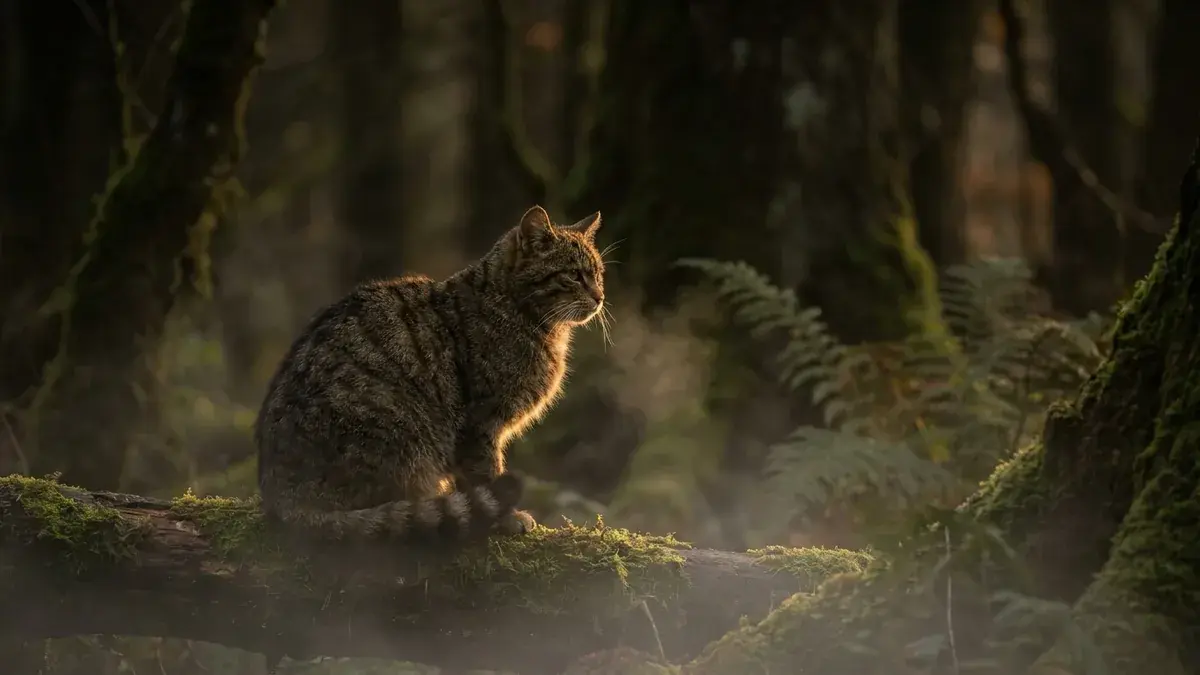
The cat is a spirit animal associated with independence, intuition, and a willingness to deal with the unknown. In ancient Egypt, it was considered sacred, but in medieval Christian Europe, it was feared as an omen of witchcraft. Nevertheless, the cat's message is always the same: love deeply without giving up your boundaries.
An almanac
- Core message
- Independence balanced with deep affection and sharp intuition
- Spirit animal
- Teaches perfect timing, patience, and trusting instinct
- Totem for
- Night owls who value freedom, agility, and rest
- Power animal
- Restful sleep, adaptability, and shedding codependency
- In dreams
- Intuition, sensuality, and the playful inner child
- Cultural roots
- Sacred in Egypt, feared in medieval Christian Europe
- Nine lives
- English proverb & Shakespeare, not a literal count
- In Islam
- Ritually clean; beloved companion of the Prophet
The cat goes back centuries in human history. The ancient Egyptians honored it as a sacred animal. At the same time, in medieval Europe people feared it, believing it to be a sign of witchcraft. The cat has remained with us ever since, though attitudes have changed. Now the cat seems to symbolize its own will and independence, making no apologies for itself. Its presence is sure and steady, never accidental.
Cat Symbolism & Meaning
Cats and humans have had each other's lives in common for thousands of years. Cats started living as house pets around 7500 BCE, and grew in reverence from there. Egypt probably had the earliest cat cult (a group of people worshiping a specific animal), where they were called forth to protect grain supplies from rats and mice. Egyptians killed anyone who killed a cat, which explains a later story Polyaenus tells about Egyptian soldiers not shooting their arrows because they didn't want to hurt the cats who had started out carrying them. One historian, Herodotus, never mentions it.
In the cat cult, Bast was the patron cat goddess. She protected homes, fertility, and things you shouldn't tell everyone. She was also really militant about kids' and pregnant women's safety.
Cats traveled on human trade routes into Persia, Europe, and other places, but they didn't lose all their natural traits while they did it. If you leave any kind of cat alone, you'll find out: they have super good eye-hand coordination; they move fast but also like to keep very still; they spend a lot of time on their own bodies; and they can go from full chill to full flight in no time flat.
The qualities listed above are also usually why people want cats: curiosity, cleverness, independence, sensitivity, playfulness, and resourcefulness.
Grief over cats in ancient Egypt could be really dramatic. Once Herodotus saw this one household where everyone shaved off their eyebrows because the family cat died!
Cat Spirit Animal
Cats don't offer their guidance freely, so it's worth noticing when you get to see one. They tend to show up when you've been getting your timing all wrong and your patience is frayed at the edges. So if a cat comes into your life, remember that they're there to teach you how to be precise about when and where to strike—and sometimes it's best just to watch.
Cats can also appear when challenges feel overwhelming. If it seems like a situation is too big for you, remember what cats do: they adapt. Cats are about adapting with what they have—right now—and keeping it balanced.
So if cats keep appearing in your life, don't fear what it might mean. They could simply be pointing out that there's a pattern in your life that needs breaking. It might be a way you respond—or something else entirely—that needs a different perspective from you.
And then there's balance. Remember that work, effort and play all need equal attention in life.
Does Cat fit you?
Tap the ones that sound like you — 6 traits, no right answer.
0 of 6 Nothing picked yet — start tapping.
Cat Totem Animal
If Cat is your totem, you likely thrive in the night-time. You'll stay up late, often roaming without a destination. You're surprisingly agile and seldom hurt even in the most extreme circumstances. You walk and sit with an air of confidence that far exceeds your physical size.
Some of this is chance. Some of it is charm. But you carry a sense of control and mystery that lends you a little more than most when it comes to survival in difficult circumstances.
With Cat as your totem, life tends to be full of adventure, risk, unpredictability, and chaos (and sometimes naps). You're almost always in the right place at the right time. More importantly, you tend to seem ready for it.
With Cat as your totem, you need more rest than most people do. Getting enough means ignoring interrupts.
Cat Power Animal
Think of Cat for the nights when sleep comes slow; its perfection for an afternoon nap will give you a better night's rest. It's also good to have on your side if you can't see your way around an upheaval in your life, since Cat loves to be in the middle of change and so will know what you should do next. It will give you exactly the right moment to act, while helping you balance what it is that you do.
When you're being too dependent on someone else or stuck in a codependent relationship, Cat will give you the strength to become independent again. Its sharp instinct will help you get to where whatever it is that you're looking for is, and it knows the secrets of hidden knowledge that will make even the darkest clue easier to unravel.
Across cultures
4 traditions — pick one to read its take.
Native American Cat Symbolism
Domestic cats didn't arrive in native American tribes until fairly recently, around the same time that horses were first introduced. Cats tended to be kept as low-maintenance pets and companions; for example, Comanche people were known to carry their cats on their shoulders. Some, like the Oglala, believed cats had potent medicine that could curse people. Broadly, though, cats were associated with independence, protection, mystery and desire.
The Hopi word for cat also meant disrespectful man: a slang meaning. To other people, though, cats brought good luck when they were hunting or needing healing. One common figure in traditional stories was Pogumk - a black cat who was associated with witchcraft. Cats are sometimes connected with the direction south or with the color red.
The Pawnee held cats in high regard; they saw them as ancestors of some sort and felt that wildcat fur brought protection against harm or ill-luck.
Christian & Biblical Cat Symbolism
Christian tradition hasn't been kind to cats. For most of the Middle Ages and beyond, cats were associated with witchcraft and the dark arts. It didn't help that many women were persecuted as witches just because they might be healers. And then there were the plagues, when the poor cat got blamed for it all. Actually, some historians argue that the Plague was partly spread by rats.
Still, Christians have long welcomed cats in their homes. Christ himself is often portrayed as a lion, which is a grand relative of yours.
Celtic Cat Symbolism
Scottish highland legend tells of the Cat Sìth, a spectral black cat with a white chest marking, said to steal the souls of the dead and sometimes to shift into a witch or fairy. Cat's luminous, light-catching eyes only deepened its reputation for magic; in one tale, the healers of the god Nuada replace his one-eyed doorkeeper's missing eye with that of a cat.
Stories describe cats transforming into bards, warriors, and sorcerers, while demons were said to borrow feline form the way they might a weasel's. That mix of associations makes Cat a double-sided symbol in Celtic tradition, tied equally to feminine wisdom and to the restless dead.
The Welsh told of an enchantress who commanded an army of cat-servants, and the goddess Cerridwen, keeper of wisdom and transformation, was linked to shapeshifting magic, much as the Norse goddess Freyja rode a chariot drawn by two cats.
Far Eastern Cat Symbolic Meanings
East Asian mythology often depicts cats in a positive light. For instance, the goddess called Li Shou sometimes appears in the form of a cat. Even further back in the mythology, ancient stories tell of talking cats rejecting the offer to rule the world and chose easier lives instead.
A beckoning figure that looks like a cat adorns many doorways in China and Japan. People see it as a talisman meant to attract happiness and fortune.
In early Japanese society, people used to trust cats to watch over important scrolls that were kept in towers. Only members of the upper classes could own these animals. Cats of various colors had specific meanings in Japan's culture:
Cats with black fur were thought to ward off evil White fur symbolized wealth Red fur symbolized good health Yellow fur suggested strong relationships * Gold fur was associated with luck
In China, too, cats defended farmers against vermin that threatened their silk production. This animal, in turn, greatly helped the region's economy.
Cat in Mythology & Folklore
In folklore around the world, cat is cast as a guardian of secrets, just as the cat guards its own privacy. Once, a Polish story says, a mother cat's drowning kittens were rescued by reeds that bent low enough for them to climb to safety in exchange for fuzzy pussy willow blossoms. A Norwegian forest cat supposedly had fairy blood that let her eyes reveal glimpses of other realms, while legend says the Siamese cat's markings came from divine touch. Three loyal cats in British tales once kept their owner from Rumpelstiltskin's curse by spinning thread all night, supposedly the origin of a cat's purr.
Around the world, luck follows different kinds of cats: Japan favors tortoiseshell, Russia likes blue, Canada likes tri-color, China likes ugly cats, and parts of Indonesia like to pour water over a cat to summon rain.
In the United States and Belgium and Spain, black cats crossing your path warn you of misfortune. But in Britain and Ireland and Japan, it's considered good luck—perhaps a holdover from earlier times when simply owning a cat could be evidence against its keeper during the witch trials of the 17th century. In some places this split history hardened the animal's darker reputation, but in other cultures it remained a lucky charm.
Cat in Dreams
When a cat visits you in your dreams, it's often a sign of the feminine aspect of yourself. A cat who is playful and trustful of its own instincts is suggesting that you trust your instincts, too. It can be about sensuality or even a part of yourself that feels playful or that wants to get out more in your waking life.
Because cats have long been seen as connected to the spirit world, a cat in your dream can hint at a message coming from a teacher, guide, or ancestor. When you see one in your dreams and want to interpret it, take note of its color:
- If the cat is biting or nipping you in your dream, there's something important that needs your attention.
- If it's crying, it may be telling you that sorrow lies ahead.
- If the cat is trailing you, there's likely a secret admirer nearby.
- Orange cats may symbolize major changes on the horizon or indicate fertility.
- Grey cats are about calm, peace, and stability.
- A white cat might suggest that your psychic abilities are expanding.
Cat in Astrology & Zodiac
Cat's ruled the Celtic zodiac for January 21 to February 17. Cat people can be charming and playful, but on their own terms. They're observant, usually very intuitive, and hold lots of surprises. Cat's also tied to years of the zodiac (1963, 1975, 1987, 1999, and 2011). Those with that birth year are sociable, somewhat guarded.
Cat Tattoo Meaning
A cat tattoo can be a simple way to honor a cherished pet, a nod to Bast and the ancient Egyptians' veneration of the animal, or a reminder of one's own intuitive, mystical side and the quiet persistence needed to stalk a long-term goal. The cat is associated with the afterlife in many cultures—so its design might also reflect real loss: a way to stay tethered to loved ones who've passed on.
Cat Spiritual Meaning
Cat holds a special, independent spirit. Even when Cats seem to be close with their people, they hold on to their own independence. Cats aren't easily claimed. And this allows them to be deeply loving and affectionate with others without losing their own individuality.
In myth, Cats are associated with humans. Cats are connected to the afterlife and death goddesses like Lilith who was said to turn into a Cat.
Spotting a Cat can be interpreted in different ways. Some people believe it means an ancestor has visited while others think it means there's an important spiritual message waiting for them.
If you're seeking a guide for opening up your intuition, strengthening your connection to the moon or understanding deeper parts of yourself, Cat can be a good choice.
Why Cat Is Said to Have Nine Lives
The old superstition that cats have nine lives doesn't come from science or biology. It comes from folklore. It's a rather light-hearted way of saying that cats can survive horrible accidents or fatal situations. In Shakespeare's Romeo and Juliet, Mercutio even uses it to bait Tybalt before their duel. Despite the very real risk of death the cat faces, it's not meant to be taken literally, as it was a figure of speech.
In folklore, nine is the number associated with resilience. If you believe there are 9 lives in the cat's proverbial bag, it says more about your faith in its survival instincts than in science. Indeed, folks from Arabic, Turkish and Spanish-speaking countries don't necessarily subscribe to 9 lives at all. Sometimes culture simply trumps fact when it comes to animal symbolism.
Cat in Islamic Tradition
In the Muslim tradition, cats are highly respected. A beloved story about the Prophet Muhammad's cat, Muezza, illustrates the tradition's attitude. The tale says that one day, Muhammad found Muezza asleep on his sleeve while he was preparing to pray. Rather than wake her up and disturb her, he chose to cut the sleeve off and let her sleep on undisturbed. Historians aren't really sure if Muezza was an actual cat who belonged to Muhammad, but either way, the story symbolizes a deep respect that Muslims have for cats.
Another important fact in the Muslim tradition is a "hadith," or a saying attributed to Muhammad. In this hadith, cats are described as being "not impure; they are among those who go around among us." This means that they are allowed to be around people without being seen as "unclean" or having a negative impact.
Because of this respect, cats are commonly allowed to roam freely in mosques and other religious spaces in Muslim countries. There are also smaller folk beliefs that show this same respect for cats in the Muslim tradition. For example, some people believe that the faint "M" marking on a tabby cat's forehead is a blessing from Muhammad himself.
These smaller folk beliefs may not be historical facts or documented events, but they show how important and respected cats have been in the Muslim tradition for centuries.
A Black Cat Crossing Your Path — and Why the Answer Depends Where You Are
The most geographically divided of all omen animals is the black cat crossing your path, with two opposite readings in Western countries. In Britain and Ireland, where they're known to keep sailors' wives from worrying, the cat brings good luck. Across most of continental Europe, in the US, it's seen as bad luck — an inheritance from medieval connotations of witchcraft.
The Japanese reading is different again: the black cat is protective and traditionally thought to guard against loneliness. In Scotland, if a strange black cat arrives at your door it's considered a sign of prosperity. More recent interpretations attach a new meaning to the omen: crossing the driver's path while driving, this means they should slow down. There's no folk basis for this.
What all of these readings have in common is that they don't take into account the most likely scenario. Cats cross paths because cats are going somewhere. In ancient Egypt, where they were household guardians rather than an omen, a passing cat was only evidence that you were safe.
When a Stray Cat Chooses You, or Keeps Coming Back
A stray cat that sticks around is read across many cultures as a judgment about the household. This was a sign that was based on something real: Cats assess people and places and decide if the household provides safety, food, and quiet.
In Scottish, Irish folklore, it's a sign of good luck. In Islamic traditions, where cats are ritually clean animals, taking in a stray is just a good thing to do.
When a cat comes back but doesn't stick around, that's different: It may be an indicator of something unsettled in your life — like a question about whether you are actually doing what you think you're doing.
If a cat stares at nothing, watches a corner of a room without blinking, or seems to be looking through you, then it may be seeing things humans can't. The common explanation is that cats have a heightened sense of movement and sound beyond human detection — and maybe there's something to that.
Frequently Asked Questions
What does a Cat symbolize spiritually?
Spiritually, cat people are usually independent souls who, while affectionate, will also fiercely protect their own personal boundaries. They also tend to have a very close bond to the worlds of mystery and the afterlife. They tap into feminine wisdom from within.
Is seeing a Cat a good or bad omen?
The meanings that different cultures attach to cats as symbols vary. In Egypt, they were sacred protectors. In medieval times, in Christian Europe, people often viewed them with suspicion. Peoples, including Japanese and Native Americans, tend to view cats as protective or lucky rather than threatening or fearful.
What does it mean when a Cat appears in a dream?
Dreaming about cats can point to intuition, sensuality, or a playful inner child that you need to pay attention to. In general, a dreaming cat's behavior and color add more detail: For example, if a cat is crying in the dream, you may be experiencing sorrow; if it is orange, change may be coming into your life; if it's white, it suggests that your psychic awareness is growing.
Why do people say cats have nine lives?
The origins of the phrase "cat's nine lives" can be traced to an old English proverb that says a cat only has nine lives.
Its use by Shakespeare — as quoted by Mercutio when taunting Tybalt about "one of your nine lives" in Romeo and Juliet — is an example of this notion. It's shorthand for the animal's uncanny knack for surviving falls and close calls.
What does it mean when a black cat crosses your path?
It depends on where you live. In places like Britain, Ireland, and Japan, a black cat passing by is usually read as good luck. But in the United States, Spain, and Belgium, it usually means something bad is about to happen. And this divide dates back to the witch trials of the 17th century.
Did the Prophet Muhammad really have a cat?
Stories about Muhammad cutting off his own sleeve to let his cat rest are unconfirmed by historical sources. But early Islamic hadith does document cats as being ritually clean, and for that reason they've long been welcomed into mosques and homes.
Is a black Cat crossing your path good or bad luck?
In Britain and Ireland it's good luck, and black cats are welcomed into homes. That's different from continental Europe and the United States, which read it as bad luck. In Japan they're protective. And in Scotland black cats arriving at your door signal prosperity.
What does it mean when a stray Cat chooses you?
It's not a comment on you, specifically. It's a comment on your household, instead. And that has a real reason: A stray Cat that comes back has checked the place for safety, food, and quiet. Scottish and Irish folklore says that arriving Cats are lucky, and they say that if you turn them away it'll turn your luck away with them.
Cat also represents
Sources
Claims on this page were checked against these published sources.
- Battle of Pelusium (525 BC)
Cambyses had his men carry the 'sacred' animals in front of them to the attack. The Egyptians did not dare to shoot their arrows for fear of wounding the animals ... Herodotus, however, makes no mention of any such strategy
Read the source → - Bastet
Bastet was also a goddess of pregnancy and childbirth ... Because domestic cats tend to be tender and protective of their offspring, Bastet was also regarded as a good mother
Read the source → - Cat-sith
The cat-sith is all black with the exception of a white spot on its chest ... The cat-sith were believed to steal the souls of the recently deceased
Read the source → - Freyja
rides a chariot pulled by two cats
Read the source → - Vietnamese zodiac
The Vietnamese zodiac ... replaces the ox with the water buffalo, and the rabbit with the cat
Read the source → - Maneki-neko
a common Japanese figurine which is often believed to bring good luck to the owner ... maneki-neko originated in Tokyo (then named Edo) or, sometimes, Kyoto
Read the source → - Herodotus on Cats in Egypt
In households where a cat dies a natural death, all the people living there shave off their eyebrows – nothing more.
Read the source → - Why Do We Say Cats Have Nine Lives?
A cat has nine lives. For three he plays, for three he strays, and for the last three he stays... Good king of cats, nothing but one of your nine lives.
Read the source → - If a black cat crosses your path
In the UK, the opposite is true... To meet a black cat is considered good luck, especially if they cross your path... in the United States, Belgium and Spain black cats are considered very unlucky... By the 17th century cats were associated with witchcraft and considered evil. In witch trials, ownership of a cat was taken as evidence of witchcraft.
Read the source → - Did Prophet Muhammad Have a Cat?
Although there aren't many reliable early Islamic traditions that specifically mention the Prophet owning a cat... Cats are not impure; they are among those who go around among us (reported in Abu Dawood)... Because of the Prophet's view on the cleanliness of cats, they are often allowed to roam freely in mosques.
Read the source →