Mammals · Spirit animal
Monkey Spiritual Meaning & Symbolism
The clever trickster who teaches you that joy, connection, and quick wits are survival tools.
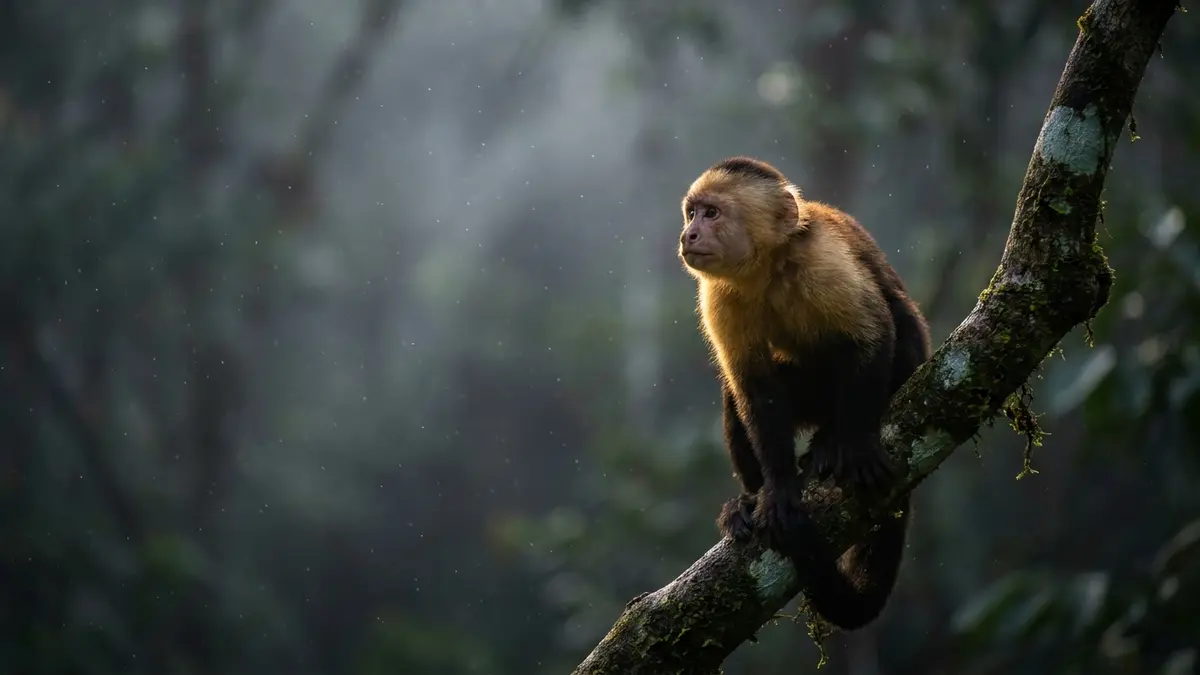
Monkeys stand for play, curiosity, and loyalty to their communities. This spirit animal urges you to have fun while staying serious. It often comes forward as a trickster, nudging you toward problem-solving and helping you open your eyes to what's going on around you. It might also spot dishonesty in yourself or others.
An almanac
- Core message
- Balance responsibility with joy
- Spirit animal
- Surprise, humor & sharper awareness
- Totem for
- Playful, adventurous, community-minded souls
- Power animal
- Creative problem-solving & true belonging
- In dreams
- Meaning shifts with the scene: flattery, joy, or creative solutions
- Cultural roots
- Hindu, Chinese, Japanese & Maya tradition
- Buddhist concept
- "Monkey mind" — restless, jumping thoughts
- Sacred form
- Baboon as Thoth, Egyptian god of wisdom
Monkeys have been an iconic teacher across many cultures for centuries, and for good reason. They're restless in their curiosity, clever in their actions, and fun to watch as they make mischief together. Yet look beyond that and you'll notice a deeper message: stay connected, stay clever, and above all enjoy your life.
Monkey Symbolism & Meaning
Monkey symbolism is all about fun, laughter, curiosity, and being a little mischievous. Spending your life just getting through stuff wears your spirit down. But spending time enjoying your life brings you back to life. A human can stay young in their mind if they stay young at heart.
Monkeys are funny and bright. And the tribe of monkeys is bonded together, they take care of one another, and they are so much a family. When monkey comes into your awareness it could be a reminder to reach out to the people around you. Reach out and care about those people in your life.
Cleverness is part of monkey symbolism, too. Monkeys can work with problems cleverly and helpfully under pressure. Hanuman is the Hindu God of Devotion, Courage, and Justice. He can untangle problems.
In Japan there's a word for monkey that is very similar to "no evil," so you often see things associated with monkey in sacred places that symbolize speaking no evil or living with integrity.
Monkey Spirit Animal
When Monkey shows up as your Spirit Animal, get ready for a wild ride. It’s likely that you’ve been feeling stuck and it’s going to shake things up. If you’re stuck, it brings a metaphorical vine to grab hold of, so you can swing free and find new momentum.
Once you get on track, Monkey makes sure your energy and morale stay buoyant.
It also has the trickster energy of showing up in your life when you least expect it to. It shows you that a sense of humor is your best defense against the challenges life throws at you.
As a guide, Monkey shows up with comedy or something unexpected to wake you up. It nudges you onto a better path. Its other medicine is helping you notice what’s happening around you — so that you don’t run into any pitfalls. And when you see something surprising, ask yourself: “Am I being fooled? Or am I getting myself in trouble by telling lies?”
Monkey guides awareness too: Pay attention to what’s around you — including other people — or else be surprised!
With it showing up for your life journey, curiosity will drive you to explore new experiences or places. But the good friends and family closest to you are worth tending, even if you travel far away.
Does Monkey fit you?
Tap the ones that sound like you — 6 traits, no right answer.
0 of 6 Nothing picked yet — start tapping.
Monkey Totem Animal
You're funny and playful and always ready to have a good time. You're inquisitive and clever, quick-witted with a mischievous streak. You take pleasure in pranks without any real malice. When someone needs a lift, you're there to make them laugh.
You never really know where life's adventures will take you. Sure, you're on the go a lot, traveling the world, or even just exploring your own town. Not because you have to be, but because it's what keeps you most alive.
Monkey Power Animal
When you want to figure out an amazing new solution, or when you're worrying about whether you're part of a group that supports what matters to you, Monkey is a great teacher. It shows you how to find clever fixes and how to choose carefully the right place to join a group.
Remember that Monkey wants you to think for yourself! You can be happy belonging, as long as joining doesn't ask you to change too much. Always weigh whether what a group offers really suits you, and whether it brings into your life the things that are most important.
Monkey Power teaches you how to relax responsibility without guilt. Too often we forget to set burdens down every once in a while! Monkey knows fun comes easy in small doses — forget guilt, it's ok to do things purely for yourself.
Monkey in Dreams
The meaning of monkeys in your dreams depends on what they're doing. Here are some possibilities.
- Loudly chattering monkeys can signify being on guard against smooth talkers trying to con you.
- Dancing monkeys signal the approach of happiness and lighthearted enjoyment. It's time to slow down and enjoy the good things in life, like laughter with people you love.
- A monkey searching in a jungle may imply a challenge to think outside the box and solve a thorny problem.
Monkey in Astrology & the Chinese Zodiac
With monkey symbolism in Chinese astrology, a basic temperament gets paired with more specific attributes. In the basic zodiac traits, these monkey people are smart and sociable. But they also have an open yet guarded nature.
People born under monkey tend to be quick-witted and especially curious. They also can laugh at themselves and their ideas. This provides the spontaneity and humor for their charming nature.
For relationships, partners must have patience. Friends must accept their need for time to adjust to new people before sharing complete confidence. Trust in people, and love, also may develop slowly for these folks as they weigh out personal costs and benefits of a new relationship.
Lucky colors usually vary in lists found online or from region to region.
Monkey Spiritual Meaning
When the monkey shows up in your life, it gives you permission to loosen your grip on seriousness and play more. A monkey never suggests that play will make you less deep or serious. The monkey shows you that laughter, curiosity, and loyalty to the community around you are at the core of what makes a life meaningful. When the monkey crosses your path, treat it like an invitation to play, to use your imagination in order to untangle a difficult problem, and to gather around those people who matter most in your life before you swing off toward another adventure.
The Buddhist "Monkey Mind"
Long ago, monkey was one of the animals representing the human mind in Buddhist teachings. The Chinese term for this is xīnyuán — literally, "heart-mind monkey." So this expression speaks to the way it feels to have your mind constantly moving around inside you.
Monkey as a spirit animal guides you to play. To be playful, even as your mind monkeys around with ideas. As a spirit guide, monkey reminds you to find joy in learning through play. Monkey as your spirit animal isn't merely telling you that you need to keep your mind active: it's pointing at that very restlessness and quieting all the more.
The invitation of monkey as your guide is not unlike the one Buddhist meditators offered themselves: keep noticing how your mind swings around in its lightheartedness, until it tires itself out.
Sacred Monkeys of Egypt and Japan
The baboon was revered in ancient Egypt as a living symbol of the god Thoth, who presided over wisdom, writing, and the moon. Thoth was seen as having a dog-like head and the body of a baboon. Baboons figured in weighing the heart, a symbolic ritual undertaken by deceased persons after death; it signified a truthful life well-lived. Thoth served as the overseer of this process.
In Shinto tradition Sarutahiko is known as the god. He is said to stand at the crossing point between Earth and heaven.
Sarutahiko is called upon for protection at crossing places. Thus he holds a significance closely linked with safety in matters concerning passage between worlds.
Why the Tail Matters
Monkeys get a lot of press for their agility and balance, both spiritually and physiologically. But this common characterization describes the situation in South America, where you'll find the only primates that evolved a tail prehensile enough to grip a branch and bear their full weight like a fifth limb. Most of the world's monkeys have tails that are at best sensitive and useful as back-up reins: they're suited for balance, not for moving or climbing.
When it comes to sorting out which kind of monkey you are, it helps to pay attention to just how good your grip on your environment is — both inner and outer. It isn't always a straightforward analysis — each of us has our own strategies — but Monkey medicine suggests that the concept is worth looking at.
Frequently Asked Questions
What does Monkey symbolize spiritually?
What does Monkey mean spiritually? Monkey energy brings with it playfulness, curiosity, cleverness, and strong social ties. It nudges you to balance playfulness with responsibility and encourages you to think creatively when you're faced with challenges.
What does it mean when Monkey is your Spirit Animal?
Monkey is a spirit animal that suggests that change and humor are in your future. It tells you to be cautious about being taken in or misled. Pay attention to what's around you and stay vigilant.
What does dreaming of a Monkey mean?
It depends on what you're seeing: if you see chattering monkeys, they're warning that flattery is hiding ulterior motives; if you see dancing monkeys, they signal joy is coming; and if you see a monkey searching the jungle, it means a problem can be solved by using creativity and trusting your instincts.
What is the Buddhist "monkey mind"?
This term for a confused, distracted, unsettled mind describes how easily minds can stray from focus and concentration. It can also mean watching how thoughts rise and subside without getting swept away by them or pursuing each one as if it's important.
Is there an Egyptian god connected to monkeys?
Yes—The Egyptian god Thoth is associated with wisdom, and writing, and this baboon serves as one form that is connected with the wise scribe of ancient Egypt.
Do all monkeys have tails that can grip branches?
No. Only the New World monkeys have tails that can grip branches and support their weight. Old World monkeys have tails that are mainly for balance, not grasping.
Monkey also represents
Sources
Claims on this page were checked against these published sources.
- Hanuman
Hanuman is the son of the wind god Vayu ... Vayuputra/Pavanputra: the son of the Vayu deva- wind god ... the exemplary devotee ... heroic, strong, assertive excellence
Read the source → - Three wise monkeys
the concept of the three monkeys originated from a simple play on words. The saying in Japanese is mizaru, kikazaru, iwazaru ... where -zaru is a negative auxiliary suffix meaning 'not' and happens to sound like a different -zaru, the voiced form of saru (猿; transl. monkey)
Read the source → - Sun Wukong
Sun Wukong ... religion includes Buddhism, Confucianism and Taoism ... He serves as Tang Sanzang's devoted bodyguard ... Courage & Martial Prowess ... Intellect & Cunning
Read the source → - Ozomatli
Ozomatli is also a god of dance, fire, the new harvest, and music.
Read the source → - Monkey mind
The term monkey mind or mind monkey originates from Chinese xīnyuán or Sino-Japanese shin'en (心猿), a word that literally means 'heart-mind monkey.'
Read the source → - Thoth
In the underworld, Duat, he appeared as an ape, Aani, the god of equilibrium, who reported when the scales weighing the deceased's heart against the feather, representing the principle of Maat, was exactly even.
Read the source → - Sarutahiko Ōkami
Sarutahiko, who stood at the crossroads between heaven and Earth, is both a god of travel as well as a guardian of boundaries. Sarutahiko helped and guided Ninigi-no-Mikoto to Earth.
Read the source → - New World monkey
New World monkeys are the only monkeys with prehensile tails—in comparison with the shorter, non-grasping tails of the anthropoids of the Old World.
Read the source →