Mammals · Spirit animal
Donkey Spiritual Meaning & Symbolism
Patience and plain self-knowledge: know your limits, and refuse to carry more than you can bear.
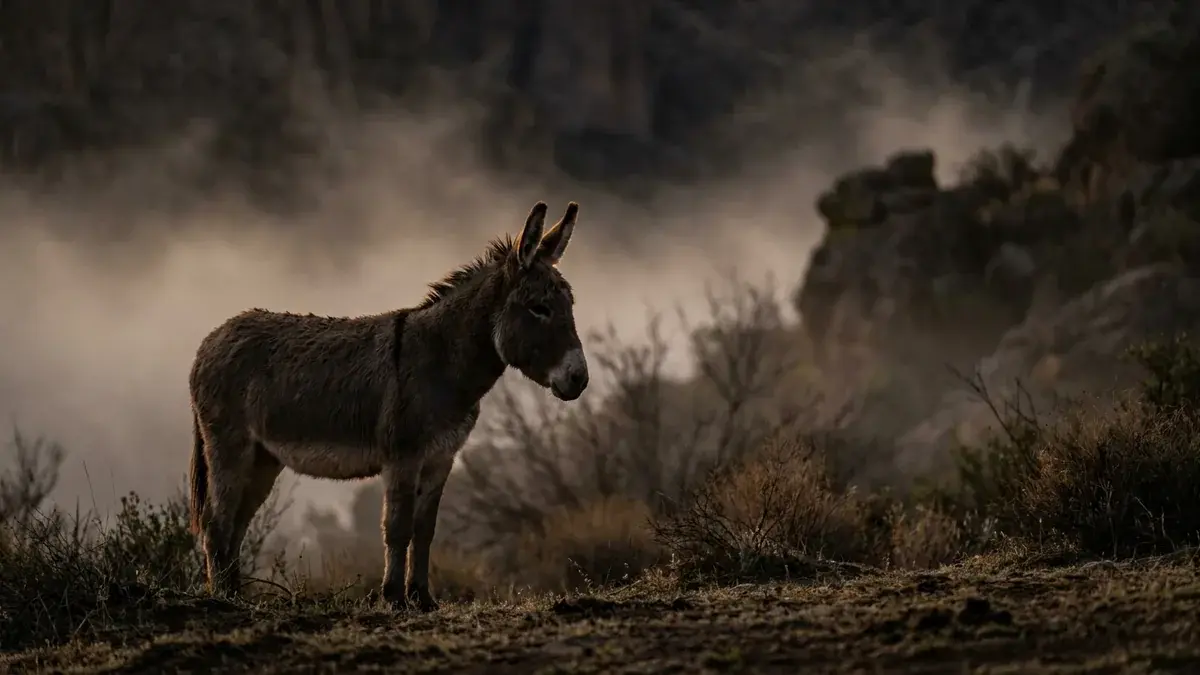
Donkey's nature as a symbol is about patience, service, and self-knowledge. In this form, it guides you to know your limits. It tells you to trust your instincts when faced with danger and teaches you to refuse to carry more than you can bear. The so-called stubbornness of the donkey is really discernment in disguise—a warning against ignoring your inner read on risk.
In a dream, a donkey usually suggests a task.
An almanac
- Core message
- Know your limits, trust your instincts
- Spirit animal
- Teaches boundaries and a firm no
- Totem for
- Independent, perceptive natural mentors
- Power animal
- Strength to hold a decision, stay planted
- In dreams
- A steady task ahead, don't overload yourself
- Cultural roots
- Egypt, Greece, Celtic Ireland, Far East
- Signature call
- Bray carries 3+ km, lasts ~20 seconds
The donkey is a symbol of patience, stubbornness, and quiet strength.
Brought to us by Mother Nature thousands of years ago, donkeys were once only found in Africa. But the donkey spread over nearly every continent, brought to us through trade, migration and conquest.
Donkey wisdom isn't always loud, but it's always consistent: know your limits, stand your ground and keep moving forward!
Donkey Symbolism & Meaning
Donkeys have been domesticated in northeastern Africa. They were originally used to replace oxen, to carry cargo or people on the long, arduous journeys across the land. Egyptian rulers treated the donkey so highly they gave it ceremonial burials. At this point the donkey began to develop into a companion animal for house-holds in Europe and was even linked to Dionysus, the Greek God of wine and revelry. As the genetics and archeology told us donkeys domesticated descend from a wild Nubian African wild ass. The oldest remains of these domesticated donkeys are known to be at Ma'adi in lower Egypt from the fourth millennium B.C.E. Donkeys are recognized for their stubborn nature (in reality, that's just deep discernment or an acute attention to risk.). This instinct comes from being observant before making any decision to pull away in order to assess if there is any danger.
This ability is what follows Donkeys across oceans and into Americas, as explorers immigrate here bringing their valued animals with them. The first donkeys arrived here during Christopher Columbus's second trip to Hispaniola in 1495 long before they carried prospectors through gold rush adventures.
Donkey Spirit Animal
Donkey comes when your workload has become unreasonable. Work isn't the only thing Donkey brings up: it also raises questions of responsibility and what you may have been avoiding. Donkey doesn't speak in words; it shows things to you with instinct, and once it does talk, it'll be hard to ignore. The presence of this animal may also let you know that some danger is imminent, and you should be cautious now that momentum may have taken over.
On the positive side, Donkey makes a great mentor for those with youthful energy, and it serves as a guide for those who want to learn from its "playful, curious intelligence." Donkey has ties with Dionysus; it may raise questions about your relationship with sensuality.
Does Donkey fit you?
Tap the ones that sound like you — 6 traits, no right answer.
0 of 6 Nothing picked yet — start tapping.
Donkey Totem Animal
People who have the donkey as their totem animal carry stubbornness. Early life experiences taught them that it was wise to hold their ground and not follow anything or anyone that didn't seem quite right. They are independent, clever, and unwilling to put up with any foolishness or cruelty, but they are especially tender with anyone who is vulnerable or unable to protect themselves.
Those with a donkey totem often become natural guides and teachers; they teach simply by helping people when they need it. They tend to be caring and warm-hearted, but they are also fair-minded and wise. When someone has been cruel or unfair, a donkey person will walk away without looking back.
Sometimes a donkey person's perceptive awareness can make others feel uncomfortable; it often seems as though they can see through other people's façade, even if they don't know the person very well. Their way of acting is usually slow, careful, and methodical; sometimes this is taken as slowness, but in fact it is just an instinct for survival. With time, the other people around them realize that their cautiousness was actually better for everyone.
Donkey Power Animal
When you need more power to stick with your decisions, call on the power of a Donkey. A Donkey can help you stay in place when it's difficult or dangerous to move, and show you exactly how to refuse a request that needs turning down.
A Donkey is especially good at helping heavy responsibilities feel lighter, and will even take on your burdens and walk alongside you until your load gets lighter.
If it feels like your mind is scattered or muffled, call on a Donkey to sharpen self-awareness. That stillness helps you hear your own intuition again.
The wisdom of this creature is especially helpful for people who need to learn self-preservation again. But anyone struggling out of painful dynamics can use a Donkey's coaching about how to keep their spirit intact.
And if you ever need to make a request politely but firmly, remember this: Donkeys bray with such strength.
Across cultures
3 traditions — pick one to read its take.
Donkey in Native American Symbolism
Donkeys did not reach the Americas until after European contact, so you won't find this animal in the mythology of older northern tribes. But there is one preserved story that really captures its protective character. One day, a chief's grandmother decided to give her grandchildren's mother a donkey as a present. She wanted the gift to be just for the children's mother. She thought of the donkey as an animal that could safely carry the babies in saddle bags.
Later, when the babies' father loaded down the donkey with pots, kettles, and stuff other than his children, it brayed loudly and kicked in protest. But their grandmother intervened. The grandmother finally made sure that the children rode on its back again.
Soon after, their camp was attacked. In all the chaos and fear, they searched desperately for their missing donkey and babies. They were afraid something terrible had happened to them. But luckily, they found out that the donkey had carried them away safely to its grandmother's tent. The story shows us how a donkey can be trusted to make good judgments.
Donkey as a Celtic Animal Symbol
In Ireland, donkeys weren't so much symbols as an essential part of everyday life. For generations, people used them to plow fields, grind grain, haul supplies and families around, and keep households going, well into the twentieth century.
Donkeys came to stand for hard work, adapting well to what you're given, and coping with a world full of limits.
For Scots, the donkey often stands for humility and patience.
Together, these views on donkeys across Celtic culture show the same basic idea: they're plodding animals.
Far Eastern Donkey Symbolic Meanings
Across northern China, Donkey was a common sight pulling plows and hauling goods, and it came to represent the disciplined, ascetic hermit, someone steady, self-sufficient, and unbothered by hardship. Taoist legend even gives the immortal Zhang Guo Lao a paper Donkey he could fold up and tuck away when not traveling.
A well-loved folk tale tells of a retiring official who, on his journey home, took pity on an old man forced to sell his one-eyed Donkey to save his son. The official paid the steep price out of compassion. Years later, his own son borrowed that same Donkey for a long journey and stayed overnight at a stranger's house, where the host secretly swapped the animal for a horse and asked only that it be returned.
The traveler later realized the generous host was the very son the old man had once been trying to rescue, and the family was repaid many times over for their original kindness. The tale's moral lingers: an unassuming, even homely companion can matter far more than appearances suggest.
Donkey in Dreams
A donkey in a dream means you have work to do, but you should remember to move gently. If a person rides on the donkey in your dream, that means they are helping with that work while not doing all of it themselves. But if the dream is about you riding the donkey, you want to remain humble.
A donkey that won't move or go somewhere can mean you're trying to do too much and need to compromise or stay strong and keep going. A braying donkey can mean someone is talking badly about you even if they are pretending to be your friend.
If the donkey is lost or struggling, you want to help something gentle and weak back into strength. A dead donkey means that burden is finished, which is good news.
When there's more than one donkey, it's asking for help with that burden.
Donkey Spiritual Meaning
Donkeys are often seen as a symbol of humility, and stubbornness. They are also said to be able to predict rain based on the twitching of their ears. Various parts of the donkey were used to treat diseases, including its hair. However, regardless of these myths, the core spiritual meaning of the donkey remains consistent: know your limits and trust your instincts.
When you see a donkey in your dreams or as a symbol in your life, you should take it as an invitation to examine what you are carrying and why. Are you carrying any excess weight that doesn't belong to you? Are you ignoring any quiet internal warning signals because it is inconvenient? Donkeys don't ask you to be impressive; they only ask that you stay honest, solid and unwavering in the face of external pressures. Over a long period of time, this steadfastness will prevail.
Donkey in the Bible & Christian Symbolism
The book of Numbers says that the donkey Balaam rode got a sense of danger before its rider, Balaam, did. Balaam's confusion turned to anger, and he hit the donkey three times without saying a word. But even so, it spoke up in defense: "What have I done to you to make you beat me these three times?" In this case, the silent creature perceived danger long before its rider did, so it turns out to have truer wisdom than we might expect.
And there are many more Bible stories that celebrate the donkey's wisdom rather than its strength. A prophet named Zechariah prophesied about a king who would ride into town on a lowly donkey rather than on a famous war horse like so many other kings do.
The Bible also says that Jesus rode into Jerusalem on Palm Sunday on the back of a donkey, fulfilling Zechariah's prophesy. Choosing the gentle donkey over the fierce war horse was Jesus's way of saying he came in peace.
To put it simply, the Bible shows us that donkeys are more than just plain animals who carry heavy loads. Over time we come to respect their humility and wisdom if we take time to listen carefully to what they have to say instead of judging them by their plain looks.
Donkey Among the Stars: The Manger of Cancer
Greek mythology gave Donkey a permanent home in the night sky. In the war between the Olympian gods and the Titans, the god Dionysus and his old tutor Silenus rode into battle on two donkeys. The enemy had never heard a bray before, and the sudden, unfamiliar noise sent them fleeing in terror, convinced some monstrous creature had arrived. As thanks, the two donkeys were placed among the stars as Asellus Borealis and Asellus Australis. They flank a hazy star cluster the Greeks called Phatne, or 'the Manger,' from which the celestial pair still seem to feed. We know that cluster today as part of the constellation Cancer.
It's a fitting elevation for an animal whose real gift was never brute strength. In myth as in daily life, Donkey wins the day with an unmistakable voice; it makes noise exactly when needed, not a moment sooner.
Frequently Asked Questions
What does a Donkey spirit animal mean?
You're probably carrying more responsibility than you can handle, or you're not carrying enough. A donkey is teaching you to set boundaries, follow your instincts about danger, and recognize when you're helping others and when you're being depleted.
Is seeing a Donkey a good omen?
People in most traditional cultures regard the donkey as an auspicious animal, an omen of steadiness, protection, and sound judgment. When you see a donkey in a dream or when it passes you on the street, it often points to caution.
What does it mean to dream about a Donkey?
In dreams, donkeys often mean you'll need to finish a job patiently and without overloading yourself. Details can add meaning too: riding the donkey can also suggest humility, a braying one warns of deceptive people around you, and one carrying someone else can mean someone is shirking their work.
Why did Jesus ride a donkey into Jerusalem on Palm Sunday?
In the ancient Near East, riding on a donkey was a sign of peacetime arrival, and riding on a horse was a sign of impending battle. But the ancient prophet Zechariah had described Israel's coming king as "lowly and riding on a donkey, on a colt, the foal of a donkey," contrasting him to other kings. This was Jesus's mission—to present himself as Israel's true king, but one who made peace.
What is the story of Balaam's donkey in the Bible?
The Prophet Balaam was riding his donkey to see a foreign king. Three times his donkey stopped because an angel of God was blocking the way. Balaam couldn't see the angel, but his donkey could. It just knew that something was blocking the road ahead.
When Balaam hit his donkey for not going forward, it spoke: "What have I done to you to make you beat me these three times?" Then God opened Balaam's eyes so that he could finally see the angel too.
Donkey also represents
Sources
Claims on this page were checked against these published sources.
- Donkey
It was domesticated in Africa some 5000–7000 years ago, and has been used mainly as a working animal since that time. Remains of domestic donkeys dating to the fourth millennium BC have been found in Ma'adi in Lower Egypt.
Read the source → - Silenus
A notorious consumer of wine, he was usually drunk and had to be supported by satyrs or carried by a donkey... a companion and tutor to the wine god Dionysus... the oldest, wisest and most drunken of the followers of Dionysus.
Read the source → - Zhang Guolao
When his journey was finished, he folded his mule up and placed it in his pocket or a small box... When he wished to use the mule again, he poured water on it from his mouth and the mule regained its form.
Read the source → - Numbers 22:28 (NIV)
Then the Lord opened the donkey's mouth, and it said to Balaam, 'What have I done to you to make you beat me these three times?'
Read the source → - Zechariah 9:9 (NIV)
Rejoice greatly, Daughter Zion! Shout, Daughter Jerusalem! See, your king comes to you, righteous and victorious, lowly and riding on a donkey, on a colt, the foal of a donkey.
Read the source → - Zechariah 9:9 – King on a Donkey
Horses are for times of war... Donkeys are for times of peace. The king, here in Zechariah, is 'triumphant and victorious,' and has no more need to wage war.
Read the source → - Cancer (constellation)
The stars represent the donkeys that the god Dionysus and his tutor Silenus rode in the war against the Titans.
Read the source →