Mammals · Spirit animal
Whale Spiritual Meaning & Symbolism
The deep-sea keeper of ancestral memory, emotional depth, and quiet inner song.
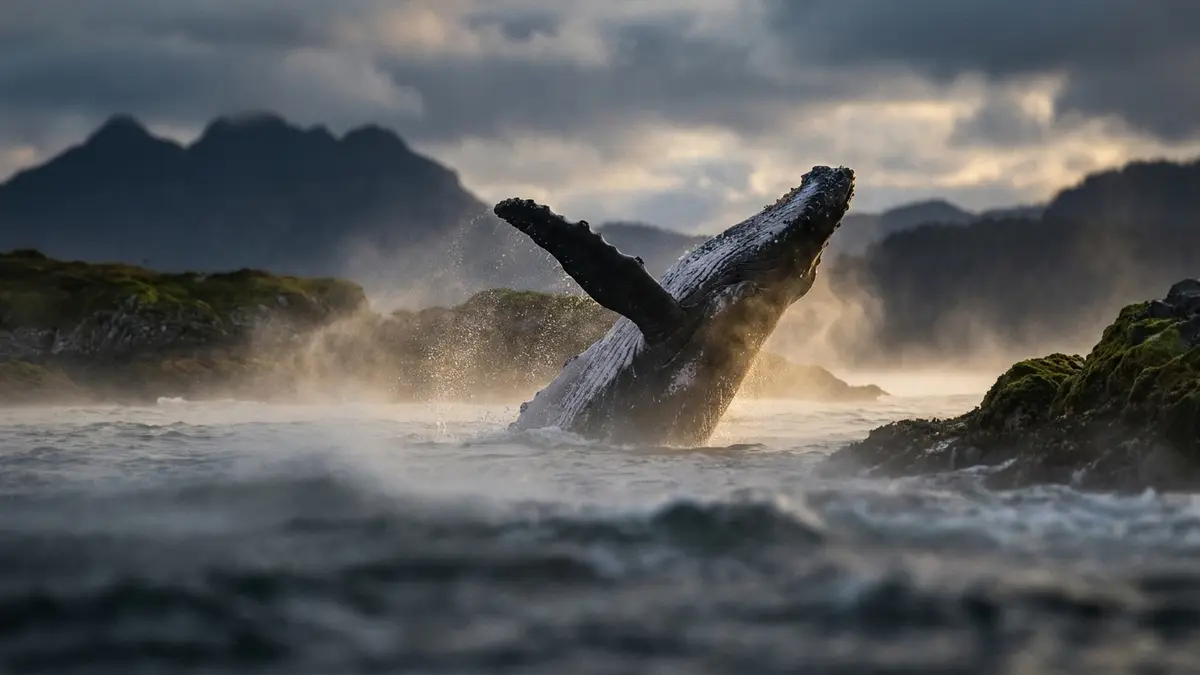
Whale is a powerful spirit animal that appears at times of deep grief or pressure. Whale asks you to endure that deep pain calmly, and to breathe again when it's time. With whale as your totem animal, you can trust the guidance of your intuition, even when what you're hearing goes against the grain. Whale in dreams points to major life change and the need to dig deeper and listen more intently for the deeper meaning beneath the surface. It can also point to maternal and nurturing themes in your life.
An almanac
- Core message
- Descend, endure, surface, renew
- Spirit animal
- Endure emotional pressure until it's time to surface
- Totem for
- Loyal, long-distance emotional communicators
- Power animal
- Finding your authentic voice through compassion
- In dreams
- Major change, deepening intuition, maternal themes
- Cultural roots
- Native American, Celtic, Christian, Far Eastern & African lore
- Loudest voice
- Blue whale calls may carry up to 1,000 miles
- Ancestor tradition
- Māori Paikea, carried to shore on a whale's back
Whales inspire a sense of awe. People used to call them keepers of memory and emotional truth. Even today, this huge mammal can draw you into stillness rather than spectacle. Whales pull you in like a pod gliding in darkness through miles of open water. They help you listen inward, pause, and tune your own frequency.
Whale Symbolism & Meaning
When a whale rises from the deep, many cultures read this event as an archetypal symbol for a journey between worlds — between what can be easily perceived and what can't. The consciousness of whale has been described as an "archive," a repository that retains the knowledge of an entire ocean. In the same way, humanity's own history is stored.
If whale surfaces in your awareness, it can be a call to descend into your own inner depths — to endure and find renewal.
The rhythm of whale diving into the deep and then rising to breathe holds archetypal meaning: to endure, renew. In the story of Jonah and the Whale, being inside the whale is not just a punishment but also a passage toward transformation.
A whale sighting has long been perceived by sailors as something of a blessing, and they will often carry small whale-tail talismans on their ship for protection during their journey at sea.
Whale Spirit Animal
The whale offers guidance when you feel submerged. The right way to deal with pressure, grief, and loss of identity is not to try to escape. Instead, understand that there's time to breathe. It will come when you need it. Don't rush it. Trust your lungs.
Another lesson the whale teaches is rhythm, on a level beyond what you know of as physical rhythm. You can trust yourself to notice what your instincts and heart are telling you, beneath any noise or fear or obligation you may feel.
Does Whale fit you?
Tap the ones that sound like you — 6 traits, no right answer.
0 of 6 Nothing picked yet — start tapping.
Whale Totem Animal
A person whose totem is whale is a natural long-distance communicator who can maintain emotional closeness with their families and close companions even when years or miles of distance have separated them.
Trustworthiness, loyalty, and truthfulness run deep for whale-totem people. Those who know them instinctively trust them to tell them the truth even when emotions have clouded judgment.
Also because of this ability to reach beyond ordinary consciousness into intuitive realms, they tend to move fluidly between those inner oceans and everyday reality, and they become an emotional bridge for others who cannot navigate those depths alone.
But they need to surface back into physical reality where they can breathe.
Whale Power Animal
You can call on the Whale energy when you want to find your authentic voice — not a message to prove anything, but just your own song. You can also use this energy when you want to explore your ancestry or trace back your family tree.
Whale may also nudge you into pursuing creative or spiritual pursuits — things that work together with other parts of yourself rather than working like a solitary force.
Across cultures
5 traditions — pick one to read its take.
Whale in Native American Symbolism
Native nations that live along the coasts in North America widely regard whale as a symbol of wisdom, spiritual insight, good fortune, and lifelong devotion. For them, whale is also the guardian of safe travel on the seas. Being splashed by an orca is a mark of joy; many people believed the first song of a killer whale could silence all creation. Some viewed whale as Mother of the Sea and used its image on their tribal crests to symbolize both its nurturing care and its great strength.
The Salish people and others from around the Pacific Northwest associate whale with peace, family, and steadfast protection. At times, they linked this creature to the souls of loved ones who had lost their lives at sea; these relatives returned to the seas as whales to watch over their families on shore. Stories about people seeing whales near land reflected strong kinship bonds with the whale family; a story that held particular importance told how whale sometimes mated with humans to produce children who were offspring of two families.
People have woven images of whales into Pacific Northwest art. Whale stories and legends can be found from Nova Scotia, including stories that tell how people were swallowed by whales but then rescued through family connections. You will also see other legends in which an ancestor's spirit visits someone on shore in the form of a whale or in which human-whale unions produce offspring.
Whale in Celtic Symbolism
Celtic legend says Saint Brendan the Navigator used a whale as a platform for an Easter service during a storm-tossed voyage. The idea of these whales as gentle giants offering refuge amid chaos lives on in Celtic myth. Whale can embody either Water or Air, and in Celtic myth, the whale rises from the waters to breathe air before plunging back into the darkness again.
In other stories, whales represent fears of being swallowed up by the unknown. Fears like when Daire, a warrior, was swallowed whole by a whale. And when Fruich, a swineherd, was turned into a whale. Even in Scotland, legends talk about a fearsome sea creature called Cirein-cròin that devours whales.
Another part of whale's nature is seen when legends say Ireland's first harp was carved from the bone of a whale.
Whale in Christian & Biblical Symbolism
The defining biblical reference for whales comes from Jonah, where Jonah is swallowed by a whale after fleeing his calling. The whale is not a symbol of God's punishment, but of Jonah's opportunity to reflect on his actions and return to carrying out his duty. Some interpreters make the connection between Jonah's rebirth into the whale and Jesus' teachings on death and resurrection.
A look inward may be exactly what you need when you're stuck trying to fulfill a calling. This can mean a quiet room, a long soak in the tub, or meditation. Whale symbolism is also found in Genesis where whales are listed as one of the earliest creatures, connecting the whale with primordial origins.
But that's not all there is to say about whales. Some later Christian symbolism makes them out to be more fearsome creatures -- monstrous mouths that lure the unwary into depths from which they might never return.
Whale in Far Eastern Symbolism
Across parts of the Far East, whale carries associations with abundance and sustenance — one legend credits the animal with delivering the first millet seed that fed all subsequent life. In Taiwanese lore, whale is said to have guided the historical figure Coxinga safely out to sea — a role that casts the animal as a divine navigator.
In Chinese tradition, the giant whale-being Yu-Kiang ruled the ocean with near-human features, and angering this deity was blamed for storms and earthquakes. Vietnamese folklore instead frames whale as protective and lucky, even crediting the animal with rescuing sailors in danger — a sharp contrast to cultures that painted whale as an adversary of seafarers.
In Hindu tradition, some retellings link whale to Matsya, the fish avatar of Vishnu, which ties the creature to primordial power, generosity, and the fathomless subconscious. Japan's modern relationship with whale, meanwhile, has increasingly turned toward conservation and respect.
Whale in African Symbolism
East African tradition tells the story of King Sulemani, a ruler who worked tirelessly to feed his people. Once, he asked for the blessing of a higher power to feed every man, woman, and child on Earth. In response, a great whale was sent to swallow up all the crops in his fields.
When the king realized what he'd asked for — that he and his people would have to fill the whale to sate its hunger — he learned a humbling lesson about ambition and humility.
Whale in Dreams
A whale surfacing in your dreams typically signifies big change coming on the horizon. The thing that you see coming, or that you have already started to embrace, could shake the foundation of what you've built up to now. These dreams can also speak to matters of nurturing or maternal connections.
The color and species of whale you see may help you connect with a specific interpretation. For example:
- If the whale is blue, this might suggest a big change with a wide-scale impact, like love or emotional healing.
- An orca may symbolize loyalty, protection, and affection.
- A motherly figure is often associated with caring for oneself.
When a whale appears calmly in your dream, it may represent feeling grounded as you take the next steps in your life's journey.
Whale Tattoo Meaning
A whale tattoo, especially a whale-tail design, often signals intuition, protection, and a bridge between the emotional depths and the wider spiritual world. For some, it marks a beloved coastal retreat or a lasting bond with the sea itself; for others, it honors a specific cultural tradition, such as Pacific Northwest whale artistry.
Whale ink can also nod to well-known stories like Moby-Dick, which captures both the pull toward exploration and the risk of being consumed by obsession. Whatever the design, the tail specifically tends to symbolize grounding strength paired with the freedom to dive deep and return.
Whale Spiritual Meaning
Whales may swallow people whole, but they don't eat them. Sperm whales, on the other hand, are notable for being singularly self-sufficient; their symbolism leans toward quiet inner worth. Bigger isn't always better: smaller beluga whales point toward gentle self-acceptance; narwhals toward embracing individuality over conformity; and gray whales toward patience.
Whale in Pacific Islander & Oceanic Symbolism
In Polynesian culture, whales are looked at as relatives, ancestors, and guides. This view differs a bit from most cultures that focus on whales as separate beings. It's less about the whale being an animal than a way of thinking about life in general. Kanaloa was known as the great ancestor who taught humans how to navigate the ocean.
The story of Paikea is probably the best known example of how whales have been seen by many native island cultures. Paikea was betrayed by a jealous brother while he was out at sea, and he called on the ocean gods for help. A whale rescued him, carrying him safely to shore. The Ngāti Konohi tribe believes that Paikea is an ancestor whose descendants are alive today and are known as Whale Riders.
In this sense, a whale becomes someone that you can turn to when things go wrong and you have no idea what's going to happen next. Instead of seeing it as a lonely spirit guide who is just there for you during your time of need, it becomes more like someone who always has your back no matter what happens.
Whale Song & the Symbolism of Sound
Long before whale became a metaphor for finding your voice, it was already the loudest voice in the animal kingdom. Blue whales are counted among the loudest animals on the planet, and their long, low pulses and moans can carry to other whales up to 1,000 miles away across open ocean — a scale of communication no other creature on Earth can match.
Spiritually, that fact reframes what "singing your own song" means in whale symbolism. The call isn't loud for its own sake; it's built to travel, to reach someone specific across distance and darkness with almost nothing lost along the way. That's the model whale offers for authentic voice — not volume for its own sake, but a signal tuned so precisely to who you are that it still lands, clearly, on the other side of whatever separates you from the people who need to hear it.
Frequently Asked Questions
What does it mean when whale is your spirit animal?
It shows up at times when you are emotionally overwhelmed, and it teaches you that you can calm yourself during difficult times until you can breathe and relax and re-gain clarity.
What does seeing a whale in a dream symbolize?
Dreams about whales usually point to an upcoming change, deepening your intuition, or feelings tied to nurturing and maternal bonds. Pay attention to the species and color, because they can sharpen the message.
What does a whale tattoo represent?
A whale tattoo, especially of a whale's tail, often represents intuition, protection, and your place in the spiritual world and your ancestors.
What is Wadi Al-Hitan and why is it connected to whale symbolism?
The UNESCO World Heritage site in Egypt's Western Desert of Wadi Al-Hitan is also known as 'Whale Valley' because the fossil record it preserves includes the world's largest concentration of intact Archaeoceti. Archaeoceti was a suborder of extinct whales that had hind legs. These fossils are proof of whales' own transformation from land-dwellers to ocean mammals, just as whales are often read as symbols of transformation.
What does a beluga or narwhal symbolize spiritually?
Belugas and narwhals are gentle, individualistic whales. They don't make the transformation dramas of their larger cousins; instead they tend inward to help you find self-acceptance and inner peace.
Is a whale sighting considered good luck?
In many seafaring cultures, seeing a whale is considered lucky. If it's a healthy whale swimming freely, it's a sign of safe travel. But if it's a sickly whale then you'd better pay attention: whale luck means the animal's condition. Good luck means the animal looks healthy and happy; poor luck signals trouble.
Whale also represents
- Other animals that represent death →Alongside Raven, Crow, Buzzard & Vulture, Owl
- Other animals that represent love →Alongside Dove, Swan, Wolf, Seahorse
- Other animals that represent rebirth and change →Alongside Butterfly, Snake, Dragonfly, Frog
- Other animals that represent wisdom →Alongside Owl, Elephant, Turtle, Raven
Sources
Claims on this page were checked against these published sources.
- Jonah
After being cast from the ship, Jonah is swallowed by a large fish, within the belly of which he remains for three days and three nights.
Read the source → - Genesis 1:21 (KJV)
And God created great whales, and every living creature that moveth, which the waters brought forth abundantly, after their kind...
Read the source → - Brendan of Clonfert
the most commonly illustrated adventure is his landing on an island which turned out to be a giant sea monster named 'Jasconius'... once they light a fire, the island starts to move revealing its true nature.
Read the source → - Humpback whale
Male humpback whales produce complex songs during the winter breeding season.
Read the source → - Wadi Al-Hitan (Whale Valley)
Wadi Al-Hitan, Whale Valley, in the Western Desert of Egypt, contains invaluable fossil remains of the earliest, and now extinct, suborder of whales, Archaeoceti... This is the largest concentration of intact whale fossils in the world with 400 skeletons representing a variety of whale species from the Eocene era.
Read the source → - Kanaloa | Kahoʻiwai
Kanaloa is often revered as the Hawaiian god of the ocean and is a pivotal deity in Hawaiian mythology. He emerged as one of the four major deities... Dolphins, whales, bananas, and even the ocean are all viewed as Kanaloa's kinolau.
Read the source → - Whale rider – Paikea rides the whale
According to the story, the ancestor Paikea was enticed on a fishing trip with others. During this, his jealous brother Ruatapu sank the canoe in an effort to drown them. However, Paikea called on the guardians of the sea to help him. A taniwha in the form of a whale was sent to take him to safety... Paikea is the ancestor of the Ngāti Konohi sub-tribe.
Read the source → - Blue Whale
They are among the loudest animals on the planet, emitting a series of pulses, groans, and moans... sounds emitted by blue whales can be heard by other whales up to 1,000 miles away.
Read the source → - Fun Facts About Wonderful Whales
Blue whales can grow up to 31 meters (100 feet)—roughly the length of a basketball court. Blue whales have weighed up to 160 tons.
Read the source →