Mythical Creature
Mermaid Symbolism & Meaning
The Mermaid guides you to balance heart and mind, embrace your emotions, and honor your own untamed individuality.
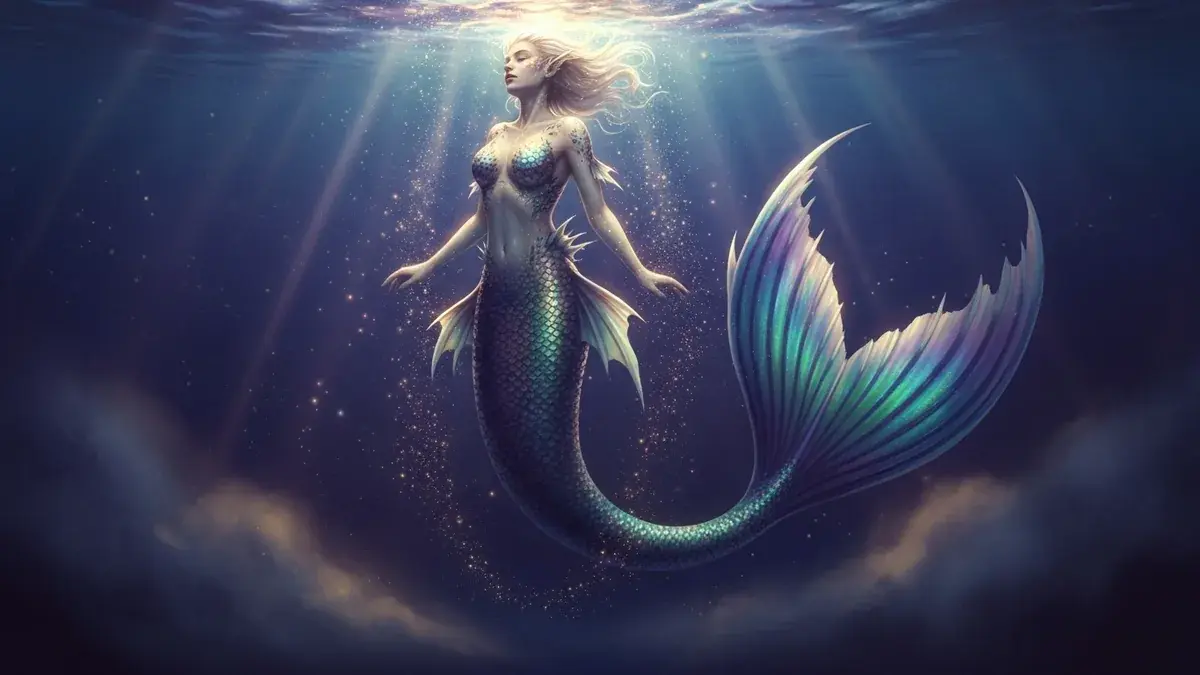
The Mermaid symbolizes the balance between heart and mind, deep emotional intuition, and fierce individuality — a guide who asks you to embrace your feelings rather than fear them. As a spirit animal, she pulls you into the emotional realm of Water, urging you to face old fears, reconnect with your inner child, and "go with the flow" of life's changes. She also carries a dual nature as an omen of luck or warning, reflecting both the healing and the danger that can come from being swept up in strong emotion.
An almanac
- Core message
- Balance heart and emotions
- Spirit animal
- Face fears, go with the flow
- Totem for
- Empathic, free-spirited souls
- Power animal
- Creativity, intimacy, transformation
- In dreams
- Feminine side, emotional depths
- Element
- Water
- Greek cousin
- Siren — a bird-woman, not fish
- African tradition
- Mami Wata, goddess of water & wealth
Half woman, half fish, and wholly captivating, the Mermaid has swum through human imagination for thousands of years. She is a creature of contradiction — luring sailors with an irresistible voice while also offering luck, wishes, and healing to those with an open heart. Explore what the Mermaid represents as a spirit guide, totem, and power animal, and discover how her image has shifted across Celtic lore, Native American legend, and stories from the Far East.
Mermaid Symbolism & Meaning
Tales of Mermaids and their male counterparts, mermen, have always carried a certain enchantment. Their song is often described as impossible to resist, drawing sailors toward beauty and desire — which is why the Mermaid stands as a symbol for keeping your head and heart in balance, especially in matters of love.
She also reminds you that it's fine to move to your own rhythm; individuality and refusing to conform run deep in her nature.
As an omen, the Mermaid carries two faces. A generous Mermaid might grant a wish or bring good fortune, yet sailors historically viewed a sighting as a warning that a voyage could end badly.
Sacred feminine and independence
Her name traces back to a medieval English term meaning "maid of the sea," with an older root meaning "water witch." Because she is female, the Mermaid is closely bound to the sacred feminine — evoking goddesses of love such as Venus and sea nymphs like Calypso.
She cannot be tamed or pinned down, and her fierce independence means she rarely stays anchored in one place, reinforcing her link to uniqueness and self-determination.
Her symbolic tools
Artists commonly show her holding two symbolic tools: - A fish-bone comb, tied to old sailor beliefs that carrying fish bones aboard a ship allowed one to divine the weather and calm rough seas - A mirror, long associated with moonlight, intuition, and scrying — much like a crystal ball
Together, these speak of prophecy, far-sight, and psychic sensitivity.
Sightings and ancient imagery
Mermaids are said to reveal themselves mainly at dawn and dusk, the thin, in-between hours when the boundary between worlds loosens; some legends claim she only appears to those with a pure heart, linking her to discretion and quiet awareness.
The classic image of a woman's torso joined to a fish's tail has roots in the ancient Near East — fish-tailed figures appear in Old Babylonian art, and the Syrian goddess Atargatis was said to have transformed into a fish-woman — and sailors once carved her likeness onto ship figureheads as a good-luck charm.
Water element and Atlantis
Because she belongs to the Water element, the Mermaid can represent life, cleansing, and renewal, but also the danger of crashing waves capable of pulling you under — a dual pull of fascination and fear that has always drawn people to her.
Some spiritual traditions hold that Mermaids originated among the shapeshifters of Atlantis before moving into the etheric realm, where seekers can still connect with their wisdom today. Mermaid medicine, in this light, is often invoked in support of ocean health and the wider marine world.
Mermaid Spirit Animal
When the Mermaid Spirit Animal enters your life, she pulls you into the realm of Water — the realm of emotion. Expect to be asked to look honestly at old fears and wounds, because true healing only comes from facing them directly. She stays with you through that process, offering comfort rather than judgment.
Her arrival can also be a nudge to reconnect with your inner child and with nature itself, blending the wonder of youth with the beauty of the wider world. As a being who exists somewhat outside of time, she can teach you to move between different states of awareness safely, in the places where past, present, and possibility overlap.
If she had a single piece of advice, it would be to "go with the flow." Let yourself move with the ebb and current of life the way water shapes itself to whatever holds it — this is where her gift of adaptability lives.
One caution: the Mermaid has no patience for pretense, so working with her means staying authentic and dropping any mask you might be wearing.
Mermaid Totem Animal
People who carry the Mermaid as a totem tend to feel deeply connected to the natural world, appreciating its beauty while sensing there is always more happening beneath the surface. They move through relationships by openly exchanging joy, calm, and vibrancy, and their preferred language of love is affirmation rather than possession.
Jealousy and the urge to control a partner don't fit their nature; they'd rather walk alongside someone toward shared goals.
Empathy and inner child
The inner child stays vivid and active in Mermaid people, and their gift for empathy runs so strong it can become a burden — crowded, emotionally noisy environments can overwhelm them quickly. With practice, they can learn to observe others' feelings the way one watches a film, present but no longer swept away, which guards against emotional exhaustion.
In relationships, Mermaid totem people rarely settle into convention, though they welcome a passionate partner and carry a strong, unfiltered sensuality; because they also tend to be private, some of that desire goes quietly unexpressed.
Water and psychic gifts
Those with this totem gravitate toward water, and the ocean especially offers a sense of healing and renewed energy. Mermaid totem people often carry strong psychic gifts, perceiving spirits, fae, angels, and other unseen beings with ease, sometimes including clairvoyance and a magnetic, hypnotic charm.
Mermaid Power Animal
Call on Mermaid as a Power Animal whenever your work involves the Water element — rituals, meditation, or spellcraft. She is especially useful when you need creative inspiration, particularly for singing or any form of vocal expression, since she can loosen self-consciousness and let true feeling come through.
When it comes to intimacy, she helps dissolve the inhibitions that keep you from real pleasure. She is also strongly tied to transition and transformation, offering steadiness when you're navigating a major life change. Finally, reach for her presence when your emotions feel unmanageable or when your intuition has run dry — Mermaid medicine mends heartache and discouragement while keeping your intuitive gifts active, helping you steer clear of emotional chaos.
Mermaid as a Celtic Animal Symbol
Celtic tradition is full of water spirits, with sprites and nymphs typically dwelling near sacred wells and waterfalls — but the Mermaid belongs to the open sea. Within this tradition, she represents the feminine force of the universe itself: potent and mysterious.
Carvings of a double-tailed Mermaid appear on numerous old churches across medieval Europe, a motif that, like the related Sheela-Na-Gig grotesques, is believed by some scholars to echo older pagan goddess imagery — though the two carving traditions are distinct.
The Merrow's Magic Cap
In Ireland, the Mermaid goes by another name: the Merrow, a green-haired, green-scaled sea-woman who slips between worlds by way of a magical cap known as the cohuleen druith. Legend says that without it in hand, she cannot return to the sea — which is why old tales tell of Merrow-wives kept ashore by husbands who hid the cap away, only for her to uncover it years later and vanish back beneath the waves. Male Merrows, by contrast, are described as far less lovely than their female counterparts, which folklore offers as the very reason Merrow maidens go looking for human husbands on land in the first place. Scotland tells a kindred story of the Maid-of-the-Wave, who relies on a sealskin rather than a cap to travel between sea and shore — proof that wherever coastal peoples have watched the tide, they've imagined a Mermaid slipping just beneath its surface.
Native American Mermaid Symbolic Meanings
Several Indigenous nations passed down their own Mermaid legends:
- The Mi'kmaq tell of a bird that stumbles upon a pond holding five striking women who are not quite human — scaled skin, seaweed hair, and fish-like lower bodies adorned with treasures from the sea.
- The Passamaquoddy recount how two girls disobeyed their parents by swimming somewhere forbidden and became covered in slime; their legs turned to serpents and their hair to black strands as they transformed into Mermaid beings called HeNwas.
- The Sekani tell of a human man who marries a Mermaid. Homesick for the sea, she is eventually allowed to hunt so she can provide for him, and the pair raise seven children together. When winter returns, he breaks open the ice so she can go home — but her children cannot follow, and her attempt to bring them along ends in tragedy beneath the water.
Mermaid Dreams
A Mermaid appearing in a dream almost always points to femininity and its many facets, often surfacing insight about your own feminine side. This is generally a favorable sign — unless the emotions and awareness she stirs feel unwelcome. If you dream of a Mermaid swimming through water, it may reflect a flood of feeling that threatens to pull you under, as though you're struggling to stay afloat beneath life's pressures. Treat it as a signal to reach for support before you go under.
Far Eastern Mermaid Symbolic Meanings
Chinese literature holds many Mermaid stories that echo Western versions — she can weep pearls, shift her shape, foresee the future, and craft enchanted objects. One well-loved tale describes a Mermaid who stays with a human household for several days so she can weave and sell cloth; grateful for their hospitality, she cries a vessel full of pearls as a parting gift to the family.
Japan's Ningyo
Japan's own Mermaid, the Ningyo ("human fish"), takes a stranger shape than her Western sisters — early depictions gave her a human head atop a fish's body, sometimes with small, monkey-like teeth. The most enduring Ningyo legend holds that her flesh grants eternal youth: in the tale of Yao Bikuni, a girl from Wakasa Province unknowingly eats Ningyo meat brought home as a guest-gift and lives on for centuries without aging, until she finally retreats to a mountain cave. Versions of this story have surfaced across dozens of Japanese regions, each one circling the same truth the Mermaid teaches everywhere — that a life without end, and without belonging, is its own kind of curse.
Mermaids vs. Sirens: A Note on Origins
Long before the fish-tailed Mermaid took her familiar shape, Greek myth told of a very different creature: the Siren. In Homer's Odyssey, sirens wore the face and torso of a woman atop a bird's wings and clawed feet — a bird-woman bound to omens of death and the underworld, not a creature of the tide.
Odysseus famously had himself lashed to his ship's mast so he could hear the sirens' song and live to tell of it, while his crew sealed their ears with wax against that same lure — the earliest version of the very warning sailors would later give about Mermaids.
Only across the Middle Ages and into the Renaissance did the siren's wings quietly vanish, replaced bit by bit with a fish's tail, until the two figures blurred into the single enchanting image most people carry today. If Siren lore has ever crossed your path, know that she and the Mermaid share a voice and a warning, but not a birthright — the winged temptress of Homer's sea and the fish-tailed woman of later legend are, at heart, two different spirits wearing a similar song.
Mami Wata: The Mermaid of West and Central Africa
Across Western, Central, Eastern, and Southern Africa — and carried onward through the Atlantic diaspora into the Caribbean and South America — devotees honor Mami Wata, a water spirit and goddess whose name blends "mother" and "water" in African Creole tongues. She is a Mermaid in her own right, ruling over wealth, fertility, healing, wisdom, and beauty.
Mami Wata is said to reshape herself at will and to command the rivers and seas she moves through, and those who seek her favor traditionally take on celibacy or other spiritual disciplines in her honor — a reminder that her gifts, like the Mermaid's everywhere else, are given only to those who approach with sincerity rather than mere want.
Her imagery has shifted across the centuries, echoing the layered, ever-changing nature the Mermaid embodies wherever she surfaces: not one fixed picture, but a living tradition still actively practiced today.
Frequently Asked Questions
What does it mean when a Mermaid appears as your spirit guide?
A Mermaid spirit guide usually signals that you're being called to work through buried emotions tied to the Water element, reconnect with playful, childlike wonder, and learn to move fluidly through life's changes rather than resisting them.
What does the Mermaid totem say about relationships?
Mermaid totem people tend to love through affirmation rather than possessiveness, resist conventional settling down, and carry strong empathic and sensual instincts — though their private nature can leave some desires unspoken.
What does dreaming about a Mermaid mean?
Mermaid dreams typically relate to your feminine side and emotional depths. A Mermaid swimming through water in a dream can suggest you feel overwhelmed by your feelings and may need to reach out for support.
What's the difference between a mermaid and a siren?
In the earliest Greek myths, sirens were bird-women — a woman's face and torso set atop a bird's wings and feet — used as omens of death, most famously in Homer's Odyssey, where Odysseus ties himself to his ship's mast to survive their song. Only during the Middle Ages and Renaissance did artists gradually swap the siren's wings for a fish's tail, blurring her into the Mermaid we picture today. So while the two share a hypnotic voice and a warning for sailors, they began as two distinct mythic creatures.
Did anyone ever really report seeing a mermaid?
Christopher Columbus recorded in his 1493 ship's journal that he'd spotted three "mermaids" off the coast near what is now the Dominican Republic, adding that they were "not half as beautiful as they are painted." Historians agree he almost certainly saw manatees, whose rounded faces and human-like eyes have fueled real-world mermaid sightings for centuries.
Sources
Claims on this page were checked against these published sources.
- mermaid | Etymology, origin and meaning of mermaid
mid-14c., meremayde, literally "maid of the sea" ... Old English had equivalent formations meremenn "mermaid, siren" and merewif "water-witch"
Read the source → - Mermaid
Fish-tailed humanoid figures... appear on Old Babylonian... cylinder seals... the Syrian deity Atargatis... was said to have transformed into a 'human-headed fish' after drowning herself in a lake, according to Diodorus Siculus
Read the source → - Calypso (mythology)
a nymph who lived on the island of Ogygia
Read the source → - Native American Mermaids (Indian Mermaid and Merman Legends)
Halfway People — the Mi'kmaq Indian mermaids
Read the source → - Ne Hwas (Newas), the Passamaquoddy mermaid
Passamaquoddy story of two girls who turned into mermaids
Read the source → - Jiaoren: The Merfolk Who Weave Exquisite Silk and Cry Pearls
One old story tells how a Jiaoren came to live with a human family for a while, to weave and trade her fabric... When at last it was time for her to leave, she asked them for a jar, and wept many tears into it. Each tear turned into a perfect shining pearl. She gave the priceless jar of pearls to the family as a parting gift
Read the source → - Mami Wata
Her first representations were probably derived from European images of mermaids and marine sculptures.
Read the source → - Ningyo
a girl who ate it acquired everlasting youth and longevity
Read the source → - Merrow
This cap resembles "a strange looking thing like a cocked hat" and is crucial for keeping merrow-wives from escaping to their marine realm.
Read the source → - Siren (mythology)
the face and upper body of a woman and the wings and lower body of a bird
Read the source → - Columbus mistakes manatees for mermaids
on the previous day, he saw three 'mermaids'—in reality manatees—and describes them as 'not half as beautiful as they are painted.'
Read the source →