Mythical Creature
Mothman & Owlman Symbolism & Meaning
Winged omens of the Air element, born from modern sightings rather than ancient myth, where fear, intuition, and imagination collide.
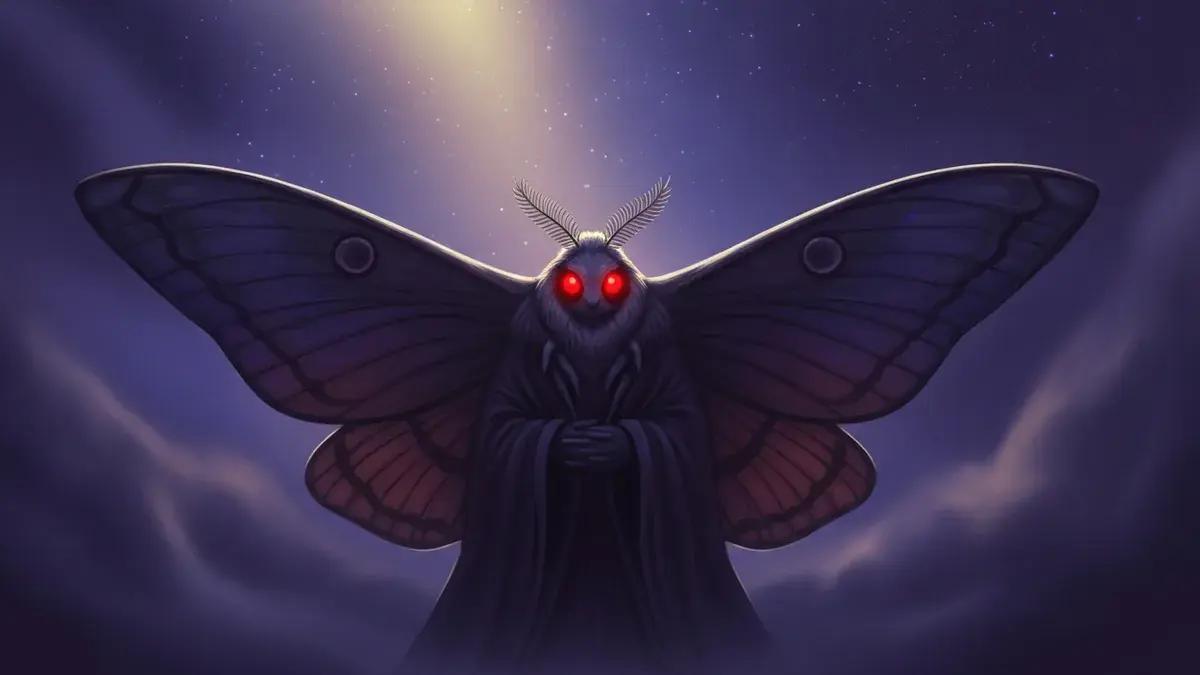
Mothman and Owlman symbolize the two sides of the Air element - rational intellect and primal intuition - and the human urge to find meaning in events that don't have an easy explanation. As a spirit animal, they signal an approaching breakthrough that combines Moth's themes of death and rebirth with Owl's nocturnal wisdom, and as a totem they mark truth-tellers who sense change before it arrives. Their central lesson is discernment: telling genuine intuition apart from fear-driven illusion.
An almanac
- Core message
- Imagination colliding with fear and intuition
- Spirit animal
- Moth's rebirth blended with Owl's wisdom
- Totem for
- Truth-tellers and early warners
- Power animal
- Confronting shadow fears at a breakthrough
- In dreams
- A coming breakthrough or an unfaced fear
- Element
- Air
- Sighting site
- The TNT area, a former WWII munitions plant
Unlike most legendary beasts, Mothman and Owlman are creatures of recent memory rather than ancient myth, each tied to a specific date, place, and cluster of eyewitnesses. The two winged figures surfaced a decade and an ocean apart, yet share so many traits - the glowing red eyes, the massive feathered wingspan, the man-like frame - that they're often read as two faces of a single symbolic pattern. This page covers where each creature came from, what skeptics have proposed as a mundane explanation, and what these encounters have come to mean as spirit, totem, and power animal.
Where Mothman & Owlman Came From
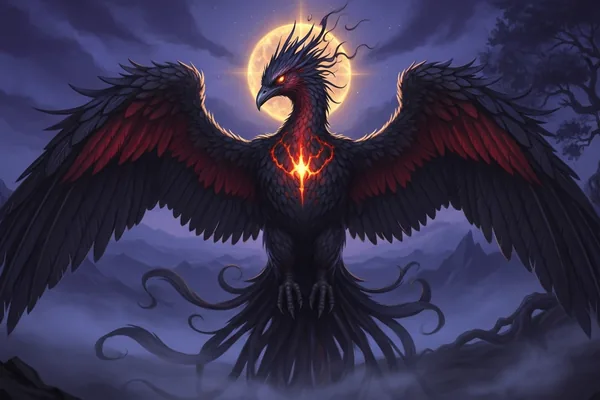
Mothman's story begins on November 15, 1966, in Point Pleasant, Virginia, when four witnesses described a man-sized figure with broad, feathered wings and glowing red eyes. The being had a grayish cast to its skin, and word of the encounter spread quickly once it reached local police and, soon after, curious researchers drawn to the strange report.
A biologist named Robert L. Smith offered a down-to-earth counter-theory: he suspected the witnesses had actually seen a Sandhill Crane, a bird whose gray plumage, red eye markings, and wide wingspan could plausibly be mistaken for something far stranger in poor light.
The legend darkened about thirteen months later, when a bridge near the original sighting collapsed and 46 people died. Many locals connected the tragedy to the earlier encounters, and that link cemented Mothman's reputation as an omen of disaster rather than a simple oddity.
Owlman surfaced a decade later, first reported in 1976 near St. Stephen's church in Mawnan, Cornwall. Witnesses described a large winged man - roughly ten feet across the wingspan - hovering above their cars. Investigator Tony Shiel gathered the accounts and gave the creature its name. That original description already included pincer-like claws alongside the same glowing red eyes later associated with Point Pleasant. Further encounters were logged in 1978, 1979, and 1995. As with Mothman, skeptics point to a natural culprit - in this case the Eurasian Eagle-Owl - as a likely source of the sightings.
Owlman's own case file is thinner but no less colorful. The first report came from two young sisters, June and Vicky Melling, who said they saw the winged shape hovering above the church tower on April 17, 1976; their father cut the family's holiday short soon after. A second, more detailed sighting followed on July 3, 1976, from fourteen-year-olds Sally Chapman and Barbara Perry, who described 'a big owl with pointed ears, as big as a man,' complete with glowing eyes and black claws.
Skeptics have offered a further alternative beyond the Eagle-Owl theory: ordinary barn owls, which regularly nest in church towers and can look startling when silhouetted against floodlights. Others go further still - occult historian Gareth Medway argued the whole episode was a hoax orchestrated by Tony Shiels, noting that the witnesses were 'either Doc Shiels, or friends of Doc Shiels, or relatives of Doc Shiels.'
Mothman & Owlman Symbolism & Meaning
Both creatures unsettled the people who encountered them, yet their legends outgrew that fear. Films, comics, and a devoted following of paranormal enthusiasts followed. Mothman and Owlman are, in essence, about the power of imagination.
Each figure blends two sides of the Air element: the rational, analytical mind, and the older, more primal current of intuition that logic alone can't capture. When those two currents mix, the result can be a burst of creative insight - or a story of terror, depending on which side takes the lead.
The glowing red eyes shared by both creatures carry a double meaning. Red can suggest menace, but it's equally the color of passion and power, and the eyes themselves are long-standing symbols of wisdom, intuition, and inner sight. The wings and feathers, meanwhile, tap into humanity's fascination with flight: they stand for freedom and movement, and for the reach of the imagination.
- Reminds us the world still holds real wonder and mystery
- Points to the blend of intellect and intuition within the Air element
- Reflects our tendency to look for connections between frightening events, even coincidental ones
The way people linked Mothman's appearance to the later bridge collapse says as much about human psychology as it does about the creature - it echoes the archetype of the scapegoat, and hints at a kind of butterfly effect where a strange sighting becomes woven into a chain of later events.
The bestselling book and film The Mothman Prophecies ran with this idea and cast Mothman as a harbinger of disaster. A reported Mothman sighting in Moscow in the late 1990s, before a deadly apartment bombing in 1999, has been cited in the same vein.
Because of their coloring and their association with sudden, unforeseen upheaval, Mothman and Owlman are sometimes linked to the Tower card in Tarot, as well as to the planet Uranus and the sign Aquarius - all symbols of abrupt, disruptive change.
These creatures speak to something very human: our drive to find meaning in the unexplainable, even when that meaning lives more in the mind than in the world.
Mothman & Owlman as Spirit Animals
If Mothman or Owlman keeps showing up in your life as a symbolic thread, it's worth looking at the two creatures they're built from: Moth, tied to death, initiation, and rebirth, and Owl, tied to nocturnal insight, lunar energy, and intellect. Together they can signal that you're standing at the edge of an unexpected breakthrough.
Working with this spirit animal often raises pointed questions. Is your imagination running wild and painting monsters where none exist? Are you so focused on fear that you're missing the real wisdom trying to reach you? Mothman and Owlman connect you to the Air element's core gifts - freedom, change, intellect, and creativity - though getting there may mean first working through deeper fears or channeling your own shadow side into something productive.
Both creatures carry a strong association with prophecy, so their appearance as a spirit guide often comes with a lesson about discernment: are you trusting genuine intuition, or letting anxiety fill in the blanks?
Mothman & Owlman as Totem Animals
People carrying Mothman or Owlman totem energy tend to be truth-tellers - often perceived as living on the margins, yet also the first to raise an alarm when real change is approaching.
- When out of balance, this energy can tip into jumping to conclusions, panic, or feeding on hysteria
- When balanced, it produces people who act as vanguards - early warning systems for their communities
- The central lesson for this totem is learning to sharpen discernment
Those who master that discernment can become powerful in two related roles: as prophets who sense change before it arrives, and as creative messengers who translate that insight for others.
Mothman & Owlman as Power Animals
Calling on Mothman and Owlman as power animals means preparing to meet the energy of breakthroughs and the unknown head-on, so it's worth grounding yourself first. Because this work can stir up shadow material, make sure you feel ready before inviting these forces in - though facing that material is often exactly where the empowerment comes from.
- Turn to Mothman and Owlman when you need to remove your blinders and see what you've been missing
- Call on them when you're on the edge of a breakthrough or ready to confront a lingering fear
- Invite them when you want to embrace your creative and intellectual gifts, or when you're seeking greater freedom
- Work with them whenever you need help telling truth apart from illusion
Mothman & Owlman in Dreams
A dream visit from Mothman or Owlman often signals a coming breakthrough, or an encounter that feels out of the ordinary and hard to explain rationally. If your first reaction in the dream is fear, that response may itself be the message: these figures can be nudging you to face your shadow side and work through fears sitting just below conscious awareness.
Mothman & Owlman in Modern Memory
Mothman's story didn't end with the Silver Bridge collapse. Point Pleasant turned a night of terror into part of its identity: the town's Mothman Museum opened in 2006, and a 12-foot stainless steel statue by sculptor Bob Roach has stood on Gunn Street since 2003. Every September, the Mothman Festival draws upwards of ten thousand visitors for a weekend built around the legend, a symbol of fear that became a symbol of community pride.
Author John Keel deserves much of the credit for that transformation. His 1975 book The Mothman Prophecies wove the original sightings together with the Silver Bridge tragedy and a wave of strange happenings that followed, giving Mothman the narrative shape most people know today. Keel himself returned to Point Pleasant as guest of honor at the second Mothman Festival in 2003, present for the statue's unveiling.
Owlman's afterlife took a darker turn. The 2013 Scottish horror film Lord of Tears recast the Cornish creature as an avatar of Moloch, the deity the Hebrew Bible associates with demanded sacrifice: an owl-faced Moloch haunts a man whose parents once bargained with it for a wish. It's a modern, fictional reinterpretation, not any documented ancient cult, but it shows how easily Owlman's stare gets tied to older fears around debt, sacrifice, and what we owe the things we call up from the dark.
Frequently Asked Questions
What do Mothman and Owlman symbolize?
They symbolize the two sides of the Air element - rational intellect paired with primal intuition - and the human urge to find meaning in strange, unexplainable events. Their glowing red eyes point to wisdom and insight as much as menace, while their wings speak to freedom, movement, and imagination.
Are Mothman and Owlman considered omens of disaster?
Popular legend has linked both creatures to tragedy - Mothman to a fatal bridge collapse in Point Pleasant about a year after its 1966 sighting, and a similar Mothman report in Moscow to a deadly 1999 bombing. Whether or not any real connection exists, the association has made Mothman a symbol of disaster and sudden change.
What's the difference between Mothman and Owlman?
Mothman was first reported in 1966 in Point Pleasant, Virginia, while Owlman surfaced a decade later, in 1976, near Mawnan, Cornwall. Both are described as winged, man-sized figures with glowing red eyes, though Owlman sightings additionally described pincers. Skeptics have proposed a Sandhill Crane as the source of Mothman sightings and a Eurasian Eagle-Owl for Owlman.
Is the Owlman sighting believed to be a hoax?
Some researchers think so. Occult historian Gareth Medway pointed out that the Owlman witnesses were 'either Doc Shiels, or friends of Doc Shiels, or relatives of Doc Shiels' - referring to Tony Shiels, the investigator who named and promoted the creature. Others prefer a simpler explanation: ordinary barn owls, which commonly nest in church towers, can look startling when caught in floodlight against a dark sky.
Were there other witnesses to Mothman besides the original two couples?
Yes. Shortly after the November 1966 sighting by the Scarberrys and the Mallettes, local contractor Newell Partridge came forward with his own account, describing eyes that glowed 'like bicycle reflectors' when caught in flashlight beam. Reports like his helped the story spread beyond the original four witnesses and into wider local and national attention.
Sources
Claims on this page were checked against these published sources.
- Mothman
First Sighting Date: November 15, 1966 ... Eyes: Described as "glowing red" by initial witnesses
Read the source → - Owlman (cryptozoology)
Date: April 17, 1976 - Location: Mawnan, Cornwall, near St Mawnan and St Stephen's Church ... Tony "Doc" Shiels investigated the report and "dubbed" the creature "Owlman"
Read the source → - The Mothman Museum
The main focal point of the John Keel exhibit in the museum is a glass display case containing a white suit which John Keel wore to the 2nd Annual Mothman Festival in 2003—his last trip to Point Pleasant, where he was the festival's guest of honor and present during the unveiling of the Mothman statue.
Read the source → - Lord of Tears
The film reveals that James's parents worshipped Moloch, a deity who would "grant wishes in exchange for a sacrifice." Moloch manifested as the Owl Man creature that haunted James's childhood.
Read the source → - Moloch
Moloch appears in the Hebrew Bible, primarily associated with Canaanite religious practices... The term is most heavily connected to child sacrifice.
Read the source →