Mythical Creature
Phoenix Symbolism & Meaning
The fire-born bird that turns every ending into a beginning
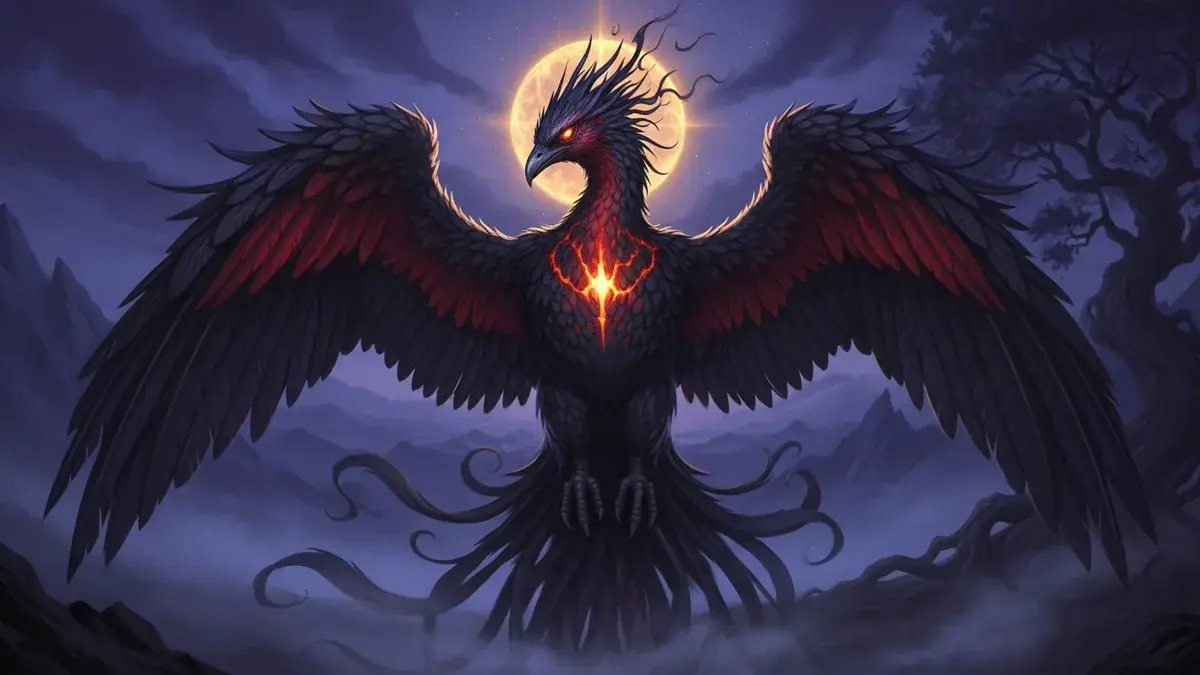
The Phoenix symbolizes rebirth, transformation, and renewal — a bird that willingly burns to ash so something new can rise in its place, turning endings into beginnings rather than losses. As a spirit animal, it signals that something in your life needs to end so growth, clarity, and creativity can take its place; as a totem, it points to a hopeful, resilient, fire-forged nature that treats major change as a positive shift.
An almanac
- Core message
- Endings make way for new beginnings
- Spirit animal
- Signals needed change and renewal
- Totem for
- Hopeful, resilient, fire-forged people
- Power animal
- Guides difficult transitions and grief
- In dreams
- New beginnings and spiritual growth
- Cultural roots
- Greek, Egyptian, Celtic, Christian, Far Eastern
- Name origin
- Greek phoinix — 'purplish-red,' possibly tied to Phoenician dye trade
Few legendary creatures carry a message as recognizable as the Phoenix — the bird that willingly turns itself to ash so something newer can rise in its place. Cultures from ancient Greece and Egypt to Celtic Ireland and imperial China have told their own version of this story, each circling back to one idea: endings aren't the opposite of life, they're how life renews itself. This guide traces the Phoenix through its major myths and traditions and what its fire, ashes, and return can mean for anyone moving through change.
Origins and Core Meaning
The Phoenix's many versions keep landing on the same handful of ideas: rebirth, transformation, renewal, permanence, and the sacredness of life itself. It's a rise out of darkness into light, a full life cycle folded into one image, often read as a stand-in for the soul's own immortality.
The earliest widely cited written account comes from the Greek historian Herodotus, who placed the bird's home at the temple of the sun in Heliopolis, Egypt. He described an oversized creature with extraordinary plumage that carries its dead parent, wrapped in myrrh, there once every five hundred years. Later classical writers added the more familiar image: the bird builds a nest, is consumed by fire, and rises again renewed. The poet Hesiod separately claimed it could outlive nine generations of ravens.
Classical writers didn't agree on how long that cycle lasted. Hesiod's Precepts of Chiron put the bird's lifespan at roughly nine ravens' worth of years — something like 972 human lifetimes by ancient reckoning. The Roman writer Manilius told a different version: the Phoenix lives in Arabia and dies every 540 years, and a worm rises from its bones and marrow to become the next Phoenix. Herodotus's 500 years is simply the figure that stuck; the myth itself was never that precise about its own timeline.
- Rome minted the Phoenix onto its coins as a symbol of the empire's strength and staying power.
- The Church adopted it as a symbol of resurrection, and linked its three days of ash to Christ's three days in the tomb.
- In Egypt, the bird took the form of the Bennu, depicted as a great grey heron and identified as the ba (soul) of the sun god Ra. Egyptian alchemists linked it to the south, to fire as transformation, to the sun as clarity, and to summer and red sulphur as symbols of the soul.
Phoenix as a Spirit Animal
When the Phoenix shows up as a Spirit Animal, its message is simple: light a fire under whatever hopes have gone quiet, and let that fire feed a tired spirit as much as it burns away what no longer serves you.
- Phoenix energy is about change — something symbolic may need to end before renewal can begin.
- It shines light into hidden darkness, and as negativity clears, clarity and creativity tend to rise in its place.
- If you're starting something new, its appearance is a sign that growth is on your side.
- For someone approaching marriage, it's considered a happy sign of a lasting relationship.
Phoenix as a Totem Animal
People who carry the Phoenix as a Totem Animal tend to share a willingness to give themselves over to something bigger than their own comfort:
- A hopeful outlook that spreads to others, with little patience for prolonged gloom.
- A life shaped by frequent, significant change — new jobs, partners, or homes — almost always felt as a positive shift.
- An inner steadiness, a core forged by fire, that keeps them grounded during hard stretches.
- A feistier streak, balanced by a real need to lean on trusted people so they don't burn out.
Phoenix as a Power Animal
Called on as a Power Animal, the Phoenix suits moments of difficult transition. It offers insight through rough patches and helps you move toward acceptance after genuine loss or grief. Working with it isn't always gentle: expect a cleansing fire and a push toward outlooks you hadn't considered.
As a creature born of flame, it's also a fitting guide for anyone working with the element of Fire, and it offers protection and wisdom along the way.
Native American Symbolic Connections
The Phoenix itself isn't part of Native American tradition, but its imagery is often linked to Eagle, and some accounts suggest the Greeks folded Eagle's imagery into their Phoenix legend after it traveled from Egypt. One Native story follows a bird that can never lay eggs: claimed by the sun for eternity and hunted by humans, it fled toward the sunrise, sang there for five hundred years until it begged the sun to renew it, then built a nest of cinnamon twigs and myrrh in place of an egg — the resulting blaze consumed it, only for it to rise again, smaller but whole, roughly every five hundred years.
- Thunderbird, whose wingbeats are said to sound like thunder, is sometimes spoken of alongside the Phoenix for its shared themes, though the two come from separate traditions; its own meaning centers on weather, balance, protection, and integrity.
- Along the Puget Sound, stories describe a Firebird credited with giving humans fire — another echo of the same pattern.
Celtic Symbolic Connections
The Phoenix doesn't appear directly in Celtic mythology, but its themes of sacred fire and rebirth show up in Irish tradition through Brigid, a fire goddess, and Lugh and Balor, gods of light.
- Celtic tradition's major seasonal holidays were historically fire festivals, including Beltaine and Samhain.
- Samhain lines up with Phoenix symbolism: it marks the thinning veil between worlds and the shift into the dark half of the year, ahead of the return of light at Yule.
- Scholar Richard Barlow's reading of Finnegans Wake notes that the word "burn" carries both a fire and a water meaning, which echoes the Phoenix's blend of destructive and regenerative elements.
- More recently, the Phoenix has been a symbol of revolution around the 1916 Easter Rising and of Ireland's economic recovery after 2008.
Christian Symbolic Meanings
The Phoenix doesn't appear prominently in the Bible, but its parallel to Christ's death and resurrection is hard to miss: a being that dies in flame only to return unblemished. Beyond resurrection, it's read as a symbol of self-sacrifice and hope — a reminder that apparent total loss can still give way to something redemptive.
Far Eastern Symbolic Meanings
The Phoenix appears throughout Far Eastern tradition, most prominently in China and Japan.
- In China, the bird is known as Feng Huang and is traditionally depicted in pairs to represent yin and yang — a popular wedding image meant to wish balance and happiness.
- Legend holds it has appeared to herald the reigns of virtuous rulers, and this cemented its reputation as an omen of blessing.
- As an imperial symbol it represented respect, fidelity, and peace; some traditions link its tail colors to the five virtues of Confucianism — charity, honesty, loyalty, knowledge, and good manners.
- Beyond the tail, five parts of the Feng Huang's body are traditionally mapped onto the same set of Confucian virtues: the head corresponds to virtue, the wings to righteousness, the back to propriety, the abdomen to trustworthiness, and the chest to benevolence — the whole bird becomes a walking model of ideal conduct.
- In Chinese tomb art it warded off evil spirits, and in Feng Shui it's considered auspicious for prosperity, traditionally placed in a home's southern area.
- The Feng Huang's pairing with the Dragon is its own named tradition: the phoenix as yin to the dragon's yang. Together they form a female-male balance that made the pair a favorite motif for weddings and imperial imagery alike. The idiom long feng cheng xiang ("dragon and phoenix bringing prosperity") describes a stroke of good fortune so complete it seems to carry the pair's blessing, while ren zhong long feng ("a dragon or phoenix among people") is still used to praise someone whose talent makes them stand out from everyone around them.
- In Japan, it's called Ho-Oo, blending the male energy "Ho" and female energy "Oo," with imagery dating to around the seventh century.
Phoenix Tattoo Symbolism
A Phoenix tattoo is widely read as a personal marker of a death-and-rebirth moment — recovering from serious illness, surviving a near-death experience, or completing a spiritual initiation. Whatever the specific story, the tattoo tends to carry one common thread: "survivor." It signals that hardship has refined rather than diminished the wearer. The tattoo is often chosen to mark a transition or the overcoming of a major obstacle.
Phoenix in Dreams
A Phoenix appearing in a dream is generally read as a favorable sign of a new beginning, often tied to spiritual growth and a burst of insight or magical awareness. A few details are worth noting:
- The dream may point to the need for closure on something from your past that continues to hold you back.
- A worn or bedraggled Phoenix can be a nudge to pay closer attention to your health and stop overextending yourself.
Phoenix Spiritual Meaning
At its spiritual core, the Phoenix is about transformation, rebirth, and the union of opposites — much like yin-yang, it represents masculine and feminine energy that coexist within every person. Its meaning is tied to transition and initiation, and to the reassurance that rebirth remains possible even when it first requires some form of sacrifice.
Its power is closely bound to fire — passion, intensity, motivation, and courage. Its symbolism can be invited into your life through meditation, ritual, or creative practice, and its presence may surface in dreams or quieter moments of awareness. That often signals it's time to release an old identity to make room for who you're becoming.
Phoenix Analogues Around the World
The Phoenix's core idea — a bird of fire that dies and returns — turns up under different names almost everywhere people have looked to the sky for meaning. In Persian tradition, the Simorgh is a wise, benevolent bird large enough to carry a man. It's associated with purification and often paired with the tree of all seeds. Arabic legend tells of the Anqa (or Anka), a vast, ancient bird so rare that its name became shorthand in Arabic for something that exists in description only, never in fact.
Hindu mythology carries its own fire-birds in Garuda, the golden eagle-man who serves as Vishnu's mount, and the smaller, fiercer Bherunda. Slavic folklore has the glowing Firebird (zhar-ptitsa), a creature whose feathers are said to light a room like a lantern and who appears across Russian fairy tales as both a prize and a temptation. Further east, Tibetan tradition names its own version Me byi karmo, which is woven into local cosmology alongside other elemental guardians.
None of these figures are simply "the Phoenix" borrowed and renamed — each carries its own myths, moods, and roles in its home culture. Taken together, though, they suggest the same thing the Phoenix points to on its own: a bird that embodies fire, rarity, and renewal answers something nearly every culture has needed to put into a story.
What Does the Phoenix Look Like? (Classical Descriptions)
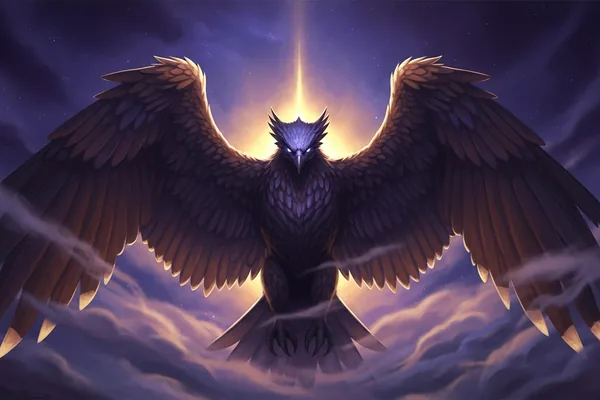
For all the attention the Phoenix's death and rebirth get, ancient writers spent real effort describing what the bird actually looked like. Herodotus, describing what he says he was told rather than what he saw himself, called its plumage "partly red, partly golden," with a shape and size "almost exactly that of the eagle." Centuries later, the Christian writer Lactantius filled in more detail: sapphire-blue eyes, a neck lined with rose-colored feathers, and scales the color of a purple-tinted gold, with rose-colored talons. Ancient artists often crowned the bird with a halo of seven rays that echoed the sun god Helios, a fitting detail for a creature so tightly bound to solar imagery across Egyptian and Greek sources alike. Pliny the Elder added one more distinguishing feature: a crest of feathers on its head that set it apart from any ordinary bird of prey.
None of these accounts fully agree with each other, which is part of the point — the Phoenix was never pinned down to a single physical form the way, say, a lion or an eagle was. Each writer's version emphasizes fire and gold and rarity, but leaves the exact picture just out of focus, which may be why the bird has stayed so easy to reimagine in art across every era since.
Frequently Asked Questions
What does the Phoenix symbolize?
The Phoenix symbolizes rebirth, renewal, transformation, and the sacredness of life. Its defining story — dying in flame and rising again unharmed — is why people read it as a symbol of resurrection, hope, and the idea that endings can lead directly to new beginnings.
Where does the Phoenix legend come from?
The earliest widely cited written account comes from the Greek historian Herodotus, who traced the bird's origins to Ethiopia. Related fire-bird traditions also appear independently in Egypt (the Bennu), China (Feng Huang), and Japan (Ho-Oo). Each carries its own cultural meaning.
What does it mean to dream about a Phoenix?
Dreaming of a Phoenix is generally read as a positive sign of a new beginning, spiritual growth, or a surge of insight. A worn or tired-looking Phoenix in a dream can also be a reminder to slow down and take care of your health.
Did anyone actually claim to see a Phoenix?
Yes — ancient Roman writers recorded supposed sightings, including one the historian Tacitus dated to 34 AD, tied to a cycle of either 500 or 1,461 years. But even in antiquity there was open skepticism: Pliny the Elder documented claimed sightings around 36 and 47 AD while still stating plainly that 'nobody would doubt that this phoenix was a fabrication.' The Phoenix, in other words, has been treated as equal parts legend and hoax since Roman times.
Is there a real-bird explanation behind the Phoenix myth?
Some researchers point to ordinary bird behavior as a possible seed for the legend. One theory ties it to 'anting,' where birds let ants crawl over their feathers or expose themselves to smoke to control parasites — a strange, fire-adjacent ritual to an outside observer. Another points to molting, where a bird sheds old feathers and grows vivid new plumage, which gives the visual impression of a creature renewing itself. Neither theory proves anything about the myth's true origin, but both offer a grounded counterpoint to its purely symbolic reading.
Sources
Claims on this page were checked against these published sources.
- Bennu
New Kingdom artwork shows Bennu as a huge grey heron with a long beak and a two-feathered crest... He was said to be the ba (personality component of the soul) of the sun deity Ra.
Read the source → - Phoenix (mythology)
the 'Numidian crane' represents the phoenix on the coinage of Antoninus Pius
Read the source → - Thunderbird (mythology)
The thunderbird is said to create thunder by flapping its wings in Algonquian tellings... Thunderbirds are often viewed as protectors, sometimes intervening on people's behalf, but expecting veneration, prayers, and gifts.
Read the source → - Fenghuang
The male feng represented the yang aspect while the huang represented the yin aspect
Read the source → - Universal Myths and Symbols: Animal Creatures and Creation
the Phoenix lives in Arabia and dies every 540 years on a sweet-smelling nest. From the bones and marrow of the dead Phoenix a worm is born and it becomes the new Phoenix.
Read the source → - The Phoenix: A Source of Divine Inspiration in Chinese Culture
Five parts of the phoenix's body have been linked to Confucian values: the head representing virtue, the wings righteousness, the back propriety, the abdomen trustworthiness, and the chest benevolence. Phoenixes are often depicted as the female, or yin, counterpart of the male, or yang, dragon, creating a female-male or yin-yang balance when the dragon and phoenix are paired together.
Read the source →