Mythical Creature
Nandi Bear Symbolism & Meaning
The solitary shapeshifting hunter of East African legend, marked by fierce self-reliance and a predatory kind of intellect.
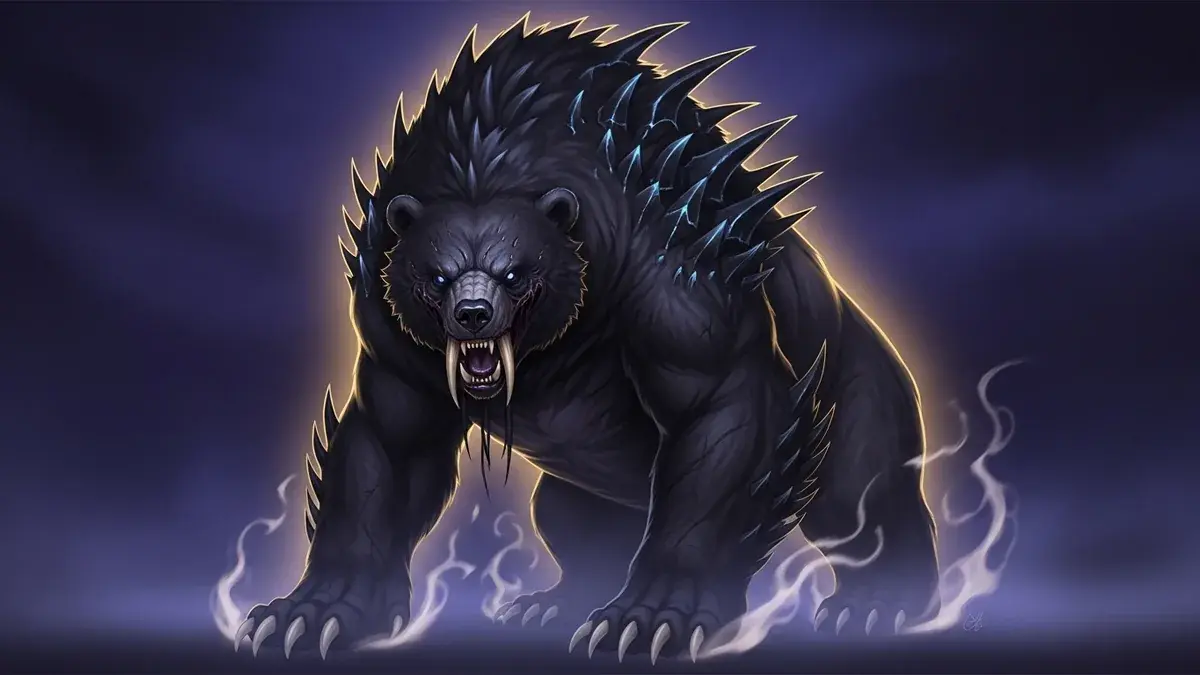
The Nandi Bear symbolizes fierce independence and strategic intelligence, the pairing of raw survival instinct with higher-level planning. As a spirit animal it tends to show up when it's time to lift your gaze toward higher ground, defend what matters with both passion and clear thinking, and outthink obstacles instead of just overpowering them. In dreams, it signals that you're gathering the strength to face down what scares you and stay locked onto what matters most.
An almanac
- Core message
- Independence fused with strategic intelligence
- Spirit animal
- Look toward higher ground
- Totem for
- Fierce, determined goal-chasers
- Power animal
- Committing fully to new ventures
- In dreams
- Facing fears, staying focused
- Element
- Earth and Air
- Alternate names
- Chemosit, Kirit, Duba, Koddoelo, Ngoloko
- Reported height
- Over 4 ft (1.2m) at shoulder
Deep in the highlands of western Kenya, the Nandi people told of a creature so elusive that outsiders spent decades arguing over what it even was. Known by names like Chemosit, Kirit, and Duba, the Nandi Bear blends the silhouette of a shaggy bear with the hunched gait of a hyena and the climbing ease of a baboon. Come to it through folklore, cryptozoology, or symbolic reflection, and its story still circles back to the same themes: solitary strength, sharp intellect, and the instinct to survive on your own terms.
Origins & Description
The Nandi Bear takes its name directly from the Nandi people, whose accounts of this animal eventually reached wider audiences through colonial-era travelers exploring East Africa. Witnesses gave varying descriptions, but most agree on a few core features: a heavy, reddish-brown to dark brown coat, a build that reads as part bear and part hyena, and at times a resemblance to a hyena-baboon hybrid.
In some tellings, the creature rests back on its haunches and moves with the same rounded hunch you'd see in a baboon.
Because of its rarity and its outsized, humanlike reputation, some have nicknamed it Africa's answer to Bigfoot or Sasquatch. What set it apart in local accounts was its comfort in more than one world — it was just as at home prowling the ground as climbing into the treetops, a reach that few predators could match.
Beyond Chemosit, Kirit, and Duba, regional tellings across East Africa gave the creature still more names — Koddoelo and Ngoloko among them. The name Duba itself is thought to trace back to Arabic, echoing either dubb ("bear") or ḍabʿ ("hyena") — a small linguistic clue to just how thoroughly this animal straddled two categories in the minds of everyone who described it.
Accounts of its size were just as striking as its shape: witnesses described front shoulders standing over four feet (1.2 meters) tall, with a back that sloped down toward the hindquarters — a silhouette closer to a hyena's profile than a true bear's, even at that imposing scale.
Folklore & Legend
One of the first written descriptions to reach audiences beyond East Africa came from Geoffrey Williams in the 1930s, who is generally credited with attaching the "Nandi Bear" label to the creature because of its ursine looks and its ties to Nandi territory.
In the stories, this was no gentle beast — it was described as a highly capable hunter, strong enough to break through livestock fencing and reportedly drawn to the brains of the animals it killed. Some of the more unsettling accounts even claimed it targeted children in the same gruesome way.
Sightings piled up from explorers, hunters, and colonial settlers throughout the 1900s, then thinned out dramatically as the century wore on, with very few modern reports to speak of. Skeptics and naturalists have floated a few explanations over the years:
- Some argue that sightings actually describe a chalicothere, an unusual clawed mammal.
- Others believe the Nandi Bear was a real species that has since gone extinct, its memory kept alive only through oral history.
- Naturalist Charles William Andrews first proposed the chalicothere theory in 1923, and Louis Leakey revisited it in the 1930s, even though the real chalicothere was a plant-eater rather than a predator.
- Zoologist Reginald Innes Pocock argued many sightings were simply misidentified spotted hyenas — a reading the British Natural History Museum backed in 1932, stating that many reports had "proved to have been nothing more than a spotted hyena."
- Paleontologist George Gaylord Simpson suspected some accounts described a ratel, or honey badger, a species already known to science since 1776.
- Explorer Richard Meinertzhagen offered a different guess in 1905, wondering if witnesses had glimpsed an "anthropoid ape now extinct on account of decreased rainfall."
- As recently as 2000, paleontologist Louis L. Jacobs suggested the whole legend might trace back to garbled, word-of-mouth descriptions of gorillas carried into regions where gorillas never actually lived.
Even the physical evidence stayed frustratingly indirect: in 1914, colonial administrator Charles William Hobley produced a diagram of a supposed Nandi Bear footprint, but no bone, hide, or body was ever recovered to settle the debate.
Whatever its zoological truth, the creature's reputation for menace points to something simple: from the perspective of would-be prey, every predator looks monstrous. Read symbolically rather than literally, the Nandi Bear's ferocity has less to do with evil than with the raw discipline it takes to survive in the wild.
Symbolism & Meaning
Because nearly every account describes a lone animal rather than a pack or family group, little is known about how Nandi Bears might organize socially — and that gap in the record becomes symbolically meaningful in its own right. The Nandi Bear symbolizes the person who charts their own course, someone who doesn't wait on a group consensus before acting.
Its signature colors, brown and red, tie it to passion, grounding, practicality, and intense drive. Its dual comfort on the ground and in the branches links it to both the Earth and Air elements — the patient, practical instinct to stay rooted, paired with the agility to rise above a situation and see it from higher up.
Because folklore blends this creature from three different animals, each contributes its own layer of meaning:
- Bear brings protective, nurturing energy alongside a willingness to fight fiercely for family and territory.
- Hyena represents the balance of masculine and feminine principles — the wisdom to know when to push forward and when to hold back.
- Baboon carries a reputation for sharp intelligence, historically associated with the wisdom of the god Thoth.
Taken together, the Nandi Bear symbolizes the bridge between raw survival instinct and higher strategic thinking — the ability to plan, adapt, and use your mind as skillfully as your strength.
Nandi Bear Spirit Animal
When the Nandi Bear shows up as a spirit animal, it often arrives at a moment when you sense there's more out there for you to pursue. If your career, relationship, or some other corner of life suddenly feels flat or unsatisfying, this creature nudges you to lift your gaze and look toward higher ground.
It teaches you to pace yourself while climbing toward a vantage point that gives you a real edge over whatever you're up against.
It can also surface when you need to defend what matters to you — your home, your people, your interests — and reminds you to combine passion with clear thinking rather than letting emotion alone drive the fight. Its folkloric link to feeding on the intellect of its prey ties this creature to sharp, strategic thinking: when the Nandi Bear arrives, it may be time to go on the offensive and outthink whatever stands in your way.
Nandi Bear Totem Animal
People carrying Nandi Bear totem energy tend to come across as fierce, determined, and hard to stop. You approach your goals the way this creature approaches a hunt — carefully, deliberately, and with a plan. If this is your totem, you likely have real intellectual firepower, capable of building an argument that actually has bite to it.
You tend to blend ambition and passion with sharper insight, and you shift your perspective as a situation demands. Because you're intellectually nimble, you're often the one who can win a debate others thought was already settled. This totem pushes you to stay focused on your goal and push past whatever barrier stands between you and it — there's no obstacle too inconvenient to cross when you're after something you truly want.
Others may occasionally find your intensity a lot to handle, but learning to stand firm for your own interests is one of this totem's core lessons.
Nandi Bear Power Animal
Call on the Nandi Bear power animal whenever you need to commit fully to a new project or need a fresh surge of energy behind your ambitions. It's especially useful when you're adapting to unfamiliar territory or fighting for a foothold on ground that isn't yet your own.
This power animal helps you find balance between opposing forces inside yourself — the pull to assert yourself versus the need to stay watchful, your intellect versus your more primal drives. When you draw on the Nandi Bear, you may discover strengths you didn't realize you had, and you'll also temper wild instinct with a willingness to cooperate rather than overpower everyone around you.
Just as this creature slips out of the forest to hunt near villages, its power animal energy can coax you out of your comfort zone so you become more resourceful in going after what you need.
Nandi Bear Dreams
If a shaggy, reddish-furred creature with a hunched back appears in your dream, an initial jolt of fear is normal — but this visitor is often there to help you face down what scares you so you can move forward.
Dreaming of the Nandi Bear can be a sign that you're gathering the strength for a big leap into unfamiliar territory.
When it shows up at night, consider asking yourself:
- What am I actually hunting for right now?
- How can I put my resourcefulness and creative power to better use?
- Am I holding back because I'm worried about intimidating someone?
The dream may push you to prioritize and assert yourself more openly, or it may point to something in your subconscious that still needs facing. Either way, the Nandi Bear in dreams tends to point toward clearing away distractions and staying locked onto what matters most.
Frequently Asked Questions
What is the Nandi Bear?
The Nandi Bear is a legendary creature from the folklore of the Nandi people of western Kenya and Uganda, also called Chemosit, Kirit, or Duba. Witnesses described a shaggy, reddish-brown to brown animal with features of a bear, a hyena, and a baboon, at home moving on the ground and climbing into trees.
What does the Nandi Bear symbolize?
The Nandi Bear symbolizes fierce independence, strategic intelligence, and the blend of raw survival instinct with higher-level planning. Its colors, brown and red, connect it to grounding and passion, while its comfort on land and in trees ties it to both Earth and Air energies.
Why do explanations of the Nandi Bear vary so much?
Historical sightings were reported mostly by individual witnesses describing a single animal at a time, and accounts differed in detail. Some naturalists have suggested the sightings describe a chalicothere or a now-extinct species, while modern sightings have become rare.
How big is the Nandi Bear said to be?
Descriptions consistently give the Nandi Bear a powerful, high-shouldered build, with front shoulders reported at over four feet (1.2 meters) tall and a back that slopes down toward the hindquarters. That silhouette — tall in front, low behind — is part of why witnesses so often compared it to a hyena rather than a true bear.
Where does the name 'Duba' come from?
One of the Nandi Bear's alternate names, Duba, is thought to derive from Arabic — either dubb, meaning "bear," or ḍabʿ, meaning "hyena." The dual root fits a creature that folklore never fully claimed for either category.
Did naturalists ever agree on what the Nandi Bear actually was?
No single explanation ever won out. At different points, naturalists proposed a surviving chalicothere, a misidentified spotted hyena (a reading the British Natural History Museum endorsed in 1932), a honey badger, an unknown ape, and even garbled descriptions of gorillas passed along by word of mouth. That lack of consensus is part of what has kept the legend alive for over a century.
Sources
Claims on this page were checked against these published sources.
- Nandi people
historically occupied the highland areas of the former Rift Valley Province of Kenya, in what is today Nandi County
Read the source → - Nandi Bear
may be a surviving representative of the extinct Chalicothere
Read the source → - Thoth
He also appears as a dog-faced baboon or a man with the head of a baboon when he is A'an, the god of equilibrium.
Read the source → - Nandi bear
In 1923, Charles William Andrews suggested the Nandi bear may be a surviving representative of the extinct Chalicothere. In the 1930s, Louis Leakey also suggested Nandi bear descriptions matched the Chalicothere, though those extinct creatures were herbivores.
Read the source →