Mythical Creature
Pegasus Symbolism & Meaning
A winged horse who belongs to both earth and sky. He carries inspiration, courage, and the belief that the soul can rise above hardship.
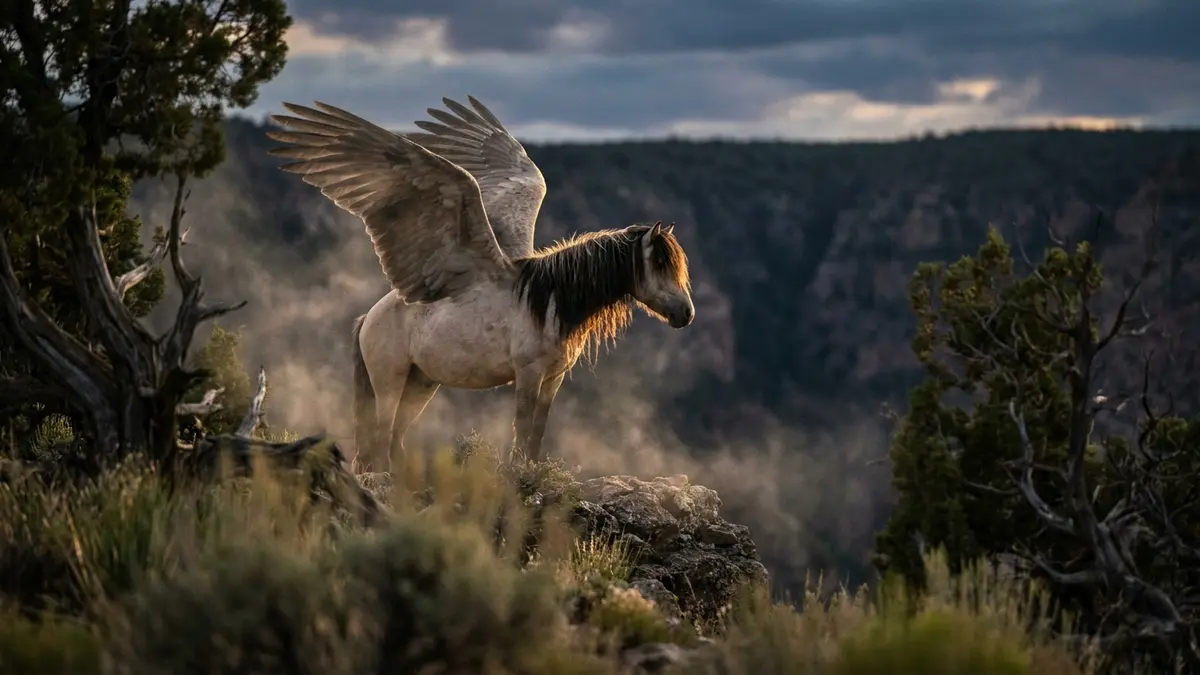
Pegasus symbolizes the union of earth and sky: inspiration, courage, freedom, and the soul's capacity to rise above hardship. As a spirit animal he can signal awakening intuition, a need for courage, healing, or protection, or a season of creative inspiration; sometimes he arrives as a messenger from higher realms. As totem and power animal, he lends artists, healers, and seekers of higher purpose the strength and courage to aim for greatness.
An almanac
- Core message
- Union of earth and sky; rising above hardship
- Spirit animal
- Awakening intuition, courage, healing, and protection
- Totem for
- Artists, healers, and environmentalists
- Power animal
- Strength and courage to aim for greatness
- In dreams
- Flight signals deep love; upward flight signals expanding possibilities
- Watch for
- Staying grounded amid the pull toward higher realms
- Tamed by
- Bellerophon, with Athena's golden bridle
- Constellation
- One of Ptolemy's 48; home to the first exoplanet found around a sun-like star (1995)
Few creatures capture the dream of flight quite like Pegasus, the white horse whose wings carry him between the ground beneath our feet and the heavens above. Born from thunder and shaped by the sea, Pegasus has galloped through Greek myth, Renaissance art, and modern emblems, always carrying the same restless hope: that we can rise higher than our circumstances suggest. This page covers his origins, his roles as spirit, totem, and power animal, and the winged horses that turn up in cultures far from Greece.
Origins and Etymology
The name Pegasus has more than one proposed root. Hesiod linked it to a word for "spring" or "well" — a nod to his gift for striking the earth and calling up fresh water. Other scholars trace it to the Luwian word pihassas, meaning "lightning," tied to a local storm and weather deity, which fits the thunder and lightning running through his origin story.
Because of his equine form, Pegasus carries much of the same symbolism as the horse itself, plus one addition: wings. That combination makes him a living image of "as above, so below" — at home on solid ground and in open sky alike.
On earth he represents stability and forward motion; in the heavens he symbolizes aspiration and the higher, spiritual side of the self.
His usual portrait — a white horse with sweeping wings — evokes clarity of mind, focus, enchantment, and passage between states of being.
Pegasus in Greek and Roman Mythology
Pegasus's birth was dramatic. He is described as the offspring of Poseidon, god of the sea, and Medusa, the gorgon, with thunder and lightning said to have rolled through the sky the instant he came into being.
Once grown, Pegasus gave his loyalty to Zeus, credited with helping deliver thunder and lightning down from Mount Olympus. He was treasured by the Muses and lent his strength to the fight against the monstrous Chimera. In gratitude, Zeus ultimately set him among the stars as an eternal constellation.
The rider who first tamed him was the hero Bellerophon, who found the wild colt drinking at a sacred spring near Corinth and, with Athena's aid, bridled him with a golden bit the goddess herself provided. Astride Pegasus, Bellerophon flew above the Chimera and finished the beast with a grim trick: a lump of lead lodged on his spearpoint, which the monster's own fiery breath melted down its throat. But triumph bred hubris — Bellerophon later tried to ride Pegasus all the way up to Mount Olympus to sit among the gods, and Zeus sent a stinging gadfly to bite the horse mid-flight. Pegasus reared, threw his rider back to earth, and continued on alone to a permanent stall beside Zeus's own steeds — a myth the Greeks told as a warning against reaching past your mortal place.
This cluster of stories makes Pegasus an emblem of fire, leadership, charisma, courage, and artistic inspiration. Through the Middle Ages and Renaissance, he stayed a symbol of wisdom, poetry, and creative inspiration; he appeared again and again in art, so often that gazing on his image was thought to spark creativity.
One legend still told holds that wherever Pegasus struck his hoof, a spring would bubble up, and drinking from it brought peace and inspiration — the best-known of these, the Hippocrene ('horse's spring') on Mount Helicon, was sacred to the Muses and said to grant poetic inspiration to anyone who tasted its water. An older name, Pegasos, dates to the pre-Greek period, with matching imagery found on Crete and in Minoan art. He was also called the Thundering Horse of Jove, an alternate name for Zeus.
Pegasus in History and Modern Emblems
Pegasus's symbolism didn't stay locked in antiquity. British Airborne forces adopted his image for their parachute troops, using the winged horse to represent a brave warrior descending from the sky. The emblem stuck so well that a bridge captured during a major assault still bears the name Pegasus Bridge today.
Pegasus has also found a place in national and commercial identity: - Tuscany has featured Pegasus on its regional coat of arms and flag since Benvenuto Cellini's 1537 coin. - Exxon Mobil uses a Pegasus figure on its station signage.
Across these contexts, Pegasus keeps the same job: a marker of swift, elevated, heroic movement.
Pegasus as a Spirit Animal
When Pegasus arrives as a spirit animal, he tends to show up for a few recognizable reasons. He may signal the awakening of clairvoyance, so it's worth tracking any unusual intuitive impressions. He also supports magical and spiritual growth when you enter a new stage of development, and appears for people who need strength, vitality, or healing.
As a warrior spirit, Pegasus teaches how to use bravery, courage, and energy wisely rather than recklessly. His wings can point to a season of prayerfulness: sit with whatever burdens you carry, since his role is to lift you above the struggle.
He can also serve as a messenger. He carries word from the Divine or higher realms, and — since myth credits him with guiding souls heavenward — sometimes from those who have passed on.
For writers and poets, Pegasus is an ideal muse. Given his partnership with Zeus and ties to Athena and Perseus, he can also arrive as a protector: his wings around you are reassurance that you are safe.
Pegasus as a Totem Animal
Someone born under a Pegasus totem tends to be genuinely one of a kind. You have a gift for inspiring people and sharing deeper wisdom in an approachable way, yet you're rarely showy about it; quiet humility suits you better than spectacle.
You're drawn to beauty at a soul level and called to create, whether through painting, music, writing, or another art form.
Pegasus people often find it hard to stay fully grounded, since part of them is always reaching for the heavens to soak up higher, more expansive energy. That pull can leave you a little disconnected from everyday concerns, so grounding and centering stay an ongoing task.
This totem also brings notable flexibility, echoing legends of a Pegasus that could shrink small or grow as tall as a house: some moments call for standing out boldly, others for receding into the background. You're naturally intuitive, may show flashes of telepathy, and many feel a pull toward water and rolling thunderstorms as sources of renewal. When your energy runs low, seeking out moving water can help recharge you.
As for vocation, this totem does well as a healer, artist, or environmentalist, with a capacity to decide and act quickly once direction is clear.
Pegasus as a Power Animal
As a power animal, Pegasus shares traits common to winged creatures: the sense that we are free by nature and capable of reaching for the stars. Unlike mythical beings who speak in riddles, Pegasus offers his medicine through silence and example.
His dramatic birth amid thunder and lightning, as the child of Poseidon and Medusa, means that invoking his energy can instill the strength and courage to aim for greatness. His signature white coloring adds another layer: the qualities traditionally tied to the color white are worth invoking when you want to approach situations in a more elevated, compassionate way.
Celtic and Native American Echoes
Pegasus himself is a distinctly Greek figure, but sacred horses appear in other traditions too, even without carrying his name.
In Welsh tradition, the goddess Rhiannon is closely tied to horses and said to inspire singers, artists, and poets, as well as help bring about dreams that do good in the world. She's often pictured riding a pale horse, sometimes shown with wings, though this figure is never called a Pegasus.
Native American folklore doesn't feature Pegasus directly, but it has white horses of its own: - In Blackfoot tradition, the god of snow rides a swift white horse. - In Navajo myth, the sun god crosses the sky aided by five horses, one of them white, and a pearly white horse is associated with fair weather.
Far Eastern Winged-Horse Symbolism
China has its own parallel to Pegasus in the Longma, or Dragon Horse, a legendary creature with wings and dragon scales. Seeing a Longma was traditionally read as an omen that a wise ruler was about to rise to power, and the symbol was especially popular during the Tang Dynasty, where it stood for diplomacy, aristocracy, and military strength.
Legend holds the Longma was born from the waters of heaven and moves freely between sky and earth; it's described as towering and able to walk across water while regulating its flow. Chinese folklore names two further winged horses alongside it: Tianma, a celestial winged horse, and Chollima, also a mythical horse with wings.
Pegasus in Dreams
The meaning of a Pegasus dream shifts with the details of the vision. Seeing Pegasus in flight is often read as a sign of deep, loving feelings toward someone special. For mothers, such a dream can point to a strongly nurturing, protective instinct toward her children, the way a mother bear watches over her cubs.
Watching Pegasus fly upward tends to suggest expanding possibilities, carried on a fresh wave of energy. The lesson is to stay clear about what you actually want rather than charging ahead without direction. Pegasus offers momentum, but it's up to you to aim it.
Pegasus in the Night Sky
Zeus's gift to Pegasus after his long service was a permanent home overhead: the horse became one of the sky's oldest recognized shapes, one of forty-eight constellations catalogued by the astronomer Ptolemy in the second century and still counted among the eighty-eight recognized worldwide today. Its most familiar feature, the Great Square of Pegasus, is a landmark autumn skywatchers use to navigate the surrounding stars, though it technically marks only the horse's body, since Pegasus is traditionally drawn upside-down, with no legs visible below the square.
The constellation carries one more layer of meaning for anyone who reads the sky as a message. In 1995, astronomers detected 51 Pegasi b, the first planet ever confirmed orbiting a sun-like star beyond our own, sitting within the very constellation that carries the winged horse's name. For a creature whose myth was always about bridging the world we know and the reaches beyond it, having his name attached to proof of other worlds feels less like coincidence than continuity.
Winged Horses of Islamic and Hindu Tradition
Winged, otherworldly horses gallop through traditions well beyond Greece and China. In Islamic tradition, the Buraq is described as a tall white creature, larger than a donkey but smaller than a mule, with two wings at its thighs that lent speed and strength to its legs. Tradition holds that the Buraq carried the Prophet Muhammad on the Isra and Mi'raj, the Night Journey from Mecca to Jerusalem and up through the heavens. Like Pegasus, this winged steed became a vehicle for crossing between the earthly and the divine.
Hindu mythology offers its own counterpart in Uchchaihshravas, a snow-white, seven-headed flying horse said to have risen from the Samudra Manthan, the churning of the cosmic ocean of milk that also produced the elixir of immortality, amrita. Revered as the king of horses, Uchchaihshravas became the mount of Indra, ruler of the heavens; his gleaming coat still carries a trace of the immortality that surrounded his birth.
Frequently Asked Questions
What does Pegasus symbolize?
Pegasus symbolizes the union of earth and sky: inspiration, courage, freedom, and the soul's capacity to rise above hardship. His wings, paired with a horse's grounded strength, make him a picture of both stability and aspiration at once.
Where does Pegasus come from in mythology?
Pegasus is the offspring of Poseidon and Medusa in Greek mythology, born amid thunder and lightning. He served Zeus, helped bring down thunderbolts from Mount Olympus, assisted in the battle against the Chimera, and was eventually placed in the sky as a constellation.
What does it mean if Pegasus is your spirit animal?
A Pegasus spirit animal often signals awakening intuition, a need for courage or healing, or a season of creative inspiration. He can also arrive as a protector, or as a messenger who carries guidance from higher realms or from those who have passed on.
Who was Bellerophon, and what happened when he tried to fly to Mount Olympus on Pegasus?
Bellerophon was the Greek hero who tamed Pegasus with a golden bridle gifted by the goddess Athena and rode him into battle against the Chimera. Later, driven by pride, he tried to fly Pegasus all the way up to Mount Olympus to join the gods. Zeus sent a gadfly to sting the horse mid-flight; Pegasus reared and threw Bellerophon back to earth, then continued on alone to live among the gods. The Greeks told the story as a warning against hubris.
What is the Hippocrene spring?
The Hippocrene, meaning 'horse's spring,' was said to have burst from Mount Helicon at the strike of Pegasus's hoof. Sacred to the Muses, its waters were believed to grant poetic and artistic inspiration to anyone who drank from them — one of several springs myth credits to Pegasus's touch.
Is there really a constellation named after Pegasus?
Yes. Pegasus is one of the original forty-eight constellations catalogued by Ptolemy and remains one of the eighty-eight recognized today, marked by the easily spotted Great Square of Pegasus. It also carries a modern claim to fame: the star 51 Pegasi, within its bounds, was the first sun-like star found to host a confirmed exoplanet, discovered in 1995.
Sources
Claims on this page were checked against these published sources.
- Pegasus
He was sired by Poseidon, in his role as horse-god, and foaled by the Gorgon Medusa.
Read the source → - Pegasus
Bellerophon rode (and flew) Pegasus and managed to kill the monstrous Chimaera with his spear.
Read the source → - Longma (mythology)
the horse's 'tremendous importance' to Tang dynasty rulers for military tactics, diplomatic policy, and aristocratic privilege... tianma [is] the closest relative [of longma], the legendary 'heavenly horse' or 'Chinese Pegasus'
Read the source → - Pegasus (mythical creature) - Research Starters
The hero tamed Pegasus using a golden bridle gifted by Athena and rode the winged horse to defeat the Chimera, a "fire-breathing monster with a lion's body and head, a snake's tail, and the head of a goat on its back."
Read the source → - Bellerophon
he attached a lump of lead to the end of his spear and thrust this into the monster's mouth. The flaming breath of the creature melted the lead which then poured down its throat and solidified in its vital organs... riding Pegasus high in the sky in a vain and foolish attempt to join the gods on Mount Olympus... Bellerophon was thrown by Pegasus and so fell unceremoniously back to earth. Pegasus had been disturbed by a gadfly biting his rear, the insect having been sent by Zeus.
Read the source → - Buraq
served as the mount of the Islamic prophet Muhammad during his Isra and Mi'raj journey from Mecca to Jerusalem and up through the heavens... a tall, white beast, bigger than the donkey but smaller than the mule... two wings on his thighs which lent strength to his legs.
Read the source → - Uchchaihshravas
Uchchaihshravas rose from the Samudra Manthana ('churning of the milk ocean')... Uchchaihshravas is said to be snowy white in colour... a seven-headed flying horse, created during the churning of the ocean... Uchchaihshravas is often described as a vahana of Indra.
Read the source →