Mythical Creature
Minotaur Symbolism & Meaning
The bull-headed guardian of the labyrinth — the shadow self we must face before we can reclaim our own power.
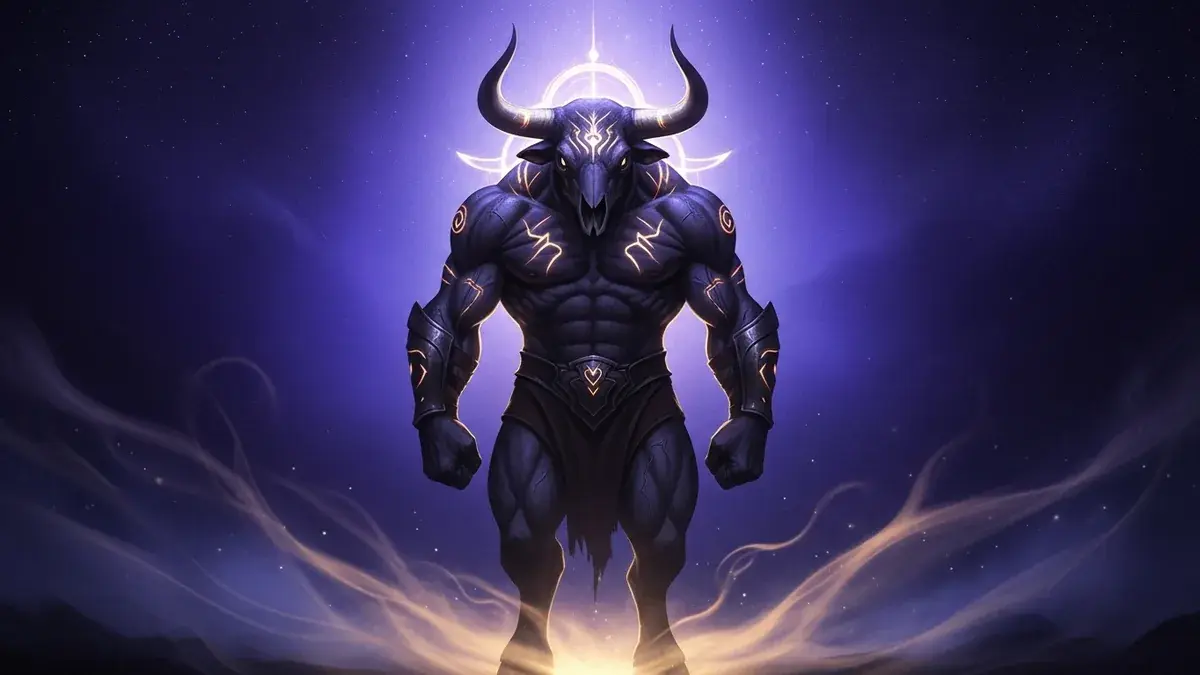
As a spirit animal, the Minotaur means confronting the shadow self: the suppressed fears, instincts, and desires you've hidden away, so your genuine strength and gifts can finally surface. Its arrival often brings emotional turbulence before clarity. It wants you to walk the maze of your own personality instead of avoiding it. In dreams, it raises a similar question: are you protecting what you cherish, or quietly isolating yourself out of fear?
An almanac
- Core message
- Confront the shadow self to reclaim inner power
- Spirit animal
- Emotional conflict and shadow work before clarity
- Totem for
- Passionate people who fight to be seen before they shine
- Power animal
- Guides you out of chaos through shadow work
- In dreams
- Facing fears; hoarding vs. healthy openness
- Element
- Earth (green, brown), with white from the sacred bull
- True name
- Asterion — "the starry one"
- Labyrinth's architect
- Daedalus, master craftsman of Crete
Half man, half bull, the Minotaur is one of Greek mythology's most haunting figures — a creature born of divine punishment and hidden away where no one could look upon it. Its name literally means "Bull of Minos," and its story can't be separated from the maze built to contain it. Underneath the monster story sits a much older question: what do we bury within ourselves, and what does it cost to keep it there?
Origins of the Minotaur
The Minotaur's story begins with a bargain gone wrong. King Minos of Crete asked the sea god Poseidon for a sign that his rule was divinely favored, and Poseidon sent up a magnificent white bull from the ocean, expecting it to be sacrificed in his honor.
Minos, awestruck by the animal's beauty, could not bring himself to kill it and hid the bull away instead, keeping a lesser bull for the sacrifice.
- Poseidon's revenge came through Minos's wife, whom the god caused to fall into an unnatural passion for the bull. Ancient sources name her Pasiphaë, queen of Crete.
- Their union produced the Minotaur, a being with the head and tail of a bull attached to a human body.
- Guided by the Oracle at Delphi, Minos had a vast labyrinth built beside his palace, and the creature was sealed inside it, out of sight of Crete and the world. Its architect, according to the myth, was Daedalus — the same master craftsman who later fashioned wings to fly himself and his son Icarus off the island.
The labyrinth was a prison, but it doubled as a place of tribute. Every nine years, Minos forced Athens to send fourteen young citizens — seven men and seven women — into the maze as an offering to the Minotaur, exacted as retribution for the death of his son Androgeus. The Athenian prince Theseus volunteered himself among this doomed tribute, which led to his eventual confrontation with the beast.
The Minotaur's exact form was never fixed in the ancient sources. Classical Greek art commonly pictured a man's body topped with a bull's head, though Ovid never actually specified which half was bull and which was man — and some later depictions even reimagined the creature more like a centaur, with a bull's hindquarters beneath a man's torso.
The Minotaur's form and fate were never told the same way twice across the ancient world. The familiar ending — where the hero Theseus slays the beast — is simply the version that happened to become standard.
Symbolism & Meaning
Read one way, the Minotaur is raw vitality and power: some traditions link it to solar-deity imagery — strength, heat, and life-force given form. Read another way, that same power is a prisoner, locked away in the dark at the center of a maze. That contradiction sits at the center of what it symbolizes.
- The labyrinth itself represents the winding, layered work of uncovering deeper wisdom — you cannot reach the center, or the truth, in a straight line.
- Ariadne's thread, which let Theseus find his way in and back out, connects the Minotaur's myth to the symbolism of spirals, spider-webs, and the patient unspooling of a path through confusion.
- The shadow self is perhaps its most resonant meaning: the Minotaur is what we fear lurks in the unconscious, the instinct to wall off the parts of us that feel monstrous, embarrassing, or unfinished.
- Facing mortality and the unfamiliar — the creature also mirrors our guardedness against death and against strange, unwelcome change, even as it hints that facing that fear head-on can reveal an inner strength we didn't know we had.
- As a being tied to the Earth, the Minotaur carries the colors green and brown, while its descent from the sacred white bull also links it to white, and through that color, to purity and protection.
- It has also come to represent internal chaos — the ongoing tug-of-war between our drive to create and our drive to destroy.
Minotaur Spirit Animal
When the Minotaur arrives as a spirit animal, expect turbulence before clarity. You may find yourself abruptly caught up in emotional conflict, wrestling with anger or rage you didn't see coming. This isn't the Minotaur stirring up trouble for its own sake. It's showing you what you've been quietly suppressing.
Its appearance often lines up with a season of integration and healing — and healing rarely feels gentle while it's happening. Because the Minotaur carries solar, life-giving symbolism yet stays out of sight in the dark, its presence can mean you need to confront your own shadow side so your genuine gifts can finally surface.
It may also show up when you're facing real fears, including the fear of your own mortality. It asks you to thread your way through the maze of your personality rather than avoid it.
The Minotaur spirit animal also speaks to relationships: it may prompt you to ask whether you're mistaking control for love, or hiding away something precious — a partner, a child, a pet — out of fear of losing it. If so, the lesson is to loosen your grip.
Minotaur Totem Animal
People born with the Minotaur as a totem animal tend to feel a forceful pull toward their passions, even though the road to expressing them is rarely smooth — you may have to fight to be noticed and heard before you're allowed to shine. Once that breakthrough comes, though, you become a model of stamina, power, and fortitude.
- You may have spent years suppressed or hidden as you worked to bring a deeper brilliance out into the open.
- Your strengths can feel almost too large to be comfortable with, and you may wrestle with fear of the unknown or fear of loss as a result.
- Learning to embrace impermanence and live more fully in the present is one of this totem's core lessons — it helps you notice when fear is quietly stealing enjoyment from your life.
- True to the bull half of its nature, Minotaur totem people can be remarkably stubborn, but that same stubbornness is what fuels their refusal to give up on a dream.
- This totem also nudges you toward uncovering hidden talents and subconscious wisdom, since your biggest fears often point straight at your greatest strengths.
Minotaur Power Animal
Call on the Minotaur power animal whenever you've lost your way inside a chaotic situation and can't see a path out. It's especially suited to shadow work — and you'll usually know when that work is due, such as when your creativity starts feeding your anxieties instead of relieving them.
The Minotaur power animal steps in to help you move bravely into unknown territory rather than around it. If you feel trapped, confined, or stuck — in a dead-end job, an unhappy relationship, or any situation that's stopped moving — it helps you follow the thread of clues that leads back toward growth and the changes you actually need to make.
Minotaur Dreams
A Minotaur appearing in a dream often signals a coming initiation into deeper spiritual understanding, as if your subconscious mind is inviting you further into its own winding corridors. It can mean you're ready to meet a difficult situation head-on and convert fear into genuine personal power.
If the Minotaur shows up while you sleep, it's worth asking whether you've built a maze of your own: guarded your vulnerability so thoroughly that you've shut other people out in the process. The dream may be nudging you toward more openness and connection.
- It can also point to a treasured person or thing in your life that you're holding especially close.
- The dream also raises the question of whether that devotion has tipped into hoarding or isolation.
- The Minotaur dream asks you to find balance — between protection and isolation, control and raw emotion, strength and domination.
The Minotaur's True Name: Asterion
Long before he was simply "the Minotaur," the creature had a name of his own: Asterion, or Asterios — a Cretan title he shared, oddly enough, with Minos's own foster-father. In Ancient Greek the name descends from astēr, meaning "star," so Asterion translates roughly to "the starry one."
- The etymology of "Minotaur" itself is far colder: a fusion of Minos and tauros, Greek for "bull" — literally "Bull of Minos," the label history remembers him by rather than the name his own mother gave him.
- Some scholars, including the mythologist Karl Kerényi, have pointed to that "starry" birth-name as a sign the Minotaur was once regarded as a luminous, even divine figure in Crete — in keeping with the solar associations already woven through his myth — before later tradition flattened him into pure monster.
- The contrast between "Asterion" and "Minotaur" says something on its own: one name carries wonder and light, the other only condemnation and function. Which name you choose for your own hidden parts — the wounded, misunderstood self versus the label others hung on you — is worth sitting with.
The Minotaur in Art & Literature
The Minotaur has never stayed confined to antiquity. Artists and writers keep returning to him to work through their own inner conflicts.
- In 1935, Pablo Picasso etched Minotauromachy, a haunting scene in which the Minotaur looms over a wounded female bullfighter and a candle-bearing girl. Created during a period of deep personal turmoil, the print reads almost like a self-portrait: the beast appears by turns as menace, artist, and helpless creature — man and animal locked in the same body, capable of both creating and destroying.
- A few decades later, Jorge Luis Borges flipped the myth entirely in his short story The House of Asterion, narrating events from inside the labyrinth in the Minotaur's own voice — a lonely, misunderstood figure quietly longing for a "redeemer" to end his solitude, unaware until the story's final line that his redeemer is death at Theseus's hands.
- Both works point at the same idea this page keeps returning to: the Minotaur is not simply a villain to be slain. He stands in for whatever part of us has been shut away and mislabeled monstrous, waiting for someone — even ourselves — to finally step into the maze and look him in the eye.
Frequently Asked Questions
What does the Minotaur symbolize?
The Minotaur symbolizes the hidden, shadow parts of ourselves — instincts, fears, and desires we keep locked away, as well as the raw vitality and power associated with its solar and bull-derived origins. Its home in the labyrinth also makes it a symbol of the layered, winding path required to reach real self-understanding.
Where does the Minotaur come from in mythology?
The Minotaur was born after King Minos of Crete kept a sacred white bull, sent by Poseidon, instead of sacrificing it. In retaliation, Poseidon caused Minos's wife to conceive a child with the bull, producing the Minotaur, which Minos then had sealed inside a labyrinth built on the advice of the Oracle at Delphi.
What does it mean to dream about a Minotaur?
Dreaming of a Minotaur can suggest you're close to turning your fears into strength. It may also point to something you cherish deeply and ask whether you're protecting it in a healthy way or isolating it — and yourself — out of fear.
What was the Minotaur's real name?
In Cretan tradition, the Minotaur was named Asterion or Asterios, meaning "the starry one" — a name he shared with Minos's own foster-father. "Minotaur" itself is simply the Greek for "Bull of Minos," the functional label later myth settled on rather than his birth name.
Why did Athens send tribute to the Minotaur?
According to Greek myth, Athens was forced to send fourteen young citizens — seven men and seven women — to Crete every nine years, to be offered up to the Minotaur inside the labyrinth. The tribute was demanded by King Minos as retribution for the death of his son Androgeus, and it was as one of these fourteen that the hero Theseus volunteered to enter the maze.
How has the Minotaur been portrayed in art and literature?
Beyond ancient myth, the Minotaur has become a recurring figure for artists who explore inner conflict — most famously in Pablo Picasso's 1935 etching Minotauromachy, created during a turbulent period in his life. Jorge Luis Borges took the opposite approach in his short story The House of Asterion, telling the myth from inside the labyrinth in the creature's own lonely voice.
Sources
Claims on this page were checked against these published sources.
- Minotaur
Minos prayed to the sea god Poseidon to send him a snow-white bull as a sign of the god's favor...owing to the bull's beauty he decided instead to keep him...Poseidon arranged with Aphrodite for Minos's wife, Pasiphae, to fall in love with the bull.
Read the source → - Minotauromachy
Minotauromachy (La Minotauromachie) is a 19.5 by 27.4" etching and engraving created by Spanish artist Pablo Picasso in Paris in 1935.
Read the source → - A Summary and Analysis of Jorge Luis Borges' 'The House of Asterion'
Asterion's narrative then breaks off, and the story ends with a second narrator telling us that Theseus has slain Asterion – who is now revealed to have been the Minotaur of Greek myth
Read the source →