Mythical Creature
Ladon Symbolism & Meaning
The vigilant serpent-dragon who guards what is too precious to be taken lightly.
As a spirit animal, Ladon symbolizes devoted protection of something irreplaceable, paired with the discernment to know what truly deserves guarding and the boundaries to keep it safe. His myth is really about the tension between guardianship and greed, showing how the same watchful instinct can look like heroism or villainy depending on whose side you're standing on. He tends to surface when growing personal power, or something precious in your life, calls for greater care, discretion, and vigilance.
An almanac
- Core message
- Guardianship and greed are two sides of one story
- Spirit animal
- Worth, scale, and firmer boundaries
- Totem for
- All-in, protective devotion to what you treasure
- Power animal
- Keeping something precious and confidential safe
- In dreams
- Stronger boundaries, staying alert from every angle
- Element
- Water, fire, and earth combined
- Labor number
- Heracles' 11th labor
- Epithet
- "The sleepless dragon" (Ovid)
In Greek myth, the name Ladon points to a "dragon devoted to Hera" — a colossal, serpentine guardian entrusted with one of the most coveted treasures imaginable. This creature's name is thought to trace back to an older word meaning "powerful current," hinting at a deep, ancient tie to the primeval sea gods even though Ladon made his home firmly on dry land. Few figures in classical legend embody the idea of sacred protection as vividly as this coiling watcher of the golden boughs.
Origins and the Garden It Watched Over
Ladon's story is anchored in a single, sacred location: the Garden of the Hesperides, sometimes called Hera's own garden, said to sit at the westernmost edge of the known world beside the ocean. This was no ordinary orchard — it was safeguarded by sea-born nymphs and held Hera's most cherished possessions, chief among them a tree bearing apples of solid gold.
Those apples were no mere fruit; legend says Gaia herself gave them to Hera as a wedding present, and that they carried the gift of immortality. Ladon's entire purpose was to stand between mortals and that impossible reward, making him less a monster of destruction and more a living lock on a vault meant only for the gods.
Because the tale of a serpent coiled around a tree of forbidden, golden fruit sounds so close to a story many people already know, it's worth noting that Ladon's legend actually predates that later story by a long stretch. Scholars trace his roots to some of the oldest layers of Greek myth, likely inherited from Minoan tradition or cultures further east across the ancient Mediterranean.
Lineage, Form, and Elemental Ties
Ladon's family tree connects him straight to the primordial sea. Accounts differ on his parentage: Hesiod's Theogony names him the offspring of the sea deities Phorcys and Ceto, while other sources make him a child of the monstrous Typhon and Echidna — either way, an ancestry rooted in ancient powers tied to the ocean's depths. That heritage explains why, even though Ladon lived far from the water's edge, his character still carries the imprint of the sea.
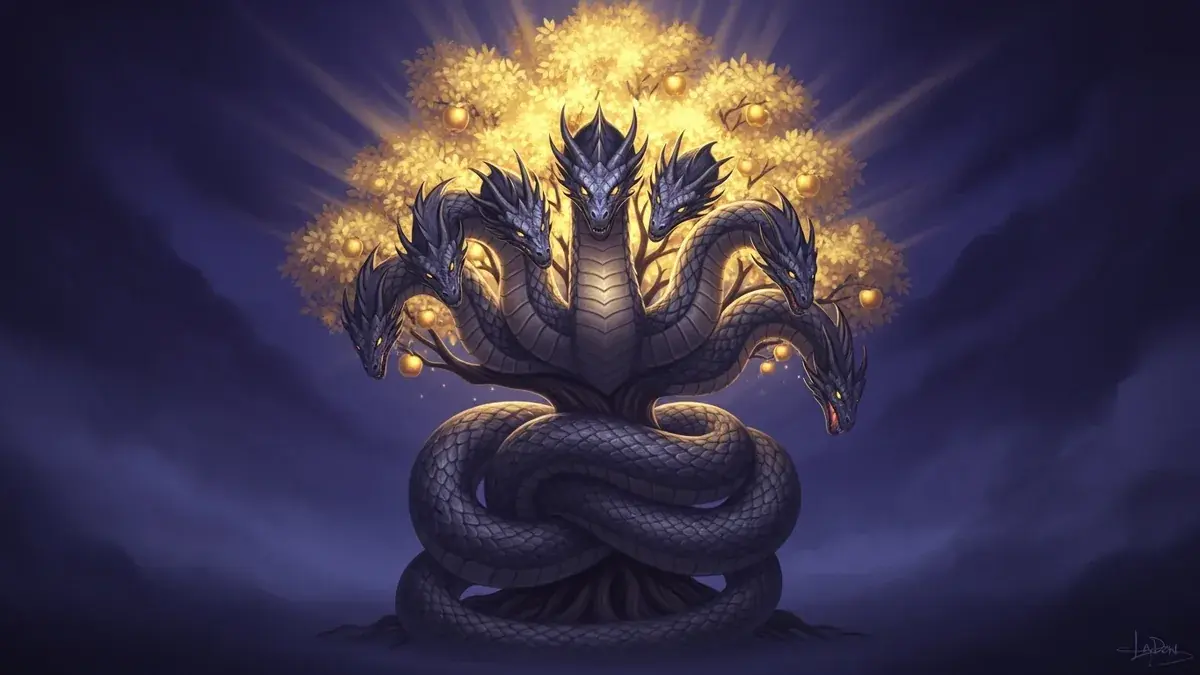
Artists on ancient Greek pottery typically show him as an enormous serpent-like dragon wound tightly around the trunk of the golden-apple tree, and some versions of the myth give him many heads rather than one — a detail that amplifies just how impossible it was to catch him off guard.
Because his identity draws from several forces at once, Ladon can be read as a creature of three elements together:
- Water — inherited from his oceanic parentage, often linked to the color blue
- Fire — fitting for a dragon, often linked to the color red
- Earth — drawn from his role rooted beside the tree in Hera's garden, often linked to green or brown
One later writer, Diodorus Siculus, offered a more grounded version of the tale, describing Ladon as a human shepherd guarding sheep with a golden fleece rather than a literal dragon — a reminder that even ancient audiences sometimes reinterpreted the core symbol of the vigilant protector in more down-to-earth terms.
The Legend: Encounters with Heroes
Ladon's fate splits across different tellings of the myth. In one version, he is slain outright by Hercules, and his body is later come across by Jason and the Argonauts on their travels. In another, more cunning telling, Ladon isn't killed at all — instead, Heracles teams up with Atlas to outmaneuver the dragon and slip the golden apples away without a direct confrontation.
Whichever version you follow, the myth invites a second look at who the real hero of the story is. Hercules is remembered as the triumphant one, but Ladon was simply doing exactly what he was created to do: protect something sacred from those trying to take it.
Hera herself is said to have honored his loyalty by placing him among the stars as the constellation Draco, ensuring his watchfulness would be remembered long after the golden apples were gone.
Even the ending of the myth underscores what Ladon was protecting in the first place. In most tellings, the golden apples couldn't simply stay in mortal hands once Heracles carried them off — since they belonged to Hera and were never meant for anyone but the gods, they were ultimately brought back to the garden or handed over to Athena to return there. Ladon lost the fight, but the treasure he guarded never really left its rightful place for long — a quiet reminder that some things resist being taken, no matter who does the taking.
What Ladon Represents
Ladon's symbolism turns on the tension between guardianship and greed, and about recognizing that heroism and villainy often depend entirely on which side of the fence you're standing. He represents:
- Devoted protection of something irreplaceable, whether a physical treasure or a body of sacred knowledge
- Discernment, since guarding the golden apples meant understanding exactly what made them worth protecting in the first place
- Boundaries, drawn from his role as the barrier between mortal hands and immortal gifts
- Perspective, since his story reminds us that the "monster" of one account is the loyal guardian of another
Ladon as a Spirit Animal
When Ladon shows up as a spirit guide, he often arrives around questions of worth and appropriate scale — helping you recognize your own value while also cautioning you against reaching for mysteries you aren't yet ready to hold. If you feel like you're closing in on something valuable on your spiritual path, Ladon's presence can be a nudge to think carefully about how you'll use it once it's yours.
He also tends to appear when greater personal power calls for greater discretion — as your intuition, insight, or wisdom deepens, so does your responsibility to wield it carefully. And when you're guarding something precious in your own life, whether it's a relationship, an idea, or a piece of hard-won understanding, Ladon can help you set firmer boundaries so it isn't taken advantage of.
He's especially likely to surface when you're standing at the edge of unfamiliar territory, about to step into a new chapter of life.
Ladon as a Totem Animal
People who feel a lifelong connection to Ladon as a totem tend to have powerful protective instincts. If this is your totem, you likely pour yourself completely into whatever you treasure most — whether that's a person, a cause, or an idea — becoming so wrapped up in it that, much like the dragon coiled around his tree, you can develop tunnel vision toward everything else.
Still, that single-mindedness comes from a genuine gift: an instinct for spotting real value versus surface shine, and knowing that not everything that glitters is worth guarding. This totem energy also tends to pair sharp intuition with a grounded, practical streak, along with a natural talent for staying watchful across more than one front at once.
Ladon as a Power Animal
Turn to the Ladon power animal when you need help keeping something safe — your loved ones, your most valued possessions, or your core beliefs. He's a strong ally when you've come across something both powerful and fragile, since he can help you approach it with the focus and steady vigor it deserves.
If you find yourself easily pulled off course, working with Ladon's energy can help you commit fully to a goal and see it through no matter the obstacles. He's also a fitting presence when you need to protect confidential information or hold a situation steady before it spirals out of control, and when you're stepping toward the edge of new discoveries that still feel unfamiliar or intimidating.
Ladon in Dreams
Seeing Ladon in a dream often points to parts of your life that need stronger boundaries or closer attention. His appearance can suggest that something valuable — a piece of wisdom, an opportunity, a truth — is sitting in plain sight, waiting to be noticed, and that you should be selective about who you share it with once you find it.
Given that some tellings give Ladon as many as a hundred heads, dreaming of him can also be a signal to stay alert from every angle, almost as if you need eyes in the back of your head right now.
The Sleepless Dragon
Ancient writers didn't just call Ladon a guardian — they gave him an epithet that captures the whole heart of his myth. In Ovid's Metamorphoses, Hercules looks back on his own labors and describes the treasure he once won as "the apples of the Hesperides, guarded by the sleepless dragon." That single word, sleepless, does a lot of work: it suggests a watchfulness so complete it never lapses, day or night, for as long as the task demands it.
The tradition of his hundred heads reinforces the same idea from another angle. In the account preserved by the mythographer known as Pseudo-Apollodorus, Ladon is described as having "a hundred heads" and speaking "with many diverse voices" — a guardian built, quite literally, without a blind spot or a single mouth that could be silenced. Whether the ancients meant this as literal anatomy or as a poetic exaggeration of his vigilance, the message lines up with everything else his myth stands for: some things are worth watching so closely that rest itself becomes a liability.
Frequently Asked Questions
What does the name Ladon mean?
Ladon is generally understood to mean "dragon of Hera," reflecting his role as the loyal guardian bound to her service. The name is also believed to derive from an older term meaning "strong" or "powerful flow," pointing to his ancestral link to the sea gods even though his post was on land.
What was Ladon guarding, and why did it matter?
Ladon guarded the tree of golden apples in the Garden of the Hesperides, a gift from Gaia to Hera said to grant immortality. His task made him the barrier between mortals and one of the most closely held secrets of the gods.
Did Hercules kill Ladon?
Accounts differ. In one version, Hercules kills Ladon outright, and his remains are later found by Jason and the Argonauts. In another, Hercules never fights him directly, instead working with Atlas to obtain the golden apples through cunning rather than force.
Why is Ladon sometimes called "the sleepless dragon"?
The Roman poet Ovid uses this exact phrase in the Metamorphoses, describing the apples of the Hesperides as "guarded by the sleepless dragon." It's a fitting shorthand for a guardian whose entire mythic purpose was constant, uninterrupted vigilance — a watcher who could never be caught unaware.
What happened to the golden apples after Heracles took them?
They didn't stay with him for long. Since the apples belonged to Hera and were never meant for mortal hands, most versions of the myth have them returned to the gods soon after the labor was complete — either brought back to the garden or handed over to Athena. Even a hero's triumph couldn't permanently undo what Ladon had spent his whole existence guarding.
Is Ladon related to Medusa or other Greek monsters?
In the lineage traced through Hesiod's Theogony, where Ladon is named as a child of the sea deities Phorcys and Ceto, his siblings include the Gorgons — Medusa among them — along with the Graeae. Other ancient sources instead make him a child of Typhon and Echidna, placing him in the same family as monsters like the Hydra and Cerberus. Ancient mythographers themselves never agreed on a single family tree, which only adds to his mystique.
Sources
Claims on this page were checked against these published sources.
- Garden of the Hesperides
Hera was so enchanted that she requested Gaia plant them in her gardens extending toward Mount Atlas... Hera assigned the Hesperides nymphs to tend the grove, while she stationed a formidable guardian—"an immortal, never-sleeping, hundred-headed dragon named Ladon"—to protect the precious fruit from theft.
Read the source → - Ladon (mythology)
Hesiod's Theogony identifies him as "the last of the progeny of Phorcys and Ceto"... Apollodorus calls him "the offspring of the monstrous Typhon and Echidna"
Read the source → - Draco (constellation)
When Heracles was tasked with stealing the golden apples during his twelve labors, he killed Ladon and Hera transformed Ladon into a constellation.
Read the source → - Ovid (43 BC–17) - The Metamorphoses: Book 9
the apples of the Hesperides, guarded by the sleepless dragon
Read the source → - Apples of the Hesperides
After completing the labour, Heracles brought the apples to Eurystheus. However, in many versions of the myth, the apples were ultimately returned to the gods, as they belonged to Hera.
Read the source → - The golden apples of Hesperides
return[ed] to Athena, who took them back to the garden
Read the source → - Phorcys
Hesiod's Theogony lists the children of Phorcys and Ceto as the Graeae (naming only two: Pemphredo, and Enyo), the Gorgons (Stheno, Euryale and Medusa), probably Echidna...and Ceto's 'youngest, the awful snake who guards the apples all of gold'
Read the source →