Mythical Creature
Kraken Symbolism & Meaning
The depths made visible, testing whether you trust your instincts or your wishful eyes.
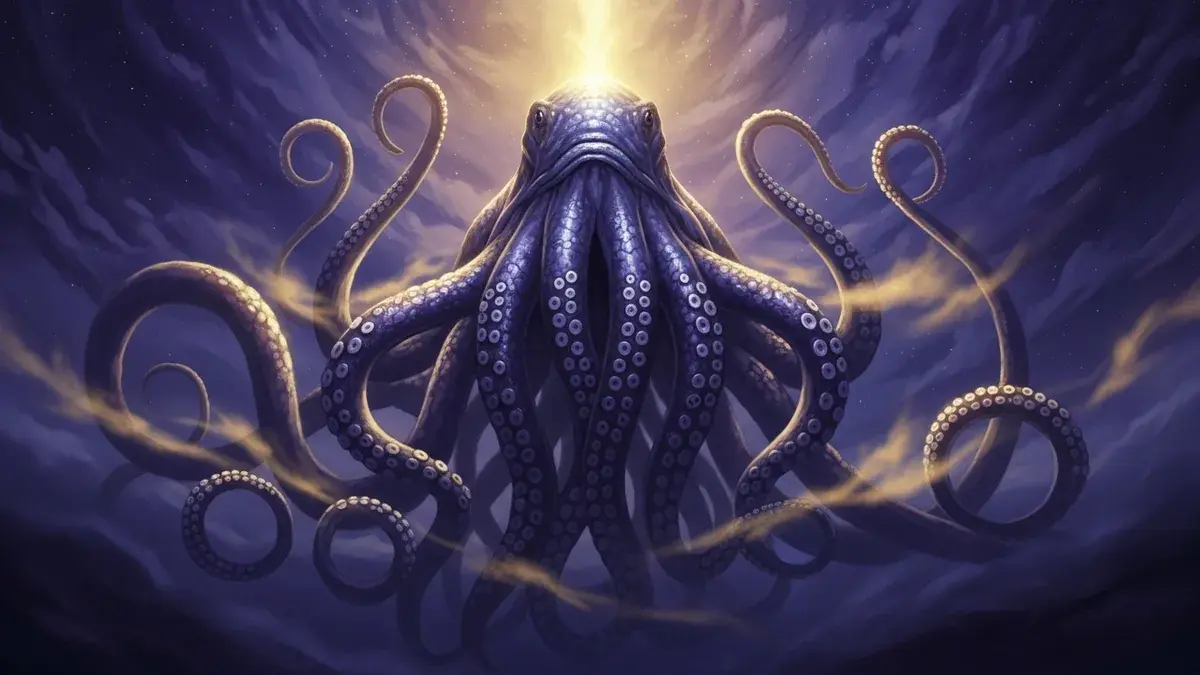
As a spirit animal, the Kraken symbolizes overwhelming hunger and emotion and the churning power of the subconscious, and it warns against letting wishful thinking override intuition. It calls you to face resurfacing feelings head-on rather than bottling them up, and to stop mistaking what you want to see (the island) for what's actually there. Its message is one of patience and camouflage: treat deep emotion as intuitive strength, not something to fear.
An almanac
- Core message
- Trust intuition over wishful thinking
- Spirit animal
- Face emotions that keep resurfacing
- Totem for
- Healers hiding deep emotional currents
- Power animal
- Facing feelings, finding balance
- In dreams
- Fear of being overwhelmed by emotion
- Element
- Water
- First recorded
- Named in a 1646 Norwegian glossary
- In poetry
- Tennyson's 1830 sonnet "The Kraken"
Few sea monsters loom as large in maritime lore as the Kraken, a colossal tentacled terror said to rise from Scandinavian waters and swallow ships whole. Its name traces back to old Norse and Norwegian roots meaning something twisted or unnaturally deformed, a hint at how strange and monstrous this creature seemed to the fishermen who first whispered about it. What began as sailors' tall tales about an enormous sea beast has grown into a symbol of hidden depths and consuming emotion, and of the gap between what we wish were true and what actually lies beneath the surface.
Where the Name Comes From
The word Kraken comes to us through Norwegian and Swedish, from the Germanic root Krake, a term for something bent, distorted, or grotesquely misshapen. That original sense carries real weight: the Kraken wasn't imagined as merely large, but as an animal warped into something unnatural.
Fittingly, old Norwegian also used the word for octopus, a real if far smaller creature the legend clearly grew from.
The name matters for how you read the symbolism. The Kraken isn't just "big and scary" — it represents distortion itself, the way fear and distance can twist something ordinary into something monstrous in the imagination.
The word's earliest written use predates even the sailors' tales that made the creature famous: a Norwegian glossary compiled by Christen Jensøn in 1646 defined it plainly as "a sea monster with many arms that grabs boats down into the abyss." The name and the fear behind it were already fixed in folk speech more than a century before naturalists like Pontoppidan wrote it down.
Origins in Norse Sailor Lore
Long before Hollywood ever put a Kraken on screen, Norwegian fishermen swapped stories about a monster from the deep. Many researchers now suspect these tales grew from real encounters with giant squid, animals that can stretch to roughly fifty feet and would have been an astonishing, unforgettable sight to sailors whose lives depended on the sea's moods.
A few threads run through the old accounts:
- The naturalist Carl Linnaeus took the Kraken seriously enough to list it in his 18th-century catalog of animals.
- Reports of sightings go back to sailors and texts connected with the Greenland Sea in the mid-1200s, when the King's Mirror (c. 1250) described a sea monster of this kind as the largest in the ocean.
- The Norse hero Örvar-Oddr, in the Konungs skuggsjá ("The King's Mirror"), described the beast's habits in enough detail that it was treated as a real animal rather than pure myth.
- The Kraken was said to lure fish by belching up food (or, in other tellings, through its own waste) and drew schools of prey close before it struck.
- Fishermen read a sudden surge of fish near the surface as an omen: the Kraken lurked nearby and had frightened the fish upward.
- Some older descriptions gave the creature crab-like limbs rather than the squid arms we picture today.
One image outlasted all the rest: the Kraken appearing to look like an island. Exhausted or hopeful sailors would sometimes try to land on what they thought was solid ground, only to be dragged under once the "island" revealed itself as a living creature.
Even ships it didn't seize outright could be pulled beneath the waves by the violent churn of water left in its wake.
Kraken Symbolism & Meaning
The Kraken symbolizes hunger and appetite — its many grasping arms reaching for ships, fish, and sailors all at once evoke greed and an insatiable craving. Later writers leaned into this and used the Kraken as a stand-in for class tension — an unseen force from below, rising up to seize the wealthy vessels of the aristocracy above.
Because the Kraken lives in water, and water has long stood for intuition, emotion, and the subconscious mind, the creature also represents the parts of ourselves that can feel overwhelming: desire, longing, feelings so large they seem to swallow us whole. When emotions build past what feels manageable, the Kraken is a fitting image for that flood.
The island illusion adds another layer of meaning. The Kraken warns of what happens when wishful thinking overrides intuition: you're so eager to reach solid ground, comfort, or a desired outcome that you convince yourself an illusion is real and ignore the instincts (and the maps) that would tell you otherwise.
Kraken symbolism, in this sense, asks you to look closely at whether you're seeing what's actually there or only what you want to see.
Finally, the Kraken's kinship with real cephalopods, master colour-changers themselves, adds a symbolic note of patience and camouflage: the wisdom of staying quiet and unnoticed until the right moment arrives to act or reveal yourself.
Kraken Spirit Animal
Old lore held that simply speaking the Kraken's name sent it back into the depths, and some sailors relied on this to survive an encounter. If the Kraken has surfaced as your spirit animal, though, it's worth leaning into what it's trying to teach rather than shying away.
Much like the Kraken draws in prey by regurgitating its own food, something emotional may be resurfacing in your life right now, repeating until you finally deal with it. Kraken spirit animal energy tends to appear when you've been tempted to bottle up your feelings rather than sit with them.
Facing emotional turmoil directly, rather than pushing it under, is what actually leads to healing. It may also nudge you to get creative in how you go after what you need.
Kraken Totem Animal
People carrying Kraken totem energy tend to be stealthy by nature. On the surface, they can seem calm and easy to overlook, even as deep emotional currents churn beneath that calm exterior.
This totem often equips you to ride out emotional turbulence, which can draw you toward work as a healer or helper for others. You may find yourself especially pulled toward people wrestling with hunger, addiction, or unsatisfied longing, since Kraken totem energy gives you an intuitive gift for disarming others and helping them confront buried fears.
The catch is that you'll need to face your own unresolved emotional baggage first — with Kraken as your totem, there's no ignoring what your subconscious is trying to tell you.
Kraken Power Animal
Just as legend says naming the Kraken could send it back into the depths, you can turn to it as a power animal through meditation, ritual, or quiet time spent near water, its natural element. Since the creature was known for its size and enormous appetite, leaving symbolic offerings is one way to connect with its energy.
Working with Kraken as a power animal can help you find the courage to face emotions head-on instead of shoving them into the subconscious. It's also a teacher of moderation — if you've noticed your own desires tipping into obsession or excess, Kraken power animal energy can help you rebalance.
Ultimately, it teaches you to treat emotion as a source of intuitive strength rather than something to fear being swept away by.
Kraken Dreams
When the Kraken appears in a dream, it often signals a call toward healing: an invitation to face subconscious fears you may have been avoiding. It can also point to something you're afraid will consume or overpower you, whether that's a relationship, a passion, or an obsession you've lost yourself in.
A Kraken dream is often a nudge to be strategic and to pace yourself, rather than letting a powerful feeling pull you under. At the same time, it can be an invitation to trust your intuition and let your truer, wilder instincts come forward.
Bishop Pontoppidan's Account
In 1752, the Norwegian bishop Erik Pontoppidan did more than any single writer to fix the Kraken in the popular imagination. In his Natural History of Norway, he described tentacles so vast that if they "were to lay hold of the largest man-of-war, they would pull it down to the bottom." He wrote it up as sober zoological fact, not campfire tale.
Pontoppidan also recorded a saying among Norwegian fishermen: "You must have fished on Kraken" — a half-joking way of explaining an unusually plentiful catch, since the creature was believed to draw schools of fish toward the surface as it lurked below. He even compared the whirlpool left by its dive to Norway's real, genuinely dangerous Moskstraumen maelstrom, a comparison that blurs the line between documented ocean hazard and monster lore.
Read symbolically, Pontoppidan's account is a reminder that abundance and danger often arrive from the same source. The very thing that fills your nets can also be the thing that drags you under if you linger too long chasing it.
The Kraken in Poetry & Modern Culture
The Kraken slipped from sailors' warnings into literature in 1830, when a young Alfred, Lord Tennyson published the sonnet The Kraken, imagining the beast in an "ancient, dreamless, uninvaded sleep" at the bottom of the sea, destined to rise only once before dying at the surface. The poem is unusual even in its shape: fifteen lines rather than the standard fourteen, yet still classed as a sonnet by scholars who study it.
More than a century later, the Kraken resurfaced inside an entirely different mythology: the 1981 film Clash of the Titans recast it as "the last of the Titans," a monster Zeus orders Poseidon to release and destroy the city of Argos — a Greek-myth reinvention with no real link to the creature's Norse origins. The 2010 remake's booming delivery of the line "Release the Kraken!" turned it into one of the internet's most reused catchphrases, a sign of just how far the old sailors' monster has drifted from where it began.
Symbolically, this arc from dormant terror to summoned weapon mirrors what the Kraken teaches as a totem: the same depths you're tempted to leave sleeping can become a deliberate source of strength once you choose to call them up, rather than waiting for them to rise on their own.
Frequently Asked Questions
What does the Kraken symbolize?
The Kraken symbolizes overwhelming hunger and appetite and the churning power of deep emotion and the subconscious. It also captures the danger of letting wishful thinking override intuition, most vividly in the old tales of sailors mistaking its back for an island.
Where did the Kraken legend come from?
The legend grew out of Norwegian and Scandinavian sailor lore, likely inspired by real encounters with giant squid reaching around fifty feet long. Naturalist Carl Linnaeus even catalogued the Kraken as a real animal in the 18th century, and earlier sighting reports date back to Greenland-bound sailors in the mid-1200s.
What does it mean if Kraken is your spirit animal?
Kraken as a spirit animal often shows up when repressed emotions keep resurfacing and need to be faced rather than suppressed. It encourages you to sit with emotional turmoil as a path to healing and to get creative in pursuing what you truly need.
Is the Kraken based on a real animal?
Most researchers trace the legend to real encounters with the giant squid (Architeuthis), which can grow to roughly 34 feet (10.5 meters) long. For centuries the giant squid was itself dismissed as myth, until specimens began washing ashore and scientists documented them, including a famous 1873 find off Newfoundland with a beak reportedly the size of a six-gallon keg. Once the animal was confirmed real, its enormous, alien scale gave the old Kraken tales a plausible biological root.
Where does the phrase 'Release the Kraken' come from?
It comes from the 1981 film Clash of the Titans, where Zeus orders the Kraken — reimagined there as one of the Greek Titans — unleashed on the city of Argos, with no real connection to the creature's original Norse sailor lore. The 2010 remake's dramatic delivery of the same line turned it into a widely shared internet catchphrase, a sign of how far the sea monster has drifted from its origins.
Why is the Kraken so often shown as an octopus?
Because old Norwegian used the same word for both, and because real octopuses already carry an otherworldly biology: three hearts (two pumping blood through the gills, one circulating it to the rest of the body) and blue, copper-based blood instead of red, iron-based blood. Even without any exaggeration, the octopus was strange enough to seed a monster.
Sources
Claims on this page were checked against these published sources.
- Kraken
The word "kraken" derives from Norwegian kraken (definite form of krake)... root meaning is "malformed or overgrown, crooked tree." It originates from Old Norse kraki, related to Old Norse krokr meaning 'hook'.
Read the source → - Giant squid
Maximum total length, when measured relaxed post mortem, is estimated at 12 m (39 ft) or 13 m (43 ft) for females and 10 m (33 ft) for males from the posterior fins to the tip of the two long tentacles.
Read the source → - The Kraken (poem)
His ancient, dreamless, uninvaded sleep / The Kraken sleepeth
Read the source → - Clash of the Titans (1981 film)
kills Acrisius and orders Poseidon to release the last of the Titans, a gigantic sea monster called the Kraken, to destroy Argos
Read the source → - Ten Wild Facts About Octopuses: They Have Three Hearts, Big Brains and Blue Blood
Two of the hearts work exclusively to move blood past the animal's gills, where it releases carbon dioxide and gains oxygen. Then, the third heart circulates that oxygen-rich blood to the organs and muscles.
Read the source →