Mythical Creature
Jormungand Symbolism & Meaning
The tail-biting sea serpent of Norse myth who teaches you to hold steady through endless cycles of change.
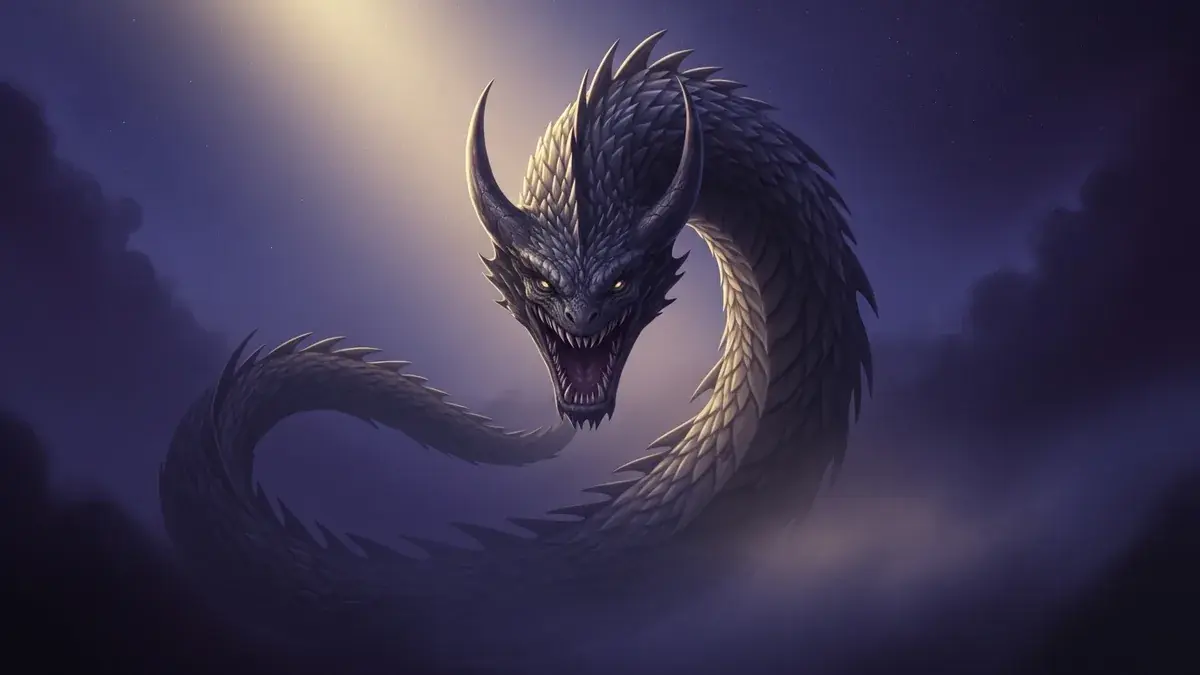
Jormungand, the Norse World Serpent, symbolizes vastness, raw power, and the endless Ouroboros cycle of destruction and renewal that holds Midgard together. As a spirit or power animal, it signals that a major transformation is already underway and calls for more emotional openness, sharper intuition, and the strength to rebuild after hardship. In dreams, it points to hidden stability, closely guarded secrets, or a fresh start on the horizon.
An almanac
- Core message
- Endless cycles of change and renewal
- Spirit animal
- Signals a major life transition
- Totem for
- Private, unconventional, deeply ethical souls
- Power animal
- Rebuilding strength after hardship
- In dreams
- Hidden stability, secrets, fresh starts
- Element
- Water — intuition and the subconscious
- Carved in stone
- Altuna Runestone, 11th-century Sweden
Jormungand is the immense sea-dwelling serpent of Norse mythology, coiled so far around the world of Midgard that it grips its own tail in its mouth. Known by names like the Great Serpent and the Midgard Serpent, this beast is a symbol of scale, endurance, and the endless turning of one age into the next. Its story blends menace with renewal, and few figures in Norse mythology carry that much meaning at once.
Jormungand Symbolism & Meaning
Pronounced roughly YOUR-mun-gand, Jormungand goes by several names across the old sagas, including "Jormungandr," often translated as "Great Beast." This colossal serpent-dragon lives in the seas that ring Midgard, and according to legend it stretches its body all the way around that world, seizing its own tail between its jaws — the classic Ouroboros image of a snake devouring itself in an endless loop.
Because of its sheer scale, Jormungand has become shorthand for: - Something vast beyond ordinary measure - Raw power and strength - Prominence, standing out, and being impossible to overlook
Family ties shape its character. Jormungand's father is Loki, the mischief-maker forever unsettling gods and mortals alike, while its mother is the giantess Angrboda — a name that roughly translates to "one who brings grief." Its siblings include Hel, ruler of the Norse land of the dead, and the fearsome wolf Fenrir.
Some accounts give the serpent long, sharp fangs, which lend it associations with hostility, cutting remarks, and both emotional and literal poison. Its venomous strike doubles as a metaphor for defensiveness, for "sinking your teeth" into a difficult task, or for taking on challenges head-on without flinching.
As an Ouroboros figure, Jormungand carries meanings tied to the cycles of life, creation, rebirth, past-life memory, boundlessness, eternity, the cosmos at large, and feminine divine energy. Within tarot, The World card carries this same duality of destruction and creation, and depicts a vast being who holds ancient knowledge and mystery.
Because it lives beneath the sea, Jormungand is also linked to the element of Water: the realm of intuition, the subconscious mind, imagination, dreaming, and spiritual insight. Water is restless and always shifting, and the serpent reflects that same continuous change.
Jormungand Spirit Animal
When a relationship feels emotionally distant or cool, Jormungand may surface as a Spirit Animal guide. Since it's pictured as a serpent or dragon, it's a cold-blooded creature by nature, and its appearance can be a nudge to warm up — to open toward others with more compassion, tenderness, and honest expression.
Expect big turning points when Jormungand shows up in this role. Like any snake, the beast sheds its skin, and that shedding has long stood for renewal, so its arrival often signals that transformation, transition, or a new chapter is already underway for you.
Jormungand also appears to those who need to tune in more closely to their surroundings, to repeating patterns, or to natural cycles. Its presence can sharpen your psychic awareness, so you read other people's true intentions and notice subtle shifts in the energy around you.
Since it belongs to the waters, its emergence can likewise point you toward paying closer attention to your dreams and the messages they carry.
Jormungand Totem Animal
People carrying Jormungand as a Totem Animal often come across as private, unconventional, and quietly magnetic. You're likely drawn to ancient mysteries, hidden knowledge, holistic healing practices, and anything just beyond the edge of ordinary explanation. Part of you suspects you lived a past life as a shaman or healer, even if that's not your current path.
You're comfortable existing outside the mainstream and take a certain pride in standing apart from the crowd. Your sense of ethics runs deep, though that doesn't mean you cling to every tradition just because it's tradition.
With Jormungand as a Birth Totem, you carry an inner understanding that everything shifts and evolves eventually — which is why you adapt to change easily and often welcome it outright. People are drawn to your easygoing outlook, rooted in a quiet trust that things tend to resolve themselves given time.
That said, when someone fails to respect you or falls short of your expectations, you can come across as sharp or forceful. It's worth pausing before speaking when anger flares — some biting words cut so deep they can never really be unsaid.
Jormungand Power Animal
Turn to the Jormungand power animal when you need to come out of a difficult situation stronger than you went in. Whether you're facing a breakup, financial hardship, or another personal crisis, this serpent models how to rebuild and reemerge.
In the old stories, after its clash with Thor, Jormungand rises up from the ocean — a reminder that you too can cleanse away toxic emotions holding you back before stepping into a new phase of life. As a Power Animal, it reframes dramatic change as a blessing in disguise rather than a disaster, and reminds you that things aren't as final as they seem.
Invoke Jormungand when you want to broaden your thinking or explore past-life questions — it's said to help you access older, deeper wisdom, and that makes it a fitting ally for esoteric or spiritual study. It also reinforces the idea that life moves in cycles rather than straight lines, with every ending clearing space for a new beginning.
Finally, turn to Jormungand when you need support keeping a secret or holding a confidence. Given its air of mystery and its role guarding old knowledge — tail gripped firmly in its mouth — it's a fitting symbol for learning to hold your tongue.
Norse Jormungand Symbolic Meanings
Jormungand shares a kinship with the Phoenix of Greek legend, since both figures undergo a kind of death and rebirth. The key difference is that, unlike the Phoenix, the Norse serpent isn't the cause of its own end.
Jormungand's coils encircle the whole of Midgard, and in that embrace the creature literally holds the world together. Norse lore holds that once the serpent lets go of its own tail, Ragnarök — the prophesied end of the current age — begins.
Thor, son of Odin, stands as Jormungand's fated enemy, and the two ultimately destroy one another in their final battle.
That clash triggers a wave of catastrophe: major gods including Thor, Loki, Heimdall, Freyr, Tyr, and Odin all perish, and Midgard itself is swallowed by the sea. Yet the story doesn't end in ruin. Midgard eventually rises anew from those same waters, and two survivors go on to repopulate the reborn world — a pattern that echoes the biblical account of Eden and the first humans.
Jormungand Dreams
Seeing Jormungand wrapped around the world in a dream often points to a need to lean into your family, friends, or loved ones during waking life. It can also suggest that even though circumstances feel chaotic, there's no genuine danger — the situation remains firmly held together.
If you dream of the serpent biting its own tail, it may reassure you that your secrets are safe, or it could hint that someone is about to ask you to keep something confidential. This kind of dream also encourages you to watch for recurring patterns in your life, since noticing them can help you step out of habits or situations that no longer serve you.
When Jormungand rises out of the ocean in a dream, take it as a sign of a fresh start — perhaps renewed harmony in a relationship or a genuinely new beginning. It can also mark a stretch of time when old, buried emotions resurface so you can finally process them rather than let them shadow your future.
A dream where the serpent is locked in a life-or-death battle can warn of upheaval ahead, possibly the close of a relationship. Whatever shift is coming, it's likely significant — but the dream's deeper message is that hard conditions, however intense, don't last forever.
Thor's Fishing Trip for Jormungand
Long before the two meet their end together at Ragnarök, Thor and Jormungand cross paths in one of the most vivid tales in Norse myth: the fishing trip. Sailing out with the giant Hymir, Thor beheads Hymir's largest ox and threads the massive head onto his hook as bait, rowing far past where Hymir feels safe going. When Jormungand takes the bait, Thor hauls with such force that his feet punch through the floor of the boat as he braces against the sea itself. Hymir, gripped by terror at what pulling the serpent fully to the surface might unleash, cuts the line before Thor can finish the fight, and the World Serpent sinks back to the ocean floor.
This near-miss shows up again in a separate story where Thor, visiting the hall of the giant Útgarða-Loki, is challenged to lift what looks like an ordinary grey cat. He can barely raise one paw off the ground, to his own frustration — only afterward does he learn the "cat" was Jormungand in disguise, and that his small lift had actually stretched the serpent almost far enough to touch the sky.
Both episodes carry the same lesson as the serpent's bigger role in the myths: some forces are too vast to fully grasp or subdue, no matter how strong you are. They're worth sitting with if Jormungand has come to you as a guide — a reminder that not every struggle needs to end in total victory to still count as meaningful.
Jormungand in Viking Art & Runestones
The fishing trip wasn't just told around the fire — Viking Age carvers put it in stone. The Altuna Runestone, raised in Uppland, Sweden sometime in the 11th century, shows Thor braced in his boat with a line running down to the serpent below, one of the clearest surviving illustrations of any Norse myth carved directly into rock. Similar scenes appear on picture stones from Gotland and on stone crosses in England, which suggests the image of god and serpent locked in struggle held real weight across the Norse world, not just in the sagas that later got written down.
That the same dramatic moment kept getting carved, generation after generation, says something about why the story stuck: it's tension held at the breaking point, a battle that almost happens but doesn't quite resolve. Many people who feel a pull toward Jormungand describe something similar in their own lives, a slow-building standoff rather than one decisive clash.
Frequently Asked Questions
What does Jormungand symbolize in Norse mythology?
Jormungand symbolizes vastness, power, and the endless cycle of destruction and renewal. As the World Serpent circling Midgard with its tail in its mouth, it's the Ouroboros image of continuous change, eternity, and the balance that holds the world together.
What does it mean when Jormungand appears as a spirit animal?
As a Spirit Animal, Jormungand often signals a need for more emotional warmth in a relationship, or that a major life transition and renewal is already unfolding. It can also encourage sharper intuition and closer attention to your dreams.
What does dreaming of Jormungand mean?
Dreaming of Jormungand can carry several messages depending on the scene: the serpent wrapped around the world suggests hidden stability, one biting its tail points to safely kept secrets, one rising from the sea signals a fresh start, and one in battle warns of significant but temporary upheaval.
Why did Odin throw Jormungand into the sea?
According to the Prose Edda, Odin removed all three of Loki and Angrboda's children from Asgard once he saw how dangerous they would become — casting Hel down to rule the underworld, binding Fenrir, and hurling the young serpent Jormungand into the ocean that surrounds Midgard. Left there, the serpent grew until it was large enough to circle the entire world.
What happens when Thor and Jormungand finally fight at Ragnarök?
At Ragnarök, Thor kills Jormungand with his hammer Mjolnir, but the serpent's venom has already done its work — Thor manages only nine steps before collapsing dead from the poison. Their mutual destruction is one of the clearest examples in Norse myth of a victory that costs everything.
Sources
Claims on this page were checked against these published sources.
- Jörmungandr
Jörmungandr is said to be the middle child of the god Loki and the jötunn Angrboða.
Read the source → - Angrboða
The one who brings grief, she-who-offers-sorrow, or harm-bidder.
Read the source → - Ragnarök
Thor... defeats the serpent Jörmungandr but is poisoned by the serpent, and manages to walk only nine steps before falling to the earth dead
Read the source → - Jörmungandr: The Misunderstood Midgard Serpent of Norse Mythology
the boat seems close to capsizing when Hymir, fearing for his life, leans forward and cuts Thor's line
Read the source →