Mythical Creature
Dragon Symbolism & Meaning
The ancient guardian of the elements — it calls you to rise into your own authority and wisdom.
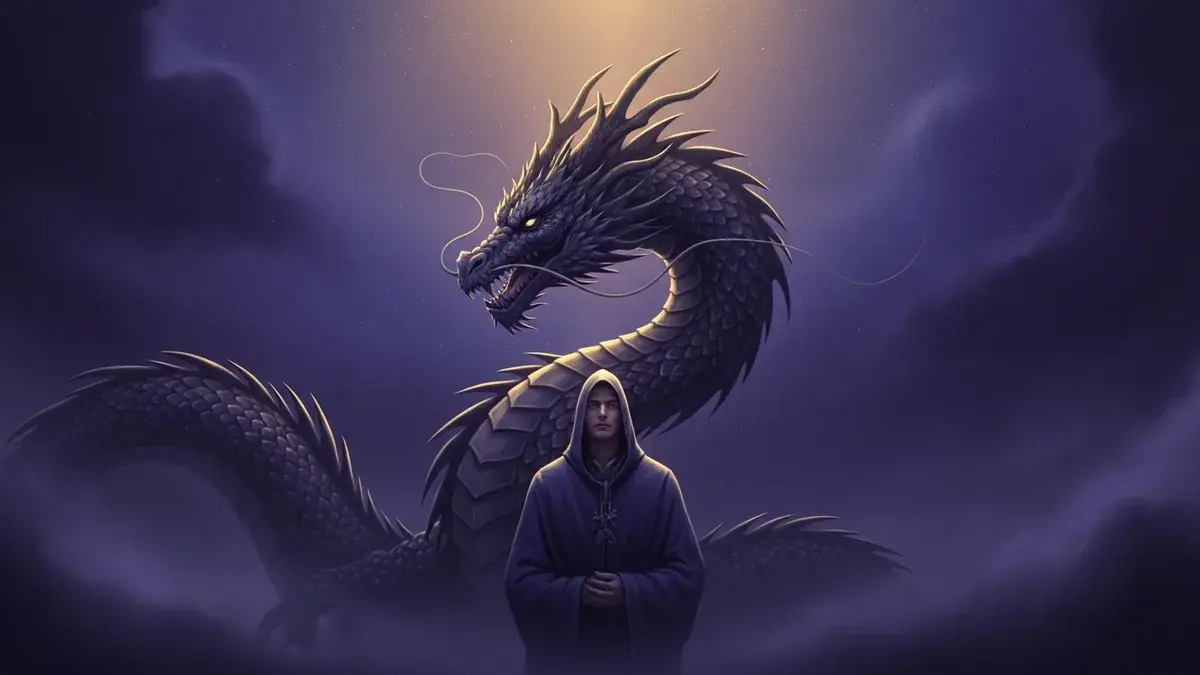
Dragon symbolizes elemental power, rightful authority, and transformation. Across cultures it's read as guardian, ruler, and teacher — in Feng Shui tied to prosperity and good fortune, in Celtic lore to vitality and ancestral wisdom. As a Spirit Animal it calls you to claim your voice and rise into your own authority, often by confronting something powerful within yourself or around you. In dreams, Dragon points to what you value most deeply, or to something you're keeping hidden.
An almanac
- Core message
- Rise into your own authority and wisdom
- Spirit animal
- Find your voice and be truly heard
- Totem for
- Those with a fierce, powerful nature
- Power animal
- Alchemical transformation and protection
- In dreams
- What you value most — or keep hidden
- Cultural roots
- Feng Shui, Celtic lore, European folklore
- Word origin
- Greek drákōn — "the one who sees"
- Why so universal
- Inherited snake-fear, or fossil finds, say scholars
Few creatures in world mythology carry as much weight and mystery as the Dragon. It looms over nearly every legendary bestiary, read as guardian, ruler, trickster, and teacher depending on where in the world you ask. Dragon symbolism is bound up with the elements themselves — earth, air, fire, water, and spirit — and with an old question: what does it mean to hold real power responsibly?
Dragon Symbolism & Meaning
Of all the legendary beings people look to for guidance, Dragon may be the oldest and most commanding. Across East Asian tradition, the Dragon has long been bound up with imperial authority — the figure who dreamed, in a sense, on behalf of an entire nation.
Wherever this creature appears, it commands the elements and shifts shape at will. Shamanic tradition often reads Dragon's transformations as mastery over nature and passage into the dream realm.
In Feng Shui, Dragon is prosperity, rightful authority, expansion, and good fortune. European folklore takes a different angle: Dragon as a symbol of rising above hardship and gaining clear-eyed perspective on one's circumstances. Underneath these readings sits something more universal — Dragon as a stand-in for raw natural force, for long life, and for magic so old its meaning has largely been lost.
The recurring image of a knight locked in combat with a Dragon isn't really about armor and scales. It's a picture of the internal struggle every person faces in trying to reconcile the physical self with something more spiritual. Scotland's own water-beast folklore — the older Celtic tradition behind legends like the Loch Ness Monster — echoes this same association between Dragons and the depths they're said to guard.
Anyone said to have witnessed it earns the title of "Dragon kin," and Dragon's energy is linked in turn to healing stones and to the realm of one's ancestors.
Dragon Spirit Animal
Dragon tends to seek out people marked by sharp intellect, dignity, and a magnetic kind of drive. It guides them toward their own brilliance and, eventually, a deeper awakening. As a Spirit Animal, Dragon's lesson is about learning to roar: claiming your voice, being heard, and being understood on your own terms.
Because Dragon is such a rare and formidable presence, it's natural to feel a little unsettled the first time it shows up in your life. This creature has earned every bit of the respect it commands, and it doesn't arrive without reason, though working out exactly what that reason is can take real effort. Dragon spirits don't hand over their secrets easily.
The particular form your Dragon takes can offer a clue to its message. Certain legends, such as those of dragon-slaying saints, cast Dragon as a stand-in for something more sinister. But any true Spirit Animal shows up with your best interests at heart.
Sometimes that means confronting and "slaying" a dragon that lives within you — a habit, a temper, a wound to your self-worth. Other times it means standing up to someone genuinely doing harm to you, your loved ones, or your home.
To be clear, "slaying" here is symbolic language about inner and relational courage, never a literal call to harm anyone.
Dragon Totem Animal
People who claim Dragon as a Totem Animal carry a fierce quality about them. That doesn't mean they're frightening, or that they need to fear this ferocity in themselves — fierceness, used well, is simply a powerful kind of energy, though it can turn destructive if mishandled.
The hope is that you'll channel the Dragon within toward thoughts, words, and actions that serve the greater good.
Dragon has always been bound to the elements in both old and modern myth. The five classical elements — earth, air, fire, water, and spirit (also called aether) — each claim their own totem creatures, the way Fish belongs to water, Bear to earth, Eagle to air, and Lion to fire.
When something as vast and formidable as Dragon pairs with one of these elements, the resulting force is extraordinary, so it's worth identifying which elemental type of Dragon you carry before fully claiming it as your totem.
Dragon totem energy carries an obvious risk: letting the ego run away with it. Save Dragon's energy for genuinely large struggles or ambitions — the kind that would otherwise feel impossible to face — rather than spending it carelessly, since Dragon favors those who treat its power with discretion.
Learning as much as you can about these beings deepens your connection to your totem and sharpens your ability to read what it's telling you. If you ever get the chance to sit in quiet reflection inside a cave, take it — caves are considered a resting place for Dragons in myth.
Don't be surprised if your totem seems to argue a point with you rather than simply agree; it's often a way of pushing you toward sharper clarity.
Dragon Power Animal
Working with Dragon as a Power Animal is a bit like being handed a key to the supernatural and to authentic magic, though learning to use that key well takes time. Every Dragon carries an alchemical quality; it works to refine you the way old alchemists sought to turn base matter into gold. That is a substantial gift, and one to accept with humility rather than pride.
Calling on Dragon in this way also raises the karmic stakes considerably. Dragon offers protection so long as your efforts serve the greater good, but reaching for power out of greed is the fastest way to lose this ally — and to get burned in the process.
Dragon's particular kind of energy and medicine is especially suited to those drawn toward healing work and medicine, acupuncture among them.
This alchemical thread runs deeper than metaphor. Carl Jung himself called the Ouroboros — the ancient image of a serpent or dragon devouring its own tail — the basic mandala of alchemy. He read it as a picture of the individuation process itself: the self consuming and renewing its own raw material until something more refined emerges. It's a useful image to hold alongside Dragon Power Animal work, since the point was never to slay or discard any part of yourself, but to let it double back and transform what it touches.
Native American Dragon Symbolic Meanings
Dragons in the strict sense don't appear in traditional Native American storytelling — Serpents and Snakes fill a related role instead. Because Dragon mythology is so closely intertwined with Snake symbolism worldwide, understanding Snake as a Spirit, Totem, and Power Animal can round out your sense of what Dragon represents.
Dragon as a Celtic Animal Symbol
Dragon holds a prominent place in Celtic legend, where it's tied to all four classical elements and the cardinal directions. The Druids read Dragon as a symbol of vitality, the psychic and inner self, ancestral wisdom, and the raw power of creation. Tales describe Dragons as guardians of hidden, sacred passageways into other realms, which makes it no surprise that a Red Dragon sits on the Welsh flag, under a motto roughly translating to "the Red Dragon leads us."
Unlike much of the darker European tradition, Celtic Dragons lean benevolent, turning aggressive only when true evil is at hand. What are commonly known as Ley Lines were later linked by some writers to Dragon Lines, a term borrowed from the Chinese feng shui concept of dragon veins rather than a documented Celtic source. The association stuck anyway, tying Dragon symbolism to geomancy and the web of forces connecting everything on Earth. Stonehenge itself is thought by some to have served as a resting place for traveling Dragons.
The Anglo-Saxon root of the word "Dragon" carries the sense of a "clear seer." That suggests the Celts regarded these beings as prophetic figures holding deep wisdom. Spotting a Dragon was considered a strong omen of good health and a bountiful harvest, and even now Dragon holds a nearly divine status as a protector of the natural world.
Dragon Dreams
Dreaming of a Dragon guarding a hoard of treasure often points to what you value most deeply — or, just as often, to something you're keeping hidden from others. Dragon dreams can also touch on themes of creation, personal power, sexuality, and transcendent or primal forces that call for careful handling rather than suppression.
- Treasure caves — things you cherish, or things you conceal
- Elemental Dragons — connection to earth, air, fire, water, or spirit
- Fierce or threatening Dragons — a call to face something powerful within or around you
- Benevolent or guiding Dragons — wisdom, protection, or an invitation toward transformation
Because Dragon symbolism is so closely bound to Snake symbolism, dreams featuring Snakes often shed useful light on a Dragon dream as well, and vice versa.
Dragon in Greek & Norse Mythology
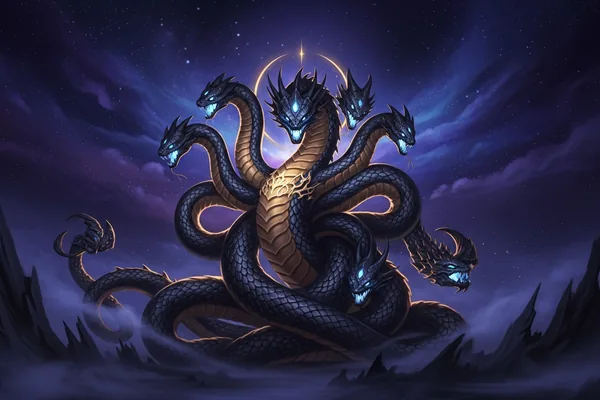
Greek mythology gave Dragon its very name — drákōn traces back to a root meaning "to see" or "to glare," as though the word was coined for a gaze no creature could hold. Typhon, the storm-giant said to bear a hundred serpent heads that breathed fire, was the gravest threat the Olympian gods ever faced. Ladon coiled endlessly around the golden apples of the Hesperides, an eternal guardian rather than a destroyer, while the many-headed Hydra taught Heracles that some threats can't simply be struck down — each severed head grew back until the wound itself was sealed, a quiet lesson about how old habits regrow unless you close the door behind them.
Norse myth carries a colder, more corrosive current. Níðhöggr gnaws without end at one of the three roots of Yggdrasil, the World Tree that holds the nine realms together, doing its damage from beneath where no one can see. Fafnir began as a dwarf, not a monster — he murdered his own father for a cursed hoard of gold, and it was greed itself that shapeshifted him into a dragon to guard it at Gnitaheath. The hero Sigurd eventually slew him by striking from a hidden pit below, but the story's real center isn't the kill. It's a man transformed by the very treasure he meant to possess.
Dragon in Near Eastern & Vedic Tradition
Long before Greece had a word for it, Mesopotamia already had a shape for it: the mušḫuššu, a "furious serpent" rendered as a divine attendant and protective emblem, carried through Babylonian and Akkadian tradition as a guardian rather than a threat. The Hebrew Bible's Book of Job describes a sea-dragon named Leviathan in similarly fearsome terms — "his breath kindleth coals, and a flame goeth out of his mouth" — a figure of chaos vast enough that only its creator could rightly tame it.
India took the serpent in a gentler direction entirely. The Nagas — a race of half-human, half-serpent beings said to descend from the sage Kashyapa — rule a jeweled underworld realm called Naga-loka, and one of their kings, Shesha, is the eternal coiled being on whom Vishnu reclines between cycles of creation. Where the Western dragon is so often something to be slain, Shesha is something the world quite literally rests on — a reminder that not every tradition asks you to fight this power to earn it.
Dragon as Psychological Archetype
Carl Jung read Dragon less as a monster to defeat and more as a portrait of the shadow — in his own words, everything "the subject refuses to acknowledge about himself, whether consciously or unconsciously." Seen this way, the treasure a dragon guards was never separate from the beast itself. It's unclaimed potential, sealed away behind exactly the qualities we're most reluctant to face in ourselves.
This reframes the old hero-slays-dragon story in a useful way. Notice how often the slayer ends up carrying something dragon-like forward rather than simply extinguishing it — Fafnir's greed, Sigurd's fire, the treasure that outlives the fight over it. Read through this lens, "defeating" your dragon was never really the point. Integrating what it protects is.
Frequently Asked Questions
What does Dragon symbolize across different cultures?
Dragon's symbolism shifts by region but stays rooted in power and the elements. In the Far East it has long been tied to imperial authority and, through Feng Shui, to fortune and growth. In Celtic tradition it represents vitality, ancestral wisdom, and guardianship of sacred places, while much of European folklore frames it as a force to be overcome to gain clarity and rise above hardship.
What does it mean if Dragon is your Spirit Animal?
Dragon as a Spirit Animal tends to appear for people of intellect and drive, and it pushes them to find their voice and be truly heard. It often shows up when you need to confront something powerful — whether an inner struggle like self-worth or addiction, or an outside force doing harm — always with your highest good in mind.
What does dreaming about a Dragon mean?
A Dragon guarding treasure in a dream often reflects what you value most or what you're keeping hidden, while Dragon dreams more broadly can touch on creation, personal power, and primal forces that deserve careful handling. Because Dragon lore is so closely tied to Snake symbolism, Snake dreams can offer useful context for interpreting a Dragon dream too.
Why do dragon myths appear in almost every culture on Earth?
Scholars don't fully agree on why, but two theories stand out. Anthropologist David E. Jones argues humans may carry an inherited fear response to snakes and large predators, which naturally coalesces into monster-shapes across cultures that never had contact with one another. Paleontologist Adrienne Mayor instead points to fossil finds of prehistoric creatures as a likely spark for certain dragon legends — though that theory struggles to explain places like Scandinavia, where such fossils are scarce yet dragon lore runs just as deep.
What is the Ouroboros and how does it connect to Dragon symbolism?
The Ouroboros is the ancient image of a serpent or dragon swallowing its own tail, read since antiquity as a symbol of eternal cyclic renewal — life, death, and rebirth folded into a single unbroken shape. Carl Jung called it "the basic mandala of alchemy." He saw in it the same self-consuming, self-renewing process this guide traces through Dragon's alchemical side as a Power Animal.
Sources
Claims on this page were checked against these published sources.
- Chinese dragon
Dragons (usually with five claws on each foot) were a symbol for the emperor in many Chinese dynasties... They traditionally symbolize potent and auspicious powers, particularly control over water and weather... prosperity and good luck
Read the source → - Welsh Dragon
Y ddraig goch ddyry cychwyn — this translates to 'The red dragon will show the way' or alternatively, 'the red dragon inspires action.' ... appearing on the Royal Badge of Wales established in 1953.
Read the source → - Dragon
Unhcegila [is listed] among famous prototypical draconic creatures globally
Read the source → - Níðhöggr
Níðhǫggr is a being which gnaws one of the three roots of Yggdrasill.
Read the source → - Fáfnir
Fáfnir then takes all the hoard, refusing to share it with his brother, and takes to Gnitaheath, where he took the shape of a worm. [...] The hero Sigurð, aided by Fáfnir's own brother Regin (who forged the sword Gram), killed the dragon by stabbing him from beneath as he passed over a hidden pit.
Read the source → - Job 41 (King James Version)
Biblical Leviathan exhibited fire-breathing capabilities (Job 41:19-21).
Read the source → - Nāga
Nagas are divine or semi-divine beings... they are children of the sage Kashyapa and Kadru... Vishnu is "originally portrayed in the form sheltered by Sheshanāga or reclining on Shesha," establishing this naga as fundamentally connected to the supreme deity.
Read the source → - Ouroboros
The ouroboros is "an ancient symbol depicting a snake or dragon eating its own tail"... representing "eternal cyclic renewal or a cycle of life, death and rebirth"... Carl Jung identified it as "the basic mandala of alchemy".
Read the source → - Shadow (psychology)
The shadow personifies everything that the subject refuses to acknowledge about himself, whether consciously or unconsciously.
Read the source →