Mythical Creature
Jackalope Symbolism & Meaning
The sly frontier trickster who teaches you to stay sharp, stay quiet, and wait for the lightning-strike of inspiration.
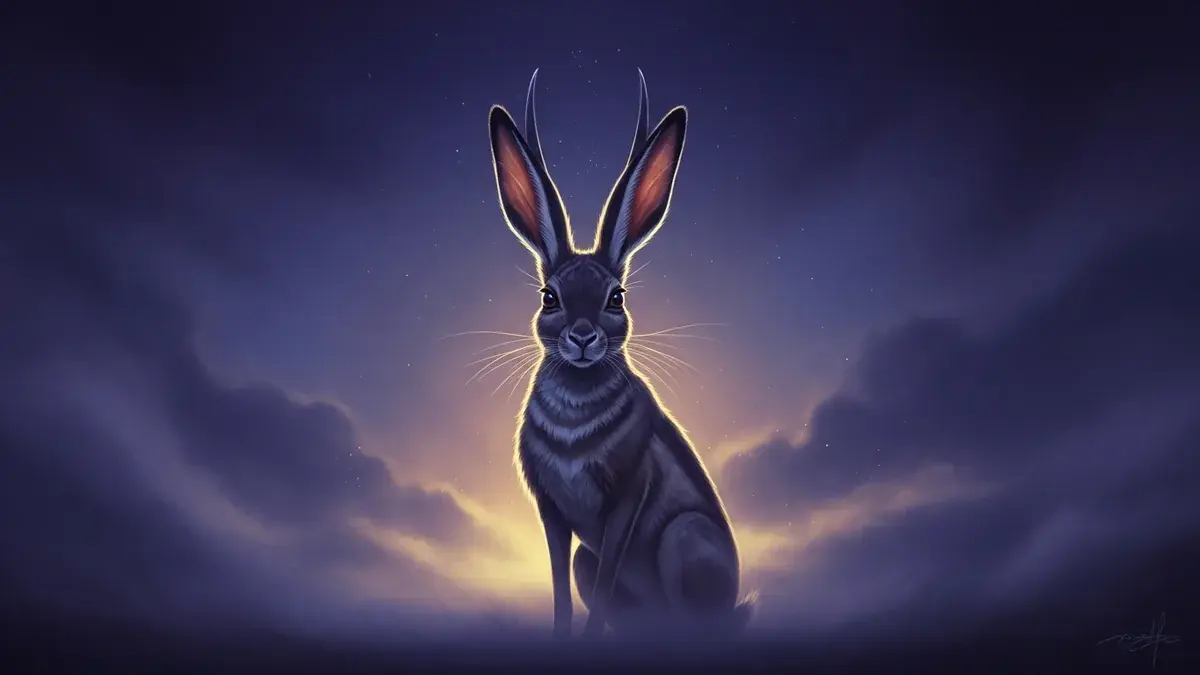
The Jackalope symbolizes cunning, elusiveness, and sharp perception — a trickster spirit that rewards watchfulness, stillness, and quick decisive action once the moment is right. As a spirit or dream symbol it often signals an approaching flash of insight or breakthrough, alongside a caution against tempting distractions that could cloud your judgment.
An almanac
- Core message
- Stay sharp, stay quiet, act fast when ready
- Spirit animal
- Trust instincts, await sudden insight
- Totem for
- Solitary, quick-witted, playful people
- Power animal
- Quick decisions, sharpened intuition
- In dreams
- Fast decisions, need for solitude
- Watch for
- Tempting distractions clouding judgment
- Folk capital
- Douglas, Wyoming (self-declared)
The Jackalope is a tall-tale creature of the American frontier — a hare crowned with antelope horns, part joke, part warning, and part genuine mystery. Beneath the campfire humor sits a surprisingly rich symbol of cunning, watchfulness, and the flash of insight that arrives when you least expect it. Trace its story back far enough and you find horned hares showing up across centuries and continents, always carrying the same core lesson: look closely before you believe what you see.
Jackalope Symbolism & Meaning
The name Jackalope is a blend of "jackrabbit" and "antelope," describing a hybrid animal that fuses two very different creatures into a single body — a shape-shifting quality that puts it in the same imaginative family as the Rabbit, the Antelope, and the Deer, and it's worth reading up on each of those animals' meanings for extra layers of insight.
According to some versions of the legend, the creature is actually a cross between a fierce hare and a miniature deer.
Folklore paints the Jackalope as fast, sharp-witted, and slippery — a natural-born trickster. That reputation traces partly to its documented origin story: taxidermist Doug Herrick and his brother mounted deer antlers onto a jackrabbit and sold the mounted "trophy," turning a joke into an American folk icon.
Yet reports of horned hares predate the Herricks by centuries, so the Jackalope isn't purely a 20th-century invention.
Horned-rabbit imagery shows up in 13th-century Persian artwork, portraying a single-horned hare reminiscent of a unicorn. That Persian creature carries its own name in old bestiaries — the Al-mi'raj — described as a yellow-coated hare with a single black horn, so fearsome that other wild animals were said to flee at the sight of it. Similar beasts populate European legend:
- The Bavarian Wolpertinger — a fanged creature with a pheasant's wings and legs, a deer's antlers, a squirrel's body, and a rabbit's head
- The Germanic Rasselbock (or Raspelbock) of the Harz Mountains and Thuringian Forest — antlered, rabbit-headed, with canine teeth, and known in Austria as the Raurackel
- The Swedish Skvader, which pairs a European hare's head, forequarters, and hindlegs with the back, wings, and tail of a female wood grouse
A parallel trickster tradition exists closer to home, on the other side of the ocean from those European tales. In Ojibwe and Anishinaabe oral tradition, the trickster-culture-hero Nanabozho (also called Manabozho) frequently takes rabbit form, appearing as Mishaabooz, the "Great Rabbit" — a shape-shifter whose pranks and mischief carry moral lessons even while stirring up chaos. The Jackalope's blend of humor and hidden wisdom echoes that older pattern: a rabbit-shaped trickster who teaches by misdirection rather than lecture.
For several centuries, people took the so-called Lepus cornutus, or "horned rabbit," to be a real species. Modern science eventually traced the sightings to Shope papillomavirus, an infection that produces tumor-like growths on rabbits that can resemble horns. In this light, the Jackalope also symbolizes mistaken perception — how appearances shift and how easily a strange sight can be misread as something else entirely.
Campfire lore adds plenty of color: the Jackalope supposedly craves whiskey, charges at the ankles of hunters who threaten it, and can mimic a human singing voice well enough to harmonize with cowboys around a fire. Old-timers claimed hunters wrapped their legs in stovepipes for protection, and that the creature breeds only during lightning storms.
Like the uncatchable Cadmean vixen of Greek myth, the Jackalope is said to always slip away from pursuers — clever, quick, and rarely caught off guard. Taken together, the legend points to elusiveness, secrecy, solitude, and thoughtful stillness, paired with a readiness to move fast the moment the coast is clear.
Jackalope Spirit Animal
Jackalope tends to show up when trust feels shaky — when you sense something is off but can't quite name it. Its arrival is a nudge to lean on your own instincts and read a situation carefully rather than reacting on impulse.
This animal spirit guide models a simple discipline: sit still, stay quiet, and let your inner voice do the talking before you decide anything.
Because the legend ties Jackalope's mating season to lightning storms, its appearance can also signal that a breakthrough or sudden insight is heading your way — the kind of flash of clarity that ancient sky deities like Zeus or Jupiter were said to send down along with the thunder. Think of it as a jolt of inspiration meant to expand how you think and grow.
The creature's one soft spot, its fondness for whiskey, doubles as a caution. When Jackalope turns up as a guide, it may be flagging a tempting distraction that could cloud your judgment — a reminder to keep your head clear rather than let something enticing pull you off course.
Jackalope Totem Animal
People born under the Jackalope totem rarely chase every social invitation; solitude suits them just fine. That doesn't mean they avoid people altogether — in a group setting, they go quiet and attentive, absorbing everything being said and left unsaid. Their read on human behavior can feel almost uncanny to those around them.
Being reserved doesn't mean being a pushover. A Jackalope totem holder will stand their ground when challenged, relying on wit and quick thinking rather than brute force to hold their own. Many carry a playful streak too, enjoying a harmless prank now and then without ever meaning real mischief.
A distinctive gift of this totem is vocal talent — a good singing voice paired with a knack for mimicry, picking up other people's speech patterns and tone. That skill can become a real asset for entertainers, and more broadly it helps this person connect with others by naturally adapting to how those around them communicate.
Jackalope Power Animal
Call on Jackalope as a power animal whenever a moment calls for quick thinking or decisive action. In the wild, this creature survives by making split-second choices to outrun danger — the same instinct you can borrow when a fleeting opportunity demands you move now rather than overthink it. Jackalope's energy helps you stay level-headed even when everything around you feels chaotic.
Its antlers double as a kind of antenna in this symbolism, tuning you into subtler forms of awareness. Invoke Jackalope when you want to sharpen your intuition, deepen your clairvoyant sense, or simply get better at reading the energy of a room or situation.
Jackalope Dreams
When a Jackalope appears in a dream, it may be carrying a message from a higher source — however you conceive of that guidance, whether ancestors, spirit, or the wider universe. Its horns in dream imagery point toward tuning into a higher frequency of awareness.
- Seeing it dart around suggests you're facing a decision window that requires speed, or you risk missing the opening
- Watching it run without catching it may mirror a goal that keeps slipping out of reach, leaving you feeling like you're working hard and getting nowhere
- Spotting it hidden in the woods points to a needed stretch of solitude — time to recover your energy and simply observe before acting
Key themes tied to Jackalope dream symbolism include: cunning, elusiveness, enigma, inspiration, intellect, mimicry, paradox, psychic sensitivity, solitude, and swiftness.
Douglas, Wyoming & the Jackalope Hunting License
Nowhere takes the Jackalope more seriously — in jest — than Douglas, Wyoming, the town that calls itself the official Jackalope Capital of the World. Doug Herrick's original mounted trophy sold there in the 1930s, and the town has run with the legend ever since, selling souvenir "Jackalope Hunting Licenses" that only work as a joke: the tag is valid for a single night of hunting season, June 31 — a date that doesn't exist, since June only has 30 days — from midnight to 2 a.m., and the hunter is required to have an IQ "greater than 50 but not over 72."
The town's civic pride runs deeper than tourist merchandise. Wyoming lawmakers tried three separate times — in 2005, 2013, and 2015 — to pass a bill naming the Jackalope the state's official mythical creature; each version cleared the House only to die in a Senate committee. The Wyoming Lottery adopted its own jackalope mascot in 2014 anyway, nicknaming it "YoLo" for its tickets and marketing.
Symbolically, this civic playfulness circles back to the creature's oldest trait: the trickster's wink. A whole town built part of its identity around a joke everyone is in on together — proof that the Jackalope's gift for blurring fact and fiction never needed to convince anyone, just to delight them.
Frequently Asked Questions
What does the Jackalope symbolize?
The Jackalope symbolizes cunning, elusiveness, and sharp perception — the ability to stay hidden, observe carefully, and move fast once it's safe to act. Its folklore also touches on mistaken appearances, since real horned-rabbit sightings were later traced to a virus that causes tumor-like growths, not an actual antlered hare.
Is the Jackalope a trickster figure?
Yes. The Jackalope is widely treated as a trickster creature, partly because of its blended, shape-shifting form and partly because its best-known modern origin — two taxidermist brothers mounting antlers on a jackrabbit — was itself a lighthearted hoax that grew into folklore.
What does it mean if a Jackalope appears in a dream?
A Jackalope in a dream can point to a fast-approaching decision, a need for solitude, or a message worth tuning into carefully. Chasing one without catching it often reflects a goal that feels just out of reach, while seeing it hide in the woods suggests it's time to rest, regroup, and simply observe.
Can you actually get a license to hunt a Jackalope?
Only as a novelty. Douglas, Wyoming sells souvenir "Jackalope Hunting Licenses" valid for one night of an invented season — June 31, a date that doesn't exist since June has only 30 days — and requiring the hunter to have an IQ "greater than 50 but not over 72." It's a wink at the legend, not a real permit for a real animal.
Is the Jackalope Wyoming's official state creature?
Not officially, though it came close. Wyoming's legislature introduced bills in 2005, 2013, and 2015 to name the Jackalope the state's official mythical creature; each one passed the House but died in a Senate committee. The Wyoming Lottery gave the creature its own mascot anyway in 2014, nicknamed "YoLo."
Are there jackalope-like creatures in other cultures?
Yes, several. Beyond the Bavarian Wolpertinger, Germanic Rasselbock, and Swedish Skvader, medieval Persian and Islamic bestiaries describe the Al-mi'raj — a yellow, single-horned hare so fearsome that other animals were said to flee it. In Ojibwe and Anishinaabe oral tradition, the trickster Nanabozho (Manabozho) frequently takes rabbit form as Mishaabooz, the "Great Rabbit," echoing the same rabbit-shaped-trickster pattern.
Sources
Claims on this page were checked against these published sources.
- Jackalope
Jackalope is a portmanteau of jackrabbit and antelope.
Read the source → - Wolpertinger
The head of a rabbit, the body of a squirrel, the antlers of a deer, and the wings and occasionally the legs of a pheasant.
Read the source → - Skvader
It has the head, forequarters and hindlegs of a European hare (Lepus europaeus), and the back, wings and tail of a female wood grouse (Tetrao urogallus).
Read the source → - Teumessian fox
the Teumessian fox, sometimes called the Teumessian vixen, was an enormous fox that was destined never to be caught... the Teumessian fox is referred to by the elegant variation Cadmean vixen
Read the source → - Al-Mi'raj
a yellow-colored beast which resembled a rabbit with a black horn
Read the source → - Nanabozho
In his rabbit form, he is called Mishaabooz ("Great rabbit" or "Hare")... Nanabozho is the Ojibwe trickster figure and culture hero
Read the source →