Mythical Creature
Griffin Symbolism & Meaning
The eagle-lion guardian of treasure, boundaries, and hard-won wisdom.
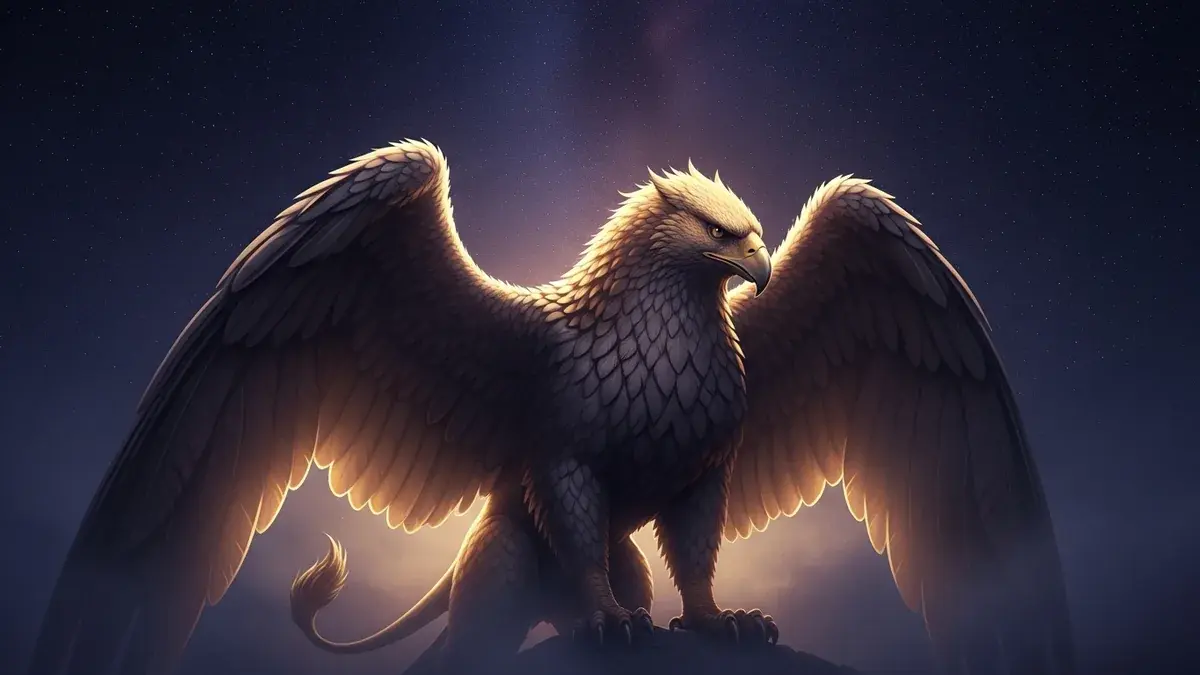
As a spirit animal, the Griffin symbolizes guardianship, power, and nobility: the lion's strength meets the eagle's command of the sky, and together they signal that something precious in your life needs protecting. It also carries themes of material wealth, unwavering loyalty, and hidden truths about to surface, so pay attention to your intuition and to the boundaries you've already built. As a totem or power animal, it points to natural leadership, a scholar's hunger for knowledge, and the nerve to take a leap of faith.
An almanac
- Core message
- Something precious is being protected
- Spirit animal
- Signals protection & hidden truths revealed
- Totem for
- Natural leaders with sharp intuition
- Power animal
- Leaps of faith & guarding sacred space
- Watch for
- Possessiveness & holding grudges
- Cultural roots
- Greek, Iranian (Shirdal) & Egyptian lore
- Hindu parallel
- Garuda, Vishnu's eagle-mount
- Christian symbol
- Christ's dual nature (Dante's Purgatorio)
Part eagle, part lion, and wholly legendary, the Griffin has stood guard over treasure, temples, and thrones for thousands of years. Its name likely traces back to a Greek word for "curved," a nod to that unmistakable hooked beak, though some scholars point to an Akkadian root meaning "winged creature." Whatever its origin, the Griffin has always meant one thing above all: something precious is being protected.
Origins and Appearance
Picture the front half of an eagle fused seamlessly onto the back half of a lion, and you have the classic Griffin (sometimes spelled Gryphon or Griffon). The head, beak, talons, and wings belong to the eagle; the muscular body, legs, and tail belong to the lion.
Some artists add feathered ears for good measure, which link the creature to both the Earth (through its lion half) and the Air (through its eagle half).
Not every depiction gives the Griffin wings, though. A wingless version earned its own name, the Keythong, and writers have never fully agreed on what that variant is meant to represent — some call it feminine, others insist the opposite.
In practice, the female Griffin shows up more often in general artwork and decorative imagery, while the male tends to dominate heraldry, where it represents the power of God and defends sacred things fiercely.
Heraldry has its own cousin creature worth knowing: the Opinicus, which swaps in a camel's tail and a dragon's head alongside the eagle wings and lion body. A few researchers have even floated a real-world explanation for the myth: ancient people who unearthed fossilized Protoceratops skeletons — complete with a beaked skull and four-legged frame — may have mistaken the bones for evidence of a living Griffin.
Because it borrows so freely from real animals, the Griffin has always carried an air of paradox and shapeshifting. It is chimerical by nature, stitched together from two dominant forces of the animal kingdom: the lion, ruler of beasts, and the eagle, ruler of birds.
That pairing is why the Griffin reads as a symbol of power, nobility, and leadership wherever it appears.
Symbolism of Guardianship and Wealth
Strength alone doesn't explain the Griffin's staying power in myth — it's what that strength gets used for. Across cultures, the creature was cast as a protector of priceless treasure, chasing off bandits and thieves who came looking to steal riches that weren't theirs.
That job is why the Griffin became such a lasting symbol of protection and guardianship.
Greek writers rooted the Griffin's story in Central Asia, in lands known for their gold deposits. The Roman naturalist Pliny the Elder wrote that the creature built its nest underground, and that gold could be found buried right alongside it.
The Greek city-state of Abdera even minted a coin called the "Griffon," stamped with the creature's image on its face — a detail that shows how closely the Griffin was tied to material wealth and prosperity.
The ears are an odd detail worth pausing on. Most depictions give the Griffin large ears, sometimes shaped like a lion's, sometimes closer to a horse's — which is a strange choice, since the horse was traditionally considered the Griffin's enemy in old lore.
That tension between the two animals hints that horse symbolism adds another layer of meaning wherever it shows up alongside a Griffin story.
Greek writers gave this gold-guarding role its own adversary, too. The historian Herodotus, drawing on a now-lost poem by the 7th-century-BCE poet Aristeas of Proconnesus, described a legendary one-eyed people called the Arimaspi, living in the far northeast of Scythia, who were said to spend their time stealing gold from the griffins that guarded it. Ancient artists loved the pairing, often showing richly dressed Arimaspian warriors locked in combat with the very creatures they were trying to rob — a vivid, early version of the Griffin's role as treasure's last line of defense.
Medieval Lore: Loyalty and Healing
A great deal of what we know about the Griffin's supposed behavior comes down to us from the Medieval Era. According to that lore, the Griffin mates for life. When one partner dies, the survivor never takes another mate and lives out its days alone. That detail turned the Griffin into an emblem of:
- Fidelity and unwavering commitment
- Loyalty between partners
- Marriage and lasting love
- A moral stance against remarrying, which medieval Christians sometimes drew on directly
Medieval Europeans also believed the Griffin carried healing power. Its feathers were said to cure blindness, and its claws were said to have healing properties of their own. This belief got surprisingly literal: European courts of the era drank from cups carved into the shape of Griffin claws and consumed so-called "Griffin eggs" — which were, in reality, ostrich eggs — in hopes of drawing out the creature's restorative gifts.
Griffin in Greek, Iranian, and Egyptian Tradition
The Griffin appears across several ancient civilizations, each adding its own accent to the legend.
In Greek tradition, as noted above, the creature was tied to the gold-rich lands of Central Asia, guarding buried treasure and lending its image to coinage as a mark of prosperity.
In Iranian lore, the Griffin goes by the name Shirdal, meaning "Lion-Eagle." Artisans in the region were casting small Griffin figures and crafting Griffin artwork as far back as the 2nd millennium BCE, among the earliest evidence of this hybrid image anywhere in the ancient world.
In Egypt, the trail runs even further back. Residents of Hierakonpolis — a name that translates to "Hawk City" — owned cosmetic palettes decorated with Griffin imagery as early as 3000 BCE. Egyptian tradition also links the Griffin visually to the Sphinx, another hybrid guardian creature long associated with divine authority. The Sphinx and the Griffin together show how important hybrid animal-guardians were in Egyptian visual culture.
Griffin as a Spirit Animal
When the Griffin shows up as a Spirit Animal, it tends to arrive at moments when you need protection — its talons are always ready to tear through whatever obstacle blocks your path, especially when that obstacle stands between you and emotional balance or spiritual growth.
The Griffin also carries an enlightenment current. In Jewish legend, a version of the creature called Ziz is described as so enormous it can block out the sun entirely — or, just as easily, choose to let sunlight pour back down onto the earth.
When Griffin arrives in this form, it's often a signal that something in a situation or relationship isn't fully visible to you yet, and the creature has come to help reveal what's been hidden.
Several major Greek deities were linked to the Griffin, including Apollo (who was said to ride a griffin to Hyperborea each winter), Dionysus, and Nemesis, with the creature sometimes styled as the "hounds of Zeus" in classical writing. As a self-styled Lord of Earth and Sky and a divine guardian figure, the Griffin is closely tied to your psychic senses — so if your spiritual practice has gone quiet, or you're craving a stronger connection to Spirit, this creature can help light the way. It's also considered a herald for messages from otherworldly realms.
Griffin as a Totem Animal
People who claim the Griffin as a Totem Animal tend to carry themselves with a distinct, magnetic presence — others naturally look to them for direction. That presence comes paired with something like eagle-sharp vision, both literally and in the extrasensory sense: a knack for seeing situations clearly and sensing how they'll unfold before they do.
Griffin-totem people also tend to have a scholar's mind, with a near-insatiable appetite for learning, particularly anything touching on the metaphysical or mysterious. That combination of vision and hunger for knowledge makes them natural role models, and they often find themselves standing up for the underdog without being asked.
A few more traits round out the profile:
- A strong, unforgiving memory when someone crosses them
- A genuine love of beauty and an eye for the luxurious
- Deep attachment to their own possessions, treated almost like treasure
- A fierce instinct to protect what belongs to them, at nearly any cost
Griffin as a Power Animal
Call on Griffin as a Power Animal when you're staring down a leap of faith. As self-proclaimed King of Birds and Lord of the Sky, the Griffin's bond with the Air element makes it a strong ally for moments when you need to set turbulent emotion aside, lean on cool-headed intellect, and commit fully to a decision or relationship.
Griffin also answers the call in matters of raw strength, mental or physical. According to legend, the creature is as strong as eight lions and a hundred eagles combined, with old stories describing it hauling off full-grown oxen and horses to feed its nest.
That kind of power makes Griffin a steady presence whenever a task demands real endurance — or whenever you need to brace yourself against an emotional storm.
Finally, invoke Griffin as a Power Animal whenever you're working to establish sacred space. True to legend, the creature builds its nest from gold, hides precious gems inside, and defends that space fiercely against any intruder.
That makes Griffin a fitting ally for anyone setting clear boundaries or carving out a space that is unmistakably their own.
Griffin Dream Meaning
A Griffin appearing in a dream rarely feels neutral — its dual nature tends to mirror something unresolved between instinct and intellect in the dreamer's own life.
- A Griffin soaring overhead often signals that you're being called to combine grounded action with a higher, wider view of your situation — the eagle-half calls you to rise above a problem the lion-half has been fighting on the ground.
- A Griffin guarding a nest, cave, or hoard usually points straight back to the creature's oldest job: something you value, whether a relationship, a secret, or your own peace of mind, needs closer protection.
- A Griffin that turns aggressive or blocks your path can reflect an inner tug-of-war between raw instinct and your more measured, intellectual side — a sign that one half of that partnership has been ignored too long.
- A Griffin glimpsed from a distance, simply watching, tends to nudge you toward integrating a part of your personality you've kept separate rather than confronting it directly.
As with most dream figures, the tone of the encounter matters. A Griffin that feels like an ally in the dream generally affirms that your strength and vision are already working together; one that feels threatening is more often a signal that they aren't — yet.
Garuda: The Griffin's Hindu Cousin
The Griffin isn't the only hybrid eagle-guardian in world mythology — Hindu tradition has its own, and the resemblance runs deep.
Garuda, part eagle and part man in most depictions, is the vahana, or divine mount, of the god Vishnu. According to the World History Encyclopedia, Garuda "is the vehicle (vahana) of Vishnu and appears on the god's banner," a role that makes him both a means of transport across the cosmos and a personal emblem of the deity he carries.
Like the Griffin, Garuda combines the qualities of a fierce bird of prey with a higher, more deliberate purpose: his power serves something greater than himself. That parallel is worth sitting with if Griffin has shown up in your life as a spirit or totem animal; across very different cultures, the eagle-bodied guardian keeps returning as a symbol of strength that has chosen what to protect.
Frequently Asked Questions
What does the Griffin symbolize?
The Griffin symbolizes guardianship, power, and nobility: the lion's strength combined with the eagle's mastery of the sky. It's also tied to material wealth through its legendary gold-guarding nests, and to loyalty and fidelity through medieval lore that describes it as a lifelong-mate creature.
Where does the Griffin legend come from?
Griffin imagery appears across several ancient cultures. Greek writers placed its origins in the gold-rich lands of Central Asia, Iranian artisans were crafting Griffin (Shirdal) figures by the 2nd millennium BCE, and Egyptians in Hierakonpolis owned Griffin-decorated palettes as early as 3000 BCE.
What does it mean to have the Griffin as a spirit or totem animal?
A Griffin Spirit Animal tends to arrive when you need protection, or help seeing something hidden in a situation. As a Totem Animal, it points to sharp intuition, a scholarly hunger for knowledge, natural leadership, and a strong protective streak over the people and possessions you cherish.
What does it mean to dream of a Griffin?
Dreaming of a Griffin usually points to the same territory it covers as a waking symbol: protection, and the balance between instinct and intellect. A soaring Griffin suggests you're being called to pair grounded action with a wider perspective, while a Griffin guarding a nest or hoard often means something you value needs closer attention. An aggressive Griffin can reflect an inner conflict between your fiercer instincts and your more measured, thinking side.
Is the Griffin a Christian symbol?
Yes — medieval Christian art and literature adopted the Griffin as an emblem of Christ's dual nature, human and divine, with the eagle-half representing divinity and the lion-half representing humanity. The clearest example appears in Dante's Purgatorio, where a Griffin draws a chariot symbolizing Christ leading the Church through the Earthly Paradise.
Is there a Hindu equivalent to the Griffin?
The closest parallel is Garuda, a part-eagle, part-human figure who is the vahana, or divine mount, of the god Vishnu, and who appears on his banner. Like the Griffin, Garuda combines a bird of prey's raw power with a role in service of something greater: he carries and represents the deity rather than acting on instinct alone.
Sources
Claims on this page were checked against these published sources.
- Griffin
It could be related to the Greek word γρυπός (grypos), meaning 'curved', or 'hooked'. ... It could also have been an Anatolian loan word derived from a Semitic language; compare the Hebrew כרוב kərúv.
Read the source → - Hierakonpolis
Hierakonpolis (Greek: Ἱεράκων πόλις, romanized: Hierákōn pólis, meaning City of Hawks or City of Falcons
Read the source → - Ziz
The Ziz is a giant griffin-like bird in Jewish mythology, said to be large enough to be able to block out the sun with its wingspan. ... His wings are so huge that unfurled they darken the sun.
Read the source → - Garuda
He is the vehicle (vahana) of Vishnu and appears on the god's banner.
Read the source → - The Griffin
were used to symbolize the union of Christ's divine and human natures
Read the source → - Arimaspi
engage in stealing gold from the griffins, causing disagreements between the two groups
Read the source →