Mythical Creature
Hydra Symbolism & Meaning
The many-headed water serpent: face compounding problems with patience, teamwork, and a fresh point of view.
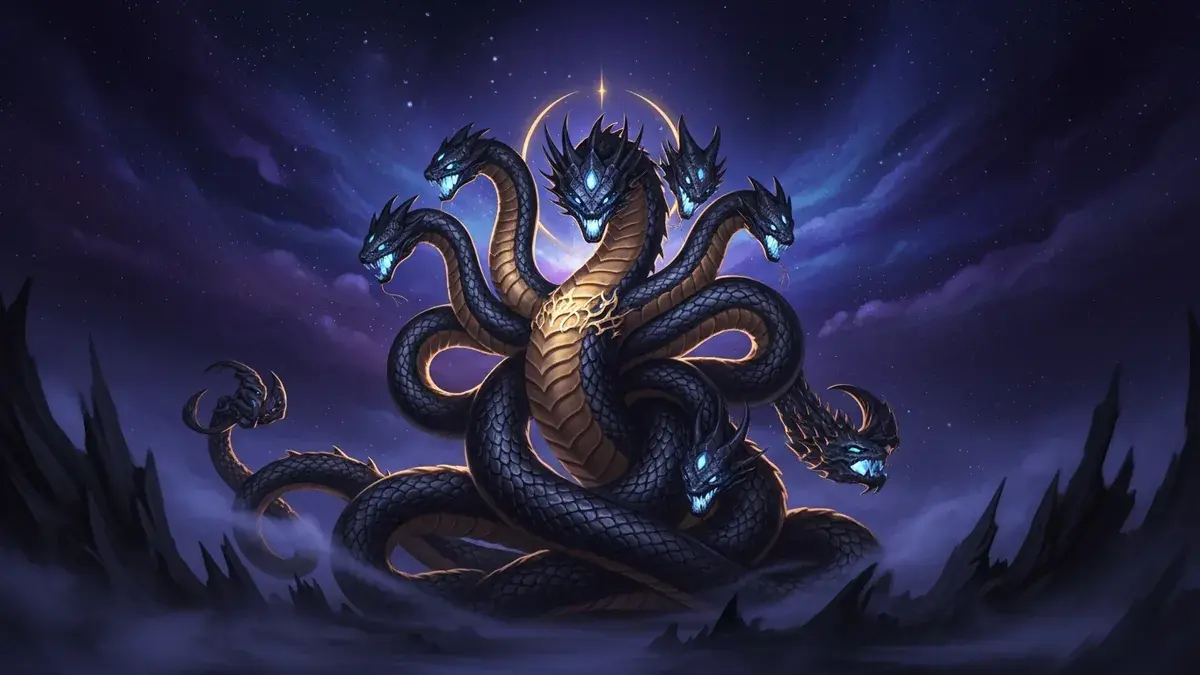
As a spirit animal, the Hydra is about facing compounding problems — the kind where cutting off one issue only makes two more grow back — with patience, teamwork, and a willingness to see the situation from more than one angle. It often shows up as an early warning that several difficulties are converging at once: cauterize the root causes with allies instead of fighting symptoms alone. Its regenerating heads also connect it to transformation, duality, and undying persistence.
An almanac
- Core message
- Face compounding problems with patience and allies
- Spirit animal
- Early warning of converging troubles beneath the surface
- Totem for
- Curious, persistent, team-minded thinkers
- Power animal
- Staying afloat emotionally and financially
- In dreams
- Multiple challenges converging at once
- Cultural roots
- Greco-Roman myth and African folklore
- Common idiom
- "Hydra-headed" = a problem that multiplies (since the 1590s)
- Night sky
- Constellation Hydra sits near Cancer
Do you feel like every solved problem sprouts two more in its place? The Hydra is the ancient creature that names that exact frustration, and its myth offers a way through it. The serpentine, multi-headed being appears in Greco-Roman legend and again in African folklore, and both versions circle back to the same ideas: regeneration, perspective, and facing overwhelming odds with allies at your side.
Origins and Core Symbolism
The Lernaean Hydra takes its name from Lake Lerna in Argolis, a murky, forbidding body of water that ancient storytellers regarded as a doorway to the underworld. The word "Hydra" traces back to the Greek term for water snake, which ties the creature to the element of water from the start.
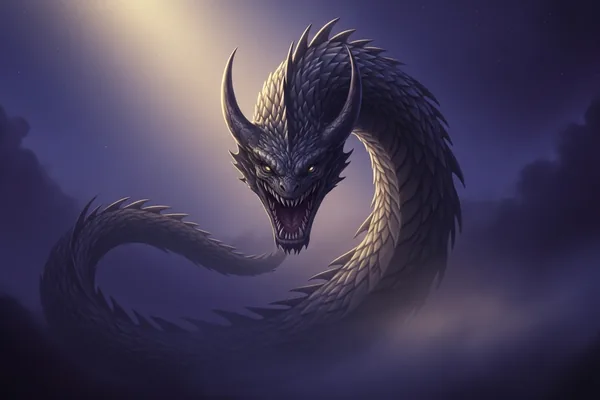
Most accounts picture it as an oversized serpent or dragon-type beast, though a rare version imagines it built more like a colossal hound — likely a mix-up with its kin Cerberus, the three-headed dog who guards the gates of the underworld.
Hydra is a creature stationed at the threshold between worlds, so it carries the weight of transformation, mortality, and the working-out of karma. It belongs to a monstrous family tree: its parents are Echidna (half-serpent, half-woman) and Typhoeus (a colossal serpent), and its siblings include Cerberus, the Chimera, Orthos, the Sphinx, and the Nemean Lion.
Because it's a hybrid, chimerical being, Hydra also adds duality and paradox to the picture — a living blend of masculine and feminine energy in one body.
The number of heads shifts from telling to telling — five, seven, nine, or even a hundred-plus in some versions — but one head is always immortal, which permanently ties the creature to the idea of undying persistence. Numerologically: - Five heads point to the five senses, the four classical elements plus spirit, and the assertive energy associated with Mars. - Seven heads carry the emotional, relational tone associated with Venus. - Nine heads evoke lunar rhythms, instinct, and the sense of meaningful coincidence.
Hydra's signature trait is rapid regeneration — sever one head and more grow back before you can celebrate. Its breath is said to be venomous to anyone who inhales it, and a handful of tellings even give it feet or wings.
Put all these variations together and Hydra reads as shapeshifting and illusion — proof that outward form is never the whole story.
Hydra as a Spirit Animal
When Hydra shows up as a Spirit Animal, treat it as an early warning. Its arrival tends to coincide with a stretch of life where several difficulties are converging at once, and its underlying message is simple: stay alert, because trouble is brewing beneath the surface.
Hydra also surfaces when a situation calls for you to consider more than one point of view. Each of its heads thinks independently, and that's the point — you may be standing in front of a relationship or dilemma that only makes sense once you look at it through someone else's eyes.
If you've been locked into a single way of seeing things, to the point that it's stalling your own growth, Hydra is the nudge to widen the lens. Its core medicine is trying more than one approach: circling a problem from multiple angles until the smartest solution reveals itself.
Hydra as a Totem Animal
People who carry Hydra as a Totem Animal tend to be sharp, curious minds who never stop learning. Anything that stretches the intellect appeals to them, and many gravitate toward esoteric or fringe fields of study — parapsychology, psychology, and other subjects that demand holding several competing theories in mind at once.
A few traits that tend to show up in Hydra-totem people: - A strong preference for teamwork over solo effort - Real persistence — once committed to a task, they see it through no matter how hard it gets - Comfort with sudden or chaotic change, and the ability to make quick decisions under pressure - A refusal to be cornered or trapped into a compromising position - Blunt, sometimes cutting honesty — they say exactly what's on their mind
Hydra as a Power Animal
Turn to the Hydra power animal when a romantic relationship threatens to pull you under emotionally. In one popular retelling of Hydra lore, the creature governs the water level of the river it inhabits, letting it rise only as high as it chooses — a fitting image for staying in command of your own emotional tide rather than being swept away by it.
Hydra's energy is also useful whenever you need to keep your head above water, especially with money troubles, or when you need a seemingly bottomless reserve of stamina to push through a demanding task. Because it regenerates so fast, Hydra is a strong ally when deadlines are closing in and you need to recharge quickly enough to see a project through to completion.
Hydra in Greco-Roman Mythology
Hydra's most famous appearance is in the myth of Hercules (called Heracles by the Greeks), specifically his second labor. Every time Hercules lops off one of the beast's heads, two more grow back in its place. The goddess Hera (Juno to the Romans), determined to see Hercules fail, even sends a giant crab named Carcinus (Karkinos) to distract him mid-battle.
Hercules eventually turns to his nephew Iolaus for help, and together they find the trick to winning: as soon as Hercules severs a head, Iolaus cauterizes the stump so nothing can regrow there. The one immortal head is finally cut off and buried under a massive boulder.
Read this way, the myth is about overcoming odds that look impossible through teamwork and fair, determined effort, not raw force alone.
The story doesn't end at the boulder, either. Hercules dipped the tips of his arrows in the Hydra's poisonous blood, turning them into weapons lethal enough to finish off several of his later labors — the Stymphalian Birds, the giant Geryon, and the dragon Ladon all fell to that same venom. The legacy cut both ways, though: a stray drop of Hydra blood on the centaur Nessus's tunic was ultimately what killed Hercules himself, a fitting last twist, since nobody who wielded that poison ever fully controlled it, only borrowed it for a while.
Even the number of heads was never settled among the ancient storytellers. The oldest surviving depictions — bronze fibulae from around 700 BC — show just six heads, the poet Alcaeus counted nine a century later, and by the time Simonides was writing, the number had ballooned to fifty. Afterward, Hera honored her failed champion by placing both the Hydra and the crab among the stars, giving us the constellation Hydra, whose head still rests near Cancer in the night sky today.
Hydra in African Folklore
A popular modern retelling, often circulated as African folklore though its specific cultural origin is undocumented, tells of a male Hydra who presides over the waters of a river that a nearby village depends on. A couple worried about their water supply offers their daughter, Jinde, to the Hydra in marriage.
Jinde becomes his wife but longs for home, and the Hydra allows her a single day's visit, warning that he'll come after her if she doesn't return.
When Jinde's parents refuse to help her escape the marriage, she turns instead to a human lover. The Hydra comes looking for her, and her lover kills the creature by cutting off each of its seven heads. In this version, Hydra's story becomes a tale of surviving against impossible odds and love winning out over a forced fate.
Hydra in Dreams
Seeing a Hydra in a dream suggests multiple challenges are converging in your waking life, and getting through them will take some cleverness. Expect problems to appear suddenly and escalate quickly — you might feel worn down by a drawn-out conflict in a relationship, or by a pile-up of obstacles at work.
A dream Hydra with several heads hints that teaming up with like-minded people, or approaching a hard task as a group effort, will serve you better than going it alone. If the creature appears in water, it may point to rising emotional turmoil or old feelings resurfacing. Either way, the dream is a nudge not to lose your composure when things get complicated.
Hydra in Everyday Language
Long before it became a fixture of fantasy games and superhero franchises, Hydra had already slithered into ordinary speech. The adjective "hydra-headed" entered English around the 1590s and has always carried the same double meaning: something with many branches or facets, and more pointedly, something riddled with problems that keep multiplying. Dictionaries still define it as "containing many problems, difficulties, or obstacles," which shows how far the myth's core image traveled past the myth itself.
That's why the phrase "hydra-headed problem" shows up so often in conversations about bureaucracy, addiction, corruption, or any tangled situation where solving one part of the mess seems to spawn two more. It's the same lesson the ancient story was always telling, just repackaged for boardrooms and news cycles: brute force against a compounding problem only feeds it — you need strategy, patience, and often a second pair of hands to actually finish the job.
If this phrase keeps echoing in your head lately, take it as confirmation of what the Hydra spirit is already trying to tell you. The exhaustion of chasing a problem that regrows doesn't mean you're failing. It means you're using the wrong tool.
Hydra as a Symbol of Inner Demons
Beyond myth and dream, Hydra has become a favorite shorthand for the private battles people carry, which is part of why its image shows up so often in tattoo art and personal-growth language. Each head, in this reading, represents a specific bad habit, addiction, phobia, or self-defeating pattern: cut one down and, if the root cause goes untouched, another rises to take its place.
Worn or invoked this way, Hydra becomes a promise to keep going rather than a symbol of defeat. It says: this fight regenerates, it will test your patience more than once, and giving up isn't on the table. That's a different flavor of courage than facing a single, one-time threat. It's the courage of showing up again and again for as long as the fight takes.
If you feel a pull toward Hydra in this sense, ask yourself honestly whether you've been treating the symptom of a struggle instead of its root. The myth's own solution — cauterizing the wound the instant a head falls — is a reminder that lasting change usually requires sealing off whatever keeps feeding the problem, not just repeating the same cut.
Frequently Asked Questions
What does the Hydra symbolize?
The Hydra symbolizes regeneration, transformation, and duality. As a guardian tied to the underworld's threshold, it represents change, mortality, and karmic consequence, while its ability to regrow severed heads makes it a lasting emblem of persistence and renewal.
Why does the Hydra have so many heads, and does the number matter?
The number of heads varies by story — commonly five, seven, or nine, occasionally far more — and each count carries its own numerological weight: five ties to the senses and the elements, seven to emotional depth, and nine to lunar instinct. In every version, one head remains immortal, anchoring the creature to the idea of undying endurance.
How did Hercules defeat the Hydra?
Hercules couldn't win by cutting alone, since each severed head produced two more. With help from his nephew Iolaus, who cauterized each neck the instant a head was cut, the regrowth stopped. They finished by removing the one immortal head and burying it beneath a heavy boulder.
Is there a Hydra constellation, and does it connect to the zodiac?
Yes — after Hercules defeated the creature, it was placed among the stars as the constellation Hydra, one of the largest in the sky. Its head sits near the constellation Cancer, which the sun passes through during the zodiac sign of the same name, and both figures are thought to descend from earlier Babylonian sky-symbols: Bashmu, the venomous snake, and Alluttu, the crayfish.
What did Hercules do with the Hydra's poisonous blood?
After finally severing the immortal head, Hercules dipped his arrow tips in the Hydra's venomous blood, turning them into weapons that never missed lethally. He went on to use those poisoned arrows against several other foes in his labors, including the Stymphalian Birds, the giant Geryon, and the dragon Ladon — and, in a darker twist, a drop of that same blood on the centaur Nessus's tunic later caused Hercules's own death.
Did every ancient source agree on how many heads the Hydra had?
Not at all — the number grew with each retelling. The earliest known depictions, on bronze fibulae from around 700 BC, show a Hydra with six heads. The poet Alcaeus, writing around 600 BC, put the number at nine, and a century later Simonides pushed it as high as fifty. Later writers like Euripides and Virgil sidestepped the question entirely and left the count vague.
What does it mean to dream about killing or fighting a Hydra?
A dream where you're actively battling or striking down a Hydra usually points to a challenge you're determined to face head-on, even knowing it may not resolve in one clean blow. If the fight feels endless or the heads keep multiplying no matter what you do, it's often a nudge to change your method rather than your effort — the dream may be asking you to find your own version of Iolaus, someone whose help lets you close off the problem for good instead of just chipping at it.
Sources
Claims on this page were checked against these published sources.
- Hydra - Etymology, Origin & Meaning
from Greek Hydra, fem. of hydros 'water-snake,' from hydor 'water'
Read the source → - Lernaean Hydra
Its lair was the lake of Lerna in the Argolid
Read the source → - Echidna (mythology)
First there was Orthrus, the two-headed dog who guarded the Cattle of Geryon, second Cerberus, the multiheaded dog who guarded the gates of Hades, and third the Lernaean Hydra, the many-headed serpent... Hesiod next names two more descendants of Echidna, the Sphinx... and the Nemean lion
Read the source → - Cancer (mythology)
Cancer also known as Carcinus (Ancient Greek: Καρκίνος, romanized: Karkínos)
Read the source → - Iolaus
Iolaus was the son of Iphicles and Automedusa ... Iolaus provided essential help to Heracles in his battle against the Hydra ... cauterizing each neck as Heracles beheaded it
Read the source → - Hydra-Headed Definition & Meaning
containing many problems, difficulties, or obstacles. First recorded 1590–1600
Read the source →