Mythical Creature
Gremlin Symbolism & Meaning
The impish saboteur whose hidden mischief teaches a lesson in vigilance, humor, and facing the unknown.
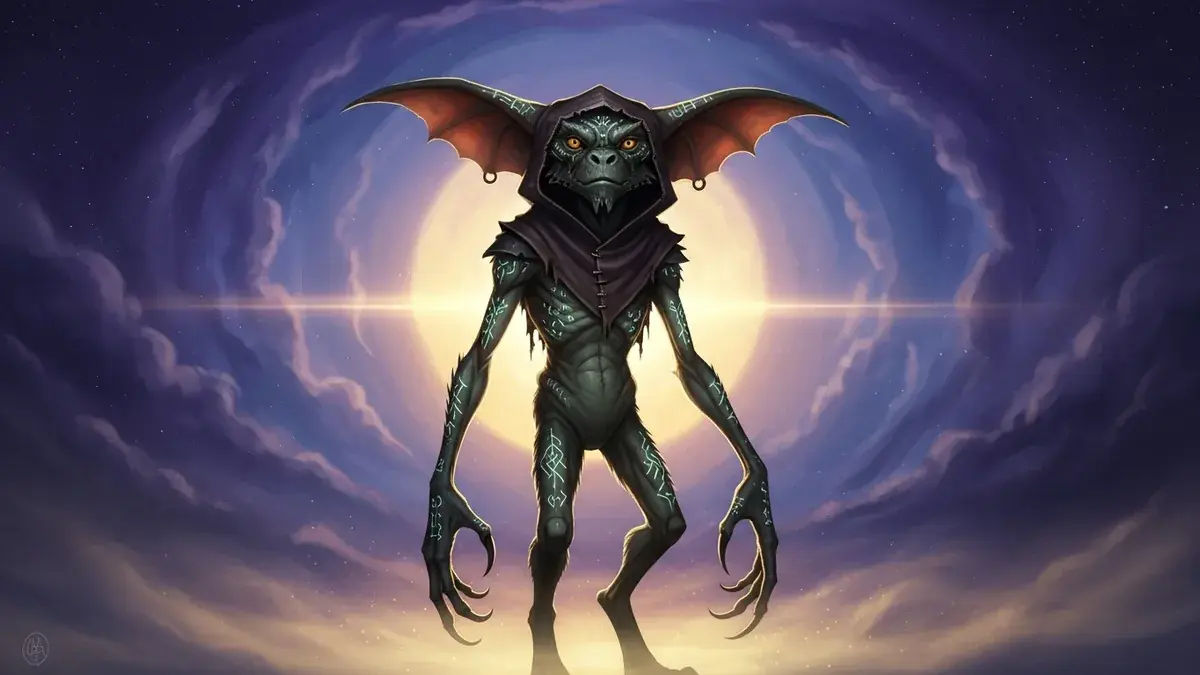
The Gremlin symbolizes mischief, hidden sabotage, and the way small overlooked details can snowball into real setbacks. The legend comes from WWII airmen's stories about unexplained mechanical failures, so it's tied to the Air element and to scapegoating, and its shape-shifting nature keeps it elusive. As a spirit, totem, or power animal, it pushes you to stay vigilant and prepared, but it also leaves room for trickster humor and playfulness.
An almanac
- Core message
- Expect the unexpected; stay alert to hidden mischief
- Spirit animal
- Sharpens attention and intuition against overlooked setbacks
- Totem for
- Playful, meticulously prepared trickster souls
- Power animal
- Troubleshooting, moving unseen, mastering silence
- In dreams
- Warns of nearby mischief or misplaced blame
- Element
- Air
- Named kin
- Brownies, Kobolds, Domovoi
- First recorded
- 1929, in an RAF poem
Say the word Gremlin and most people picture a fuzzy, big-eyed movie star, not a folkloric troublemaker. Long before Hollywood softened its image, the Gremlin was a small, destructive creature blamed for equipment failures nobody could otherwise explain. Its meaning comes down to mischief, hidden sabotage, and the uneasy comedy of things going wrong at the worst possible moment.
Where the Name Comes From
The label most people associate with this creature, Mogwai, has nothing to do with its cuddly on-screen appearance. In Cantonese the term points to a demon, devil, or evil spirit.
The name Gremlin itself traces back to the Old English "gremian," meaning "to vex" or "to irritate." Put together, the etymology paints a picture very different from a lovable puppet: a small, vexing entity built for causing harm.
That's not the only theory in circulation, though. Folklore researcher Carol Rose has proposed the name is a portmanteau of "Grimm's Fairy Tales" and Fremlin, while etymologist Paul Quinion suggests it simply blends "goblin" with Fremlin, the beer most commonly poured in RAF messes during the 1920s. Either way, the drink and the demon seem to have gotten tangled together somewhere over Malta.
The creature's actual origins trace to Royal Air Force slang from the 1920s, coined by British pilots stationed in India, the Middle East, and Malta — the earliest printed record appears in a 1929 poem in the aviation journal Aeroplane. The legend was then popularized far more widely among airmen during World War II. A few writers try to push the story back to World War I, but there's no print evidence to back that claim up.
A Creature With No Fixed Shape
Descriptions of the Gremlin are wildly inconsistent, which is itself part of its symbolic punch. Common threads include:
- Large, unsettling eyes and pointed ears
- Spiky ridges along the back
- A small, compact body
- Razor-sharp teeth
Beyond that baseline, accounts diverge sharply — some describe something elf-like or goblin-ish, others a hairless, reptilian figure with bat-style wings. Author Roald Dahl, who wrote the 1940s story The Gremlins, gave the species its own internal social structure: adult females as Fifinellas, young males as Widgets, and young females as Flibbertigibbets.
Other tellings compare the creature to an odd cross between a Bull Terrier and a jackrabbit, or liken it to Merfolk. Even its size shifts from story to story, ranging from a few inches tall to roughly three feet.
This shape-shifting inconsistency is central to what the creature means: the Gremlin is the unfathomable and the visually startling made physical, and its ever-changing form ties it to transformation and to things that resist being pinned down.
The Saboteur of the Skies
In folklore, Gremlins are best known for one specialty: wrecking machinery, especially aircraft. Aviator Pauline Gower's 1930s novel The ATA: Women with Wings calls Scotland "Gremlin Country," describing creatures that snip the wiring on biplanes so quietly that pilots don't discover the damage until they're already airborne.
Members of the Royal Air Force voiced near-identical complaints whenever a flight suffered a malfunction with no clear mechanical cause.
Because its chosen battleground is flight and mechanical failure, it's tied to the Air element. For a while, some believed Gremlins favored sabotaging enemy planes over friendly ones, hinting the creature might pick sides. Closer investigation showed enemy aircraft suffered roughly the same rate of unexplained damage — the Gremlin, it turns out, doesn't discriminate.
It disrupts whatever it encounters, which is why it reads as chaos and trickster energy rather than loyalty or allegiance.
A Convenient Scapegoat With an Upside
With no hard proof that an actual creature ever touched a single engine, blaming a Gremlin for equipment failure was really a way of redirecting blame away from human error or mechanical limits. That's part of why the Gremlin is symbolically tied to scapegoating.
Curiously, this misplaced blame had a silver lining. Being able to fault an invisible saboteur, rather than their own skill, helped pilots hold onto their confidence during high-stakes missions. Some writers credit this morale boost with contributing to the successful defense against Germany's planned 1940 invasion of the United Kingdom.
Historian Marlin Bressi puts it plainly: gremlin tales "helped build morale among pilots, which, in turn, helped them repel the Luftwaffe invasion during the Battle of Britain." The tradition ran especially deep among reconnaissance crews — the Photographic Reconnaissance Units based at RAF Benson, RAF Wick, and RAF St Eval leaned on gremlin lore as heavily as any fighter squadron, using the shared joke to steady nerves on long, unescorted flights over enemy territory.
In that light, the Gremlin also points to unlikely allies and unexpected upside — a story of destruction that indirectly bolstered courage.
Sightings, Hallucination, and Elusiveness
Some pilots claimed to have witnessed Gremlins in the act of wrecking equipment, or discovered the aftermath of their handiwork. Skeptics chalk these accounts up to the mental strain of high-altitude flying, which can produce hallucination-like effects under stress and altitude change.
Whether real or imagined, these reports tie the Gremlin to elusiveness, intangibility, and brushes with alternate states of reality — it's a creature defined as much by what can't be verified about it as by what can.
Gremlin as a Spirit Animal
When the Gremlin shows up as a Spirit Animal, treat it as a cue to sharpen your attention and lean into your intuitive senses. Its arrival warns you to expect the unexpected — if you're distracted or under-prepared right now, small overlooked details could snowball into real setbacks.
The Gremlin is also playful by nature. Its appearance can be a nudge to bring more lightness and humor back into your days. If inspiration has dried up or laughter has been scarce, this is the creature asking you plainly: when did you last let yourself cut loose without worrying about the consequences?
Gremlin as a Totem Animal
People who carry the Gremlin as a Totem Animal are trickster souls at their core. April Fools' Day probably ranks among your favorite occasions, and a well-executed prank feels deeply satisfying. Your humor and playful streak are genuine gifts, even if not everyone appreciates the more mischievous games you like to run — those who do get it treasure the joy you bring.
Despite the impish streak, Gremlin-totem people tend to be meticulously prepared. You plan ahead, double-check your work obsessively, and as a result have unusually strong organizational instincts. Many with this totem also show a natural affinity for technology, often gravitating toward careers in technical writing, computing, or electronics.
Gremlin as a Power Animal
Turn to the Gremlin power animal when you're troubleshooting a problem, especially one rooted in technology. This creature's reputation for mechanical mischief doubles as a deep familiarity with how things work, and how to take them apart. That makes it a useful ally when something needs disassembling or repairing.
Gremlin is also the animal to invoke when you need to stay under the radar. If you want to slip out of the spotlight or need the advantage of surprise, this creature knows how to move unseen. Much of its historical "damage" was done quietly, long before anyone noticed — which is why, as a Power Animal, Gremlin helps you master silence and sharpen your observation of a person, situation, or relationship before you act.
Gremlin in Dreams
Spotting a Gremlin in a dream is usually read as a warning that someone nearby is up to no good — anything from lighthearted pranks to genuine sabotage. Multiple Gremlins appearing at once can signal that it's time to brace yourself, since this creature embodies surprise and sudden disruption.
A dream Gremlin can also point to blame being unfairly shifted: either someone is trying to pin their own misdeeds on you, or you're the one using another person as a scapegoat.
Kin Among the World's House Spirits
Long before airplanes existed for anything to sabotage, cultures across Europe already told stories about small beings who lived inside the walls, attics, and hearths of a home — and the Gremlin's mischief carries an old family resemblance to them.
In Anglo-Scottish folklore, the Brownie attaches itself to one household and quietly performs chores like threshing corn and cleaning the house overnight, asking for little more than a bowl of milk and honey in payment. Germany's Kobold fills nearly the same role — folklore scholars consider it functionally "exactly the same being" as the Danish Nis, the Scottish Brownie, and the English Hobgoblin, a spirit so persistent it survived Christian conversion and even appears in Martin Luther's own writings. Slavic households, meanwhile, kept faith with the Domovoy, a guardian spirit and ancestral progenitor of the family line, honored with small offerings to keep its favor.
What separates these older spirits from the Gremlin is mostly a change of address. Where Brownies and Kobolds tended the hearth and Domovoys watched over the family line, the Gremlin moved its territory into the cockpit and the engine bay — the same old animistic instinct to put a face on the unexplained, just relocated from farmhouse to fuselage.
Fifinella, Disney, and the Women Who Flew for the War
The story of the Gremlin nearly became a Walt Disney feature film. In July 1942, Disney's studio received the manuscript for Roald Dahl's The Gremlins — Dahl himself had served as an RAF pilot — and began developing it as a combined live-action and animated picture. Rights disputes over the RAF's involvement stalled the project for over a year, and by August 1943 Disney had scaled it back to a short before cancelling it outright. The book was published that same year regardless, cementing Dahl's version of Gremlin society for good.
Disney's most lasting contribution from the aborted project was Fifinella, the female gremlin Dahl had already named in his manuscript. He borrowed the name from a real racehorse: Fifinella, the "flying filly" who won both the Epsom Derby and the Epsom Oaks in 1916 — the same year Dahl was born. Disney's studio dressed her in a flight cap, goggles, and high-top boots, and in 1943 the Women Airforce Service Pilots (WASP), the first American women to fly military aircraft, adopted her as their official mascot, painting her onto planes and patches as a badge of pride rather than a warning of sabotage.
It's a fitting twist for a creature built around mischief: somewhere along the way, the very imp blamed for wrecking aircraft became the emblem worn by the women flying them.
Frequently Asked Questions
What does the Gremlin symbolize?
The Gremlin symbolizes mischief, hidden sabotage, and the unpredictability of things going wrong without warning. Because it's tied to mechanical failure and flight, it also carries associations with the Air element, scapegoating, and elusiveness.
Where did Gremlin folklore originate?
The legend is most strongly traced to stories among airmen during World War II, particularly British Royal Air Force pilots who blamed unexplained mechanical failures on the creatures. Some accounts try to push the origin back to World War I, though there's no solid evidence for that.
What does it mean if a Gremlin appears in your dream?
A Gremlin in a dream often suggests someone around you is engaging in mischief or sabotage, or that blame is being unfairly shifted onto you or by you onto someone else. Multiple Gremlins can also warn that it's time to prepare for sudden, unexpected disruption.
Is the Gremlin related to other household spirits like Brownies or Kobolds?
Yes — folklorists place the Gremlin in the same family as older household spirits like the Scottish Brownie, the German Kobold, and the Slavic Domovoy, all of which were said to inhabit and quietly influence a home. The main difference is location: those older spirits tended hearths and farms, while the Gremlin relocated its mischief to cockpits and engines.
Who was Fifinella, and why is she linked to Gremlins?
Fifinella was the female gremlin Roald Dahl named in his 1943 book The Gremlins, borrowed from a real 1916 Epsom Derby-winning racehorse. Walt Disney designed her image for a planned film adaptation, and in 1943 the Women Airforce Service Pilots adopted her as their official mascot, turning a symbol of sabotage into one of pride.
Was Roald Dahl's Gremlin story based on real RAF experience?
Yes. Dahl served as an RAF pilot before writing The Gremlins, drawing on the mischief-blaming culture already circulating among airmen. Walt Disney's studio received his manuscript in July 1942, and the book itself was published in 1943 after the planned film adaptation fell apart.
Sources
Claims on this page were checked against these published sources.
- Gremlin
the folklorist John W. Hazen states that some people derive the name from the Old English word gremian, 'to vex.'
Read the source → - Mogwai
The word mogwai means 'evil spirit' or 'devil' in Cantonese.
Read the source → - Household deity
The Kobold is exactly the same being as the Danish Nis, and Scottish Brownie, and English Hobgoblin.
Read the source → - Fifinella
Dahl took the name from the great 'flying' filly, Fifinella, who won The Derby and Epsom Oaks in 1916, the year Dahl was born... portrayed with horns, a yellow flight cap, a red top, yellow slacks, long black gloves, red high-top boots, and goggles.
Read the source →