Mythical Creature
Chimera Symbolism & Meaning
The fire-breathing hybrid that fuses lion, goat, and serpent into a single living paradox.
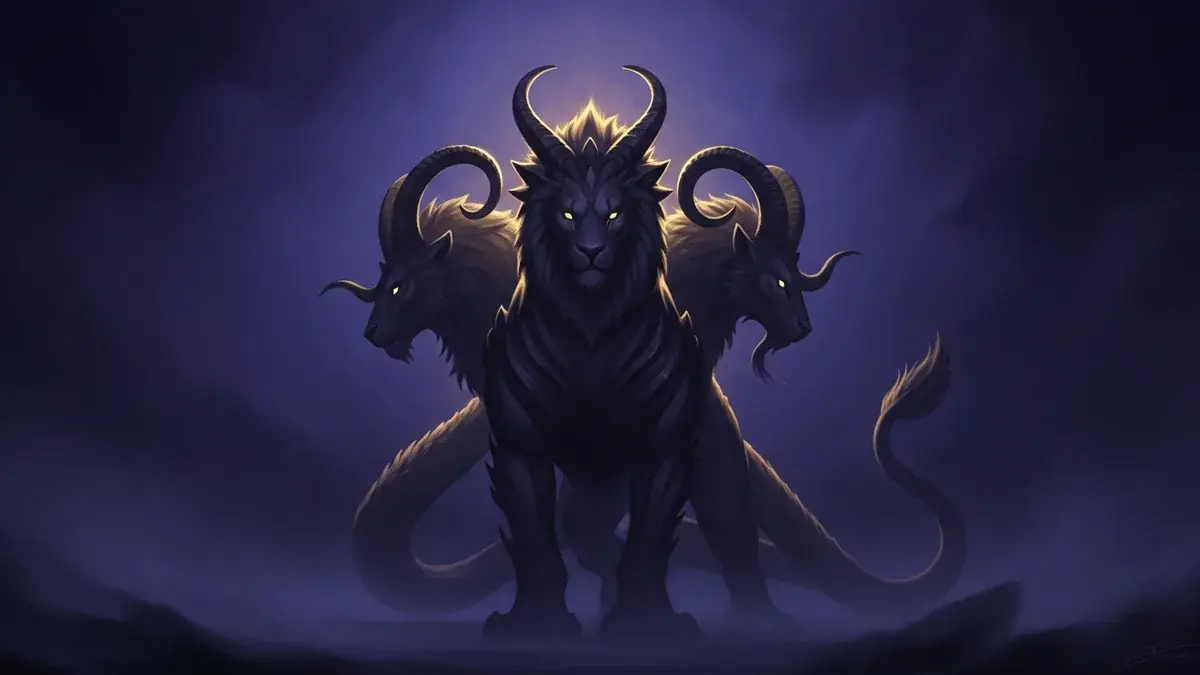
The Chimera symbolizes paradox and contradiction — a lion, goat, and serpent fused into one creature that shouldn't logically work but somehow does. The lion gives it raw strength, the serpent brings wisdom and the ability to transform, and the goat contributes diligence and steady persistence. Because it breathes fire, it's also tied to the Fire and Air elements. As a dream symbol, it usually points to a feeling of being scattered or fragmented in waking life, where pieces of a situation or relationship simply don't fit together.
An almanac
- Core message
- Paradox and contradiction embodied in one being
- Best qualities
- Strength, wisdom, transformation, diligence
- Element
- Fire and Air
- In dreams
- Feeling scattered or fragmented in waking life
- Watch for
- Fiery/harsh words and hidden denial in others
- Cultural roots
- Greek myth (Typhon & Echidna); Egyptian parallels (Sphinx, Sekhmet)
- Real-world echo
- Yanartaş's burning gas vents in ancient Lycia, Turkey
- Famous artifact
- The Chimera of Arezzo, an Etruscan bronze votive (c. 400 BCE)
Few figures from ancient storytelling capture the strange and the sublime quite like the Chimera. Stitched together from a lion, a goat, and a serpent, this fire-breathing hybrid has stood for cosmic paradox, and in some readings, for the changing of the seasons, since it first appeared in the mythology of the ancient Mediterranean. Its name has outlived the legend itself: today it's a byword for anything impossible, contradictory, or improbably combined. What follows covers the Chimera's blended body, its Greek origin story, and its echoes across other cultures.
Origins & Symbolic Meaning
The Chimera's story traces back to the ancient Near East, though its most famous telling comes from Ancient Greece, where the name itself translates roughly to "she-goat." Greek myth casts the Chimera as the child of Typhon and Echidna, a monstrous pair regarded as the ultimate parents of the era's fearsome creatures. Its siblings, by this lineage, include some of mythology's most recognizable monsters:
- The three-headed hound Cerberus
- The two-headed dog Orthrus
- The multi-headed serpent Lernaean Hydra
- The Nemean Lion
- The giant eagle that endlessly preyed on Prometheus
- The riddling Sphinx
Each of these siblings shares a family trait: a body built from mismatched, real-world creatures pushed into something otherworldly. The Chimera carries this furthest of all. Traditionally, it's shown with a lion's head, mane, and body, a goat's head sprouting from its back or midsection, and a serpent (or in some renderings, a dragon) for a tail.
Some sculptures even give the lion's mane a second set of ears, a subtle clue that beneath the fearsome exterior, the beast may be female despite its markedly masculine, lion-like features.
That blending of qualities is really the heart of Chimera symbolism. The creature has long been read as a stand-in for anything that defies tidy categories: paradox, contradiction, and things that shouldn't logically coexist but somehow do. Because humans struggle to picture divinity in any single, coherent form, some interpreters have suggested that a being like the Chimera is what the sacred looks like once squeezed into a body — striking precisely because it refuses to make sense. The Chimera, in that light, symbolizes something more than monstrousness: the limits of human imagination when it tries to grasp something greater than itself.
Each part of its anatomy carries its own layer of meaning:
- The lion aspect lends raw strength and ferocity
- The serpent aspect brings wisdom and the capacity for transformation
- The goat aspect contributes diligence and steady persistence
Breathing fire ties the Chimera to both the Fire and Air elements, since air is what feeds flame and makes it unpredictable and consuming. Over time, the word "chimera" broadened well past this one myth, coming to describe any creature, or any idea, built from incompatible pieces.
It's used today for things that are illusory, inconsistent, or too contradictory to hold together: ambiguous feelings, unresolved internal conflict, or a plan that looks fine on paper but falls apart in practice.
The Legend: Bellerophon & the Chimera
The most detailed ancient account of the Chimera comes from Homer's Iliad, which describes the creature as immortal and capable of snorting bright flame from its jaws. Homer credits a figure named Amisodorus with raising the beast and describes it as a destructive force that terrorized the region of Lycia, devastating the people who lived there.
Eventually, King Iobates decrees that the Chimera must be destroyed, and the task falls to the hero Bellerophon. With the aid of the winged horse Pegasus, Bellerophon defeats the beast by melting lead in its fiery throat, turning the creature's own flame-breath against it.
The story is often read as praise for clever problem-solving over brute force: even an overwhelming, seemingly impossible obstacle can be beaten with the right trick.
A separate interpretive tradition, attributed to the scholar Robert Graves, reads the Chimera differently: as a symbol of the year itself. In this view, its three heads — lion, goat, and serpent — stand in for the three seasons of an older tripartite calendar. Because the Chimera is immortal, this reading stretches its symbolism to cover time itself: cyclical change and the shift from one season to the next.
The word "chimera" also took on a scientific meaning far removed from myth: it now describes an organism, including a human being, that carries more than one distinct set of DNA within its body. This biological condition usually produces no visible physical anomalies, and the person carrying it is often completely unaware.
Egyptian Symbolic Parallels
The Chimera's blend of species wasn't unique to Greece. Ancient Egypt had its own chimerical figures built from combined forms. The Sphinx is the most obvious example, merging animal and human elements into one composite being. Egypt's pantheon also included Sekhmet, a lion-headed goddess with a woman's body who was worshipped as a goddess of war and protection and revered as the fierce eye of the sun god Ra.
Across these Egyptian figures, a consistent pattern holds: they represent the divine, the immortal, and forces of protection, their combined forms marking them as more than ordinary animals and tying them to command over natural or cosmic forces.
Chimera-Like Figures in Other Folklore
China's folklore includes its own hybrid beast, the Nian, which shares the Chimera's combined-creature structure but little else. Described as larger than an elephant, the Nian is said to have a lion's head lined with razor-sharp teeth, two long horns, and a dog's body.
Unlike the Greek Chimera, the Nian has clear vulnerabilities: it's frightened off by the color red, by loud noise, and by fire. According to tradition, the creature emerges once a year at the start of the Chinese New Year to prey on livestock, crops, and people in nearby villages — a myth still echoed today in the fireworks, drums, and red decorations associated with the holiday.
Chimera in Dreams
When a Chimera shows up in a dream, it's often read as a sign that you're feeling scattered or fragmented in waking life. Pay attention to relationships or situations where the pieces just don't seem to fit together, no matter how you try to arrange them.
A few common dream variations and their suggested meanings:
- If the dream-Chimera is breathing fire, it may be a caution against speaking too sharply or heatedly, since fiery words can end up scorching relationships you'd rather keep intact.
- If the Chimera in the dream isn't the traditional lion-goat-serpent form, look closely at whatever mismatched parts it does have — those specific combinations may point to the exact areas of your life that feel incongruent.
- If the Chimera appears as a human with no visible physical anomaly, the dream may be nudging you to look at people in your waking life whose behavior seems driven by something unconscious or unacknowledged — consider whether denial, lack of self-awareness, or deception might be at play.
Mount Chimaera: A Real Fire-Breathing Landmark
The Chimera's fire-breathing reputation may not be pure invention. Ancient writers, including Pliny the Elder, connected the myth to a real place in Lycia (in modern-day Turkey): a hillside near ancient Olympos, close to today's village of Çıralı, where roughly two dozen natural vents still burn continuously along the slope above the ruins of a Temple of Hephaestus. The flames come from methane seeping up through the rock, and sailors once used the glow as a navigation marker along the coastline at night.
It's easy to see how a landscape like that, fire leaking straight out of the ground with no visible fuel, could calcify into a legend about a beast that breathes flame from its own body. Read this way, the Chimera may be more than an abstract symbol of paradox: it could be the ancient world's way of narrating a strange, unexplainable natural phenomenon they had no other framework for.
The site, now known as Yanartaş ("burning rock"), still draws visitors who hike up at dusk to watch the flames flicker across the same ground that may have given the myth its name.
The Chimera in Ancient Art & Coinage
Long before Homer's Iliad fixed the Chimera's story in writing, artists were already picturing it. The creature appears early in proto-Corinthian pottery, and by the 670s BCE the now-familiar Corinthian type, lion body, goat head at the spine, serpent tail, had become standardized across Greek vase painting.
The most famous three-dimensional version is the Chimera of Arezzo, a life-size Etruscan bronze cast around 400 BCE using the lost-wax technique. Discovered by accident in 1553 in Arezzo, Italy, during construction work under Cosimo de' Medici, the statue carries an inscription reading "tinscvil", "gift to Tin", identifying it as a votive offering to Tinia, the supreme god of the Etruscan pantheon. It now stands among the star pieces of the National Archaeological Museum of Florence.
The Chimera also circulated on everyday currency: coins struck at Sicyon, near Corinth, carried the chimera motif for generations, proof that the image traveled well beyond myth and temple art, reaching the coins that changed hands in the marketplace.
Frequently Asked Questions
What does the Chimera symbolize?
The Chimera symbolizes paradox and contradiction — a being made of incompatible parts (lion, goat, and serpent) that somehow functions as one creature. The lion gives it strength, the serpent gives it wisdom and the capacity for transformation, and the goat gives it diligence. Beyond myth, it has become a general symbol for anything that seems irrational, inconsistent, or too strange to categorize neatly.
Where does the Chimera come from in mythology?
The Chimera's roots trace to the ancient Near East, but its best-known telling is Greek, where it's described as the offspring of the monstrous deities Typhon and Echidna. In the Iliad, Homer describes it as an immortal, fire-breathing beast that terrorized Lycia until the hero Bellerophon killed it with the help of the winged horse Pegasus.
What does it mean to dream about a Chimera?
Dreaming of a Chimera often points to feeling fragmented or scattered in waking life, as if pieces of a situation or relationship aren't coming together. A fire-breathing Chimera can warn against harsh words damaging a relationship, while a human Chimera without visible anomalies may suggest hidden denial, unawareness, or deception in someone around you.
Is the Chimera based on a real place?
Possibly. Ancient writers, including Pliny the Elder, linked the myth to a hillside in Lycia (modern Turkey) where natural gas vents still burn continuously out of the rock near ancient Olympos. Sailors reportedly used the flames as a nighttime landmark, and the site, now called Yanartaş, may be the real-world spark behind the story of a beast that breathes fire from its own body.
How is the Chimera different from the Manticore?
They're often confused because both are composite monsters, but they come from different traditions. The Manticore originates in Persian legend (first recorded by the Greek writer Ctesias) and combines a human face, a lion's body, and a scorpion's tail. The Chimera is purely Greek in its classic form and has no human features at all, just lion, goat, and serpent fused into one body.
Sources
Claims on this page were checked against these published sources.
- Chimera (mythology)
Ancient Greek: Χίμαιρα, romanized: Chímaira, lit. 'she-goat'
Read the source → - Echidna (mythology)
First there was Orthrus...second Cerberus...and third the Lernaean Hydra
Read the source → - Bellerophon
He gets a large block of lead and mounts it on his spear... he lodges the block of lead inside the Chimera's throat. The beast's fire-breath melts the lead, which blocks its air passage, sufficing to kill it.
Read the source → - Chimera (genetics)
Normally, genetic chimerism is not visible on casual inspection... Most human chimeras will go through life without realizing they are chimeras.
Read the source → - Sekhmet
Sekhmet is a warrior goddess as well as goddess of medicine ... acted as the vengeful manifestation of Ra's power.
Read the source → - Nian
larger than an elephant with two long horns and many sharp teeth ... a sensitivity to loud noises, fire, and a fear of the color red.
Read the source → - Chimera of Arezzo
discovered in 1553 CE when fortifications were being built in the city of Arezzo... Cast in bronze, using the lost wax technique... The life-size creature stands 78.5 cm (31 inches) high... reads tinscvil or 'gift to Tin', indicating that it was intended as an offering to the god Tin (aka Tinia), the supreme deity of the Etruscan pantheon.
Read the source → - Manticore
The manticore originates from ancient Persian mythology and was first documented by Ctesias... It has the face of a human, the body of a lion, and the tail of a scorpion or a tail covered in venomous spines similar to porcupine quills.
Read the source →