Mythical Creature
Champ, Nessie, & Ogopogo Symbolism & Meaning
The lake monster who teaches you to surface with confidence while honoring what still hides beneath.
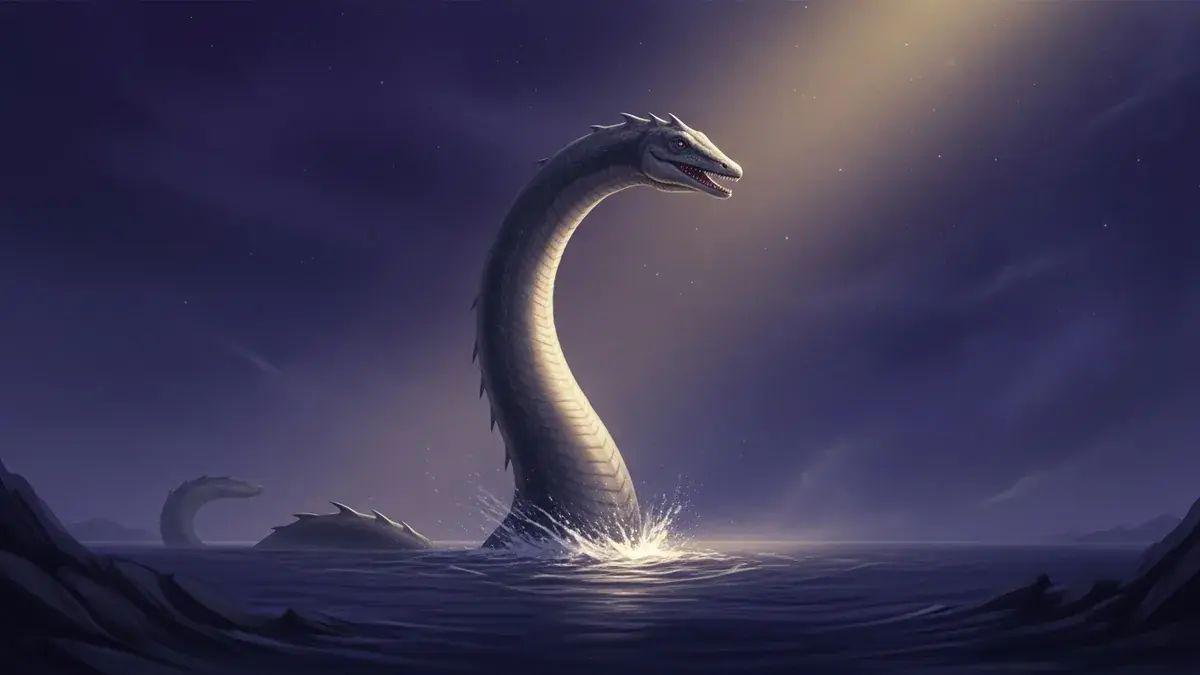
As a spirit animal, the lake monster — Nessie, Champ, or Ogopogo — symbolizes the unknown and hidden. She asks you to bring buried emotions into the light and move forward despite uncertainty. She also represents self-deception and mistaken perception, since so many sightings turn out to be ordinary wildlife or debris, and she carries associations with secrecy, shapeshifting, and lasting public fascination.
An almanac
- Core message
- What's hidden eventually surfaces
- Spirit animal
- Face buried emotions with confidence
- Totem for
- Solitary, secretive shapeshifters
- Power animal
- See past illusions, stay afloat
- In dreams
- Confronting your shadow side
- Element
- Water
- Ogopogo's home
- Caves near Rattlesnake Island
- Champ's Mohawk name
- Onyare'kowa, "great serpent"
Few creatures stir the imagination like the lake monster. Whether she's called Nessie, Champ, or Ogopogo, this serpentine giant surfaces just long enough to leave witnesses breathless and unsure of what they saw. These legendary water-dwellers double as guides for your inner life, and their folklore took shape across three very different shorelines.
Champ, Nessie, & Ogopogo Symbolism & Meaning
Lake monsters have haunted the popular imagination for centuries. Countless eyewitnesses across the world describe strikingly similar serpent-like beasts rising from freshwater depths, and whatever the truth behind them, their staying power says something about what they represent to us.
Among the most celebrated is Nessie, said to inhabit Scotland's Loch Ness — the largest lake by volume in the British Isles. It stretches 22 miles and plunges roughly 750 feet down. That scale alone makes any search a monumental task, and the peat draining in from the surrounding hills turns the water nearly black.
Sunlight fades out quickly beneath the surface, and anything beyond arm's reach vanishes into darkness. That's part of why Nessie has come to represent the unknown, the hidden, and the elusive.
Accounts of the creature stretch back roughly 1,400 years, to a 7th-century tale of Saint Columba, which describes a substantial body and a long, undulating neck compared to an elephant's trunk. Estimates of her length range from ten feet to well over twenty-five, which is part of why she's seen as a symbol of the extraordinary and larger-than-life.
Some believe she's a surviving Plesiosaur; skeptics point instead to known animals like Greenland sharks, large eels, otters, or oversized birds. When researchers sampled the loch's water for environmental DNA, European eel genetic material turned up in large quantities. Some scientists now suspect an unusually large eel population could explain many of the sightings.
A recurring theme across Champ, Nessie, and Ogopogo reports is mistaken identity: floating logs, ripples, or ordinary wildlife misread as something mythical. This pattern gives lake monsters a second layer of meaning — they symbolize self-deception, faulty perception, and the biases that shape what we think we see. That same confusion between the ordinary and the extraordinary is also why these creatures carry associations with secrecy, shapeshifting, and transformation.
Despite generations of inconclusive evidence, sightings continue every year, and the surrounding towns have built thriving tourism industries around the legends — which makes lake monsters a symbol of lasting fame and the pull of public fascination as well.
Champ, Nessie, & Ogopogo Spirit Animal
As a Spirit Animal, a lake monster tends to surface when old emotions have settled quietly in your subconscious, steering your present behavior without your full awareness. Her appearance is a nudge to finally bring those feelings into the light for honest examination. That's how you release stored emotional weight and let old wounds actually close.
She also shows up when you're facing a situation full of unknowns. If you feel adrift, or you're questioning a relationship you can't quite read, her comfort in murky, unfamiliar waters is a model for moving forward despite the uncertainty.
And if you've been avoiding a truth you already sense, part of her medicine is simply this: what's hidden eventually has to surface.
Champ, Nessie, & Ogopogo Totem Animal
If a lake monster is your Totem Animal, water likely feels like home to you. You're drawn to solitude — these creatures are almost never reported in groups — and you find your deepest sense of safety when you're on your own.
People who carry this totem often show a shapeshifting streak:
- Your style, wardrobe, or grooming choices shift frequently
- If your look stays the same, you'll rearrange something else in your surroundings instead
- You enjoy staying a step ahead of predictability
- You keep other people's secrets close and rarely repeat what's shared in confidence
- You lean toward emotional escapism and find real comfort in imagination and fantasy
Champ, Nessie, & Ogopogo Power Animal
Call on Nessie, Champ, or the Ogopogo power animal whenever you need clarity about what's really driving a situation, or when a relationship needs more honesty and less guesswork. Her comfort in deep water makes her a strong guide for looking past the surface of a situation, or past someone's carefully maintained façade.
Lake monsters are also masters of staying hidden. Genuine photographs, footage, and recordings of them are exceedingly rare, and they choose exactly when to reveal themselves. If you need to keep a low profile for a while, this Power Animal helps you move quietly, unnoticed.
She's equally useful when you're facing financial strain: many sightings describe just her head and neck breaking the surface, a fitting image for staying afloat and keeping your head above water when obligations pile up.
Champ, Nessie, & Ogopogo American Folklore Symbolic Meanings
Champ ranks among the best-known lake monsters in American folklore. Sightings date back to at least 1819 in Lake Champlain, a 125-mile freshwater lake shared by New York, Vermont, and Quebec. Some theorize Champ is actually a longnose gar, a lake sturgeon, or an unusually large alligator-type reptile, while others connect the creature to the long-extinct Plesiosaur.
Descriptions put Champ anywhere from 20 to 50 feet long, with a serpentine build, and some audio recordings attributed to the creature resemble the calls of dolphins or beluga whales. The towns around Lake Champlain have leaned into the legend as a tourism draw, which has made Champ a symbol of cultural popularity and staying power.
Champ's story also reaches back further than 1819. Iroquois oral tradition already told of giant serpents living in the region's waters long before settlers arrived, and the Mohawk gave one such being the name Onyare'kowa, meaning roughly "great serpent." Set beside Ogopogo's Naitaka and Nessie's own deep roots in Highland legend, Champ's Indigenous name shows that the lake monster is older and more layered than any single sighting report: each culture along these shorelines had already given the water's mystery a name and a story of its own.
Champ, Nessie, & Ogopogo Canadian & Salish Symbolic Meanings
In Salish tradition, Ogopogo (sometimes called Oggy) is said to live in Okanagan Lake, British Columbia. Witnesses describe a sea serpent 40 to 50 feet long, and some compare it to extinct marine reptiles like the Mosasaurus or Basilosaurus. First Nations accounts of the creature go back to the 19th century, where it was known as Naitaka, or "Spirit of the Lake" — a name that ties Ogopogo directly to the Water Element, dreams, and intuition.
In the late 1960s, a filmmaker named Art Folden captured footage he believed showed the creature, though later analysis suggests he may have filmed an ordinary animal, such as a beaver, or a waterfowl. Sightings around Okanagan Lake are further complicated by the thousands of submerged logs left behind by the region's timber industry — logs regularly mistaken for the serpent itself. That confusion is part of why Ogopogo is a symbol of illusion and the pull of fantasy.
Long before settlers arrived, the Secwepemc and Syilx peoples related to the creature — known more fully as N'ha-a-itk — as a being to be respected rather than hunted for sport. Tradition held that the spirit made its home in caves near Rattlesnake Island and Squally Point. For generations, travelers crossing the lake left small offerings before setting out; they were asking for safe passage, not warding off an attack.
That older relationship complicates the "monster" label later attached to it. Pat Raphael of the Westbank First Nation has described the creature as a sacred spirit of the lake that protects the valley. He has said its reputation as something sinister grew out of miscommunication between early European settlers and the Syilx people. Read this way, Ogopogo's symbolism widens beyond illusion and fantasy to include guardianship, reciprocity, and the quiet respect owed to what protects the place you call home.
Champ, Nessie, & Ogopogo Dreams
Because every lake monster is tied so closely to water, seeing one in a dream — whether it's Ogopogo, Champ, or Nessie — connects to the collective unconscious and the shared shadow we all carry. On a larger scale, such a dream might reflect anxiety about unforeseen forces suddenly disrupting your life.
On a more personal level, it may simply point to your fear of your own shadow side — the untamed, unpredictable parts of yourself you'd rather not examine.
If the creature emerges fully from the water in your dream, it can be a sign to meet a waking situation with more confidence and pride. And if you're wrestling with an important decision and can't see your way forward, her appearance is often a message to wait until the waters clear before committing to a direction.
Champ, Nessie, & Ogopogo as Guardian Spirits
Strip away the cryptozoology, and a quieter thread runs beneath all three legends: in their oldest tellings, these weren't monsters to be hunted, but spirits entrusted with watching over the water. Ogopogo's earlier name, Naitaka, carried exactly that sense of sacred stewardship, and Champ's Iroquois-era serpent, Onyare'kowa, belonged to the same older tradition of great water-beings that predates any English-language talk of a "monster."
That framing matters for what these creatures can teach you as guides. A protector doesn't reveal itself for spectacle — it surfaces only when the balance of its home feels threatened, or when it decides a traveler deserves reassurance rather than fear. If this is your animal, you may find yourself quietly looking after a person, place, or tradition without needing credit for it.
It's worth holding both readings at once: the modern lake monster as mystery and mistaken identity, and the older lake spirit as guardian and reminder of what's owed to the water that sustains a community. Neither cancels the other out — together they show how the same creature can carry a shiver of fear and a genuine sense of protection, depending on who's telling the story.
Frequently Asked Questions
What does Nessie symbolize?
Nessie is closely tied to the unknown and unseen, thanks to the deep, dark waters of Loch Ness she's said to inhabit. She also represents the extraordinary and larger-than-life, along with self-deception and mistaken perception, since so many sightings turn out to involve ordinary animals or floating debris.
How are Champ, Nessie, and Ogopogo different?
Nessie is linked to Scotland's Loch Ness, Champ to Lake Champlain in the United States and Canada, and Ogopogo to Okanagan Lake in British Columbia, where the Secwepemc and Syilx peoples called the creature Naitaka, translated as "water-demon" or "sacred creature of the water". Despite their different homes, all three share a similar serpentine description and a history of sightings that blur real wildlife with legend.
What does it mean to dream about a lake monster?
Dreaming of a lake monster often reflects your relationship with your subconscious or shadow side — the untamed parts of yourself you may be avoiding. If the creature surfaces fully in the dream, it can be encouragement to move through a waking situation with more confidence; if you're facing a hard decision, the dream may be telling you to wait for more clarity.
Is Ogopogo considered evil or protective in Indigenous tradition?
Early accounts from the Secwepemc and Syilx peoples described the spirit, known as N'ha-a-itk, as a powerful being deserving of respectful offerings before crossing its waters. Some Indigenous voices today, including Pat Raphael of the Westbank First Nation, describe the character of a menacing 'monster' as a misunderstanding born from early settler contact, and say the spirit is better understood as a sacred protector of the lake and valley.
Did Champ have a name before European settlers arrived?
Yes. Iroquois oral tradition already told of giant serpents living in the region's lakes, and the Mohawk called one such being Onyare'kowa, meaning roughly 'great serpent.' The now-familiar name 'Champ' is a much later, English-language layer added to a far older story.
Sources
Claims on this page were checked against these published sources.
- Loch Ness
the largest by volume in the British Isles, containing more water than all the lakes in England and Wales combined... approximately 37 kilometres (23 miles)... 230 metres (126 fathoms; 755 feet)
Read the source → - Loch Ness Monster
a long, wavy, narrow neck, slightly thicker than an elephant's trunk
Read the source → - Champ (folklore)
An 1819 report in the Plattsburgh Republican, entitled "Cape Ann Serpent on Lake Champlain", reports a "Capt. Crum" sighting an enormous serpentine monster... Lake Champlain, a 125-mile (201 km)-long body of fresh water shared by New York and Vermont, with a portion extending into Quebec, Canada.
Read the source → - Ogopogo
showing a large wake moving across the water... a 2005 National Geographic investigation suggested it was likely a water fowl, otter, or beaver too far away to be identified
Read the source →