Mythical Creature
Cerastes Symbolism & Meaning
A horned desert serpent from Greek myth, tied to patient timing, adaptability, and unconventional paths.
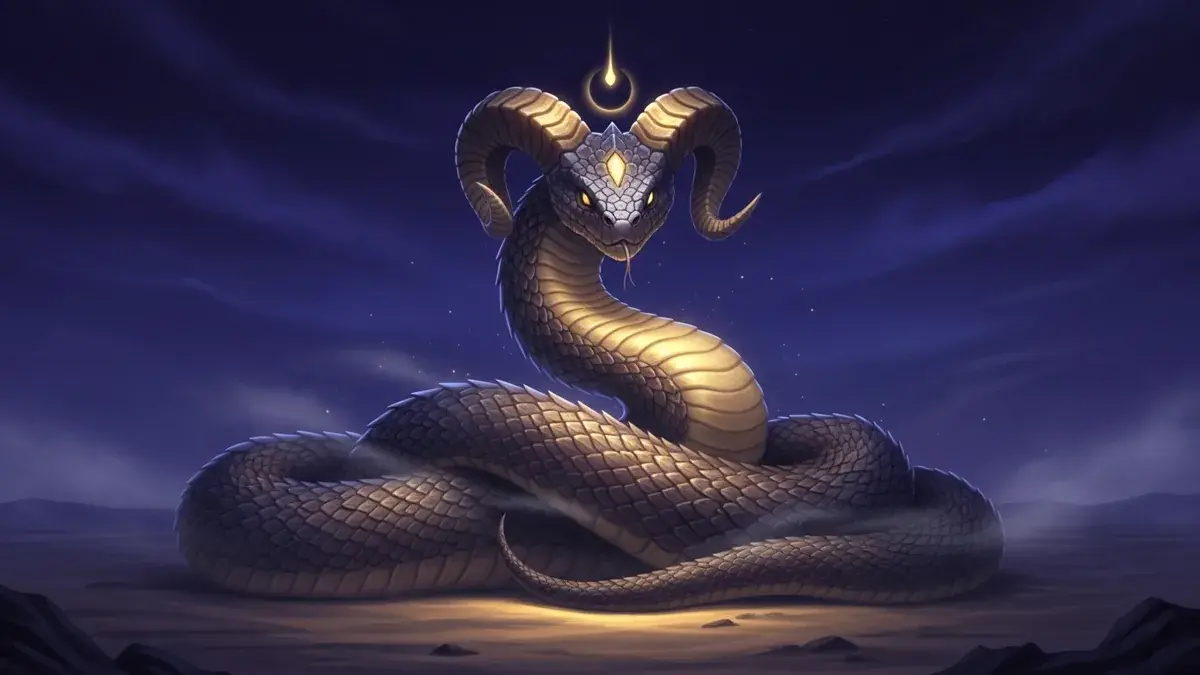
Cerastes, the horned serpent of Greek myth and medieval bestiaries, symbolizes cunning, patience, and adaptability. The image draws on the real horned viper, which buries itself in sand and waits to ambush prey. As a spirit animal, it shows up when you've grown rigid or you're avoiding a problem: loosen up, face what you're avoiding, and hold your boundaries with calm, fluid confidence instead of rigid force. In dreams it points to avoided issues, hidden rivals, or a transformation on the way.
An almanac
- Core message
- Wait for the right moment, then act
- Spirit animal
- Loosen rigidity; stop avoiding problems
- Totem for
- Resourceful, adaptable, intuitive types
- Power animal
- Navigating unpredictable change or chaos
- In dreams
- Facing avoided issues or coming transformation
- Watch for
- Hidden rivals, toxic influences, gossip
- Mythic origin
- Born from Medusa's blood, per Lucan
- Real viper size
- Under 20 inches long
Cerastes is a horned serpent from Greek myth and later medieval bestiaries, described with anywhere from one to four ram-like horns on its head. Its legend borrows from a real desert-dwelling viper known for ambush and camouflage, and that's where Cerastes gets its reputation for cunning, patience, and the art of the well-timed strike. Its symbolism works almost like a guide: get more flexible, pay closer attention, or simply wait for the right moment instead of forcing one.
Cerastes Symbolism & Meaning
The name Cerastes traces back to the Greek word for "horns," a fitting label for a serpent said to carry between one and four horn-like projections. This legendary figure has roots in an actual animal, the horned viper, which grows a small spiked ridge above each eye.
That real snake buries its body in loose sand, leaving only its twin horns exposed, so birds and small creatures mistake them for wriggling grubs worth a closer look. Both the folkloric serpent and its real-world counterpart came to represent deception, calculated strategy, and the patience to lie in wait.
The real biology backs up more of the myth than you might expect. Of the three living species in the modern Cerastes genus, only two actually grow horns, and even those don't always have them, a detail that echoes the old debate over whether the creature carried two, four, or eight. These desert vipers average under 20 inches long, yet they sidewind rapidly across open sand and bury themselves in seconds by rocking their specialized scales back and forth; only their eyes and nostrils stay above the surface.
Because its horn-like protrusions were imagined as antennae reaching toward the heavens, Cerastes also became associated with a link to the cosmos and with clairvoyant insight. In ancient Egypt, small horned serpents living near Thebes were considered sacred to Zeus, ruler of the sky and chief of the Olympian gods, and when one of these serpents died, it was laid to rest within his temple.
Despite a body that looks built for slow crawling, Cerastes was said to travel with a sideways, gliding motion across the dunes, faster and more graceful than its shape would suggest. One ancient tale even credits Helen of Troy with snapping the creature's back simply by stepping on it, and that's given as the reason for its sidewinding gait.
Other legends describe the serpent as boneless, bending and coiling with extraordinary looseness, able to climb from open sand into shrubs and branches as though ordinary rules of movement didn't apply to it. Taken together, these details make Cerastes a symbol of:
- Nonconformity and resistance to rigid limits
- Adaptability across very different terrain and circumstances
- Deliberate, unhurried action rather than impulsive movement
- The power of intention, planning, and conserving one's energy
- A willingness to delay reward until precisely the right instant
The serpent's bite carries its own weight of meaning. Ancient accounts describe it as intensely venomous: it produced painful sores and heavy bleeding, and some stories claim instant death while others describe a lingering decline stretched across nine days. Ancient writers described Cleopatra's fatal asp bite as a peaceful-looking sleep before death, though the snake involved is usually identified as the Egyptian cobra rather than Cerastes itself.
In this light, the serpent is also a symbol of hidden defenses, simmering anger, and a caution against letting toxic influences creep into one's life.
Cerastes Spirit Animal
Cerastes tends to show up as a spirit animal when you've grown stiff and resistant to change, refusing to bend even when bending would serve you better. Since serpents periodically shed their old skin and move with such fluid ease, this creature's appearance often carries one blunt message: loosen your grip and allow yourself more room to enjoy life.
This horned serpent also surfaces when you're avoiding a problem instead of facing it, burying your own head in the sand the way its desert relative buries its body. In that case, Cerastes arrives as something like a wake-up call: stop hiding, stop hoping the difficulty will resolve itself, and engage directly with what's in front of you.
As the serpent might put it, wanting something different won't make it real, and problems rarely dissolve just because you look away.
When you're struggling to hold a boundary or speak up for yourself, Cerastes offers a different kind of support. It teaches you how to draw a firm line, communicate clearly what happens if that line gets crossed, and still carry yourself with a supple, graceful confidence rather than rigid aggression.
Cerastes Totem Animal
People born under Cerastes as a totem tend to be resourceful and unusually good at adjusting when circumstances shift abruptly. You can shift from one task to another with real ease, rarely rushing, and you notice small details that others overlook. Many with this totem find their creative energy peaks after dark.
Having Cerastes as a totem also tends to make you outspoken. You say what's on your mind without much filtering, and if you sense someone poses a threat, you can respond with a sharply worded warning rather than staying quiet.
Alongside that directness often comes a strong intuitive streak, with a natural pull toward psychic senses such as clairvoyance, clairsentience, clairgustance, and clairolfaction, plus a lasting fascination with metaphysical and mysterious subjects.
Cerastes Power Animal
Turn to Cerastes as a power animal whenever you need help adjusting to conditions that keep shifting under your feet. Its skill at adapting to a harsh desert environment is central to the wisdom it offers, and that makes it a strong ally when a relationship feels emotionally unpredictable or a workplace feels chaotic and hard to plan around.
Call on this serpent's energy, too, when you'd benefit from an element of surprise or from holding off on immediate gratification. As an ambush hunter by nature, Cerastes models the discipline of waiting for exactly the right opening before acting. That discipline helps you seize opportunities cleanly and keep others from getting ahead of your plans or claiming credit for your work.
Finally, invoke Cerastes when you're trying to deepen your knowledge. Long treated as a symbol of ancient wisdom, it makes a fitting companion for students and for anyone drawn toward the healing arts.
Global Cerastes Symbolic Meanings
Cerastes belongs to the wider family of mythic serpents, so its meaning gets extra context from snake symbolism across many cultures. Serpent imagery appears on Sumerian boundary stones from the ancient Near East, and Mesopotamian tradition includes Nirah, a messenger deity with serpent form.
In Abrahamic scripture, the serpent takes the role of a cunning deceiver who tempts Eve in the Garden of Eden. Across numerous traditions, snakes are paired with sacred trees, which echoes the Tree of Knowledge from that same story.
Some writers have even compared the Milky Way to a great serpent of light stretched across the sky, an image of the cosmic serpent as an emblem of totality itself. In both ancient Egyptian funerary art and Greek tradition, the Ouroboros, a serpent swallowing its own tail, symbolizes cycles of renewal, birth, and death.
Later alchemical texts paired that image with the phrase hen to pan, meaning "the all is one," and Norse mythology offers a parallel figure that grows so enormous it wraps entirely around the world. Among Australian Aboriginal traditions, the Rainbow Serpent, sometimes called Wagyl, travels between waterholes and is credited with shaping the earth's ridges and mountains. It is a symbol of water and the turning of the seasons.
Cerastes Dreams
Seeing Cerastes glide in a sidewinding motion within a dream can be a nudge to ask whether you're skirting around a real issue instead of confronting it head-on. If the serpent bares its fangs, the dream may be warning of spiteful, envious people nearby, or of gossip aimed in your direction.
A dream where Cerastes conceals itself in sand suggests it's time to stay watchful, since someone may be working against your happiness or success out of view. Being bitten by the serpent in a dream can point toward an upcoming stretch marked by vivid visions or the start of a personal vision quest.
And when Cerastes sheds its skin in a dream, it typically signals that a significant transformation is on its way for you.
Cerastes in Ancient Texts & Legend
Long before any bestiary illustrator sketched its horns, Cerastes already had an origin story soaked in blood. The Roman poet Lucan's Pharsalia claims the horned serpent was one of many venomous creatures born in the Libyan desert when Medusa's severed head was carried overhead, her blood dripping onto the sand and poisoning the ground itself. It's a fitting birth for a creature whose whole legend is built on lying still until the moment to strike arrives, since even its origin story is a slow contamination rather than a single dramatic event.
Ancient writers also linked the horned serpent's homeland to a real desert people, the Psylli, a Libyan tribe said to live along the Gulf of Sidra. Sources reaching back to antiquity claim the Psylli were naturally immune to snake venom, and describe an unsettling custom in which newborns were exposed to snakebite as a test of legitimacy, on the belief that a child born of an unfaithful union would not survive the encounter. It's a hard tradition to read comfortably by modern standards, but it shows how deeply serpent lore like Cerastes' was tangled up with questions of trust, inheritance, and hidden truth.
Read together, these two threads deepen what Cerastes already teaches. A creature born from poison and shadow, yet tied to a people said to shrug off that very poison, mirrors the balance the horned serpent asks of anyone who claims it: hold both the danger and the antidote, the sting and the shield, without needing to be only one or the other.
Frequently Asked Questions
What does Cerastes symbolize?
Cerastes symbolizes cunning and deception, along with patience, adaptability, and the discipline of waiting for the right moment to act. Its horn-like features also connect it to cosmic awareness and clairvoyant insight, while its potent bite carries warnings about hidden defenses and toxic influences.
What message does Cerastes bring as a spirit animal?
As a spirit animal, Cerastes usually appears when you've become rigid and resistant to change, or when you're avoiding a problem instead of facing it. Its message is to loosen up, stop hiding, and confront challenges directly while still standing firm on your own boundaries.
Where does the legend of Cerastes come from?
Cerastes comes from Greek mythology and later medieval bestiaries, describing a large serpent with one to four ram-like horns. The legend draws on the real horned viper, a desert snake that buries itself in sand and uses its exposed horns to lure prey within striking distance.
Where does the myth say Cerastes came from?
The Roman poet Lucan's Pharsalia describes Cerastes as one of several venomous serpents born in the Libyan desert from the blood of Medusa's severed head. In that telling, the horned serpent's very origin is an act of quiet, spreading poison rather than a single violent birth.
Was any ancient tribe said to be immune to the Cerastes' bite?
Yes. Ancient sources describe the Psylli, a Libyan tribe, as naturally immune to snake venom, and credit them with a custom of exposing infants to snakebite to test legitimacy and fidelity within a marriage. The tradition is unsettling to modern readers, but it shows how tightly serpent lore was bound up with trust and hidden truth in the ancient world.
Sources
Claims on this page were checked against these published sources.
- Cerastes
The term cerastes derives from Greek (κεράστης, kerastēs), meaning "having horns."
Read the source → - Cerastes cerastes (Desert Horned Viper)
characterized by the presence of supraorbital 'horns', which consist of a single scale above each eye... Beginning at the posterior end, the snake extends its body anteriorly into the sand, usually until only its eyes and nostrils are exposed.
Read the source → - Pliny, Natural History, 8 (a)
All serpents have a deadly venom... The cerastes, or horned viper, is a Libyan snake ... one of the most dangerous snakes known to ancient naturalists.
Read the source → - Ouroboros
The ouroboros entered Western tradition via ancient Egyptian iconography and the Greek magical tradition... The ouroboros is often interpreted as a symbol for eternal cyclic renewal or a cycle of life, death and rebirth... [encloses] the Greek phrase 'hen to pan' (ἓν τὸ πᾶν), meaning 'the all is one.'
Read the source → - Rainbow Serpent
Wagyl by the Noongar... The Rainbow Serpent came from beneath the ground and created huge ridges, mountains, and gorges as it pushed upward... is viewed as a giver of life through its association with water
Read the source → - Nirah
Nirah was a Mesopotamian god who served as the messenger (šipru) of Ištaran, the god of Der... The snakes depicted on kudurru are often identified as depictions of him in accompanying inscriptions.
Read the source → - Lucan (39–65) - The Civil War, Pharsalia: Book IX
Though those lands are sterile, fecund with no good seed, they drank venom from the blood-wet dripping head of Medusa, soaked with the foul dew of that savage blood, distilled by heat, and dyeing the putrid sand.
Read the source → - Psylli
Infant Psylli were subjected to snake-bites. If the infant died of the snakebite, illegitimacy was supposed to be implied.
Read the source → - Cerastes (genus)
only the two larger species, C. cerastes and C. gasperettii, are known to have horns, and even these do not always have them... averaging less than 50 cm (20 in) in total length (body + tail)... capable of sidewinding. When doing so, they can move quickly across the sand.
Read the source →