Mythical Creature
Centaur Symbolism & Meaning
The half-horse, half-human guide who holds instinct and intellect in one body.
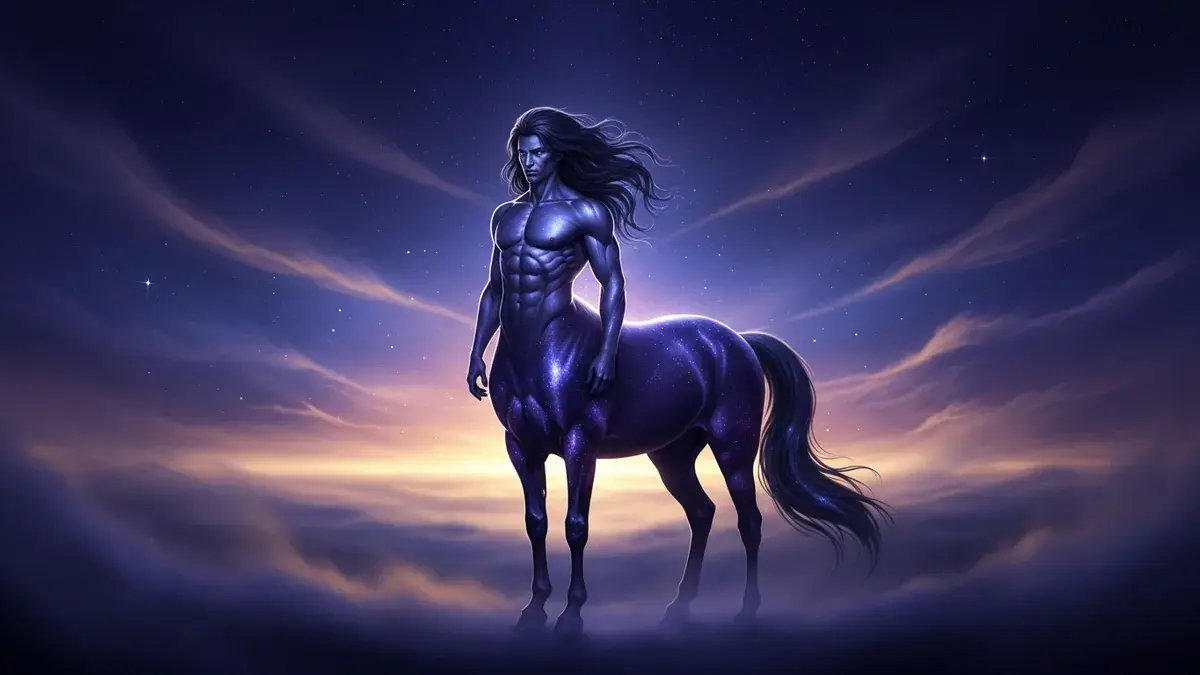
The Centaur symbolizes the duality between instinct and reason — the untamed drives of its horse half fused with the discipline and wisdom of its human half. As a spirit animal it shows up when some part of your life has tipped out of balance, and it asks you to reconcile logic with feeling, work with play, or body with spirit rather than let one side take over. In dreams it points to the same tug-of-war between heart and head, or masculine and feminine sides, and warns against letting yourself be tamed into an unhappy life.
An almanac
- Core message
- Reconcile instinct with reason
- Spirit animal
- Signals your life has tipped out of balance
- Totem for
- Private, purposeful, deeply honest people
- Power animal
- Self-reliance and breaking through barriers
- In dreams
- Balance between heart and head, don't be tamed
- Watch for
- Money troubles, blunt words, burning out fast
- In the stars
- Zodiac's Sagittarius + constellation Centaurus
Few beings capture the tension between our animal instincts and our higher reasoning quite like the Centaur. Born from Greek imagination as a creature with the torso of a person fused to the body of a horse, the Centaur has always represented the push and pull between wild appetite and disciplined wisdom. Look closer at its stories and you find a figure of real contradiction — sometimes a drunken brawler, sometimes a healer and teacher of heroes — and that contradiction is exactly where its meaning lives.
Where the Centaur Comes From
The word Centaur traces back to the Latin centaurus and the earlier Greek kentauros. Some scholars think the term first described real horsemen from the region of Thessaly, riders so skilled that onlookers described them as though the man and the horse were a single being.
Over generations of retelling, that image hardened into literal myth: a race of creatures with a human upper body growing out of a horse's frame.
In the old tales, Centaurs are far from one-note monsters. They're written as sensual, appetite-driven beings who prize good food, beautiful company, and physical pleasure. They're fiercely independent and quick to fight when provoked, and they carry an unmistakable charge of raw earth energy — intense, unrefined, a little untamed.
Two Bloodlines, One Divided Nature
Greek myth gives Centaurs two separate origins, and the split says a lot about what this creature represents:
- One lineage descends from Philyra and Cronos — thoughtful, learned, and self-possessed.
- The other springs from Ixion and a storm cloud — impulsive, disorganized, and prone to stirring up chaos wherever they wander.
That divide is the whole point of the Centaur. It is a creature built from opposites: the reasoning human half and the instinct-driven animal half, each pulling for control. Ancient storytellers used it to hold up a mirror to a very human struggle — the ongoing argument between our impulses and our better judgment, between the parts of us that want indulgence and the parts that want order.
Chiron: The Centaur Who Became a Teacher
Not every Centaur fits the wild, undisciplined mold, and no exception is more famous than Chiron. Where most of his kind leaned into appetite and disorder, Chiron was remembered as a master of music, medicine, and hidden knowledge — a mentor figure who guided legendary students including Achilles, Asclepius, and Jason.
Chiron's story ends in sacrifice. Struck by an arrow that Hercules had poisoned with the Hydra's blood, Chiron — who was immortal — was left in endless agony. When Hercules later pleaded with Zeus to free the imprisoned Prometheus, Zeus required someone to take Prometheus's place.
Chiron offered himself, trading his own eternal suffering for Prometheus's release and a form of peace at last. The story reframes the Centaur as more than a symbol of chaos: it becomes one capable of civilization, sacrifice, and wisdom.
The Symbolism of the Bow and Arrow
Centaurs, especially in their more heroic depictions, are closely tied to the bow and arrow, and the pairing carries its own layered meaning. The arrow is read as a masculine element, while the bow represents the feminine. Together, aimed true, they strike the mark with precision — or, out of sync, they fail badly, snapping or missing.
It's a small but pointed metaphor for the Centaur's larger theme: two different forces that must cooperate, or else everything goes wrong.
Centaur as a Spirit Animal
When the Centaur shows up as a guide, it's usually a signal that something in your life has tipped out of balance — work crowding out play, logic overriding feeling, or the reverse. Its presence is an invitation to restore symmetry rather than let one side of yourself dominate.
A Centaur guide may also appear when you're wrestling with your own sensuality or holding onto pent-up tension. It's a prompt to see your body and spirit as worth celebrating rather than restraining. It has a particular affinity for certain paths in life:
- Military or protective service
- Music and the arts
- Healing work, including herbal knowledge
The Centaur also carries a strong sense of community. In its stories, a tribe functions only when each member carries their share of the load and elders and teachers are given real respect — so its arrival can be a prompt to examine whether your own circle is pulling its weight, and whether you're honoring the people who taught you.
Centaur as a Totem Animal
People who carry the Centaur as a totem tend to be private by nature, more comfortable with their own company than a crowd, even if their humor lands a bit deadpan. They often feel pulled by a strong sense of purpose, as though their path was mapped out for them early, and they can be drawn to introspective or star-gazing pursuits.
Honesty runs deep in the Centaur-totem personality. These are people who repay favors, never leave a debt hanging, and enjoy wrestling with big philosophical or spiritual questions — which suits them well, given the old tales that credit Centaurs with lifespans stretching across centuries.
Even as children, they can seem unusually mature. They value trust and steer clear of dishonesty. They love a good exchange of ideas with sharp minds, not to win an argument but because they genuinely enjoy learning and adapting once something proves to work.
A few weak spots are worth watching for if this is your totem:
- Handling money is rarely a strength — lean on a partner who's good with budgets.
- Words can come out before they're fully thought through, so pause before speaking.
- Personal energy burns fast, so guard against overextending yourself.
Centaur as a Power Animal
Call on Centaur energy when you're building spiritual skills or feel boxed in and need help breaking through a barrier. It's also a fitting ally when you want to reclaim your own sense of power. Centaur pushes you toward self-reliance, so that you can eventually stand without a teacher once you've learned what you need.
Because the Centaur is half-horse, invoking it also brings in classic Horse qualities: independence, freedom of movement, passion, raw vitality, and a warrior's resolve. As a hybrid being that straddles two natures, Centaur power is especially suited to work involving shapeshifting or moving between different worlds or states of being.
It can also be a steadying presence for anyone from a blended family or mixed background who has faced judgment for it, and it offers the courage to stand firmly in who you are.
The Centaur Beyond Greece
Although the Centaur is a Greek invention at its core, echoes of the figure — or something startlingly similar — show up elsewhere:
- Native American accounts: Centaurs have no traditional place in Native American symbolism, but there are more recent reports, including a story from an Apache reservation describing an eight-foot, dark red, horned, four-hooved figure glimpsed near a church, with a similar sighting reported at the Four Corners Navajo reservation. These accounts circulate mainly in modern cryptid- and paranormal-sighting circles rather than documented Native American tradition, with some tellers suggesting the figure appears when a community has a problem it refuses to face.
- Celtic art: Centaur-like figures appear carved at the top of certain Irish crosses, which stands out given that mainstream Christian symbolism more often cast the Centaur as an emblem of unchecked lust and heresy.
- Japanese storytelling: The Centaur appears in the manga A Centaur's Life (Sentōru no Nayami), which follows a centaur girl who navigates ordinary adolescent life — friendships, body image, and family — in a modern Japan where mythological beings live alongside humans.
What a Centaur in a Dream Might Mean
A Centaur turning up in a dream is often read as a message about internal balance — the tug-of-war between heart and head, conscious thought and buried instinct, or masculine and feminine aspects of yourself that are asking to be integrated rather than kept separate.
On a spiritual level, the dream may point toward potent, nature-rooted magic in your life, or guidance and wisdom arriving on your path. It might also stir up something more primal and untamed. The dream tends to circle back to one message: don't let yourself be tamed into a version of your life that leaves you unhappy.
The Battle of the Lapiths: Centaurs at Their Worst
If Chiron shows the Centaur at its most civilized, the Centauromachy shows the opposite extreme. The story goes that Centaurs were invited as guests to the wedding of Hippodamia and the Lapith king Pirithous — and, unused to wine and overtaken by lust, they tried to carry off the bride and the other Lapith women right there at the feast. The Lapiths, with the hero Theseus fighting at their side, drove the Centaurs back in a brutal battle that Greek artists carved again and again onto temples like the Parthenon.
Read symbolically, the wedding-feast brawl is the Centaur's cautionary half: what happens when the horse half seizes the reins entirely and appetite is given no counterweight of restraint. Where Chiron's story argues that the instinctual and the civilized can fuse into something wise, the Centauromachy argues the reverse — that civilization itself can be trampled the moment discipline slips. Both stories belong to the same creature, and neither cancels the other out; the Centaur's meaning has always lived in the gap between them.
Nessus: The Centaur Whose Blood Outlived Him
Another Centaur story threads directly back into Chiron's own ending. Nessus was a Centaur ferryman who tried to abduct Heracles's wife, Deianira, while carrying her across a river — and was killed for it by one of Heracles's arrows, the same arrows tipped with the poisonous blood of the Hydra that would later wound Chiron.
In some tellings, the dying Nessus convinced Deianira to keep a portion of his blood as a supposed love charm, blood that was in fact still lethal from the arrow that killed him. When Deianira later used it on a garment meant to win back Heracles's affection, it poisoned him instead. It's a grim echo of the Chiron myth's central irony — the same poisoned blood that ends Chiron's suffering with a noble sacrifice becomes, in Nessus's story, an instrument of deception and ruin. Together the two tales frame the Centaur as a creature whose fate is tangled up with poison, choice, and the different ways a single, terrible substance can be used.
The Centaur in the Sky: Sagittarius and Centaurus
The Centaur's reach extends past myth and into the stars in two distinct ways. The zodiac sign Sagittarius, traditionally depicted as an archer-centaur drawing a bow, carries forward the same restless, freedom-loving, half-wild energy — associated with travel, adventure, and a hunger to keep moving that can tip into recklessness when it goes unchecked.
Separately, the constellation Centaurus was said by the ancient Greeks to be Chiron himself, placed among the stars by Zeus as a lasting honor after his sacrifice. Centuries later, in 1977, astronomer Charles Kowal discovered a small icy body orbiting between Saturn and Uranus and named it 2060 Chiron — fittingly, it became the first identified member of an entirely new class of solar-system objects that astronomers now simply call centaurs, bodies whose unstable, wandering orbits carry them between the asteroid belt and the Kuiper belt, much like the mythic creature caught forever between two natures.
Frequently Asked Questions
What does the Centaur symbolize?
The Centaur symbolizes the duality between instinct and reason — the animal drives of the horse half fused with the human capacity for thought, discipline, and even wisdom. Its meaning shifts depending on which half of its nature is in charge at a given moment.
Who was Chiron, and why does he matter to Centaur symbolism?
Chiron was the most renowned Centaur, remembered as a wise healer, musician, and mentor to heroes such as Achilles and Jason, rather than the chaotic, appetite-driven figure typical of his kind. His story, which ends in a sacrifice that freed Prometheus, shows that the Centaur can represent civilization and selflessness as much as raw wildness.
What does it mean to dream about a Centaur?
A Centaur dream is often interpreted as a nudge to examine the balance between your rational mind and your instincts, or your masculine and feminine sides. It can also signal nature-based spiritual guidance, or serve as a reminder not to let yourself be forced into an unhappy mold.
What was the Battle of the Lapiths and Centaurs?
Known as the Centauromachy, it broke out when Centaurs invited to the wedding of Hippodamia and the Lapith king Pirithous grew drunk and tried to abduct the bride and the other women present. The Lapiths, aided by the hero Theseus, fought them off, and the scene became one of the most common images carved into Greek temples as a symbol of civilization overcoming brute chaos.
Who was Nessus and how does his story connect to Chiron?
Nessus was a Centaur who tried to abduct Heracles's wife, Deianira, and was killed by one of Heracles's Hydra-poisoned arrows — the very same poison that would later wound Chiron. Nessus's tainted blood was later used, unknowingly, in a way that caused Heracles's own death, linking the two Centaurs through the same fatal poison used for very different ends.
Is the Centaur connected to astrology or astronomy?
Yes, in two ways. The zodiac sign Sagittarius is traditionally shown as an archer-Centaur and carries similar themes of restlessness, adventure, and a love of freedom. Separately, the constellation Centaurus was said to be Chiron placed among the stars, and in 1977 a small solar-system body named 2060 Chiron was discovered; it became the namesake for an entire class of objects astronomers call centaurs.
Sources
Claims on this page were checked against these published sources.
- Centaur
Perhaps the horsemen of Thessaly were so skilled that they seemed at one with their horse and so the myth of a single creature was born.
Read the source → - Centaur
The centaurs were usually said to have been born of Ixion and Nephele, ... a cloud made into the likeness of Hera.
Read the source → - Chiron
Chiron was sired by the Titan Cronus when he had taken the form of a horse and impregnated the nymph Philyra.
Read the source → - Early Religions of the Irish: Irish Crosses
The base of the cross at Kells, Co. Meath, has the figure of a centaur with the trident, another centaur behind armed with a bow and arrows, birds, fishes, and a sacred hare.
Read the source → - Centaurs vs. Sirens: A Medieval Showdown
The centaur, as a half-human, half-animal figure, embodies the duality of the human soul, torn between reason and bestiality.
Read the source → - 2060 Chiron
the first-identified member of a new class of objects now known as centaurs—bodies orbiting between the asteroid belt and the Kuiper belt
Read the source →