Animal Facts
Spider Facts & Trivia: Silk, Venom and Bad Statistics
Almost every spider story you have been told is a misidentification.
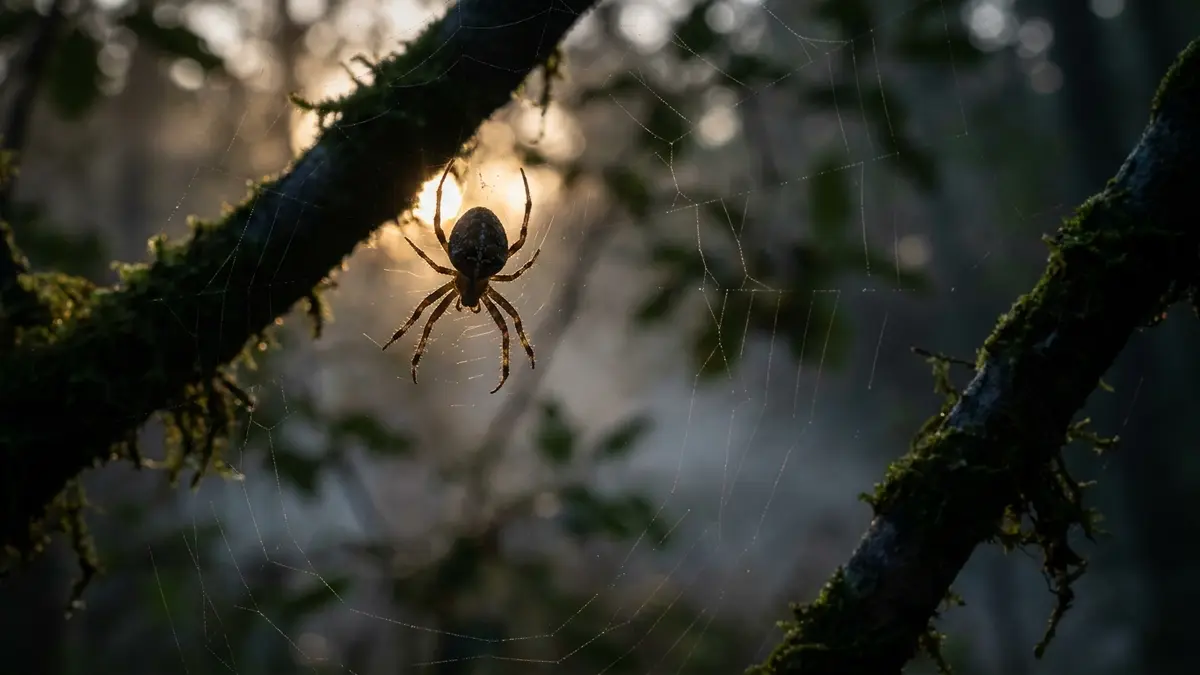
Brown recluse bites are diagnosed across North America and the spider lives in a limited part of it — most such diagnoses are something else. Black widows rarely eat the male. And the spider in your house in autumn did not come in from the cold: it has almost certainly lived indoors its whole life.
An almanac
- Named species
- 54,066 species in 4,524 genera and 139 families (World Spider Catalog v27, accessed August 2026)
- Size range
- From the 12.7-19 mm eyeless Kauai cave wolf spider to the goliath birdeater at roughly 170 g with a leg span near 12 inches
- Lifespan
- Most species live a year or two; the wild record is 43 years, set by an Australian trapdoor spider tracked from 1974 to 2016
- Range
- Every continent except Antarctica, from Madagascan riverbanks to Hawaiian lava tubes
- Diet
- Overwhelmingly insects and springtails - more than 90% of prey captured - plus documented predation on fish, frogs, snakes, birds, bats and mice
- Conservation status
- Barely assessed as a group; the Kauai cave wolf spider was listed as US endangered on 14 January 2000 and is known from just five caves
- Standout number
- 400-800 million metric tons of prey killed worldwide each year, by an estimated 25 million tons of spiders
Spiders attract more confident misinformation than any other animal, and most of it comes down to misidentification.
The brown recluse is the clearest case. Bites get diagnosed right across North America, while the spider itself occupies a much smaller range — which means the great majority of those diagnoses are something else entirely, sometimes something that needed different treatment.
The others below follow the same pattern: a real behaviour, observed once, generalised into a rule that was never true.
Spider Facts Worth Knowing
- As of August 2026 arachnologists have formally named 54,066 spider species, sorted into 4,524 genera and 139 families.
- The world's spiders collectively kill an estimated 400-800 million metric tons of prey every year - roughly what the entire human population eats in meat and fish.
- An orb-weaving spider does not make one kind of silk - it makes silk in seven distinct pairs of glands, each producing a different material for frame lines, capture spirals, prey wrapping, egg cases and attachment discs.
- The dragline silk of Darwin's bark spider (Caerostris darwini), described from Madagascar in 2010, is over ten times tougher than Kevlar and twice as tough as any silk measured before it.
- Darwin's bark spider slings its web across whole rivers, anchoring it with bridge threads up to 25 metres long, with the orb itself reaching 2.8 square metres.
- The jumping spider Bagheera kiplingi lives mostly on plant matter, eating the protein-rich leaf-tip nodules (Beltian bodies) that acacia trees grow as payment for their ant bodyguards. "The world's only vegetarian spider" overstates it. The 91% figure is from one Mexican population; at a Costa Rican site plant food was only about 60% of the diet, and the spiders still take ant larvae, flies and occasionally each other. It is a mostly-vegetarian spider, not a strict one.
- Spiders have no extensor muscles in their major leg joints - they straighten their legs by pumping body fluid into them under pressure, which is why a dead spider curls up. The neat "spider legs are pure hydraulics" line is too clean. The same Journal of Experimental Biology study found that in large spiders, muscle-driven flexion, not hydraulic pressure, dominates during powerful movements. Hydraulics does the extending; muscles still do most of the work.
- The goliath birdeater (Theraphosa blondi) of northeastern South America is the heaviest spider known, at roughly 170 grams with a leg span close to a foot. The name is a two-century-old libel. National Geographic's piece notes that "T. blondi only rarely devours birds" - the diet is mostly invertebrates, with the odd mouse or lizard. The label traces back to an 18th-century engraving of a tarantula eating a hummingbird, not to typical behaviour.
- Ogre-faced net-casting spiders hear airborne insects from up to six feet away using a sensor near the leg tip, then execute a backward strike in about 200 milliseconds.
- The diving bell spider Argyroneta aquatica lives its whole adult life underwater inside a silk air bubble that pulls dissolved oxygen out of the water, letting it stay submerged for more than a day between surface trips.
- Spiders vomit digestive fluid onto their prey and then chew the softened tissue with their chelicerae, swallowing solid matter along with the liquid. "Spiders suck their victims dry like vampires" is only half right, and only for some families. Orb weavers and wolf spiders genuinely chew and leave a mangled pellet. It is the small-jawed crab spiders and cobweb weavers that inject fluid inside the prey and leave a hollow shell.
- A 2022 global review found 966 documented cases of spiders killing and eating vertebrates - fish, frogs, snakes, lizards, birds, bats and mice - involving 39 of the 129 spider families then recognised.
- The Kauai cave wolf spider (Adelocosa anops) is the only wolf spider in the world with no eyes at all; it has been found in just five Hawaiian lava-tube caves and was listed as endangered on 14 January 2000.
- Jumping spiders see with camera-type eyes on movable tubes, giving them visual acuity in the same league as pigeons, cats and elephants despite bodies a few millimetres long.
What People Get Wrong About Spiders
“Brown recluse bites happen all over North America.” The spider's actual range is the central Midwest - roughly Nebraska south to Texas and east to southern Ohio and north-central Georgia. Diagnoses are routinely handed out in California, Canada and even Alaska, thousands of miles outside any known population. Decades of California spider submissions produced no established recluse populations at all.
“Black widows always eat the male after mating - that's how they got the name.” Sexual cannibalism as the rule in the wild is confined to Southern Hemisphere Latrodectus species. In the eastern (southern) black widow of the US it happens sometimes and most males survive. In the western black widow - the only widow found west of Kansas - it has never once been seen in the wild. The myth largely comes from cramped laboratory containers where the male cannot escape.
“Spiders come indoors in autumn to escape the cold.” House spiders are mostly different species from the ones in your garden, and they have lived indoors their whole lives. Spiders are cold-blooded and not attracted to warmth - they simply slow down and go dormant. The late-summer surge in sightings is sexually mature males wandering in search of females, not refugees from the frost.
In Culture
Spider-Man made his debut in Marvel's anthology title Amazing Fantasy #15, cover-dated August 1962, written by Stan Lee and drawn by Steve Ditko. He has since become the most commercially successful spider in any medium: Insomniac's Marvel's Spider-Man (2018) shifted 3.3 million copies in three days to become the PlayStation 4's fastest-selling game and its best-earning first-party title, and its 2023 sequel moved 2.5 million units in 24 hours. On the friendlier end, E.B. White's Charlotte's Web - published 15 October 1952 with Garth Williams's illustrations, and a Newbery Honor book in 1953 - made a barn spider the most sympathetic arachnid in children's literature. Cinema went the other way with Arachnophobia (1990), Frank Marshall's directorial debut starring Jeff Daniels and John Goodman, released in US theatres on 18 July 1990, in which a Venezuelan spider stows away to a small American town. The internet's own contribution is the peacock spider: Australian researcher Jurgen Otto was the first to film the males' fan-waving courtship dance, and the clips turned a genus of five-millimetre jumping spiders into a viral phenomenon.
Notable Individuals
Arabella and Anita, two common cross spiders (Araneus diadematus), flew on Skylab 3 from 28 July to 25 September 1973 to test whether spiders could spin webs without gravity. The experiment was proposed by high-school student Judith Miles; both spiders now belong to the Smithsonian's National Air and Space Museum, with Anita preserved in formalin. Number 16, a female trapdoor spider in Western Australia, was tagged by arachnologist Barbara York Main in 1974 and monitored until October 2016, dying at 43 - the oldest spider ever recorded - after a parasitic wasp breached her burrow. Nefertiti, a Johnson jumping spider (Phidippus johnsoni), spent 100 days aboard the International Space Station in 2012 on an experiment proposed by 18-year-old Amr Mohamed of Alexandria, Egypt. She went on display at the Smithsonian on 29 November 2012 and died there of natural causes on 3 December, aged 10 months.
Frequently Asked Questions
Can you get a brown recluse bite anywhere in North America?
The spider's actual range is the central Midwest - roughly Nebraska south to Texas and east to southern Ohio and north-central Georgia. Diagnoses are routinely handed out in California, Canada and even Alaska, thousands of miles outside any known population. Decades of California spider submissions produced no established recluse populations at all.
Do black widows always eat the male?
Sexual cannibalism as the rule in the wild is confined to Southern Hemisphere Latrodectus species. In the eastern (southern) black widow of the US it happens sometimes and most males survive. In the western black widow - the only widow found west of Kansas - it has never once been seen in the wild. The myth largely comes from cramped laboratory containers where the male cannot escape.
Do spiders come indoors in autumn to escape the cold?
House spiders are mostly different species from the ones in your garden, and they have lived indoors their whole lives. Spiders are cold-blooded and not attracted to warmth - they simply slow down and go dormant. The late-summer surge in sightings is sexually mature males wandering in search of females, not refugees from the frost.
Is spider silk really stronger than steel?
By weight, yes — dragline silk has a higher tensile strength-to-weight ratio than steel, and it is also far tougher, absorbing more energy before breaking. A steel cable of the same diameter is still stronger in absolute terms.
Are all spiders venomous?
Nearly all spiders have venom, because nearly all are predators that use it to subdue prey. Very few have venom that matters medically to a human, and many cannot pierce human skin at all.
More about the Spider
More from Animal Facts
Sources
Claims on this page were checked against these published sources.
- World Spider Catalog, Version 27
139 Families 4,524 Genera 54,066 Species
Read the source → - An estimated 400-800 million tons of prey are annually killed by the global spider community
the annual prey kill of the global spider community is in the range of 400–800 million metric tons
Read the source → - Structure-Function-Property-Design Interplay in Biopolymers: Spider Silk
Orb web spiders produce silk in seven distinct pairs of glands.
Read the source → - Bioprospecting Finds the Toughest Biological Material: Extraordinary Silk from a Giant Riverine Orb Spider
C. darwini silk is more than twice tougher than any previously described silk, and over 10 times better than Kevlar®.
Read the source → - Bagheera kiplingi - the mostly vegetarian spider
In Mexico, Beltian bodies make up 91% of the spider's diet, while in Costa Rica, they make up 60% of it.
Read the source → - Hydraulic leg extension is not necessarily the main drive in large spiders
Unlike most other arthropods, spiders have no extensor muscles in major leg joints.
Read the source → - World's Biggest Spider Explained
With a leg span nearly a foot wide, the goliath bird-eater is the world's biggest spider.
Read the source → - Buzz kill: Spiders 'hear' airborne prey via their legs
Spiders don't have ears, but they can sense a wide range of sounds thanks to the metatarsal organ located near the tip of their legs
Read the source → - The diving bell and the spider: the physical gill of Argyroneta aquatica
The bell can take up dissolved O2 from the water, acting as a 'physical gill'.
Read the source → - Myth: Spiders only "suck juices" of prey
the spider will literally vomit digestive fluid over the prey. Then the prey is chewed with the 'jaws' (chelicerae), and the fluid is sucked back into the mouth together with some liquefied 'meat' from the prey.
Read the source → - Spiders feeding on vertebrates is more common and widespread than previously thought, geographically and taxonomically
A total of 39 out of the 129 known spider families (∼30%) contain species capable of capturing vertebrate prey.
Read the source → - Recovery Plan for the Kauai Cave Arthropods: The Kauai Cave Wolf Spider (Adelocosa anops) and the Kauai Cave Amphipod
While wolf spiders are typically visual predators, the most conspicuous physical character of the Kauai cave spider is its complete lack of eyes (Figure 2).
Read the source → - How jumping spiders' senses capture a world beyond our perception
Their sight is comparable to that of much larger animals like pigeons, cats and elephants.
Read the source →
Not sure which animal is yours?
Consult the quiz