Insects · Spirit animal
Spider Spiritual Meaning & Symbolism
Quiet authorship of your own fate, built one deliberate thread at a time.
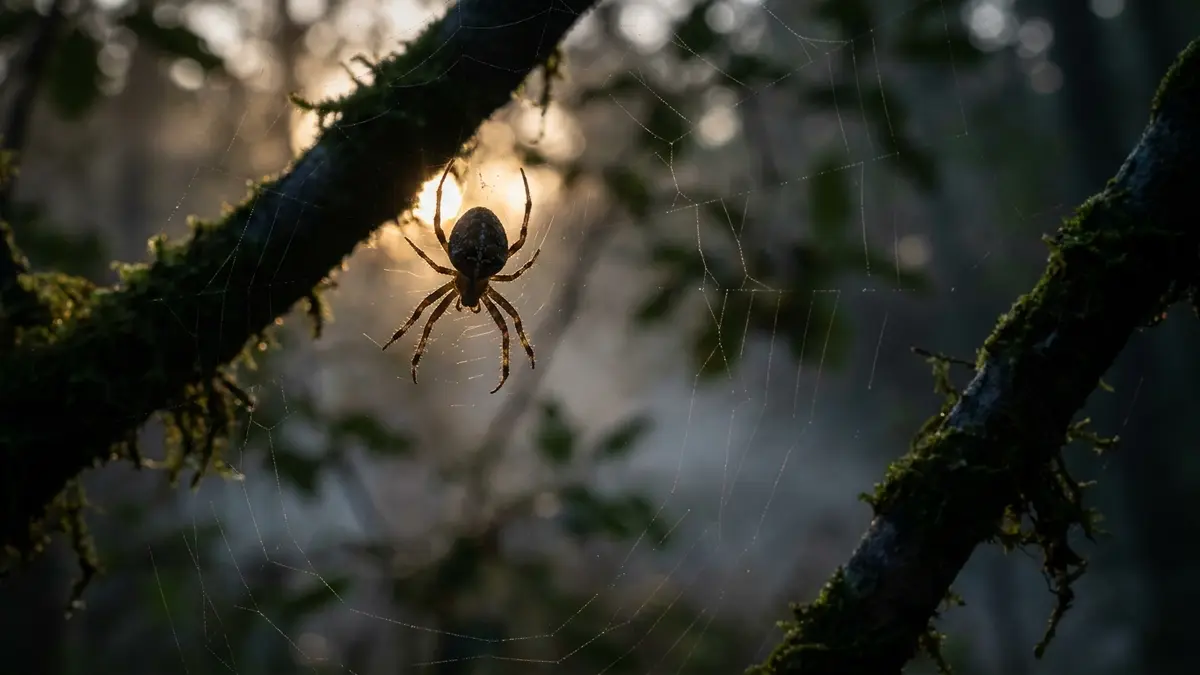
Spiders symbolize patience, creativity, and quiet confidence in your ability to control your own destiny. As a spirit animal, they bring imagination and creative confidence.
An almanac
- Core message
- Weave your fate through patient, deliberate effort
- Spirit animal
- Recharges stalled creativity and inner power
- Totem for
- Patient, inventive pattern-seekers
- Power animal
- Steadies you when your footing feels unstable
- In dreams
- A drifted-from calling, or feeling caught in a web
- Cultural roots
- Egyptian, Native American, Celtic, and West African myth
- Why eight?
- Eight legs and eyes echo cycles, infinity, and paths like the Eightfold Path
Spiders show up in our lives for a reason. People around the world have read them as teachers of patience, craft, and quiet power. This article will explain Spider spirit animal meanings by highlighting its lessons in dreams, lore, totem usage, and power ally possibilities.
Spider Symbolism & Meaning
Spiders are wonderfully patient creatures, who never rush. They make their intricate webs, and they wait for things to happen — which is a good lesson in patience for any human being.
Spider Spirit Animal
The spider often appears as an emissary of the sacred feminine energy. A spider's web is essentially the spider's entire universe, so if you see a web, it may be asking you to take control of your life in the same way that spiders take control of theirs by building a web from the center and having it radiate outwards. In West African folklore, the Anansi also represents this cunning and story-weaving side of the spider.
Does Spider fit you?
Tap the ones that sound like you — 6 traits, no right answer.
0 of 6 Nothing picked yet — start tapping.
Spider Totem Animal
If Spider is your Totem, then you have a natural and highly developed sense of balance between the physical and spiritual, as well as the old ways and the new. People with this totem easily grasp complex and cyclical patterns. They are good at solving puzzles and mysteries. They will have an inventive, tenacious, and quick-witted personality that often assists others without being heavy-handed.
Those with this totem notice larger patterns early on. Many are drawn towards writing because Spider is known for long being tied to language and storytelling.
Spider Power Animal
Whenever your situation feels delicate and precarious, lean on the Spider power animal for support. Spiders have frail bodies but can rebound from any crisis. Rely on that resilient energy to construct an innovative path out of your troubles.
Spiders have a talent for both creation and toughness: build your life with the same protective strength as you would guard it. And if you're stuck, break down any barriers between yourself and your goal by redrawing the way you will reach it.
Across cultures
9 traditions — pick one to read its take.
Spider Native American Symbolism
Grandmother Spider, the spider, is a teacher found in Native American stories across many tribes. In Lakota traditions a trickster called Iktome is seen. The Navajo link webs with rays of sunlight and the creation of the world. In Hopi traditions the great spider Spider Woman works alongside the sun god Tawa to pull the Earth into existence and then leads people up through the underworlds to teach them to plant, weave and shape clay into pottery. Some Navajo weavers rub their fingers along a spider's web as they start work to honor her skills. A Choctaw story adds more to this. At the beginning of time, after greedy beings have taken fire from people, the animal and bird people try to get it back by force.
Spider Celtic Symbolism
The spider is a fascinating creature in Celtic and Druidic thought, taking on three different roles: bard, ovate, and druid. The bard uses words to create. The ovate sees the bigger picture with a clear eye. The druid instructs. It's said that the spider invented Ogham, the ancient Irish script, and that killing one was thought to bring bad luck.
In Scottish folklore, a wee spider inspired Robert the Bruce to claim his crown. It might not seem much, but sometimes you can influence a nation's future.
Spider Depictions in Christianity
Christianity has painted two very different pictures of the spider. One treats its web as a symbol of vulnerability and self-delusion, seeing only what you wish to see. But folklore soothes this harsh judgement: legend says that Mary and Joseph were hidden with a web when they fled into Egypt. And St. Felix, who's the patron saint of spiders, was concealed by a spider sealing his hideaway with its fresh webbing, fooling pursuing soldiers into thinking the place was abandoned.
Spider in Islamic Tradition
In one story about the Prophet Muhammad, he and his friend Abu Bakr were on the run from pursuers and took refuge in a cave in the Thawr mountains. A spider built a web across the cave's entrance. Seeing this web, the pursuers concluded it was impossible for anyone to have entered without breaking it. They didn't think anyone was there, so they moved on. Spider's spiderweb enabled Muhammad and his friend to go free.
Egyptian Representation of Spiders
Egyptian mythology sometimes describes Spider's weaving as that of the goddess Neith, a creator deity who was imagined weaving the fabric of the universe on a cosmic loom. One tradition claimed that Neith renewed this fabric every day, since each dawn did indeed reset what we worked with, making Spider more of a steady renewer than a static builder.
Greek and Roman Spider Depictions
In Greek mythology, Arachne was a weaver so skilled that she challenged the goddess Athena and was turned into a spider for her hubris — a caution to artists who think too well of their skills. By contrast, the Fates (or Moirai) who spin the fates of humankind are typically associated with spider-like activity. Other Roman depictions treat small house spiders as good omens and symbols of prosperity.
African Spider Folklore
In West Africa and in communities where West Africans settled, spider tales feature a common character known as Anansi, the trickster hero of traditional African wisdom tales. The Ashanti call stories with Anansi the main character "Anansesem", meaning "Spider Stories", and the Hausa regard spider as the cleverest of all animals, something close to royalty among animal characters.
Spider Meanings in China
The Chinese consider the spider "the happiest of insects," or perhaps more accurately, it has become synonymous with happiness because the word for "happiness" and the word for "spider" sound similar to one another in Chinese. Seeing a spider in the morning is said to bring joy, while seeing it at night is lucky because it might mean wealth. Some legends even attribute the invention of fishing nets to a man named Fuxi, after he observed a spider making a web.
Japanese Spider Symbolism
Japanese folklore holds that a golden orb-weaver spider watches over swimmers in Joren Falls, but shape-shifting spiders are often tricksters or seducers. In fact, there is a goddess known as Yushkep Kamuy, who is the protector of women during childbirth.
Hindu and Buddhist Spider Symbolism
Hindu and Buddhist teachings say Spider's web reminds us of universal connection. Tug on one strand and the whole structure trembles, just as any cause reverberates through the rest of the universe. To make this point, they use a formal name for this network that stretches forever, called Indra's Net. Vedic philosophy sees illusion where everyday people see truth. According to Atharva Veda, which is incredibly old, Indra's Net has an endless lattice of perfect jewels hanging from each intersection, all of them reflecting every other jewel to infinity and beyond — no end to anything in sight.
Types of Spiders and Their Meanings
With roughly 45,000 known species, the symbolic meaning of a spider varies by type. The black widow suggests stillness and caution. House spiders represent quiet balance at home. Jumping spiders represent personal freedom.
The Symbolism of Spider Colors
The color of a particular spider can add to its message, so notice the shade as well as the species. If you see a spider three or more times over different settings, it may be trying to get your attention.
Spider Tattoo Meaning
A spider tattoo can mean just about anything to its wearer. It could stand for protection or remembering to push past your fears. Bright color is often used when a tattoo is meant to symbolize creative vitality, as the spider is tied to language in stories. Because spiderwebs contain different geometric patterns, it might also represent your feelings about creation. And a spider in its web might make you think about devotion and family.
Spider in Dreams
Dreaming of a spider can symbolize a call back to your path or an intuitive hunch from your ancestors. Pay special attention to the details:
- If the spider is crawling on you, that could mean something is trying to protect you.
- Getting tangled in a web could mean you feel trapped in a situation outside of your control.
- A larger spider could mean there's an important message for you.
- If the spider in your dream is making a web, it may be a good sign that something positive is going to happen if you keep putting in the effort.
- And if someone else was trapped in a web, it might be a sign that they need some help or are trying to hold on to something too tightly.
Seeing a Dead Spider
The death of a spider usually marks the end of a difficult struggle. It could also mean you're spreading yourself too thin, so you need to prioritize your concerns. According to some folk beliefs, dead spiders may have absorbed dangers that were headed your way. In some other readings, it's an alarm to watch out for any tendency to ignore your own abilities.
Spider Spiritual Meaning
Spider brings you an idea to hold in mind: that you create your life. You don't react passively to fate. That means choices matter. Also, attraction matters, which is: what you attract toward yourself today shapes your future. So take responsibility for your words and ideas and thoughts! Do not let other people's voices overwrite yours.
Spider in Literature, Film & Pop Culture
Spider's storytelling life didn't end with ancient myth — it kept spinning into modern pages and screens, still carrying both sides of its old reputation. Charlotte's Web, E. B. White's 1952 novel, gave Spider one of its gentlest modern portraits: Charlotte is a heroine rather than a horror, and her web-written words speak of loyalty and quiet cleverness rather than menace. A far older poem, Mary Howitt's 1829 "The Spider and the Fly," struck the opposite note, using a spider's charm as a warning about flattery and seduction — proof the two readings of Spider have coexisted for close to two centuries.
J.R.R. Tolkien leaned hard into Spider's shadow side. Ungoliant, an ancient, spider-shaped devourer of light, appears in his earliest legendarium as something closer to living darkness than animal, and her monstrous daughter Shelob later guards the pass of Cirith Ungol in The Lord of the Rings — Spider cast here as primordial dread rather than teacher.
Modern pop culture splits the difference again, casting the web-spinner as a source of power rather than fear — a hero built on the same patience, craft, and quiet strength this page keeps returning to. Across all these versions, Spider holds both menace and wisdom in the same web, and leaves each storyteller to decide which one to follow.
Spider Crawling on You, or Found in Your Bed
The difference between a spider crawling on your skin and one crawling around your house is its effect on the person looking at it. Contact means the person and the spider are interacting. It becomes part of them, rather than something they’re observing.
A spider on you is a message that you’re being affected by something. It could be from a relationship or a project, or something else where you feel like you’re more involved than other people think.
Spiders are also about structure. They build their own structures with their own bodies.
When the symbolism of the spider appears, it often involves an object like your bed, or something small or intimate. In those situations it means that people can’t see what’s really bothering you, but still being bothered is having an effect on how you act and feel.
Folklore says that if you have a spider crawl on you, don’t harm it.
A lot of folklore suggests using a card and a glass to get rid of spiders.
White, Black and Brown Spiders: What Each Colour Is Read to Mean
People call different kinds of Spiders different names, and each one is supposed to mean something.
White Spiders mean clean starts. They're said to be a sign of honesty in a situation that's been murky, and they can mean you can trust a message that you've been feeling unsure about. When people see a white Spider they think it will be read as something positive, and rarely as a warning.
People call black Spiders the 'shadows'. They're said to be where something is hidden, or where you've hidden something from yourself. It's supposed to tell you something needs looking at.
People call brown or house-coloured Spiders the 'domestic'. They're supposed to be about steadiness in your life. They're also said to bring good luck, and they're supposed to keep things steady in your house.
When a golden or orb-weaver Spider is seen it's said to be about what you send out and what comes back. That fits with a creature whose whole method is set up and then waited for.
People say red is urgency; energy that needs to go somewhere. If you see a red Spider it's also said to tell you not to spend its energy on the wrong thread.
Frequently Asked Questions
What does it mean when a spider appears in your home?
A spider indoors is often read as a quiet sign to check the balance of your household or personal life — house spiders are traditionally seen as unobtrusive guardians rather than a threat, so their presence usually points inward rather than warning of outside danger.
Is seeing a spider good luck or bad luck?
Across most traditions, spiders lean towards good fortune: killing a small spider was considered unlucky in Roman and Celtic folklore, and in Chinese tradition the word for spider is linked to the word for happiness. Luck, of course, can't be judged by a single sighting alone. It's the context and how often the same animal or activity is witnessed that matter most.
What is the difference between a spider spirit, totem, and power animal?
A totem animal, on the other hand, represents a facet of your core personality, one that you feel deeply. Then there's the power animal, which helps you to summon strength and discern strategy in specific moments of need.
What is 'tarantism' and how does it connect to spider folklore?
People used to think being bitten by the little brown spiders could get you wild and crazy. These days, there's no scientific reason to believe that's true. Still, for centuries people in Italy blamed spider bites for causing a strange kind of illness called tarantism, and people who were thought to have it would dance themselves all sorts of crazy. Today we think the dance was a ritualized way to "cure" spider bites, and the myth of tarantism gave the dance its name: the tarantella. Maybe there's no scientific reason for tarantism, but the tale certainly shows how much power people have assigned to spiders.
How old are spiders, really?
Older than almost anything else you share your home with. A piece of amber found in East Sussex, England dates a spider web preserved inside to about 140 million years ago, so we know how pretty much the same basic architecture has changed very little since then. Before that, spiders go back at least 380 million years, when we now think Attercopus, a small creature you might call a cousin of the modern spider, got by.
Is it true you swallow spiders in your sleep, or that daddy long-legs are the most venomous spiders?
Don't believe these myths. The second myth is just that — a myth. They may have venom, but their fangs are too small to do any harm.
What does it mean when a Spider crawls on you?
This means your awareness of something you're involved in is becoming more concrete. This might be work, a relationship, or a worry. It's not a negative omen; treat it just like you would a household spider — move it, don't kill it.
What does a white Spider mean spiritually?
White Spider sightings are consistently positive. They are associated with honesty, and in some traditions with messages that can be trusted. Unlike most Spider colours, a white Spider is rarely seen as an ominous sight, or a warning at all.
Spider also represents
- Other animals that represent peace →Alongside Dove, Crane, Deer, Elephant
- Other animals that represent protection →Alongside Bear, Wolf, Dog, Elephant
- Other animals that represent resilience →Alongside Cockroach, Camel, Salmon, Turtle
- Other animals that represent creativity →Alongside Raven, Peacock, Hummingbird, Flamingo
Sources
Claims on this page were checked against these published sources.
- Neith
As a creator goddess and patron of weaving, she was said to reweave the world daily on her loom.
Read the source → - Anansi
So well known is he that he has given his name to the whole rich tradition of tales on which so many Ghanaian children are brought up – anansesem – or spider tales.
Read the source → - Arachne
Minerva felt pity for the girl, transforming her into a spider, which would go on to create webs for all time, as would her descendants.
Read the source → - A Spider Had a Leading Role in the Story of Scottish Independence
According to local legends, while lying low in a secluded cave, Robert the Bruce became fixated on a spider stubbornly weaving its web between one side of the cave and another... it is believed that this simple experience inspired Bruce to continue the fight.
Read the source → - Overnight stay of the Prophet and Abu Bakr in the cave of Thawr
the story of the spider weaving the web over the mouth of the cave of Thawr or the story of the pigeons sitting in a nest just outside the cave are not authentic
Read the source → - How a spider helped St. Felix of Nola escape prison
It is said that a spider spun a web to hide him from his persecutors as they tried to recapture him.
Read the source → - Native American Indian Spider Legends
A popular Cherokee tale credits Grandmother Spider with bringing light to the world... Possum and Buzzard both failed – and ended up with a burned tail and burned feathers... Grandmother Spider then said she would try to capture the light.
Read the source → - Iktomi
In Lakota mythology, Iktómi is a spider-trickster spirit, and a culture hero for the Lakota people.
Read the source → - 5 Surprising Auspicious Chinese Symbols: Bats, Cats, and Spiders Are Good Luck
Spiders were called 'ximu' (meaning 'happy insects') in ancient China... xǐ (蟢), and sounds the same as 喜, the character for happiness.
Read the source → - Spider Woman
Using only their thoughts, they created the earth between the two other worlds. ... Spider Woman also teaches the Navajos the art of weaving. Before weavers sit down at the loom, they often rub their hands in spiderwebs to absorb the wisdom and skill of Spider Woman.
Read the source → - Mythological Girls: Grandmother Spider (1/2)
She made a little pot of clay, with a tiny hole in the corner and made her way to the East...she was able to steal a bit of the fire and keep it in her clay container until she made her way back to the powwow. ... Grandmother spider taught them how to use the fire, but she also taught them to make pottery out of clay and fire and about weaving and spinning.
Read the source → - Indra's net
This great world is the power net of mighty Indra, greater than the great. ... in each 'eye' of the net...a single glittering jewel is hung, and in its polished surface there are reflected all the other jewels in the net.
Read the source → - Tarantism
a form of hysteric behaviour originating in Southern Italy, popularly believed to result from the bite of the wolf spider ... it was originally described in the 11th century ... the tarantella dance supposedly evolved from a therapy for tarantism.
Read the source → - Cultural depictions of spiders
The 1952 children's novel Charlotte's Web by E. B. White is notable in its portrayal of the spider in a positive manner as a heroine rather than an object of fear or horror. ... The poem 'The Spider and the Fly' (1829) by Mary Howitt is a cautionary tale of seduction and betrayal.
Read the source → - Oldest known spider's web found in amber
Pieces of amber containing parts of a spider's web have been found in East Sussex and dated back to the Cretaceous period 140 million years ago, which makes it the oldest spider's web known.
Read the source → - Evolution of spiders
At one stage, Attercopus was claimed as the oldest fossil spider which lived 380 million years ago during the Devonian ... but has now been reinterpreted as a member of a separate, extinct order Uraraneida which could produce silk, but did not have true spinnerets.
Read the source → - Spiders As Spiritual Guides
When we take a look at the Spider itself and consider most Spiders have eight eyes and all have eight legs, we can see that the Spider also shows the meaning of the number eight, which involves cycles, passage of time, evolution and, as mentioned before, the eight fold path of the year.
Read the source →