Animal Facts
Stingray Facts: Barbs, Spiracles and Real Risk
A stingray never runs out of stingers — it sheds and regrows the barb for life.
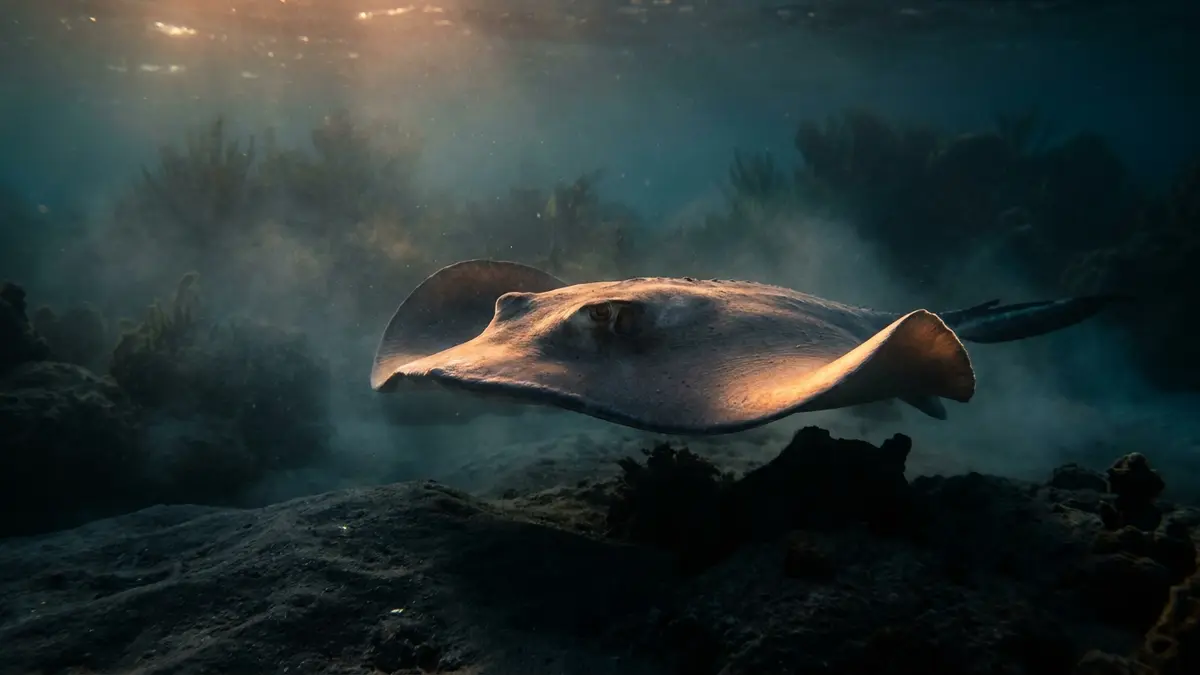
Stingrays are cartilaginous fish of the order Myliobatiformes, elasmobranchs like sharks; roughly 630 rays and skates are split across 18 families, and stingrays are one branch of that group. The tail stinger is covered with rows of sharp spines made of vasodentin, a cartilage-like material, and it is defensive equipment — around 750 to 2,000 injuries are reported a year in the US, with one to two deaths a year across the US and Indo-Pacific nations combined. The venom is heat sensitive, so hot-water immersion rather than ice is the standard field treatment.
An almanac
- Scientific group
- Order Myliobatiformes — cartilaginous fish (elasmobranchs), the same class as sharks
- Species
- About 630 rays and skates in 18 families; stingrays are one branch of that group
- Diet and teeth
- Clams, crabs, shrimp, worms and small fish, crushed by plate-like teeth
- Signature weapon
- Tail stinger covered with rows of sharp spines made of vasodentin, a cartilage-like material
- Record size
- 300 kg (661 lb) and 3.98 m — a giant freshwater stingray, Mekong River, 13 June 2022
- Risk to people
- Roughly 750–2,000 injuries reported a year in the US; one to two deaths a year across the US and Indo-Pacific nations combined
The stingray is famous for the one thing it almost never does. Its tail spine is defensive equipment, used when the animal is trodden on in shallow water — rays do not hunt with it and do not charge swimmers. Nearly every injury on record is a foot or an ankle finding a buried ray that had no warning anyone was coming.
Underneath the reputation is a flat, buried electro-sensor. A stingray has no true bone. It breathes through openings on the top of its head while lying under sand, its eyes face up while its mouth faces down, and it locates a clam or a crab by picking up the faint electric field the prey gives off.
The popular numbers deserve a second look too. The often-quoted 630 species covers rays and skates together, not stingrays alone. The one-to-two annual deaths figure covers the US and Indo-Pacific nations combined. And the record-breaking Mekong ray holds the largest-freshwater-fish title as an individual, sharing the species-level record with the Mekong giant catfish.
Stingray facts
- No true bone anywhere in the body. A stingray has no true bone — its skeleton is cartilage, which is what makes it an elasmobranch alongside sharks.
- The 630 figure is not a stingray count. There are approximately 630 species of rays and skates worldwide, divided into 18 families — a total that includes sawfishes, guitarfishes, electric rays, mantas and skates. Stingrays proper (order Myliobatiformes) are only one slice of it, so "630 species of stingray" overstates the count.
- It breathes through the top of its head. Spiracles, paired openings on the raised head, let the ray take in water dorsally while lying on the seabed, so it draws clean water down to the gills instead of sediment.
- Eyes up, mouth down. Because its eyes sit on top of its body, a southern stingray depends on electro-receptors and a keen sense of smell and touch to find food.
- It reads the electricity of buried prey. Rows of sensory cells called ampullae of Lorenzini detect the weak electric fields generated by prey items — a clam or a crab hidden under sand gives itself away.
- The stinger is tooth material, not bone or claw. It is covered with rows of sharp spines made of vasodentin, a cartilage-like material that can easily cut through skin.
- Heat breaks the venom down. In the Georgia Aquarium's wording, "The venom in a stingray's barb is heat sensitive and breaks down at higher temperatures." That is why hot water, not ice, is the field treatment.
- Hot water works, and works quickly. In a retrospective review of 119 stingray stings, 88% of the acute-presentation patients initially treated with hot-water immersion alone had complete pain relief within 30 minutes without any other analgesic.
- Stings are common; deaths are not. In the United States there are approximately 750 to 2,000 stingray injuries reported annually, nearly all to feet and ankles in shallow water. Fatalities occur one to two times a year across the United States and Indo-Pacific nations combined, and generally come from the barb physically piercing the chest or abdomen rather than from the venom itself.
- A ray never runs out of stingers. The spines are constantly shed and replaced, so a stingray sometimes carries two stingers at once while a new one grows in behind the old.
- The record holder is a ray. The largest freshwater fish individual ever documented is a stingray — a female giant freshwater stingray (Urogymnus polylepis) of about 300 kg and 3.98 m, caught in Cambodia on 13 June 2022, tagged and released. At species level Guinness records the giant freshwater stingray and the Mekong giant catfish as sharing the largest-freshwater-fish title.
- Rays were assumed silent until 2022. Researchers published the first records of voluntary active sound production in the wild by three individuals of two species — the mangrove whipray and the cowtail stingray — producing short broadband clicks. The evidence is thin and easy to overstate: the clicks came only as a diver approached and stopped when the diver backed off, and whether rays use sound with each other, or can even hear it, is unresolved.
- One freshwater ray chews its food. High-speed video of the Amazonian ray Potamotrygon motoro feeding on insect larvae showed that "The freshwater stingray P. motoro uses asymmetric, unilateral movements of the jaws to successfully reduce tough insect cuticle during feeding" — the two halves of the lower jaw move independently. Complex prey-processing behaviours of this kind had been thought to be lacking in fishes. This is one insect-eating freshwater species, not stingrays in general; most marine stingrays crush shellfish with flat tooth plates instead.
- In the Amazon they injure more people than anything else. Freshwater stingrays are docile animals, yet they are responsible for more injuries to humans each year than any other Amazonian species — ahead of piranhas, snakes and caimans.
- Florida has North America's only freshwater shark relative. Atlantic stingrays in the St. Johns River system represent the only permanent freshwater population of an elasmobranch in North America.
- Females dwarf males. Southern stingray females reach 6.5 feet (2 m) wide and 214 lb (97 kg); males reach about 2.6 feet (0.8 m) wide.
- Hammerheads eat them regardless. One scalloped hammerhead shark was found with 96 venomous stingray barbs embedded in its mouth and jaws.
Myths worth correcting
"Stingrays attack swimmers." A stingray's spine is defensive equipment, used almost exclusively when the animal is trodden on in shallow water. It has no offensive use — rays do not hunt with it and do not charge people. As Poison Control puts it, a stingray "attacks people only when it feels directly threatened, often when it's unintentionally stepped on." This is why the standard beach advice is to shuffle your feet rather than step, so a buried ray feels you coming and swims off.
"Those two big holes on top of a stingray's head are its eyes." They are spiracles — respiratory openings that pull clean water down to the gills while the ray lies buried in sand. Seen from above, both the eyes and the much larger spiracles are visible, and it is the spiracles people mistake for eyes. The "smiling face" photographed on a stingray's underside is not a face either: it is the mouth flanked by two nostrils.
"A stingray loses its barb after it stings, the way a honeybee loses its sting." Nothing is lost and nothing dies. The spine is shed and replaced continuously through the animal's life, and a single ray often carries two stingers at once while the replacement grows in behind the old one.
"Manta rays are just giant stingrays, so they can sting you." Manta rays have no stinging spine at all. They are plankton filter-feeders that funnel water into their mouths with paddle-like cephalic fins, and are of minimal danger to humans.
"Skates and stingrays are the same animal under two names." They are different groups with different life histories. Stingrays are viviparous — they give birth to fully formed young — while skates are oviparous and lay the leathery egg cases known as mermaid's purses. Skates also have thick fleshy tails with blunt thorns and no venomous barb, while stingray tails are whip-like and armed.
The stingray in pop culture
The name broke into the mainstream twice in the 1960s, and neither time had much to do with the animal's behaviour.
Gerry and Sylvia Anderson's Supermarionation series Stingray premiered in October 1964 and ran 39 half-hour episodes, following the World Aquanaut Security Patrol and its combat submarine. A year earlier, Chevrolet had launched the 1963 Corvette Sting Ray, whose split-window coupe descended from Bill Mitchell's 1959 Stingray Special racer. Mitchell, General Motors' styling chief and a keen deep-sea fisherman, took the name straight from the fish.
Pixar handed the ray its warmest role in Finding Nemo (2003): Mr. Ray, the spotted eagle ray schoolteacher who ferries his class on his back and returns in Finding Dory (2016). Real rays became a destination in their own right at Stingray City, the shallow North Sound sandbars off Grand Cayman where southern stingrays gather in waist-deep water. And in 2024 a small aquarium in Hendersonville, North Carolina turned a single round stingray named Charlotte into an international news cycle.
Famous stingrays
Boramy — "full moon" in Khmer — holds the record. Fishermen in the Stung Treng region of northern Cambodia landed the female giant freshwater stingray (Urogymnus polylepis) on 13 June 2022. At roughly 300 kg (661 lb) and 3.98 m long including the tail, Guinness World Records confirmed her as the largest freshwater fish individual ever documented; at species level the record for largest freshwater fish is shared between the giant freshwater stingray and the Mekong giant catfish. She was tagged and released alive.
The other name people know is Charlotte, a round stingray at a small aquarium in Hendersonville, North Carolina, who became an international news story in 2024 — proof that a single ray in a modest tank can out-travel every record-breaker in the Mekong.
Frequently Asked Questions
Are stingrays dangerous to swimmers?
Rarely, and almost never on purpose. A stingray uses its spine only when it feels directly threatened, usually when someone unintentionally steps on it in shallow water. Roughly 750 to 2,000 injuries are reported a year in the United States, nearly all to feet and ankles, while fatalities occur one to two times a year across the US and Indo-Pacific nations combined. Shuffling your feet rather than stepping gives a buried ray time to swim off.
What should you do if a stingray stings you?
Use heat, not ice. The venom in a stingray's barb is heat sensitive and breaks down at higher temperatures. In a retrospective review of 119 stingray stings, 88% of the acute-presentation patients initially treated with hot-water immersion alone had complete pain relief within 30 minutes without any other analgesic.
Do stingrays die after they sting you?
No. The spine is not a one-use weapon like a honeybee's sting. Stingray spines are constantly shed and replaced through the animal's life, and a ray sometimes carries two stingers at once while the new one grows in.
What is the difference between a stingray and a skate?
Mainly reproduction and tails. Stingrays are viviparous and give birth to fully formed young; skates are oviparous and lay the leathery egg cases that wash up as mermaid's purses. Skates have thick fleshy tails with blunt thorns and no venomous barb, while stingray tails are whip-like and armed.
Can manta rays sting you?
No. Manta rays have no stinging spine at all. They are plankton filter-feeders that funnel water into their mouths with paddle-like cephalic fins and are of minimal danger to humans.
How big do stingrays get?
It depends heavily on the species and the sex. Female southern stingrays reach 6.5 feet (2 m) across and 214 lb, while males reach about 2.6 feet. The largest freshwater fish individual ever documented is a giant freshwater stingray of about 300 kg and 3.98 m, caught in Cambodia on 13 June 2022 and released alive.
More about the Stingray
More from Animal Facts



Sources
Claims on this page were checked against these published sources.
- Skate & Ray FAQ
There are approximately 630 different species of rays and skates that are divided into 18 families when scientifically classified.
Read the source → - Southern Stingray — Discover Fishes
The head is elevated and contains spiracles that enable the ray to take in water dorsally while lying on the seabed.
Read the source → - Southern stingray
Since its eyes are on top of its body, it depends on electro-receptors and a keen sense of smell and touch to find food.
Read the source → - Atlantic Stingray
Atlantic stingrays are highly electroreceptive fish. They have rows of sensory cells call 'Ampullae of Lorenzini' that are able to detect weak electric fields generated by prey items.
Read the source → - Southern Stingray
The venom in stingray's barbs is heat sensitive, and breaks down at higher temperatures.
Read the source → - Stingray Sting (StatPearls)
In the United States, there are approximately 750 to 2000 stingray injuries reported annually.
Read the source → - Freshwater stingray
The spines are constantly being shed and replaced, allowing the stingray to sometimes have two stingers as a new stinger grows in to replace the older one.
Read the source → - Evidence of sound production in wild stingrays
Here we present the first records of voluntary active sound production in the wild by three individuals of two species of stingray
Read the source → - Always chew your food: freshwater stingrays use mastication to process tough insect prey
Potamotrygon motoro uses asymmetrical motion of the jaws, effectively chewing, to dismantle insect prey.
Read the source → - Scalloped hammerhead shark
One shark was found with 96 venomous stingray barbs imbedded in its mouth and jaws.
Read the source →
Not sure which animal is yours?
Consult the quiz