Animal Facts
Tasmanian Devil Facts & Trivia: The Gape Is Not a Threat
The screaming is theatre, and the cancer is contagious.
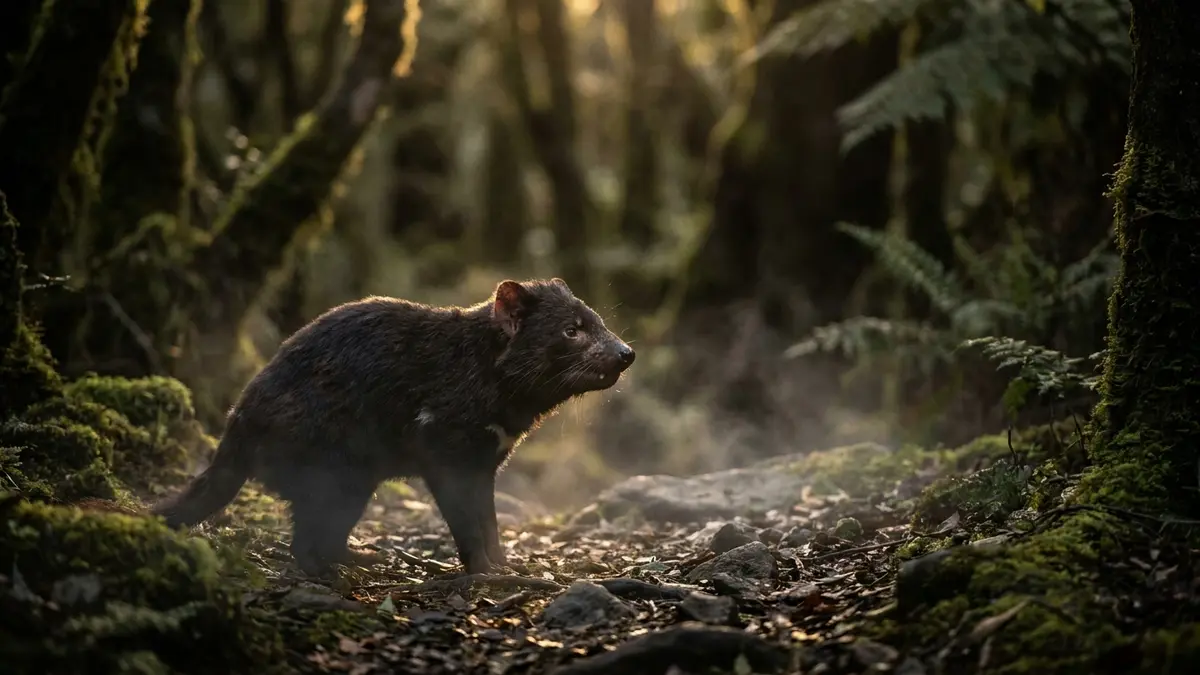
The wide-open, teeth-baring gape that made the Tasmanian devil famous is a sign of fear and uncertainty, not aggression. The screaming brawls at a carcass are mostly bluff, and rarely end in injury. Devil facial tumour disease is not a virus — it is a transmissible cancer, one of only a handful known in nature.
An almanac
- Scientific name
- Sarcophilus harrisii — the genus name means "meat-loving" (Greek sarx, flesh + philos, loving)
- Range
- Tasmania only — devils vanished from mainland Australia roughly 3,200–3,500 years ago
- Diet
- Mainly carrion; jaws and teeth let it devour prey "bones, fur and all"
- Standout number
- Bite force quotient of 181 — the highest measured in any living carnivorous mammal
The Tasmanian devil is named for a noise. The screaming, snapping commotion around a carcass sounds like animals killing each other, and it almost never is — the brawls are ritualised bluff that seldom produce injury.
The gape is misread in the same way. That wide-open, teeth-baring face is not a threat display at all; it signals fear and uncertainty.
The genuinely alarming fact about the species is one people rarely know: the facial tumour that has devastated it is not an infection but a cancer that passes physically from animal to animal, one of very few transmissible cancers known anywhere in nature.
Tasmanian Devil Facts Worth Knowing
- The Tasmanian devil is the largest carnivorous marsupial still alive anywhere on Earth.
- In the study that coined the metric, the Tasmanian devil scored a bite force quotient of 181 — the highest of any living carnivorous mammal measured. BFQ is bite force adjusted for body mass, so the devil only wins pound-for-pound. In raw newtons a lion or tiger bites vastly harder. The same paper found the very highest bite strengths belonged to extinct marsupial lions, not to any living animal, and it grouped the devil with hyaenas as a specialist bone-cracker rather than crowning it "strongest bite on Earth".
- A female devil is pregnant for only about 21 days and then gives birth to 20–30 young at once.
- A devil's pouch opens backwards, towards the tail, rather than forwards like a kangaroo's.
- A Tasmanian devil can eat up to 40 percent of its own body weight in a single sitting. The popular version says "40 percent a day", which is wrong twice over. It is 40 percent per meal, and devils do not eat every day — San Diego Zoo's fact sheet cites field data of roughly 2.4 kg of carcass per feeding session, with wild devils feeding on average only every 3–8 days.
- Devils eat the whole carcass — muscle, organs, fur and bone. Not literally every scrap. San Diego Zoo's fact sheet records devils eating "ends of long bones, nasal bones in skull, other small bones" but leaving behind "skin and larger dense bones such as skull and pelvis". The famous "nothing left" line overstates it.
- Tasmanian devils never lose a set of milk teeth — the teeth they grow as youngsters are the only teeth they will ever have.
- A devil's thinly furred ears are packed with blood vessels and flush visibly red when the animal is agitated.
- Devils have the largest vocal repertoire of any member of the dasyurid family, which includes quolls, dunnarts and antechinuses.
- The devil's genus name, Sarcophilus, literally means "meat-loving", from the Greek sarx (flesh) and philos (loving).
- Devils are afflicted by two separate contagious cancers, not one — the second, DFT2, was only discovered in 2014.
- Devil facial tumour disease has killed more than 80 percent of the Tasmanian devil population since it appeared in 1996.
- Every DFT1 tumour alive today descends from the cells of one long-dead female devil; the separate DFT2 lineage descends from a male.
- Researchers found six cathelicidin genes — the genes behind antimicrobial peptides in devil milk — in the Tasmanian devil genome, and peptides built from two of them killed MRSA and vancomycin-resistant Enterococcus faecalis.
- Where devils have been wiped out by disease, animal carcasses take about 2.6 times longer to disappear from the landscape.
- Devils moved to Maria Island in 2012 to save them from disease ate the island's seabirds; by 2016 little penguins and short-tailed shearwaters were below detectable levels at the two main colony sites. Headlines said devils "wiped out 3,000 breeding pairs of penguins". The peer-reviewed record is narrower and better documented: a DNA study of devil scats found 63 diet items and confirmed both seabirds fell below detection at two primary colony sites, and a 2011 government assessment had already warned of exactly this risk before the devils were released.
- In 2020, 26 Tasmanian devils were released at Barrington Tops in New South Wales — the first devils in mainland Australian bush in roughly 3,000 years. They went into a thousand-acre fenced enclosure, the Barrington Wildlife Sanctuary, run by Aussie Ark. This is a managed reintroduction inside a predator-proof fence, not a free-roaming mainland population, and it does not mean devils have "returned to the mainland" in the wild sense.
What People Get Wrong About Tasmanian Devils
“Tasmanian devils are dangerous animals that will attack people.” Tasmania's own wildlife agency says flatly that they do not attack people. They are shy, nocturnal scavengers that bite only when cornered, trapped or handled — which is exactly when most "devil attack" stories originate.
“That wide-open, teeth-baring gape is the devil showing aggression.” It is the opposite. The gape is a fear and uncertainty display — a nervous animal signalling that it does not want a fight. Nearly every famous photograph of a "snarling" devil is actually a photograph of a frightened one.
“The screaming, snapping brawls at a carcass are devils fighting to the death.” The noise is largely theatre. The screeches, gapes and postures are a ritual that lets several solitary animals share one carcass while doing each other as little damage as possible — the display exists precisely to avoid serious injury.
“Devil facial tumour disease is a contagious virus, like rabies or myxomatosis.” There is no pathogen. The cancer cell itself is the infectious agent — living tumour cells from one devil are physically transplanted into another during a bite and grow there as a graft. It is one of only a handful of transmissible cancers known in nature, alongside a canine tumour and several in marine bivalves.
“Devils are a menace to farmers, killing sheep and livestock.” Almost all the livestock a devil eats is already dead. Tasmania's agriculture department says newborn lambs and ground-roosting poultry can be at risk, but healthy stock is not — the devil's reputation as a killer of farm animals comes from finding it at carcasses it did not kill.
In Culture
For most people the cartoon came first. Taz debuted in Warner Bros.' "Devil May Hare" on 19 June 1954, directed by Robert McKimson, opposite Bugs Bunny. He then appeared in only four more classic shorts — "Bedevilled Rabbit" and "Ducking the Devil" (both 1957), "Bill of Hare" (1962) and "Dr. Devil and Mr. Hare" (1964). Producer Edward Selzer wanted the character retired; studio chief Jack Warner ordered him revived. Taz finally got his own series, "Taz-Mania" (1991-1995), voiced by Jim Cummings, and turned up in "Space Jam" (1996, Dee Bradley Baker), "Looney Tunes: Back in Action" (2003, Brendan Fraser) and "Space Jam: A New Legacy" (2021). The trademark has real consequences in Tasmania: the state government challenged Warner Bros. over licensing in 1997, and by 2006 the studio was selling devil plush toys with proceeds going to facial-tumour research. Tasmania's NBL basketball side was the Hobart Devils, whose licence was revoked in 1996; the AFL's 19th club, the Tasmania Devils, is due to debut in 2028 — and had to negotiate the name with Warner Bros. first.
Notable Individuals
Cedric is the most famous devil in science. In 2007 researchers at Hobart's Menzies Research Institute injected Cedric and his half-brother Clinky with facial tumour cells. Clinky developed the disease; Cedric mounted an immune response and grew no tumours, briefly raising hopes of a vaccine. A different strain defeated him in late 2008, and he was euthanised in September 2010 after the cancer reached his lungs. Cedric's genome was one of two published in PNAS in June 2011 — 3.2 billion base pairs each. The other belonged to Spirit, a wild-caught south-eastern female already carrying the cancer. On the mainland, Lisa and Lenny were released into Aussie Ark's Barrington Wildlife Sanctuary in 2020 by actors Chris Hemsworth and Elsa Pataky; Lisa went on to produce three joeys in 2023.
Frequently Asked Questions
Are Tasmanian devils dangerous to people?
Tasmania's own wildlife agency says flatly that they do not attack people. They are shy, nocturnal scavengers that bite only when cornered, trapped or handled — which is exactly when most "devil attack" stories originate.
What does it mean when a Tasmanian devil opens its mouth wide?
It is the opposite. The gape is a fear and uncertainty display — a nervous animal signalling that it does not want a fight. Nearly every famous photograph of a "snarling" devil is actually a photograph of a frightened one.
Do Tasmanian devils fight to the death?
The noise is largely theatre. The screeches, gapes and postures are a ritual that lets several solitary animals share one carcass while doing each other as little damage as possible — the display exists precisely to avoid serious injury.
Is devil facial tumour disease a virus?
There is no pathogen. The cancer cell itself is the infectious agent — living tumour cells from one devil are physically transplanted into another during a bite and grow there as a graft. It is one of only a handful of transmissible cancers known in nature, alongside a canine tumour and several in marine bivalves.
Do Tasmanian devils kill livestock?
Almost all the livestock a devil eats is already dead. Tasmania's agriculture department says newborn lambs and ground-roosting poultry can be at risk, but healthy stock is not — the devil's reputation as a killer of farm animals comes from finding it at carcasses it did not kill.
More about the Tasmanian Devil
More from Animal Facts
Sources
Claims on this page were checked against these published sources.
- Tasmanian Devil
The Tasmanian Devil is the world's largest surviving carnivorous marsupial.
Read the source → - Bite club: comparative bite force in big biting mammals and the prediction of predatory behaviour in fossil taxa
Among extant carnivorous mammals the highest BFQ was in the Tasmanian devil, Sarcophilus harrisii (181).
Read the source → - Tasmanian Devil
The pouch opens toward the back, which helps keep dirt out while they dig and move around.
Read the source → - Tasmanian Devil
Powerful jaws and teeth enable it to completely devour its prey - bones, fur and all.
Read the source → - Tasmanian Devil (Sarcophilus harrisii) Fact Sheet: Physical Characteristics
Have no 'baby (deciduous) teeth' that are lost; original teeth are kept
Read the source → - Tasmanian Devil (Sarcophilus harrisii) Fact Sheet: Behavior & Ecology
Vocalizations by devils represent the largest repertoire of calls in the whole dasyurid family
Read the source → - Tasmanian Devil (Sarcophilus harrisii) Fact Sheet: Taxonomy & History
Sarcophilus ('meat-loving') from Greek sarx or sarkos for 'flesh' and philos for 'beloved, dear, loving'
Read the source → - Tasmanian devil facial tumour lineages
DFT2 was first observed in 2014.
Read the source → - Regression of devil facial tumour disease following immunotherapy in immunised Tasmanian devils
It has been estimated that more than 80% of the devil population has been killed by DFTD.
Read the source → - The Origins and Vulnerabilities of Two Transmissible Cancers in Tasmanian Devils
karyotype evidence suggests that DFT2 arose from the somatic cells of a male animal, in contrast to the female origin of DFT1.
Read the source → - Cathelicidins in the Tasmanian devil (Sarcophilus harrisii)
Six cathelicidins were identified in the Tasmanian devil genome.
Read the source → - Top carnivore decline has cascading effects on scavengers and carrion persistence
carcasses persisted approximately 2.6-fold longer where devils have declined
Read the source → - DNA metabarcoding reveals a broad dietary range for Tasmanian devils introduced to a naive ecosystem
surveys of little penguin and short-tailed shearwater colonies saw both species below detectable levels at two primary colony sites in 2016
Read the source → - Tasmanian devils return to mainland Australia for first time in 3,000 years
26 of these endangered tiny terrors have returned
Read the source →
Not sure which animal is yours?
Consult the quiz