Animal Facts
Starfish Facts: No Brain, No Blood, Eyes on Every Arm
A starfish has no brain and no blood, yet carries a working eye on every arm.
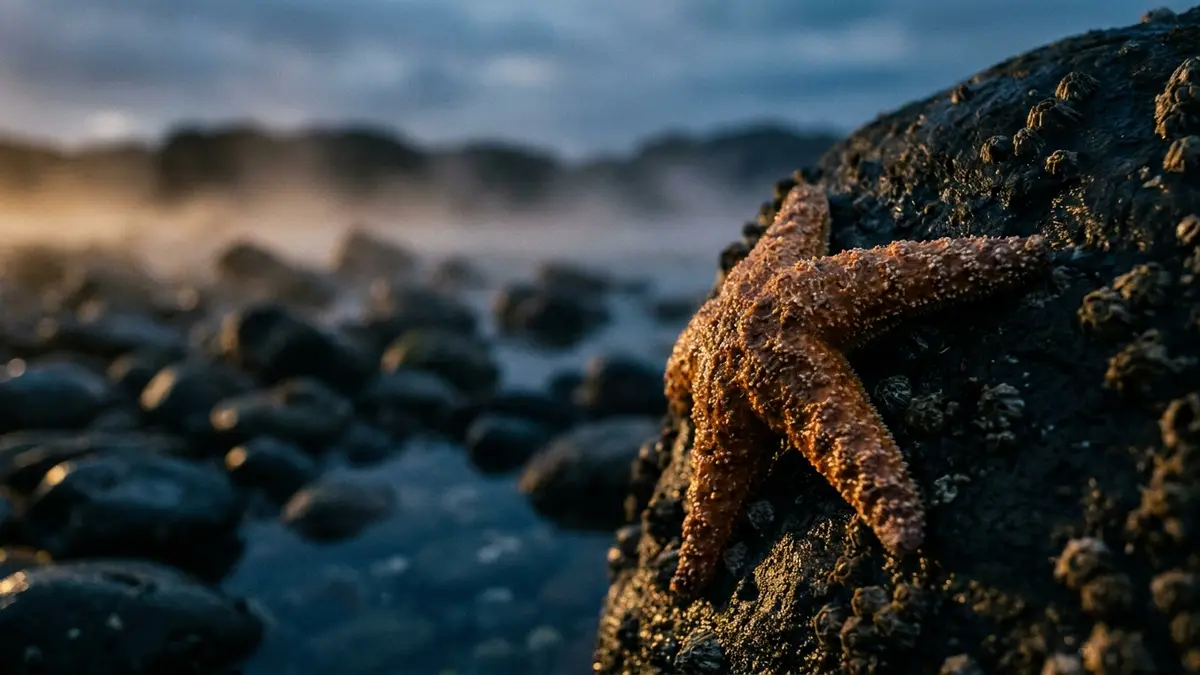
Starfish are echinoderms, not fish: about 2,000 species, all of them marine, none in fresh water. They have no brain and no blood — a nerve ring plus radial nerves and a seawater-filled canal system do the work — and most species carry a compound eye at the tip of each arm. Many push their cardiac stomach out through the mouth and digest prey outside the body before pulling it back in.
An almanac
- Scientific class
- Asteroidea — echinoderms, not fish (relatives of sea urchins, sand dollars and sea cucumbers)
- Known species
- About 2,000 sea star species, every one of them marine — no starfish lives in fresh water
- Size range
- From about 2 cm (0.75 in) across to roughly 1 m (3.5 ft) tip to tip
- Arms
- Usually 5; sunflower stars reach 24, and some species carry up to 50
- Brain
- None — a nerve ring plus radial nerves, and a compound eye at each arm tip (low-resolution, but genuinely image-forming in at least some species)
- Depth range
- Intertidal to the deep sea, with some species living below 14,500 feet (about 4,400 m)
- Conservation flashpoint
- Sunflower sea star — IUCN Critically Endangered, proposed as Threatened under the US Endangered Species Act
A starfish is not a fish, and scientists and aquariums increasingly do not call it one. It is an echinoderm, class Asteroidea, closer to a sea urchin or a sea cucumber than to anything with a spine, and every one of the roughly 2,000 known species lives in salt water.
What sits inside is stranger than the silhouette suggests. No brain, no blood, a body run by filtered seawater pumped through a network of canals, and, in many species, a stomach that leaves the body to feed. The arms carry eyes — not the light-sensing dots of older textbooks, but compound eyes that in at least two species have been shown to form real images.
Below, what the sources actually say, separated from what gets repeated: the severed arm that will not clone itself, the suction cups that are mostly glue, and the wasting epidemic that has driven the sunflower sea star to functional extinction across thousands of kilometres of Pacific coast.
Starfish Facts, Checked Against the Sources
- About 2,000 species, and every one of them lives in salt water. NOAA counts roughly 2,000 sea star species, all of which live in marine waters. No starfish species lives in fresh water.
- A starfish has no blood. Where humans use vessels filled with blood, echinoderms run a complicated series of tubes that uses seawater to convey nutrients and gases through the body. That canal network is the water vascular system, and it also handles waste.
- It has no brain either. Sea stars do not have brains; a nerve ring around the central disc plus radial nerves running down each arm do the work, with a compound eye at the tip of each arm in most known species.
- Starfish vision is real, and it is not a single-species curiosity. True image-forming vision has been experimentally demonstrated in at least two species — the blue sea star Linckia laevigata (Garm & Nilsson 2014) and the crown-of-thorns starfish Acanthaster planci (Petie et al. 2016) — and compound eyes have since been surveyed across deep-sea and Arctic species, some (e.g. Novodinia americana) with markedly higher acuity. The "slow and colour blind" finding belongs specifically to L. laevigata and should not be generalised to the class.
- Many species digest their prey outside their own body. A starfish has two stomachs. The cardiac stomach is pushed out through the mouth and digests the tissue of captured prey while it is still outside the body; the resulting soup is drawn back in to the internal pyloric stomach.
- Tube feet grip with chemistry, not only suction. One cell secretes a glue-like substance that attaches the foot to a surface, and a second secretes another substance that dissolves the glue, leaving a trail of chemical footprints behind the animal. Suction and friction contribute, but the strong, instantly reversible grip that holds a starfish onto surf-battered rock comes from the two-gland chemical system.
- A metre a minute, on about 15,000 feet. An adult sunflower sea star walks on about 15,000 tube feet and covers a metre a minute — NOAA calls it an "astonishing speed" for a sea star.
- The speed record belongs to a different animal. The fastest known sea star is not the sunflower star but Luidia ciliaris, a sand star clocked at up to 3.3 metres per minute.
- Five arms is the starting point, not the rule. Six- and seven-armed individuals turn up even within nominally five-armed species, and Smithsonian notes echinoderms with great numbers of arms, some sea stars having up to 50. Arm count is not a reliable way to identify a starfish.
- Sunflower stars add arms as they grow. Juveniles start life with five arms and have up to 24 by maturity, spanning up to a metre tip to tip.
- Regrowing a lost arm is slow — Denver Zoo says complete reformation may require a year, and the Seattle Aquarium notes it can take a year or even longer.
- There is no single starfish lifespan. The ochre sea star (Pisaster ochraceus), the purple-and-orange star of Pacific rock pools, is thought to live up to 20 years, while Denver Zoo lists just 3–5 years for the sea stars in its own collection. Any page quoting one number for all starfish is guessing.
- The oldest known starfish ancestor is roughly 480 million years old. Cantabrigiaster fezouataensis, described in January 2021 from Morocco's Anti-Atlas mountains, has an intricate design with feathery arms akin to a lacework, frozen in time for roughly 480 million years.
- Crown-of-thorns starfish have up to 21 arms, can grow up to 80 cm in diameter, and an adult can consume up to 10 m2 of coral a year. "Crown-of-thorns starfish" denotes a complex of four species — Acanthaster planci, A. mauritiensis, an unnamed Red Sea species, and the Great Barrier Reef's Acanthaster cf. solaris.
- One large female can release over 200 million eggs in a year. AIMS puts the figure for a large female crown-of-thorns at over 200 million eggs a year, which is the reproductive engine behind reef-wide outbreaks.
- Sea star wasting disease surfaced in June 2013. MARINe records the current outbreak as first noted in ochre stars along the coast of Washington state in June 2013, and says at least 20 other species of sea star have been affected. Prentice et al. 2025 describe the epidemic as reaching over 20 asteroid species from Mexico to Alaska.
- A bacterium was finally named in 2025. More than ten years after the onset of the epidemic, researchers reported that Vibrio pectenicida strain FHCF-3 is a causative agent of sea star wasting disease. The paper says "a causative agent", not the only one: Koch's postulates were fulfilled in sunflower sea stars specifically, and whether the same bacterium drives wasting in every affected species is unresolved. Earlier coverage blamed a densovirus, and that link did not survive follow-up work.
- The sunflower sea star is now functionally extinct across the southern half of its range. A study of 48,810 surveys found declines greater than 99.2% from Baja California, Mexico to Cape Flattery, Washington, and greater than 87.8% from the Salish Sea to the Gulf of Alaska. The species is listed by the IUCN as Critically Endangered and has been proposed as Threatened under the US Endangered Species Act.
Starfish Myths Worth Dropping
"Starfish are a kind of fish." They are echinoderms — no backbone, no gills, no scales, no fins. Their closest relatives are sea urchins, sand dollars and sea cucumbers, which is why scientists and aquariums increasingly say "sea star" instead. NOAA puts it flatly: sea stars, commonly called "starfish," are not fish.
"Cut a starfish in half and you get two starfish." For nearly every species, regeneration only works if a piece of the central disc goes with the arm — sea stars can regrow a lost arm as long as some part of the central disc remains intact. A bare, disc-free arm normally just dies, and even a normal regrowth takes a year or longer.
"Starfish are blind — the spots on their arms only tell light from dark." Most known starfish species possess a compound eye at the tip of each arm. True image-forming vision has been experimentally demonstrated in at least two species — the blue sea star Linckia laevigata (Garm & Nilsson 2014) and the crown-of-thorns starfish Acanthaster planci (Petie et al. 2016) — and compound eyes have since been surveyed across deep-sea and Arctic species, some (e.g. Novodinia americana) with markedly higher acuity. The "slow and colour blind" finding belongs specifically to L. laevigata and should not be generalised to the class. In that species, animals whose eyes are disabled can no longer navigate back to their home reef.
"A starfish's tube feet are tiny suction cups." Tube feet do more than suck. Smithsonian describes a two-cell system: one cell secretes a glue-like adhesive, a second secretes a solvent that dissolves it, leaving a trail of chemical "footprints". Suction and friction contribute, but the chemical adhesive is what makes the grip strong and instantly reversible.
"Crown-of-thorns starfish are an invasive species that was introduced to the Great Barrier Reef." They are native to the Great Barrier Reef, not an introduced species, and occur naturally across the Indo-Pacific from the Red Sea to the Americas. What has changed is how often they erupt into outbreaks, likely driven by nutrient runoff feeding their larvae and by the removal of their predators.
Starfish on Screen and Page
The most famous starfish on Earth is one no biologist has ever collected. Patrick Star debuted in the SpongeBob SquarePants pilot "Help Wanted" on Nickelodeon on 1 May 1999, voiced by Bill Fagerbakke. The series was created by the marine biologist and animator Stephen Hillenburg, which is why so much of Bikini Bottom's cast maps onto real reef taxonomy.
Pixar added Peach to Finding Nemo (2003), a pink sea star voiced by Allison Janney who spends the film stuck to the dentist's tank glass narrating the surgery, prompting the running gag "Can't hear you, Peach." On the villain side, DC's Starro first appeared in The Brave and the Bold #28 (1960), created by Gardner Fox and Mike Sekowsky, and holds an odd record: the first villain the Justice League ever fought. He returned as the towering antagonist of James Gunn's The Suicide Squad (2021).
Off screen, Loren Eiseley's essay "The Star Thrower," published in The Unexpected Universe (1969), is the source of the starfish parable that has been retold ever since.
Famous Starfish in Real Life
The best known real starfish is the one currently disappearing. The sunflower sea star (Pycnopodia helianthoides) begins life with five arms, matures with up to 24, spans about a metre, and walks on roughly 15,000 tube feet at a metre a minute. Since sea star wasting disease surfaced in ochre stars off Washington in June 2013, a study of 48,810 surveys has found it functionally extinct — declines greater than 99.2% — from Baja California to Cape Flattery, with declines greater than 87.8% from the Salish Sea to the Gulf of Alaska. It is IUCN Critically Endangered and proposed as Threatened under the US Endangered Species Act, and in 2025 researchers named Vibrio pectenicida strain FHCF-3 as a causative agent of the disease that took it.
Notorious rather than famous is the crown-of-thorns complex, four species of Acanthaster native to the Indo-Pacific. An adult carries up to 21 arms, grows up to 80 cm across, and eats up to 10 m2 of living coral a year, while a large female can release over 200 million eggs in the same period.
Several others hold specific records. Luidia ciliaris, a sand star, is the fastest sea star known at up to 3.3 metres per minute. The ochre sea star (Pisaster ochraceus) is the purple-and-orange fixture of Pacific rock pools and is thought to live up to 20 years. The blue sea star Linckia laevigata is the species in which starfish vision was first demonstrated, and Novodinia americana has eyes with a spatial resolution rivalling the highest acuity known among sea stars. Oldest of all is Cantabrigiaster fezouataensis, a roughly 480-million-year-old fossil from Morocco's Anti-Atlas mountains, described in January 2021.
Frequently Asked Questions
Are starfish actually fish?
No. Starfish are echinoderms in the class Asteroidea — no backbone, no gills, no scales, no fins. Their closest relatives are sea urchins, sand dollars and sea cucumbers, which is why NOAA and most aquariums prefer the name "sea star".
Do starfish have a brain?
No. A sea star runs on a nerve ring around its central disc plus radial nerves down each arm. It also has no blood: filtered seawater pumped through a canal network, the water vascular system, carries nutrients, gases and waste instead.
Can starfish see?
Most known species have a compound eye at the tip of each arm, and true image-forming vision has been demonstrated experimentally in at least two of them — the blue sea star Linckia laevigata (2014) and the crown-of-thorns starfish Acanthaster planci (2016). Blinded Linckia can no longer find their way back to their home reef. Acuity varies: Novodinia americana has among the sharpest eyes known in sea stars.
Do starfish grow back their arms?
Yes, but slowly, and only if part of the central disc stays attached. Denver Zoo says complete reformation may require a year, and the Seattle Aquarium notes it can take a year or even longer. A severed arm with no disc tissue normally just dies, so cutting a starfish in half does not give you two starfish.
How long do starfish live?
There is no single answer. The ochre sea star of Pacific rock pools is thought to live up to 20 years, while Denver Zoo lists only 3–5 years for the sea stars in its own collection. A page quoting one lifespan for all 2,000 species is guessing.
What is killing the sunflower sea stars?
Sea star wasting disease, first noted in ochre stars on the Washington coast in June 2013 and since recorded in over 20 sea star species from Mexico to Alaska. In 2025 a Nature Ecology & Evolution paper identified the bacterium Vibrio pectenicida strain FHCF-3 as a causative agent, fulfilling Koch's postulates in sunflower sea stars. Surveys show the sunflower star is now functionally extinct from Baja California to Cape Flattery, Washington.
More about the Starfish
More from Animal Facts


Not sure which animal is yours?
Consult the quiz