Animal Facts
Toucan Facts: The Bill Is a Radiator, Not a Nutcracker
The giant bill is mostly a radiator: 30–50% of the toucan's whole body surface area.
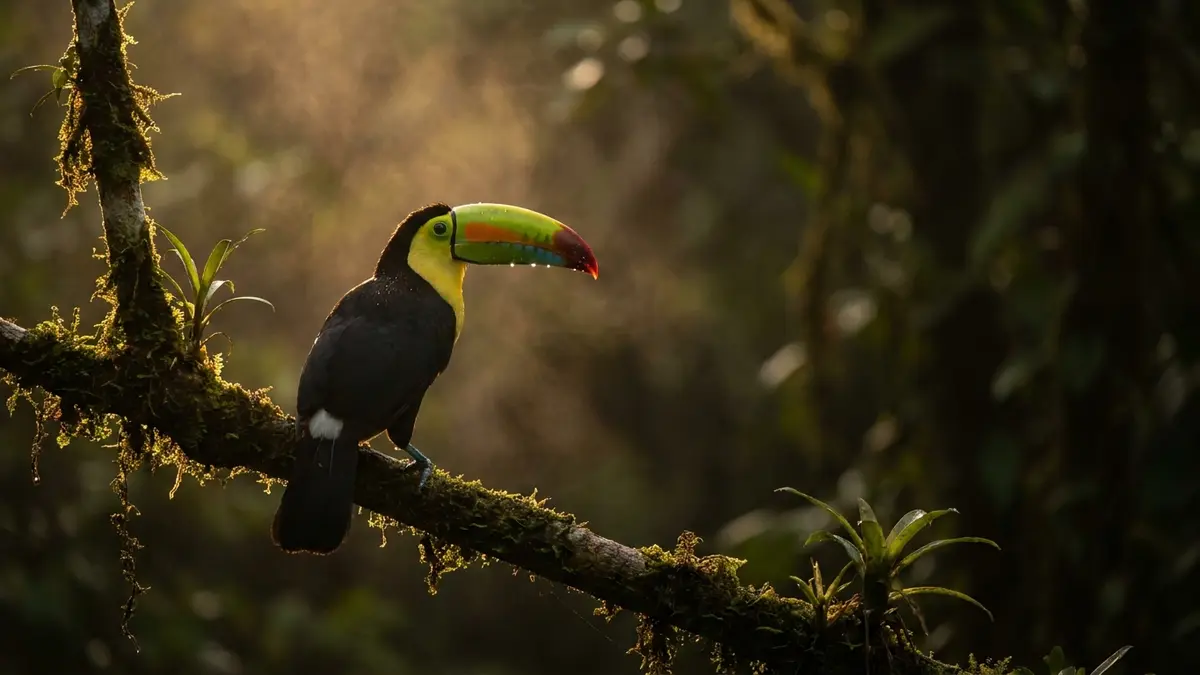
Toucans are Neotropical birds in the family Ramphastidae, order Piciformes — roughly 34–41 species in 5–6 genera depending on the authority. The bill runs about a third of the bird's length but only around a twentieth of its mass, and its best-measured job is temperature control: it accounts for 30–50% of the toucan's total body surface area. Fruit dominates the diet, with bats, nestlings and eggs taken occasionally.
An almanac
- Family & order
- Ramphastidae, order Piciformes. Toucans sit in the same order as woodpeckers, but their closest relatives are the New World barbets and toucan-barbets — not woodpeckers, and definitely not parrots.
- Species & size
- Roughly 34–41 species in 5–6 genera depending on the authority. Family length range about 33–60 cm (13–24 in); the toco toucan, the largest, is listed at 55–61 cm.
- The bill
- Up to one third of the bird's length but only about 1/20 of its mass; serrated edges and a downcurved tip
- Thermal window
- Bill surface area is 25–40 times larger than expected for a bird that size, and makes up 30–50% of the whole body's surface
- Range
- Neotropics only — tropical Americas as far south as northern Argentina
- Diet
- Fruit dominates; bats, nestlings and eggs taken occasionally
- Nesting
- Existing tree holes; usually 2–4 eggs; incubation about 18 days
The toucan is among the most recognisable birds alive and among the most confidently misdescribed. Nearly everything the popular version says about it hangs on the bill, and nearly all of it is either wrong or half-right in a way that hides the interesting part.
What the bill actually is, and what it actually does, has only been measured properly in the last twenty years or so: a 2005 mechanics study at the University of California San Diego took apart its structure, and a 2009 thermal-imaging study in Science worked out its main function. The answers are not the ones the cartoon suggests.
What follows is checked line by line against those sources. Where the sources hedge or disagree with each other — on how many toucan species exist, on how often toucans eat meat — that is said out loud rather than rounded off into a tidy number.
Toucan facts, checked against the sources
- The bill is a third of the bird but a twentieth of its weight. The UC San Diego team that dissected and tested a toco toucan beak described a structure that "comprises one third of the length of the bird and yet only about 1/20th of its mass" while still having outstanding stiffness.
- It is not hollow. "Hollow" is the usual shorthand, and even some zoo pages use it, but the cavity is not empty. The 2005 study found a sandwich composite: an outer keratin shell over a rigid network of closed cells made of calcium-rich proteins, giving the whole beak a density of about 0.1. The foam core stabilises the shell against buckling, which is what makes the bill both light and stiff.
- The bill is one of the largest thermal windows measured in any animal. In the toco toucan its surface area is 25–40 times larger than expected for a bird that size, and it accounts for 30–50% of the bird's entire body surface area.
- In still air at 21°C it radiates at least a quarter of the bird's metabolic output. The toucan controls this by dilating and constricting the blood vessels under the keratin. The widely repeated "four times its metabolism" figure is real but conditional — roughly 400% was measured only with air moving at about 12 mph. An adult can tune the bill down to as little as 5% of total body heat loss, and briefly up to essentially all of it.
- Toucans manage bill temperature while asleep. If they get too hot, the birds dump heat very quickly and briefly without waking.
- The bill is serrated, not smooth. Toucans have an unusually long and bulky but very lightweight bill with a downcurved tip and serrated edges.
- The tongue is feather-like. It is long, narrow and fringed with bristles along each side that help the bird catch and taste food before it moves down the throat — the same design a woodpecker has.
- Their nearest relatives are not woodpeckers. Toucans are Piciformes, the order that also holds woodpeckers and barbets, but the family's closest kin are the New World barbets and toucan-barbets. Hornbills, which they resemble, are only distant relations, and parrots are not in the picture at all.
- Nobody agrees on how many species there are. Roughly 34–41 species in 5–6 genera depending on the authority — San Diego Zoo says 34 in 6 genera, Grzimek's says 41 in 6, PBS Nature says five extant genera and over 40 species — because toucanets and aracaris keep being split and lumped. Any page quoting one exact figure as settled is overstating the case.
- The toco toucan is the outlier of its own family. It is the largest species, and Cornell calls it "the only non-forest toucan", living along forest edges and low wet grassland from Guyana south to northern Argentina.
- Male and female bills differ, but not reliably enough to sex a bird. Toco toucan bill length is sexually dimorphic on average — 16.6–22.9 cm in males versus 14.4–20.2 cm in females — though the ranges overlap heavily, so bill length alone does not sex an individual bird.
- Large toucans are poor fliers. After beating their wings a few times they hold them out and glide downward, which is why they spend so much of their time hopping between branches instead.
- Fruit dominates, but meat is on the menu. Both Grzimek's and Cornell describe vertebrate prey — bats, nestlings, eggs — as occasional rather than routine, but it is a normal recorded part of the diet, not an anomaly.
- They will come down to the ground to raid a nest. In a study published in the journal Food Webs in March 2017, camera traps over artificial ground nests baited with eggs at La Selva Biological Station in Costa Rica filmed two toucan species walking down to the forest floor to eat them — showing toucans will raid nests at ground level.
- They nest in holes they did not make. Toucans use existing tree holes high above the ground, with the larger species preferring natural cavities in rotted trees. The clutch is usually two to four eggs and incubation takes about 18 days.
- Chicks grow disposable knee pads. They hatch naked with bare red skin and develop thick horny "tarsal calluses" on the heels that protect the joints from friction inside the rough cavity. The pads drop off after the young leave the nest.
- A sleeping toucan folds into a ball. To fit inside a cramped tree hole it turns its head backwards and lays the bill down along its back, tucked under a wing, then flips its tail straight up and over its head.
- Losing them reshapes the forest. Where large-gape seed dispersers went functionally extinct in Brazil's Atlantic forest — toucans among them — a keystone palm shows a consistent reduction in seed size, a change the authors model as evolutionary and date, most likely, to the past 100 years.
What people get wrong about toucans
"The huge bill is a heavy-duty nutcracker, strong enough to crush hard shells and nuts." The bill is a third of the toucan's length but only about a twentieth of its mass — a keratin shell over a closed-cell foam core, total density about 0.1. Its documented use is reach: getting into tree holes, hanging nests, and fruit at the ends of branches. It is stiff and hard, but it is not built as a nutcracker.
"The bill is basically an oversized eating utensil." Since Tattersall's 2009 study in Science, the best-measured function is temperature control. The bill's surface is 25–40 times larger than expected for a bird that size and makes up 30–50% of the whole body's surface area — one of the largest adjustable thermal windows documented in any animal, comparable to an elephant's ears. Toucans throttle blood flow through it to dump or conserve heat.
"Toucans are gentle vegetarians living entirely on tropical fruit." Fruit dominates, but toucans are nest raiders. Grzimek's and Cornell both record them taking bats, nestlings and eggs — occasionally rather than routinely, but as a normal part of the diet. In 2017, camera traps over artificial ground nests baited with eggs at La Selva Biological Station in Costa Rica filmed two toucan species walking down to the forest floor to eat them, showing toucans will raid nests at ground level.
"Toucans and hornbills are the same kind of bird, so toucans live in African and Asian jungles too." They are separate families that arrived at similar bills independently. Toucans are Piciformes — the order that also contains woodpeckers and barbets — and are restricted to the Neotropics, the tropical Americas as far south as northern Argentina. Hornbills are Old World birds and only distant relations. A big-billed bird in Africa or Asia is not a toucan.
"Toucans make charming, easy exotic pets." Toucans are unusually prone to iron storage disease (hemochromatosis), because ordinary commercial bird diets carry far more iron than their natural food. Veterinary guidance calls for a low-iron diet of around 40 ppm, and affected birds can look healthy one day and die within 24 hours. Removal of chicks for the pet trade is also listed among the pressures on wild toco toucan populations.
The toucan of the popular imagination
Strip away the branding and the popular toucan is a single image: a stubby bright bird almost overbalanced by a vast beak, perched beside a pile of tropical fruit. Three things in that image need correcting, and each has a measured answer. The beak is not the heavy tool it looks like — a third of the bird's length, about a twentieth of its mass, keratin over closed-cell foam at a density near 0.1. The fruit is right as far as it goes, but Grzimek's and Cornell both record bats, nestlings and eggs in the diet. And the bird itself is routinely filed with parrots or with hornbills; it is neither. Toucans are Piciformes, sitting in the same order as woodpeckers and barbets, and they live only in the Neotropics.
The other half of the popular version is the beak trivia that circulates as a fun fact: that it is hollow. Even some zoo pages use the shorthand. The cavity is not empty, and the difference matters, because the foam core is what stops the outer shell buckling. Calling the bill hollow makes it sound like a gap where bone should be, rather than the thing that lets a structure that large weigh almost nothing.
One more piece of received wisdom deserves naming, because it travels with a number attached: that a toucan sheds four times as much heat as its body generates. That figure is real but conditional. Roughly 400% was recorded only with air moving at about 12 mph. In still air at 21°C the bill radiates at least a quarter of what the bird's metabolism produces, and an adult can tune it down to as little as 5% of total body heat loss, or briefly up to essentially all of it — a range, not a headline.
The toucans science knows best
The bird that stands in for the whole family is Ramphastos toco, the toco toucan. It is the largest species, and the one Cornell's Birds of the World calls "the only non-forest toucan", living along forest edges and low wet grassland from Guyana south to northern Argentina. It is also where most of the numbers come from: San Diego Zoo's fact sheet puts its bill at 16.6–22.9 cm in males and 14.4–20.2 cm in females, ranges that overlap across most of their span, so bill length alone will not tell you the sex of a bird in front of you.
Two studies made that beak known outside ornithology. In 2005, Yasuaki Seki, Matthew Schneider and Marc Meyers at the University of California San Diego published a mechanical analysis in Acta Materialia describing a toco beak as a sandwich composite — keratin outside, a fibrous network of closed cells made of calcium-rich proteins inside — with outstanding stiffness for its weight. Four years later, Tattersall's team pointed thermal cameras at live toucans for Science and found the bill working as a large adjustable radiator, one the birds keep tuning even while asleep, releasing heat in short bursts when they get too warm.
Two field studies belong in the same list. At La Selva Biological Station in Costa Rica, camera traps set over artificial ground nests baited with eggs filmed two toucan species walking down to the forest floor to eat them — published in Food Webs in March 2017, and evidence that toucans will raid nests at ground level. And in Brazil's Atlantic forest, where large-gape seed dispersers have gone functionally extinct, toucans among them, a keystone palm shows a consistent reduction in seed size; Galetti and colleagues reported the association in Science in 2013 and modelled it as an evolutionary change, most likely within the past 100 years.
Frequently Asked Questions
Is a toucan's beak hollow?
Not in the way the word suggests. A 2005 study of a toco toucan beak found a sandwich composite: an outer keratin shell over a rigid network of closed cells made of calcium-rich proteins, with an overall density of about 0.1. The foam core is what stops the shell buckling, which is why the beak is both light and stiff — about a third of the bird's length but only around a twentieth of its mass.
Why do toucans have such big beaks?
The best-measured function is temperature control. In the toco toucan the bill's surface area is 25–40 times larger than expected for a bird that size and makes up 30–50% of the whole body's surface, and the bird adjusts blood flow through it to dump or conserve heat — even while asleep. The bill's other documented use is reach: getting into tree holes, hanging nests and fruit at the ends of branches.
Are toucans related to parrots?
No. Toucans are in the family Ramphastidae, order Piciformes — the same order as woodpeckers and barbets. Their closest relatives are the New World barbets and toucan-barbets. Hornbills, which look similar, are a separate Old World family and only distant relations.
What do toucans actually eat?
Mostly fruit. Both Grzimek's and Cornell also record bats, nestlings and eggs, described as occasional rather than routine but a normal part of the diet. In 2017, camera traps over artificial ground nests baited with eggs at La Selva Biological Station in Costa Rica filmed two toucan species walking down to the forest floor to eat them.
Can toucans fly, or do they just hop around?
They fly, but the large species are poor at it. They beat their wings a few times, then hold them out and glide downward. Much of their movement through the canopy is hopping between branches rather than sustained flight.
Can you keep a toucan as a pet?
It is a bad idea. Toucans are unusually prone to iron storage disease (hemochromatosis) because ordinary commercial bird diets carry far more iron than their natural food; veterinary guidance calls for a low-iron diet of around 40 ppm, and affected birds can look healthy one day and die within 24 hours. Removal of chicks for the pet trade is also listed among the pressures on wild toco toucan populations.
More about the Toucan
More from Animal Facts

Sources
Claims on this page were checked against these published sources.
- Structure and mechanical behavior of a toucan beak
The toucan beak, which comprises one third of the length of the bird and yet only about 1/20th of its mass, has outstanding stiffness.
Read the source → - Toucan play at reducing the heating bill
It's big and has a surface area that's 25-40 times larger than normal for a bird of its size; in fact, the bill accounts for 30-50% of the bird's total surface area.
Read the source → - Toucans (Ramphastidae)
characterized by brightly colored plumage and an unusually long and bulky, but very lightweight, bill with a downcurved tip and serrated edges.
Read the source → - Toucan
Both toucans and woodpeckers have a tongue that is long, narrow, and feather-like. Bristles along each side of the tongue help the birds catch and taste food before moving it down the throat.
Read the source → - Toco Toucan (Ramphastos toco)
Toco Toucans are the largest species of toucan
Read the source → - Study co-authored by VCU undergraduate reveals new insights into the dining habits of toucans
The keel-billed toucan was one of two species of toucans that were documented by the team to prey upon eggs of ground-nesting birds in Costa Rica.
Read the source →
Not sure which animal is yours?
Consult the quiz