Animal Facts
Snail Facts: Blue Blood and Harpoon Teeth
Snail blood is blue, and a cone snail can fire its harpoon in 100 microseconds.
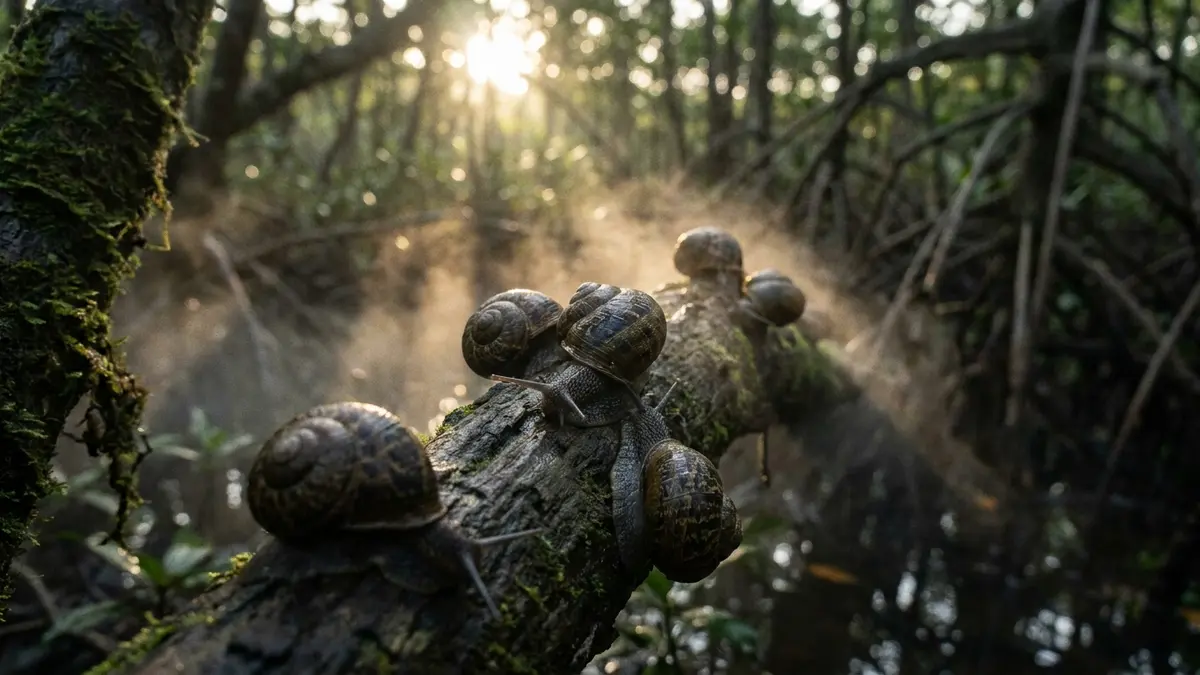
Snails are gastropods, the largest class of molluscs, with roughly 40,000–90,000 living species described and at least 13,000 extant and fossil genera. Their blood is blue because it carries oxygen with copper-based haemocyanin instead of iron-based haemoglobin, and land snails rasp food with a radula — a flexible band of thousands of microscopic teeth — backed by a jaw. Gastropods have a fossil record extending back to the Cambrian Period, which began about 541 million years ago, and continuing to the present day.
An almanac
- Class
- Gastropoda — snails and slugs, the largest class of molluscs
- Share of molluscs
- About 70% (Australian Museum) to over 80% (Animal Diversity Web)
- Living species
- Roughly 40,000–90,000 described; estimates vary by source
- Fossil record
- Back to the Cambrian Period, which began about 541 million years ago
- Teeth
- Thousands of microscopic teeth on a ribbon-like radula
- Blood
- Blue — copper-based haemocyanin, not iron-based haemoglobin
- Lifespan
- Helix pomatia: about five years wild, over ten in captivity
A snail looks like the least eventful animal in the garden. The reality is stranger: blue blood, a mouth lined with thousands of microscopic teeth, a sleep schedule that ignores the 24-hour day, and — in one marine branch of the family — a harpoon fired fast enough to catch a fish.
Snails also carry more baggage of bad information than almost any other animal. The tooth counts, the lifespans, the shell sizes and the garden remedies repeated online mostly trace back to a handful of misread sources. Where the popular version is wrong here, it is named as wrong rather than smoothed over.
Everything below is tied to a published source: the Natural History Museum of Los Angeles County, the Paleontological Research Institution, the University of Michigan's Animal Diversity Web, the IUCN, the WHO, NOAA and the Royal Horticultural Society among them.
Snail facts that hold up
- Their blood is blue. Snails carry oxygen using copper-based haemocyanin rather than the iron-based haemoglobin vertebrates use, and the copper is what gives the blood its colour (McGill University Office for Science and Society).
- Teeth on a ribbon, not in a mouth. Land snails and slugs eat with a jaw plus a radula — a flexible band of thousands of microscopic teeth that rasps food, while the jaw cuts off larger pieces. Radula form varies enormously across gastropods; in predatory cone snails it is modified into a single hollow harpoon tooth. The Natural History Museum of Los Angeles County describes the band simply as carrying "thousands of microscopic teeth" and gives no species-by-species count, so the precise tooth totals repeated online do not come from it.
- The largest class of molluscs — by an unsettled margin. Estimates of the gastropod share of mollusc species vary by source, from about 70% (Australian Museum) to over 80% (Animal Diversity Web), because the denominator itself is unsettled. What is not disputed is that gastropods are the largest class of molluscs.
- Nobody agrees how many species there are. The Paleontological Research Institution gives 40,000–90,000 living species and at least 13,000 extant and fossil genera, while Animal Diversity Web states flatly that gastropods number 40,000 species. Popular claims of "150,000 snail species" fold in estimates of undescribed species.
- The lineage is very old. Gastropods have a fossil record extending back to the Cambrian Period — which began about 541 million years ago — and continuing to the present day.
- They are not only a damp-garden animal. Gastropods live in the world's oceans, freshwater lakes and streams, and terrestrial ecosystems including deserts, mountains, backyards and beaches.
- A snail gave us a painkiller. Ziconotide, derived from cone snail venom and marketed as Prialt, was approved by the FDA in 2004 for severe chronic pain (Journal of Proteomics review via PubMed Central).
- Cone snails are chemical libraries. There are roughly 800 species of predatory cone snails, and a single species can carry a venom repertoire of about 100–400 different peptides.
- One of the fastest movements in the animal kingdom. High-speed videography showed the radular harpoon of Conus catus can be propelled into prey within 100 microseconds — among the fastest movements in the animal kingdom — in work led by UC Irvine associate professor Emanuel Azizi with colleagues at Occidental College, published in Current Biology.
- Snails sleep, but not on a 24-hour clock. University of Toronto researchers found pond snails took roughly seven bouts of sleep clustered into a 13–15 hour window, followed by more than 30 hours of uninterrupted activity, repeating on a two-to-three-day cycle.
- Courtship involves a stabbing. Land snails such as Helix pomatia are hermaphrodites, and during courtship one snail injects a calcareous "love-dart" into the sole of the other.
- Five years, not thirty-five. Animal Diversity Web gives Helix pomatia a typical wild lifespan of five years, with more than ten years possible in captivity. Circulated claims of 25- or 35-year snail lifespans are outliers or unverified captive anecdotes.
- They can seal themselves shut. To survive cold or drought, a land snail retracts completely into its shell and secretes a mucus covering called an epiphragm to seal the shell's opening.
- Freshwater snails carry schistosomiasis. People become infected when larval parasites released by freshwater snails penetrate the skin during contact with infested water; the WHO reports at least 253.7 million people required preventive treatment for the disease in 2024.
- Rat lungworm is a real reason to wash your salad. Snails and slugs are intermediate hosts for Angiostrongylus cantonensis, which is why raw or undercooked snails — or unwashed salad greens — can transmit it to people (Hawaii State Department of Health).
- 1,200 eggs a year, from one animal. Each giant African land snail contains both male and female reproductive organs and can produce up to 1,200 eggs a year (Massachusetts Introduced Pests Outreach Project).
- Extinct in the Wild, then returned. Since 1986, more than 21,000 individuals of 11 previously Extinct-in-the-Wild Partula snail species have been bred in zoos and reintroduced to islands in French Polynesia (Bristol Zoological Society).
- Shells are dissolving in acidifying water. During an August 2011 NOAA survey along the continental shelf from northern Washington to southern California, 53% of pteropods sampled in the coastal region with a fine mesh net had severely dissolved shells — sampling done during the upwelling season, when corrosive deep water rises onto the shelf.
Snail myths worth dropping
"Crushed eggshells, copper tape, sharp grit, wool pellets and bark mulch keep slugs and snails off your plants." The Royal Horticultural Society tested exactly these five remedies — crushed eggshells, pine bark mulch, copper tape, sharp horticultural grit and wool pellets — on 108 lettuces grown in nine patio pots and nine raised beds. There was "no difference in the damage sustained by either the protected lettuces or the ones left to fend for themselves". The RHS concluded that these barriers can be unreliable and ineffective, and was explicit that the research shed no light on what actually does obstruct slugs and snails.
"Releasing the rosy wolf snail is a proven way to control invasive giant African snails." Euglandina rosea never delivered control — the IUCN's Global Invasive Species Database states "no rigorous scientific evidence exists that E. rosea controls A. fulica" — while it devastated native tree snails. Of 400 recorded oceanic-island snail extinctions, 234 occurred on islands where E. rosea was introduced, and GISD reports it is highly probable that 134 of those were ultimately caused by it. The IUCN "has formally condemned the deliberate introduction of E. rosea and other carnivorous snails".
"Cone snails are among the deadliest animals on Earth, and beachcombers die from them regularly." Cone snail venom is genuinely dangerous, but the human toll is small and heavily concentrated in one species. A review compiling cases across more than three centuries found at least 141 recorded human envenomations, of which 36 were fatal, with more than half of all stings coming from Conus geographus alone. Most stings cause minimal or moderate symptoms.
"Snail teeth are the strongest natural material on Earth, stronger than spider silk." The record belongs to one specific snail: the common limpet, Patella vulgata, a marine gastropod — a snail, though not the coiled-shell garden animal people picture. Researchers measured its tooth material at 3.0–6.5 GPa tensile strength, "outperforming the high strength of spider silk currently considered to be the strongest natural material", thanks to goethite nanofibres in a chitin-protein matrix.
Snails in pop culture
Snails punch above their weight on screen. Gary, SpongeBob's pet sea snail in SpongeBob SquarePants, which premiered on 1 May 1999, is drawn as a snail but meows like a cat, voiced by Tom Kenny. DreamWorks Animation built an entire film on the joke of a fast snail: Turbo, released on 17 July 2013 and directed by David Soren, cast Ryan Reynolds as Theo, a garden snail who gains super-speed, and took roughly $282.6 million worldwide.
British audiences grew up with a slower one. Brian the snail appeared in The Magic Roundabout, adapted by Eric Thompson for BBC1 between 1965 and 1977 from Serge Danot's French series Le Manège enchanté (1964–1974). In picture books, Julia Donaldson and Axel Scheffler's The Snail and the Whale (2003) became a BBC One animation in 2019, narrated by Diana Rigg with Sally Hawkins as the snail. For adults, Elisabeth Tova Bailey's memoir The Sound of a Wild Snail Eating (Algonquin Books, 2010) won the John Burroughs Medal in 2010 and the William Saroyan International Prize in 2012.
Famous snails
George, a Hawaiian tree snail (Achatinella apexfulva), died on New Year's Day 2019 at about 14 years old. He was the last known individual of his species — a species that had been the first of more than 750 Hawaiian land snails described by western science.
Jeremy was a brown garden snail whose shell coiled the wrong way. He was found near a compost heap in south-west London by a retired Natural History Museum scientist and studied by Dr Angus Davison at the University of Nottingham, who had never seen a sinistral garden snail in 20 years of work. Jeremy died in October 2017, and all of his offspring hatched with normal right-coiling shells.
Archie holds the Guinness record for snail racing: 2 min 00 sec over a 33 cm course at Congham, Norfolk, in 1995, trained by Carl Bramham.
Frequently Asked Questions
Do snails really have 14,000 teeth?
The Natural History Museum of Los Angeles County describes a land snail's radula as "a flexible band of thousands of microscopic teeth" and gives no species-by-species count, so the precise totals repeated online do not come from it. Land snails and slugs also have a jaw that cuts off larger pieces of food, and radula form varies enormously across gastropods — in predatory cone snails it is a single hollow harpoon tooth instead of a rasping ribbon.
Why is snail blood blue?
Because snails carry oxygen with haemocyanin, a molecule built around an atom of copper rather than the atom of iron found in vertebrate haemoglobin. The copper is what makes the blood blue (McGill University Office for Science and Society).
Do snails sleep?
Pond snails do, but not on a 24-hour cycle. University of Toronto researchers recorded roughly seven bouts of sleep clustered into a 13–15 hour window, followed by more than 30 hours of uninterrupted activity, with the whole pattern repeating every two to three days.
Do crushed eggshells keep slugs and snails away?
Not in the Royal Horticultural Society's trial. Across 108 lettuces in nine patio pots and nine raised beds, five remedies were tested — crushed eggshells, pine bark mulch, copper tape, sharp horticultural grit and wool pellets — and there was "no difference in the damage sustained by either the protected lettuces or the ones left to fend for themselves". The RHS concluded such barriers can be unreliable and ineffective.
Can a cone snail sting kill you?
It can, but the recorded toll is small. A review compiling cases over more than three centuries found at least 141 human envenomations, of which 36 were fatal, and more than half of all stings came from a single species, Conus geographus. Most stings cause minimal or moderate symptoms.
How long do snails live?
Animal Diversity Web gives the Roman or Burgundy snail (Helix pomatia) a typical lifespan of five years in the wild, and more than ten years in captivity. Widely circulated claims of 25- or 35-year snail lifespans are outliers or unverified captive anecdotes.
More about the Snail
More from Animal Facts

Sources
Claims on this page were checked against these published sources.
- A Microscopic Look at Snail Jaws
a flexible band of thousands of microscopic teeth, called a radula
Read the source → - Snails and slugs
Snails and slugs, know as gastropods, are the largest group of molluscs and contain about 70% of all mollusc species.
Read the source → - Class Gastropoda
40,000–90,000 living species and at least 13,000 extant and fossil genera
Read the source → - Snails, Spiders, and Octopi all have Blue Blood
This molecule, instead of having an atom of iron in its middle, has an atom of copper that binds oxygen.
Read the source → - Pain therapeutics from cone snail venoms: From Ziconotide to novel non-opioid pathways
approval was finally given in 2004 by the Federal Drug and Food Administration (FDA) and marketed as Prialt®
Read the source → - First evidence of sleep in snails
the sleep patterns followed a two to three day period rather than a 24 hour cycle with clusters of around seven bouts of sleeping over a 13-15 hour period followed by over 30 hours of uninterrupted activity
Read the source → - Helix pomatia
After becoming stimulated, one of the snails injects a calcareous 'love-dart' into the sole of the other snail.
Read the source → - Schistosomiasis (fact sheet)
People become infected when larval forms of the parasite – released by freshwater snails – penetrate the skin during contact with infested water.
Read the source → - Neuroangiostrongyliasis (Rat Lungworm)
Snails, slugs, and certain other animals (including freshwater shrimp or prawns, land crabs, and frogs) can become infected by ingesting these larvae; these are considered intermediate hosts.
Read the source → - Giant African Land Snail — Achatina fulica
Each snail contains male and female reproductive organs and can produce up to 1,200 eggs a year.
Read the source → - Reintroducing 'Extinct' snails to the wild in French Polynesia
over 21,000 individuals of 11 previously Extinct-in-the-Wild species of Partula snails have been reintroduced
Read the source →
Not sure which animal is yours?
Consult the quiz