Fish & Sea Life · Spirit animal
Snail Spiritual Meaning & Symbolism
Patient wisdom carried home on your back.
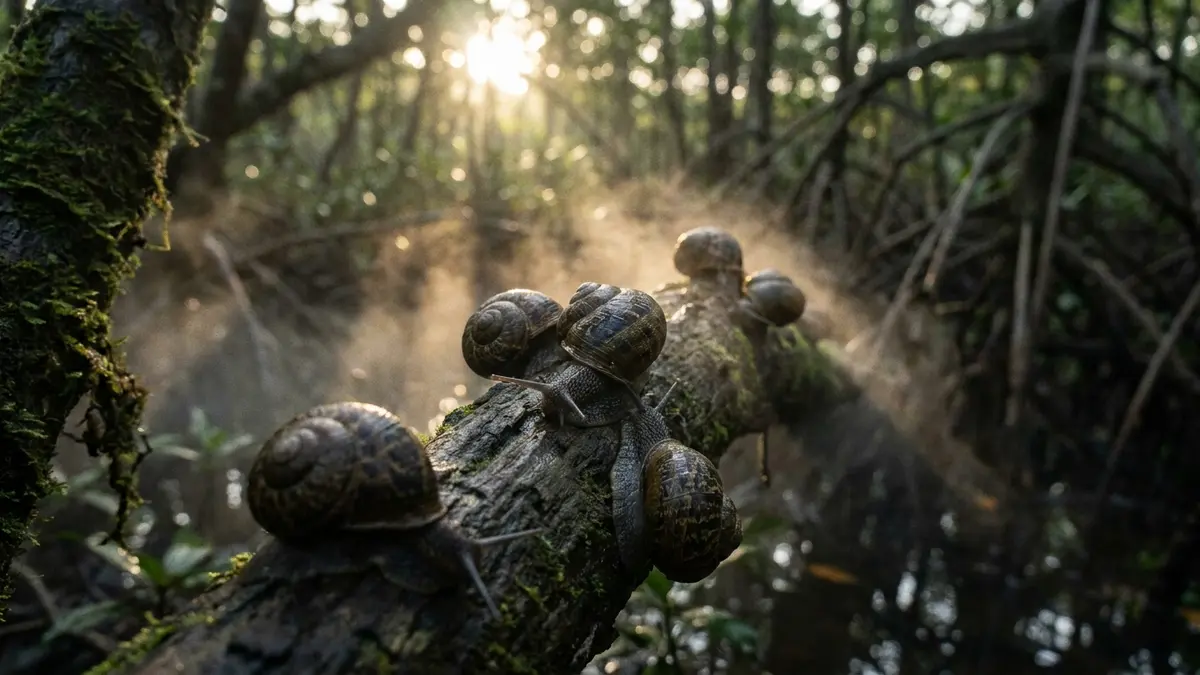
Snails embody patience, making their own homes and protecting the ones they do, and the idea that your home can be inside you rather than in one place. As a spirit or power animal, snails remind you that speed is not all that's important and also to make steady progress. As a totem, people with snail spirit energy build security through routines and guard their trust before opening up.
An almanac
- Core message
- Consistency beats speed
- Spirit animal
- Slow down, notice what surrounds you
- Totem for
- Routine-lovers who guard trust closely
- Power animal
- Building a tougher shell, one step at a time
- In dreams
- Feeling exposed or needing protection
- Element
- Land snails = earth, sea snails = water
- Sacred currency
- Sea-snail cowrie shells once circulated as money worldwide
- In scripture
- Psalm 58 likens frailty to a melting snail
Snails are known throughout the world for their slow pace of progress. They move carefully and deliberately and always carry their protective shells with them. For this reason, snail symbolism is often associated with steadiness, self-reliance, and contentment with one's own pace of life. What do you need to remember about snail symbolism as a spirit animal? Read on for the message this creature might be sending to you!
Snail Symbolism & Meaning
A snail's most striking feature is the coiled shell it hauls everywhere it goes — a built-in home, armor, and sanctuary in one package. That spiral has fascinated cultures for ages: some read it as a symbol of expanding awareness, and in Aztec tradition the moon deity Tecciztecatl lived inside a conch shell, which linked the creature to lunar cycles and change.
Older European folklore watched snails emerge after rainfall and read it as a sign about coming weather and harvests. A snail thickens its own shell using calcium carbonate it produces itself, without outside help. Its mucus does double duty: it eases movement by cutting friction against the ground, and it helps clean debris from the body.
Many snail species are also hermaphrodites, with both masculine and feminine capacity — a trait some read as a balance between yin and yang. Land varieties answer to earth, sea varieties to water, and some land species, like the Roman snail, can seal themselves inside their shell with a hardened mucus plug and survive years of drought.
Beyond myth, the shell's coil follows a mathematical pattern found throughout nature. Snail shells commonly grow in a logarithmic spiral — the same kind of pattern mathematicians describe using the Fibonacci sequence, and one that also shows up in nautilus shells, sunflower heads, and spiral galaxies. Each new whorl grows proportionally on the one before it, so the shell keeps the same basic shape as the snail grows larger, echoing in miniature the patience and consistency this creature has always stood for.
Snail Spirit Animal
Do you often rush through your day without stopping to really notice what’s going on around you? When you’re in a snail’s energy, you’re being called on to slow down.
You can’t move as fast as when you’re rushing ahead, but every step forward counts. You also need to give one thing your full attention before starting the next.
The land-dwelling snail will remind you about how important it is to know when to stand firm and be immovable versus when it’s best to withdraw for safety. The sea-dwelling snail teaches that ocean-going snails draw their wisdom from intuition and deeper, more spiritual knowledge.
Does Snail fit you?
Tap the ones that sound like you — 6 traits, no right answer.
0 of 6 Nothing picked yet — start tapping.
Snail Totem Animal
If the snail is your totem animal, you like to go about your days the same way all the time. You usually do everything in a calm way rather than in a hurry. You do this because it helps you feel comfortable and allows you to relax. Sometimes doubt happens for you, though, and when this does, you pull away instead of talking about the doubt or working on it. Because of this, trust sometimes seems slow to come for you.
You like to keep emotional issues just for yourself. This helps you feel more comfortable than when other people know what those issues are.
When you show your devotion in love relationships, you expect others to show their devotion too. With not much liking for conflict, if doubt comes in there too, you'll back off and pull away rather than talk it out. This means that other people might see you as having a hard outer shell that doesn't change or flex very easily.
To keep from feeling these ways sometimes there are some things that can help. One thing that can help is that you make sure to have good distance from people who drain energy rather than give it back. Another thing is that you remain open enough so that what is out there might come into your life.
Snail Power Animal
If you call on a snail as a power animal, you'll be encouraged to move forward slowly but steadily.
Slow steady progress is perfect for times when you feel overwhelmed or paralyzed by life. A snail is likely to remind you of the need to focus your attention on the truly important things and to take life one step at a time.
A snail can also help you build protective shells that will help you weather all the ups and downs of life. If you need inspiration when dealing with unfamiliar surroundings or facing major changes, then a snail can make sure that you're heading in the right direction.
Even if things are going well, keep in mind that a snail has its own wisdom about dangers. This includes cautioning about taking unnecessary risks. A snail can give you some practical advice about avoiding risks that are of no benefit or importance to you.
Across cultures
2 traditions — pick one to read its take.
Snail in Native American Symbolism
Native American lore doesn't always interpret a given creature in the same way. For instance, the cultural meaning of snail varies from one tribe to another.
A story from the Osage tribe tells of a snail peacefully living by a riverbank, which happens to be flooded by sudden rains. The snail is carried downstream and lands on a log surrounded by fish.
The sun bakes the little snail and then gradually reshapes it into a man.
This man remains ignorant of human ways and wanders around hungry. He is found by the Great Spirit, taught to hunt with bow and arrow, and gifted with food from the hunt until he satisfies his hunger.
The Great Spirit provides further guidance until they part ways.
Eventually, the man returns home to find his old shell, where he meets and marries the beaver chief's daughter — leading many to believe that their union is what gave rise to the Osage tribe.
Snail in Far Eastern Tradition
Japanese folktales tell about a shapeshifter called Sazae-oni: they turn into creatures that can swim or move around on land.
In Japanese folktales, the sticky tongue of a Sazae-oni really does hurt a lot, and people say that you have to get away from it and wash right off.
Chinese stories are much kinder. In one, Nuwa is the creator goddess — she's seen as the sister and wife of Fuxi. In Chinese writing, her name shares a character with "snail".
Another ancient story also comes from China; it's about the most basic kind of romance you can imagine. A farmer finds a river snail's shell, and he takes it home. And every night, a young woman comes out of that snail shell to clean his house and cook him dinner.
Then one day the woman decides to show herself.
So when this powerful corrupt official comes looking for her — trying to steal her away from her husband — he can't seem to catch her in plain sight. She uses him by doing what good people know how to do: making sure justice wins out at last over greed.
Here in this story, a shell isn't just something you hide inside; it's also like a threshold. Like something you get really good at: patience. You wait and wait inside it for a long, long time, until finally you can show yourself in person. Because then someone has earned your trust and everything feels safe out there in the open again at last.
Snail in Dreams
The snail doesn't show itself until it's ready. If your dream shows a snail hiding, it suggests you're keeping something to yourself — maybe you're keeping emotions private or holding back from sharing part of yourself. Your instinct is to protect that private thing, and it's a good instinct.
Or maybe the snail is moving slowly forward. You're putting one foot in front of another toward your goal, like how a snail moves. It takes time to reach those goals, but if you keep at it, you'll get there.
But a white snail is extra special! It means that in life, you feel at peace with what you're doing. When a snail is white in your dream, it shows an alignment between where you are in the moment and the meaning you find in the world.
Or sometimes the snail is red! In that case, think about what's getting under your skin. Is there someone in your life who makes you angry? Maybe your anger is rising from the inside out. Or are you getting tired? If your inner snail is red, it might be time to take a break.
The dream can show only slime trails and no snail at all! In those cases, saying no and setting boundaries will make life better
Snail Spiritual Meaning
Snail symbolism begins by changing how you define progress. Being patient, steady, and consistent is a path to greatness, not some abstract thing called "speed." Snail reminds you that in your own way, you can build a protective outer layer around an inner tenderness, without becoming stuck. Home isn't an address or a place; it's a sanctuary that you carry within yourself.
When you pay attention and stay on course, guided by inner wisdom, you reach the right destination when you're supposed to get there — even if it's not exactly how others thought it would go.
Snail in World Religions
Beyond folklore, several major faiths have reached for the snail — or the shell it leaves behind — as a spiritual metaphor in its own right. Christian scripture draws on the creature's real habits rather than its shell. Psalm 58:8 asks that the wicked "be like a slug that melts away as it moves along" — the snail's trail of drying mucus becomes a picture of a fleeting, unrighteous life. It's a harsher reading than most modern spirit-animal traditions offer — here, vulnerability without a shell to hide inside becomes a warning rather than an invitation to rest.
Hinduism, by contrast, sanctifies the shell itself. The shankha, coiled from the shell of a specific sea snail species, is carried by Vishnu the Preserver as one of his four sacred emblems, and its sound is blown to open temple worship and home aarti across the subcontinent. What began as one creature's self-made armor becomes, in human hands, an instrument that calls blessing in rather than shutting the world out.
Held side by side, these two traditions frame the same spiral shell in opposite ways — a boundary around a fragile life on one hand, a vessel that channels sacred sound on the other. The larger point may be that a shell only matters as much as what you choose to do inside it.
Cowrie Shells: Sea Snails as Ancient Currency
People across the world have used cowrie shells as money. The shells of a small tropical sea snail that lives in the waters around the Maldive and Laccadive Islands in the Indian Ocean, cowrie shells were once more universally accepted than any single coin. These shells were used by Chinese merchants and moved into India, Africa and North America by trade.
People liked cowrie shells as money because they're durable, small enough to carry with you, and nearly impossible to copy. They're also natural: You can look at a shell and see why someone thought it made a good choice for a coin.
If you look beyond their practical uses — as practical as a closed snail's smooth, shiny shell can be — you start seeing other reasons people liked to use them as money. On some level, they provide reassurance: that if someone is willing to carry your most prized asset close to their heart, it must be valuable. If something is still working so hard for you even after it's been pulled out of the ocean and through the machinations of international trade, maybe there are lessons worth learning from its example.
Frequently Asked Questions
What does it mean when you keep encountering snails?
If you often see snails, it's a reminder to slow down and see the small things. If you feel like nothing is happening, it's a sign that any steady effort will get you where you want to go.
Is a snail totem animal a sign of introversion?
Snail people do prefer routine and establish trust before revealing themselves. But this doesn't mean they're introverted.
What does a snail in a dream typically mean?
A snail moving forward in your dream suggests you're making progress. In contrast, a snail hiding in its shell indicates that you want to hide and/or avoid your feelings about something. The colors can also give hints: white often stands for peace, whereas red is associated with anger.
Does the Bible mention snails?
Yes. Specifically, Psalm 58:8 compares the wicked to a snail that "melts away as it moves along" — the slime trail evaporates behind a snail as it crawls. That's a perfect image for a fleeting, unrighteous life.
What is a shankha, and why does it matter spiritually?
It's the coiled shell of a sacred sea snail. The god Vishnu carries one as one of his four emblems, and people blow it to open worship and home rituals — to call a blessing and sacred sound into a space, using the snail's own protective architecture.
Snail also represents
- Other animals that represent protection →Alongside Bear, Wolf, Dog, Elephant
- Other animals that represent resilience →Alongside Cockroach, Camel, Salmon, Turtle
- Other animals that represent patience →Alongside Turtle, Heron, Spider, Ant
- Other animals that represent intuition →Alongside Owl, Cat, Wolf, Raven
Sources
Claims on this page were checked against these published sources.
- Tecciztecatl
In some depictions, Tecciztecatl carried a large, white seashell on his back, tēucciztli in Nahuatl, representing the Moon itself
Read the source → - Snail
Snail shells are mainly composed of a mixture of proteins called conchin, and calcium carbonate.
Read the source → - Folk-Lore and Legends: North American Indian — The Snail and the Beaver
The father of the Osage nation was a snail... union of the Snail-Man and the Beaver-Maid sprang the tribe of the Osages—at least so it is related by the old men of the tribe.
Read the source → - Nüwa
both the sister and the wife of Fuxi
Read the source → - Psalm 58:8, New International Version
May they be like a slug that melts away as it moves along, like a stillborn child that never sees the sun.
Read the source → - Shankha
This shell is from a sea snail species Turbinella pyrum in the family Turbinellidae. ... The shankha called panchajanya is a sacred emblem of the Hindu preserver deity Vishnu. ... Nowadays, the shankha is blown at the time of worship in Hindu temples and homes, especially in the ritual of the Hindu aarti, when light is offered to the deities.
Read the source → - Shell money
Cowries, particularly the Money Cowrie (C. moneta) and Ring Cowrie (C. annulus) have circulated as currency in more places in the world than any coin ... cowrie shells were important valuables [in China, 1200-800 BC] ... The Maldive and Laccadive islands supplied Cypraea moneta for most of the world's trade until the 18th Century.
Read the source → - The Snail Shell Girl (Fujian)
AT 465A,B 'Man Persecuted Because of his Wife' ... may be the oldest recorded Chinese folktale, with origins traceable to the Jin dynasty (A.D. 265-420).
Read the source → - What's special about the shape of a Nautilus shell?
Mathematicians have learned to use Fibonacci's sequence to describe certain shapes that appear in nature. These shapes are called logarithmic spirals, and Nautilus shells are just one example. ... spiral galaxies, and in many plants such as sunflowers.
Read the source →