Animal Facts
Peacock Facts: The Train, the Colour and the Noise
The peacock's fan is not a tail, and none of its blue or green is pigment.
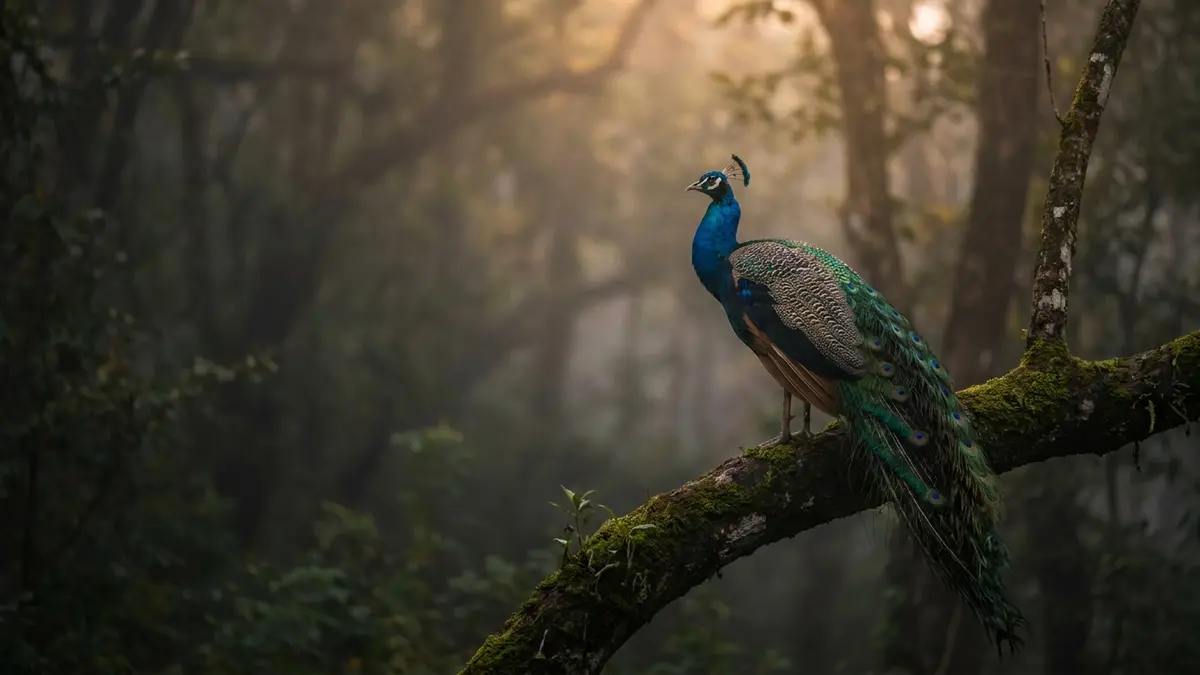
The peacock's fan is not a tail. It is a bundle of elongated upper tail coverts carrying 100 to 175 iridescent eyespots, roughly 5 feet (about 1.5 m) long, moulted and regrown every year. The blue and green are structural rather than pigmentary: in a green peacock train feather, the barbule cortex holds a two-dimensional photonic crystal of melanin rods connected by keratin with air-filled gaps. During courtship the bird rattles his short true tail sideways against the erect train at an average of 25.6 times a second.
An almanac
- Train length
- Roughly 5 ft; published figures run 1.5–1.7 m
- Eyespots
- 100–175 ocelli on a male's train
- Weight
- Up to 13 lb (6 kg), among the heaviest flying birds
- Colour
- 2D photonic crystal in the barbule cortex, not pigment
- Display rattle
- 25.6 Hz on average
- Nesting
- 4–8 eggs, about 30 days, peahen alone; chicks run at once
- Voice
- 11 distinct calls
Almost everything memorable about a peacock is described wrongly in the popular version. The fan is not a tail. The colour is not pigment. The shimmer is not the fan moving under its own power.
The bird underneath is a heavy, ground-hunting omnivore that takes small reptiles, mammals and snakes, screams with one of 11 distinct calls, and sheds the entire ornament once a year. At up to 13 pounds it is among the heaviest birds that still fly.
What follows is sourced to zoos, peer-reviewed biomechanics and Audubon reporting, with the contested parts flagged rather than smoothed over — including a live disagreement between two of the cited studies over whether the display sound is infrasonic at all.
Peacock facts, checked
- The fan is not a tail. It is made of elongated upper tail coverts, feathers that on most birds do nothing but cover the base of the tail. San Diego Zoo Wildlife Alliance puts it plainly: "Those long feathers are the male's tail coverts, or the feathers that cover the base of the tail."
- A full train runs roughly 5 feet (about 1.5 m). Published figures for a full train run from about 1.5 to 1.7 m. The Smithsonian's own page presents "the 5-foot (1.7-meter) train" as a single measurement, but 5 ft is 1.52 m and 1.7 m is 5 ft 7 in.
- A male carries 100 to 175 ocelli. Those are the iridescent eyespots scattered through the train.
- Peafowl are among the heaviest flying birds. Up to 13 pounds (6 kg), according to the Smithsonian's National Zoo.
- The colour is structural, not pigmentary. In a green peacock (Pavo muticus) train feather, the barbule cortex contains a 2D photonic crystal of melanin rods connected by keratin with air-filled gaps, and varying the lattice constant and number of periods produces blue, green, yellow and brown from that one structure. The colours are structural rather than pigmentary. Note that this work was done on the green peafowl, a different species from the Indian peafowl most of this page describes.
- The shimmer is made by the hidden true tail. High-speed video shows train-rattling peacocks stridulating their short tail feathers against the erect train at 25.6 Hz on average, generating a broadband, pulsating mechanical sound at that frequency.
- The eyespots stay still while the train moves. The mechanical structure of the train feathers holds the ocelli nearly stationary against a dynamic iridescent background. The part of the display that most strongly influences female mate choice is the part that does not shake.
- Whether the display is infrasonic is contested. Freeman & Hare's work (reported by Audubon, 2015) found infrasonic components below 20 Hz associated with train-shaking, and playback made both sexes more alert and more active. But Kane et al. 2018 argue the train-rattling display sound is a broadband impulsive rattle repeating at ~26 Hz with most spectral energy in the human-audible range, not predominantly infrasound. The repetition rate is low-frequency; the sound itself is largely audible.
- The crest sits close to the display frequency. Peafowl crests resonate within the frequency band peacocks use for train-rattling — mean crest resonance ~28.1 Hz (females) and ~26.3 Hz (males) versus a mean rattling frequency of 25.6 Hz — so the display drives the crest near resonance. Whether a peahen actually senses this is an untested hypothesis the authors propose, not a finding.
- The train costs less in flight than it looks. It doubles parasite drag during take-off, but parasite power accounts for only 0.1% of the total aerodynamic power required, and birds filmed with and without their trains took off with no measurable difference. It is not free either: the train is 6.9% of body weight, and the author cautions that no detectable take-off effect is not the same as no cost at all.
- Eyespot colour tracks mating success. Eyespot coloration explained about half of the variation in mating success across 34 displaying males in three feral populations, and the hue and iridescence of the blue-green ring were the most important of the colour variables measured. When researchers masked the ocelli on nine males, copulation success dropped almost to zero.
- Peahens look at his legs. Head-mounted eye-tracking cameras on 12 peahens found their gaze rarely fell at or above the peacocks' heads. Of the small portion of time spent looking at the males, the females looked longest at the legs and the lower portion of the train.
- The whole train is moulted every year. The eyed feathers of the train are dropped once a year after breeding season, and new feathers immediately begin growing.
- Peafowl have 11 distinct calls. The male's carrying "may-AWE" scream is the one the neighbours complain about.
- The peahen incubates alone. Four to eight eggs in a scrape on the ground, for about 30 days. The young hatch fully formed and can run and feed themselves almost immediately after hatching.
- They hunt on the ground. Peafowl are omnivores, foraging for berries and other fruits, grain and green crops, insects, and small reptiles, mammals and snakes.
- A third peafowl species lives in Africa. The Congo peafowl (Afropavo congensis) of the Congo Basin was only described as a species in 1936; males are up to about 28 inches long. Sources split on the count: Saint Louis Zoo calls it "one of only three species of peafowl," while San Diego Zoo states flatly that "There are two peafowl species," counting only the genus Pavo — the Indian and green peafowl.
- Feral peafowl are a municipal problem in Southern California. Rancho Palos Verdes has trapped its flock down from a high of around 300 birds in 2014 to fewer than 150 in recent years. Los Angeles County passed a countywide feeding ban carrying fines up to $1,000 and six months in jail, but it applies only on public property, not private yards, and no citations had been issued as of the article. Some individual cities, including San Marino and Rancho Palos Verdes, have their own feeding bans.
What the popular version gets wrong
"That giant fan is the peacock's tail." It is not. The fan is built from upper tail coverts, feathers that in most birds do nothing but cover the tail's base. The real tail sits behind it: short, stiff, brown rectrices the peacock rattles sideways against the train to make it shimmer. If you have ever wondered why the fan appears to vibrate on its own, that is the hidden tail doing the work.
"Peacock feathers are dyed brilliant blue and green by pigment." In a green peacock (Pavo muticus) train feather, the barbule cortex contains a 2D photonic crystal of melanin rods connected by keratin with air-filled gaps, and varying the lattice constant and number of periods produces blue, green, yellow and brown from that one structure. The colours are structural rather than pigmentary. Melanin is the same brown-black pigment that colours human hair; it is the spacing of the lattice, not the pigment, that decides which wavelengths come back at you.
"The train is such a burden that peacocks can barely get off the ground." Filmed taking off with and without their trains, five peacocks showed no significant difference in the power they put into the climb. The train does double parasite drag and weighs 6.9% of body mass, but drag accounts for roughly a thousandth of the power needed for take-off. Peafowl walk and run by preference, not because flight is beyond them — they fly up into trees to roost every night.
"White peacocks are albinos." Almost never. They are leucistic: the bird still manufactures melanin but cannot deposit it into the growing feathers, so the plumage comes out white while the eyes and skin keep normal colour. A genuine albino makes no melanin at all, which is why the give-away is the eye rather than the feather — an albino bird's eyes are red or pink. True albino birds also have impaired vision and rarely reach adulthood.
The peacock in culture
NBC's peacock hatched in 1956, when the network needed a way to sell colour broadcasts to an audience watching in black and white. NBCUniversal credits art director John J. Graham and Herb Lubalin of Sudler & Hennessey with the original bird and its 11 brightly coloured plumes, paired on air with the announcement "The following program is brought to you in living color on NBC." Steff Geissbuhler's 1986 redesign trimmed it to six plumes, cut a notch for the beak and turned the bird to face right.
Long before television, the peacock was religious shorthand in South Asia. India's official Conservation Plan for Indian Peafowl notes that "The Hindus consider the bird to be sacred because of its association with Lord Krishna who used to wear its feather as crown (Mor Mokut)," and that it serves as the "Vaahan" — the mount — of Kartikeya, son of Shiva and Parvati. India made the peafowl its national bird, and Schedule I of the Wildlife (Protection) Act 1972 now gives it the country's strictest legal protection.
Famous peacocks
Dexter is the peacock everyone remembers. In late January 2018 the Brooklyn photographer and performance artist Ventiko brought him to Newark Liberty International Airport as an emotional-support animal. United refused, saying the peacock "didn't meet guidelines for several reasons, including its size and weight," and had told her three times before she arrived. She and Dexter drove to Los Angeles instead.
Flannery O'Connor kept peafowl at Andalusia Farm in Milledgeville, Georgia, and wrote about them in her 1961 essay "The King of the Birds." Southern California's wild flocks trace back to Elias J. "Lucky" Baldwin, who bought 8,000 acres there in 1875 and imported peafowl from India alongside his sheep, hogs, horses and cattle.
Frequently Asked Questions
Is the peacock's fan really its tail?
No. The fan is made of elongated upper tail coverts, the feathers that on an ordinary bird just cover the base of the tail. The true tail is short, stiff and brown, and sits behind the fan; the peacock rattles it sideways against the train to make the fan shimmer.
Why are peacock feathers so blue?
Not because of blue pigment. In a green peacock (Pavo muticus) train feather, the barbule cortex contains a 2D photonic crystal of melanin rods connected by keratin with air-filled gaps, and varying the lattice constant and number of periods produces blue, green, yellow and brown from that one structure. The colours are structural rather than pigmentary.
Can peacocks fly with that huge train?
Yes. At up to 13 pounds (6 kg) peafowl are among the heaviest flying birds. The train doubles parasite drag during take-off, but parasite power is only about 0.1% of the total aerodynamic power needed, and birds filmed with and without trains showed no significant difference in take-off power. They fly up into trees to roost at night.
Do peacocks lose their feathers every year?
Yes. The eyed feathers of the train are dropped once a year after breeding season, and new ones begin growing immediately. A male's regrown train carries somewhere between 100 and 175 eyespots.
What is a white peacock?
In almost every case a leucistic bird, not an albino. It still makes melanin but cannot deposit it into the growing feathers, so the plumage is white while the eyes and skin keep normal colour. A true albino makes no melanin at all and has red or pink eyes, along with impaired vision, and rarely reaches adulthood.
Why are peacocks so noisy?
Peafowl have 11 different calls, and the male's carrying "may-AWE" scream is the one neighbours complain about. In Southern California the feral flocks have prompted trapping — Rancho Palos Verdes brought its birds down from around 300 in 2014 to fewer than 150 — plus a Los Angeles County feeding ban that applies only on public property.
More about the Peacock
More from Animal Facts


Sources
Claims on this page were checked against these published sources.
- Peafowl
Those long feathers are the male's tail coverts, or the feathers that cover the base of the tail.
Read the source → - Common peafowl
A male may sport from 100-175 ocelli
Read the source → - Biomechanics of the Peacock's Display: How Feather Structure and Resonance Influence Multimodal Signaling
Using high-speed video, we find that train-rattling peacocks stridulate their tail feathers against the train at 25.6 Hz, on average, generating a broadband, pulsating mechanical sound at that frequency.
Read the source → - Biomechanics of the peafowl's crest reveals frequencies tuned to social displays
vibrational measurements showed that although different types of feathers have a wide range of fundamental resonant frequencies, peafowl crests are driven near-optimally by the shaking frequencies used by peacocks performing train-rattling displays
Read the source → - The elaborate plumage in peacocks is not such a drag
the train incurs drag during take-off; however, while this produces a twofold increase in parasite drag, parasite power only accounts for 0.1% of the total aerodynamic power.
Read the source → - Eye for an eyespot: how iridescent plumage ocelli influence peacock mating success
Eyespot coloration explained half of the observed variation in peacock mating success, with the hue and iridescence of the blue-green patch being the most important color variables.
Read the source → - My eyespots are up here: Expert says peacocks' legs, lower feathers and dance attract most attention during courtship
The females' gaze rarely fell at or above the peacocks' heads. Of the small portion of time spent looking at the males, females looked longest at the legs and lower portion of the train.
Read the source → - Congo Peafowl
Congo peafowl are one of only three species of peafowl.
Read the source → - California Has a Peacock Problem
Rancho Palos Verdes in Los Angeles County has been trapping birds for more than two decades; it has brought their numbers down from a high of around 300 birds in 2014 to fewer than 150 in recent years.
Read the source →
Not sure which animal is yours?
Consult the quiz