Animal Facts
Raccoon Facts: What the Washing Story Gets Wrong
Raccoons do not wash food - wet paws change how their touch nerves fire.
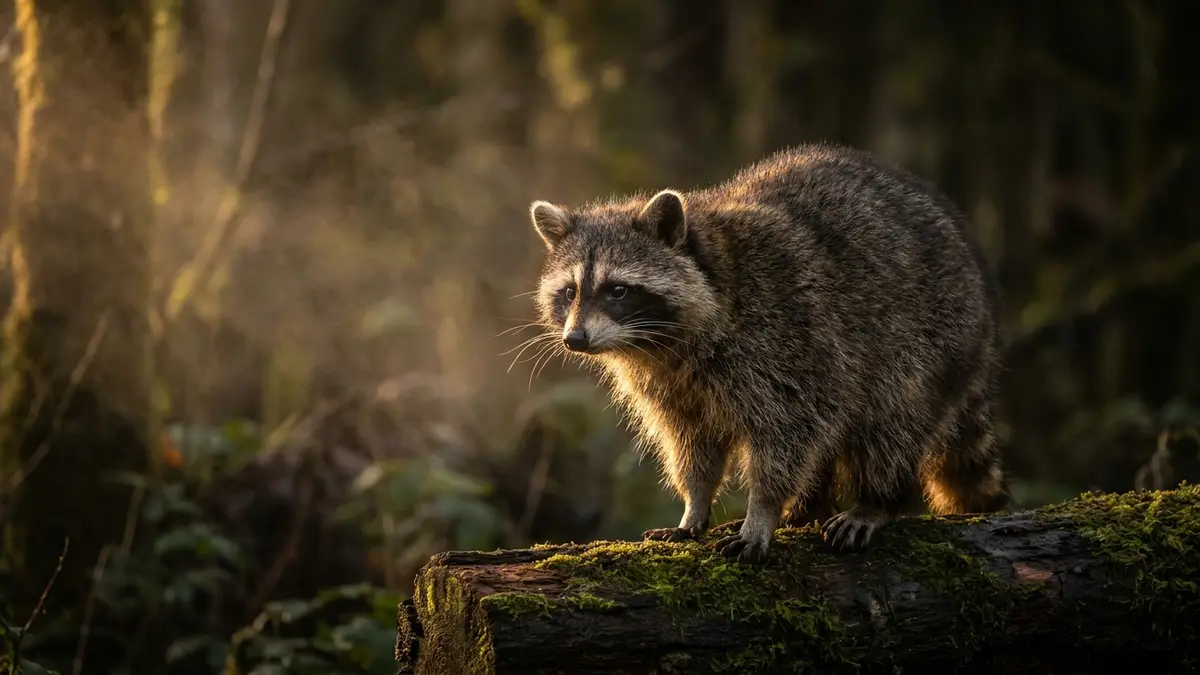
Raccoons do not wash their food. They dunk clean items and dirty items alike, and will eat without hesitation when no water is available; in nerve recordings from 136 slowly adapting fibres in the raccoon forepaw, wetting the skin made those touch fibres keep responding longer to a sustained indentation, which points to feeling rather than cleaning. They also do not hibernate: winter dormancy in a raccoon comes with no reduction in heart rate or body temperature.
An almanac
- Scientific name
- Procyon lotor, family Procyonidae - a New World family, unrelated to the raccoon dog
- Signature trait
- Reversible hind feet - they rotate 180°, letting a raccoon come down a trunk head-first, the same trick squirrels use
- Tail
- Not a fixed pattern: anywhere from four to ten black rings (Animal Diversity Web)
- Lifespan
- Up to 16 years recorded in the wild, but most raccoons do not make it past their second year
- Conservation status
- Least Concern on the IUCN Red List; assessors Timm, Cuarón, Reid, Helgen and González-Maya, with an internal assessment date of 1 March 2015 (the commonly cited 2016 is the Red List citation year)
- Range
- Native from southern Canada to Panama; introduced and established across Europe, Japan and the Caucasus; Caribbean island populations are usually treated as introduced P. lotor, though their origin is debated
- Introduced numbers
- An estimated 1.6 to 2 million raccoons in Germany alone (Senckenberg Nature Research Society)
The species name is lotor, "the washer", and most of what has been built on top of that name is wrong. Raccoons dunk clean food and dirty food alike, and they will not hesitate to eat when water is unavailable.
The mask fares no better. The built-in-sunglasses explanation is repeated everywhere, but a comparative study of facial masks in mid-sized carnivores found the pattern most compatible with a warning signal aimed at larger predators, and did not support the ecological or social explanations offered instead.
What follows is the sourced version, including what happened when researchers put latched puzzle boxes in front of 35 wild raccoons in Wyoming.
Raccoon Facts Worth Knowing
- The name is about the hands, not the mask. "Raccoon" comes from the Algonquian word arakun, which University of Wisconsin-Madison Extension glosses as "he who scratches with his hands" - a reference to the animal's dexterous use of its forepaws.
- Earliest Western reference (Smithsonian, excerpting Samuel I. Zeveloff's "Raccoons: A Natural History"). The source calls John Smith's the earliest reference to the raccoon in Western literature; his 1612 A Map of Virginia describes it as "a beast they call Aroughcun, much like a badger, but vseth to live on trees as Squirrels doe." Smith had reportedly used an earlier spelling, rahaughcums, as early as 1608 - and the same source credits Columbus with the first written record of the animal, in 1492.
- Lake Erie is most likely named after the raccoon. Huron speakers called the southern fur-trading people "long-tailed ones" after the raccoon pelts they traded, and French settlers transcribed the word as iri/eri. The source calls the raccoon derivation the likely one ("In all likelihood, both the lake and the tribe were named after the raccoon") and calls the cat reading "highly doubtful," attributing it to French/English misunderstanding - though many people in the region still assume Erie refers to a mountain lion.
- Wetting the paw changes what the nerves report. In recordings from 136 slowly adapting fibres in the median and ulnar nerves of the raccoon forepaw (Somatosensory Research, 1986), the length of time a fibre responded to a prolonged indentation "was greater after wetting of the skin."
- Reversible hind feet. Washington Department of Fish & Wildlife: "Like squirrels, raccoons can rotate their hind feet 180 degrees and descend trees headfirst."
- Autumn fat, spring deficit. In autumn adult raccoons lay on fat that may exceed an inch in thickness on some parts of the body, and by spring many have lost as much as 50% of their fall body weight.
- The tracks look like small human hands. MassWildlife rates raccoon prints among the easiest wildlife tracks to identify: five toes, and a front print close to a human handprint in shape.
- Doorknobs are within the repertoire. State wildlife biologists in Massachusetts list turning doorknobs and opening containers among ordinary raccoon abilities.
- Most wild raccoons still fail a latch. When researchers offered a latched single-solution puzzle box to free-ranging raccoons in Laramie, Wyoming, the result was blunt: "We tested a total of 35 raccoons with the single-solution box … eight individuals learnt to solve it (23%)" (Proceedings of the Royal Society B, 2024).
- The rings are not a fixed count. A raccoon's tail carries anywhere from four to ten black rings, according to the University of Michigan's Animal Diversity Web.
- The quoted lifespan is an average, not a ceiling. Raccoons may live up to 16 years in the wild, but most do not make it past their second year. Popular fact lists give a flat "2 to 3 years in the wild" - that is roughly the average outcome, driven by heavy first-year and second-year mortality, not the span the species is capable of.
- Europe's raccoons trace back to Germany. Two raccoons of each sex were released near Lake Edersee in Hesse in 1934, and 25 animals escaped a Brandenburg fur farm in 1945. The tidy two-founding-events story is incomplete: genetic work on German raccoons detected at least four independent introduction events, producing genetically differentiated subpopulations.
- The invasion has scale. Germany now holds an estimated 1.6 to 2 million raccoons, and researchers there report the animal competing with native species - already visible with amphibians and reptiles - with displacement expected over the long term.
- Globally the species is listed as Least Concern. The IUCN Red List assessment for Procyon lotor is credited to Robert M. Timm, A.D. Cuarón, Fiona Reid, Kristofer Helgen and José González-Maya, and carries an internal assessment date of 1 March 2015; the "2016" attached to it in most citations is the Red List citation year, not the year the assessment was made.
- Not every raccoon is doing well. The pygmy raccoon, Procyon pygmaeus, is endemic to Cozumel, a 486 km² island roughly 17.5 km off the Yucatán Peninsula, and is critically endangered, with fewer than 250 mature individuals left.
- Roundworm eggs are not infectious straight away. The CDC states that eggs passed in raccoon faeces take 2 to 4 weeks in the environment to become infectious - which is why clearing a raccoon latrine promptly actually works.
- Raccoon rabies is a recent arrival in the northeast. New York State's Department of Environmental Conservation records that "raccoon rabies reached New York in 1990 and has become widespread"; MassWildlife records that rabies first appeared in Massachusetts raccoons in 1992, and that raccoons are the primary - but not the only - carriers there.
What People Get Wrong About Raccoons
"Raccoons wash their food before eating it - that's why the species is called lotor, 'the washer'." They douse, they don't wash. Raccoons dunk clean food and dirty food alike, will happily eat with no water anywhere nearby, and the behaviour tracks with feeling for prey underwater rather than cleaning. Laboratory nerve recordings show wetting the paw skin changes how the touch fibres respond, so soaking is best read as a sensory act, not hygiene.
"Raccoons hibernate through the winter." They enter winter dormancy, not hibernation. A denned raccoon's heart rate and body temperature do not drop the way a true hibernator's do, and it will come back out to forage whenever the weather eases toward freezing. Massachusetts wildlife officials likewise describe raccoons as active year-round, just sleeping in for several days at a stretch during cold snaps.
"A raccoon out and about in daylight is rabid." Daytime activity is normal. Raccoons are mainly crepuscular and nocturnal but will forage in daylight when food is available - a nursing mother working longer hours is the classic case. The genuine warning signs are neurological: lethargy, uncoordinated movement, unprovoked aggression. State biologists are blunt that time of day tells you nothing about disease in any mammal.
"The black mask works like built-in sunglasses, cutting glare so the raccoon can see better at night." That explanation is repeated everywhere but has never been the best-supported one. A comparative study of facial masks across medium-sized carnivores - raccoons, badgers, skunks and relatives - found the pattern fits an aposematic warning function: the mask advertises that attacking this animal is a bad idea. Ecological and social explanations, including glare reduction, were not supported by the data.
"The 'raccoon dog' spreading across Europe is a kind of raccoon." It isn't even close. Nyctereutes procyonoides is a canid - same family as dogs, wolves, foxes and jackals - that merely evolved raccoon-like face markings. Raccoons belong to Procyonidae, a New World family. The raccoon dog is also the only canid that genuinely hibernates, which real raccoons do not.
In Culture
The raccoon entered English as a misheard word and has been mislabelled ever since. Captain John Smith reportedly wrote it as rahaughcums around 1608 and as Aroughcun in 1612, describing "a beast they call Aroughcun, much like a badger, but vseth to live on trees as Squirrels doe" - the earliest reference to the animal in Western literature, by the account of Smithsonian's excerpt from Samuel I. Zeveloff's "Raccoons: A Natural History", which also credits Columbus with the first written record of the raccoon, and its first European-language name, in 1492. The modern spelling descends from the Algonquian arakun, "he who scratches with his hands". The name was always about the paws; the mask came later, and the same Smithsonian account traces the animal through North American culture as symbol, as pet and as dinner.
The largest thing named after a raccoon is a lake. Huron speakers called the fur-trading people to their south the "long-tailed ones" after the raccoon pelts they traded, and French settlers transcribed the word as iri or eri. The source calls the raccoon derivation the likely one - "In all likelihood, both the lake and the tribe were named after the raccoon" - and calls the cat reading "highly doubtful," attributing it to French/English misunderstanding, though many people in the region still assume Erie refers to a mountain lion.
The washing image is the most durable piece of raccoon folklore and the least accurate: lotor means "the washer", but raccoons dunk clean and dirty food alike and eat readily with no water in sight. The trash-panda reputation for opening anything sits closer to the truth without quite earning it. Doorknobs and latched containers are genuinely within reach, according to state wildlife biologists - but of 35 free-ranging raccoons offered a single-solution puzzle box in Laramie, Wyoming, only eight ever worked it out.
One more case of mistaken identity is now spreading across Europe on its own four legs. The raccoon dog, Nyctereutes procyonoides, is a canid that evolved raccoon-like face markings, and, unlike a real raccoon, it genuinely hibernates.
The Raccoons That Mattered
The most consequential raccoons in the record were never given names. Two raccoons of each sex were released near Lake Edersee in Hesse in 1934, and 25 more escaped a fur farm in Brandenburg in 1945 - the two events usually credited with founding Europe's raccoon population. Genetics has since complicated that neat story: a study of German raccoons detected at least four independent introduction events and genetically differentiated subpopulations, meaning the documented history understates how many animals actually seeded the invasion. Their descendants now number an estimated 1.6 to 2 million in Germany alone, where researchers report the raccoon competing with native species - already visible with amphibians and reptiles - and expect displacement over the long term.
The eight raccoons of Laramie deserve a mention of their own. In the 2024 Proceedings of the Royal Society B study of innovative problem-solving in wild raccoons, 35 free-ranging animals were tested with a latched single-solution box; eight of them, 23 per cent, ever learned to open it. The species' reputation for cracking anything rests on that minority.
At the other end of the range sits a raccoon almost nobody has heard of. The pygmy raccoon, Procyon pygmaeus, lives only on Cozumel, a 486 km² island about 17.5 km off the coast of Mexico's Yucatán Peninsula, and is critically endangered, with fewer than 250 mature individuals remaining - a reminder that "raccoons are thriving" is a statement about one species, not the whole family.
Frequently Asked Questions
Do raccoons really wash their food?
No. Raccoons dunk clean food and dirty food alike, and University of Wisconsin-Madison Extension notes they do not always dunk even when near water and will not hesitate to eat when water is unavailable. Recordings from 136 slowly adapting nerve fibres in the raccoon forepaw found that responses to a sustained indentation lasted longer after the skin was wetted, which fits a sensory function - feeling for prey underwater - rather than cleaning.
Do raccoons hibernate in winter?
No. They enter winter dormancy, which comes with no reduction in heart rate or body temperature, so it is not hibernation. A denned raccoon comes back out to forage whenever the weather eases toward freezing, and Massachusetts wildlife officials describe raccoons as active year-round, sleeping in for several days at a time during cold snaps. The animal that does genuinely hibernate is the raccoon dog, which is a canid, not a raccoon.
Is a raccoon out during the day rabid?
Not on that evidence alone. Raccoons are mainly crepuscular and nocturnal but forage in daylight when food is available, and a nursing mother putting in longer hours is the usual explanation. MassWildlife states plainly that daytime activity does not mean the raccoon is diseased. The signs that matter are neurological: lethargy, uncoordinated movement, unprovoked aggression.
How long do raccoons live?
Up to 16 years has been recorded in the wild, but most raccoons do not make it past their second year. The widely quoted "2 to 3 years" is roughly the average outcome, produced by heavy first-year and second-year mortality, rather than a limit on how long the animal can live.
Can raccoons really open doors and latches?
Some can. Massachusetts state biologists list turning doorknobs and opening containers among ordinary raccoon abilities. The skill is not universal, though: when researchers presented a latched single-solution puzzle box to 35 free-ranging raccoons in Laramie, Wyoming, only eight - 23 per cent - ever learned to solve it.
Is a raccoon dog a type of raccoon?
No. Nyctereutes procyonoides is a canid, in the same family as dogs, wolves, foxes and jackals, that evolved raccoon-like facial markings. True raccoons belong to Procyonidae, a New World family. The raccoon dog is also the only canid that genuinely hibernates, which raccoons do not.
More about the Raccoon
More from Animal Facts



Sources
Claims on this page were checked against these published sources.
- Raccoon Ecology & Damage Management (G3997-005)
These common names are derived from the Algonquin Indian word "arakun," which means "he who scratches with his hands" and probably refers to the animal's dexterous use of its forepaws.
Read the source → - The Long and Fascinating History of Raccoons in North American Culture, From Symbols to Pets to Dinner
In all likelihood, both the lake and the tribe were named after the raccoon.
Read the source → - Sensory innervation of the raccoon forepaw: 2. Response properties and classification of slowly adapting fibers
the length of time that an SA fiber responded to a prolonged indentation was related to the magnitude of the indentation, and was greater after wetting of the skin
Read the source → - Raccoon (Procyon lotor)
Like squirrels, raccoons can rotate their hind feet 180 degrees and descend trees headfirst.
Read the source → - Wild raccoons demonstrate flexibility and individuality in innovative problem-solving
We tested a total of 35 raccoons with the single-solution box … eight individuals learnt to solve it (23%).
Read the source → - Procyon lotor (raccoon)
The most distinguishable characteristics of the raccoon are its black mask across the eyes and bushy tail with anywhere from four to ten black rings.
Read the source → - Learn about raccoons
Raccoons can vary in weight from 12 to 36 pounds, with some exceptionally large individuals reaching 50 pounds.
Read the source → - Historical Invasion Records Can Be Misleading: Genetic Evidence for Multiple Introductions of Invasive Raccoons (Procyon lotor) in Germany
In 1934, two raccoons of each sex were released near lake Edersee (Hesse, central Germany)
Read the source → - Raccoons: Invasion on Four Paws
It is estimated that there are now between 1.6 and 2 million of these masked mammals in Germany
Read the source → - Procyon lotor (Northern Raccoon) — The IUCN Red List of Threatened Species 2016: e.T41686A45216638
This species is listed as Least Concern because it is broadly distributed across North and Central America in a variety of habitats, is fairly common, and is present in many protected areas.
Read the source → - Procyon pygmaeus (Cozumel raccoon)
Procyon pygmaeus are endemic to Cozumel, a 486 square km island that lies roughly 17.5 km off the coast of the Yucatan Peninsula of Mexico.
Read the source → - About Raccoon Roundworm
Eggs passed in raccoon feces are not immediately infectious. In the environment, eggs take 2 – 4 weeks to become infectious.
Read the source → - Raccoon
Raccoon rabies reached New York in 1990 and has become widespread.
Read the source →
Not sure which animal is yours?
Consult the quiz